uss george washington
|

USS George Washington heads to Middle East as Linc…

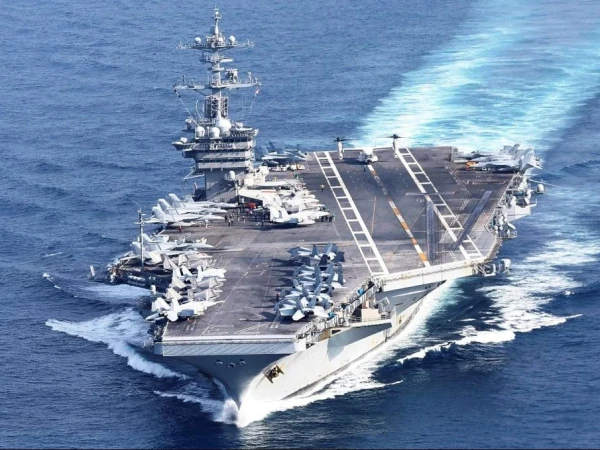
WASHINGTON: The United States is preparing to send the aircraft carrier USS George Washington to the Middle East, where it is expected to replace the USS Abraham Lincoln after the carrier’s unusually long deployment in the region.

The planned rotation comes as the United States remains deeply engaged in the ongoing conflict and heightened tensions with Iran, making the movement of another US carrier into the region closely watched.

According to a Wall Street Journal report, the deployment plan had been prepared before the latest developments highlighted the difficulties facing the Abraham Lincoln and its crew. The planned handover, however, has underscored the growing strain on US Navy personnel and warships operating at sea for extended periods.

Lincoln’s extraordinary deployment

The USS Abraham Lincoln has been deployed in the region for more than eight months and has reportedly gone around 200 days without a port call.

That is far longer than the typical schedule for a carrier, which would normally be expected to make a port visit after roughly 30 to 45 days. The prolonged deployment reflects the extraordinary operational demands created by the conflict and continuing instability across the Middle East.

For the Lincoln’s crew, the arrival of a replacement carrier could provide an opportunity for rest and recovery after months of sustained operations.

Washington moves west

The USS George Washington had been operating in the western Pacific and recently visited Vietnam before beginning its journey towards the Middle East.

The carrier has been moving west through the Strait of Malacca, before continuing across the Indian Ocean towards the Middle East. Its deployment is expected to maintain continuity in the US Navy’s carrier presence while allowing the Abraham Lincoln to leave the region.

Aircraft carriers are among the US Navy’s most important military assets. They function as mobile bases at sea, carrying fighter aircraft, helicopters and other equipment capable of supporting operations far from US territory.

Their mobility allows Washington to maintain airpower without relying entirely on land-based facilities in countries near a conflict zone.

New carrier presence draws attention

The arrival of the George Washington comes at a particularly sensitive moment. With tensions between Washington and Tehran remaining high and military operations continuing, the movement of a US carrier is likely to attract close attention from regional governments and military planners.

The Navy’s immediate objective is understood to be maintaining an uninterrupted carrier presence rather than creating a completely new deployment structure.

Still, the rotation highlights the pressures created by prolonged wartime deployments. For the United States, keeping powerful naval assets in the region provides strategic flexibility. For sailors aboard the Abraham Lincoln, however, the arrival of the George Washington could finally offer a long-awaited chance to return home and recover after one of the carrier’s most demanding deployments.

Similar Posts

  • Authorities Track Down Blaze Setters After Field Fires Smother Bangkok in Haze

    NAKHON NAYOK – Authorities are searching for those responsible for illegally setting fire to rice fields in central Thailand, after a blaze burned over 10,000 rai (4,000 acres) and sent a thick plume of toxic smoke toward Bangkok and neighboring provinces. Pollution Control Department introduces management of burning via Burn Check app The fire broke […]

  • | |

    Internet restored in Muzaffarabad after 53 days

    Broadband internet services have been restored in Muzaffarabad after a 53-day suspension, bringing relief to residents, businesses, journalists and students who had struggled with limited digital connectivity since early June. The restoration took effect late Wednesday night, allowing broadband users to regain access to online services. However, mobile internet connectivity remained unstable in several areas, with users continuing to report intermittent disruptions. The prolonged shutdown had significantly affected communication, online banking, digital businesses, educational activities and media coverage, particularly during the ongoing election season in Azad Jammu and Kashmir (AJK). Journalists and political workers had repeatedly raised concerns over the lack of internet access, saying it hindered the flow of information and election-related reporting. The restoration comes just days before the second phase of the AJK Legislative Assembly elections, scheduled for August 2, when more than 1.24 million voters are expected to cast their ballots in 21 constituencies. The polls will include nine constituencies in Muzaffarabad Division and 12 seats reserved for Jammu and Kashmir refugees residing in Pakistan. Election authorities have completed polling arrangements and announced enhanced security measures to ensure peaceful, transparent and orderly elections. A total of 351 candidates are contesting the second phase, with several high-profile political leaders participating in closely watched races. Political campaigning has intensified across Muzaffarabad, Neelum Valley and Jhelum Valley as major parties make their final push to secure voter support before polling day.

  • | |

    Petroleum minister defends daily fuel pricing mech…

    Petroleum Minister Ali Pervaiz Malik defended the government’s new daily fuel pricing system on Thursday, telling lawmakers it has ended a practice under the previous mechanism in which oil companies restricted petrol supplies ahead of expected price revisions. The federal government announced on July 17 that petroleum product prices would now be reviewed and notified daily rather than weekly, a shift introduced as renewed tensions between the United States and Iran continue to unsettle global oil markets and raise concerns about fuel supply security. The daily system followed an earlier move from fortnightly to weekly price revisions that had been introduced during the first phase of the US Iran conflict. The change has faced pushback from transporters, businesses and opposition lawmakers, who argue that frequent price adjustments create uncertainty, push up transport and freight costs, and make it harder for businesses and households to plan their spending. Petrol pump owners had threatened a nationwide strike over the issue before suspending their protest after receiving government assurances that their concerns would be addressed. Speaking at a meeting of the National Assembly Standing Committee on Petroleum, chaired by Umar Farooq, Malik said petrol and diesel prices still rely on a seven day rolling average of international market prices, even though the pricing is now updated daily instead of fortnightly. He said the government has delegated pricing authority to the Oil and Gas Regulatory Authority, which coordinates with stakeholders before finalizing prices, and noted that the pricing methodology and benchmark figures are published on the regulator’s website. He added that Prime Minister Shehbaz Sharif had instructed the regulator to also publish the formula in Urdu to improve transparency. Malik explained that international benchmark prices are drawn from Platts, with government taxes and oil company margins added afterward to determine domestic retail prices. He said the switch to daily pricing corrected a flaw in the earlier weekly system, under which companies could anticipate price movements from an emerging three day average and adjust supply accordingly. Under the new approach, he said, prices are set daily based on the seven day average, removing that predictability. Committee members pushed back sharply on the new mechanism. Senator Saifullah Abro described it as slow poison for consumers, saying the public has no way of knowing what today’s price is, let alone tomorrow’s. He questioned recent price increases, pointing out that international crude prices rose from 76 dollars a barrel on July 11 to 82 dollars on July 17, and asked how domestic fuel prices had climbed by 30 rupees over the same period. Malik responded that the comparison was misleading since domestic fuel prices track refined petroleum products rather than raw crude oil. The minister also defended the existing tax structure, saying the petroleum levy remains lower than the rate imposed during the height of the conflict period. He said reducing the levy further would be difficult without agreement from the International Monetary Fund, though he suggested an alternative revenue source could eventually make a reduction feasible. Ogra officials also addressed the committee in support of the new system. Acting Chairman Nabeel Ahmed Awan said daily prices remain based on the seven day average, meaning that both price declines and increases in the global market are passed on to consumers gradually over a week. He said the new mechanism removes opportunities for short term profiteering by preventing traders from creating false market impressions to turn a profit. Officials also told the committee that customs duty on petrol currently stands at 18.11 rupees per litre. The session grew tense at points, with committee members criticizing Ogra for failing to circulate a working paper ahead of the meeting. When the acting chairman asked what a working paper was, Abro rebuked him sharply, questioning his familiarity with basic regulatory procedure. Malik also told the committee that the process to appoint a permanent Ogra chairman had begun on schedule, but that interviews failed to produce a suitable candidate, prompting officials to restart the search. The government had reshuffled Ogra’s leadership in April, replacing then acting chairman Shahzad Iqbal with Nabeel Ahmed Awan, a senior Pakistan Administrative Service officer and secretary of the Establishment Division, who was appointed to a three month term as the search for a permanent chairman continues.

  • Thai Air Force Ready to Counter Cambodian Long‑Range Rocket Threat

    BANGKOK – The Royal Thai Air Force has stated it is prepared to launch deep‑strike defensive operations if Cambodia deploys its long‑range PHL‑03 multiple‑rocket launcher systems, which have a maximum range of 130 kilometers. Air Marshal Chakkrit Thammavichai, deputy air force chief of staff and spokesman, affirmed today that operational plans are already in place […]

  • |

    45,000 attend arbaeen procession in Dearborn

    More than 45,000 mourners gathered in Dearborn, Michigan, for a major procession marking Arbaeen, the 40th day of mourning following the martyrdom of Imam Hussain (RA) and his companions at the Battle of Karbala. The large gathering brought together members of the Shia Muslim community from Dearborn and other parts of Michigan, with participants filling the city’s streets to pay tribute to Imam Hussain (RA) and remember the sacrifices made at Karbala. During the procession, mourners recited elegies and took part in traditional mourning rituals, expressing grief and devotion while commemorating the events of Karbala. The gathering also served as an opportunity for participants to reflect on the values associated with Imam Hussain (RA), including justice, courage, sacrifice, and standing against oppression. The procession featured a strong display of religious devotion as thousands of participants marched through the streets in an atmosphere of mourning and remembrance. Families and community members joined the event, making it a significant religious gathering for the local Muslim population. Organizers described the event as the largest Arbaeen gathering of its kind in the history of the United States. They said the growing number of participants demonstrates the increasing scale of the annual commemoration and the strong connection of the community with the religious and historical significance of Karbala. The turnout also marked a notable increase compared with last year’s event. Around 40,000 people reportedly attended the Arbaeen procession in Dearborn in the previous year, while this year’s gathering attracted more than 45,000 participants. Arbaeen holds deep religious importance for Shia Muslims worldwide. It marks the completion of 40 days of mourning for Imam Hussain (RA), who was martyred alongside members of his family and companions at Karbala in 680 AD. Millions of people participate in Arbaeen commemorations across different countries, with the annual pilgrimage in Iraq drawing one of the world’s largest religious gatherings. The Dearborn procession has become an important annual event for the city’s Shia Muslim community, allowing participants to come together to remember the tragedy of Karbala and honor the legacy of Imam Hussain (RA).

Leave a Reply

Your email address will not be published. Required fields are marked *