vantage point holiday
| | | | | | | |

[Vantage Point] Holiday dividend or market coal? What GCash could deliver by Christmas

Will retail investors unwrap a plump holiday dividend this Yuletide season, or find a lump of market coal tucked inside their stockings?

With Christmas lanterns already lighting up storefronts and GCash set to make its market debut at P6.60 a share, that very question has filled our inbox. 

Many readers are tempted by the prospect of owning a slice of an app they use daily to send aguinaldo (Christmas money) and settle holiday bills — and by the tantalizing wish that a quick IPO pop might bankroll their Christmas spending.

In response, Vantage Point ran a forensic valuation exercise to separate holiday cheer from cold, hard arithmetic.

Before anyone adds GCash shares to their holiday wish list, one essential qualification is in order. What follows is strictly an analytical exercise prompted by reader inquiries. It is neither a recommendation to buy, sell, or hold GCASH (the company’s ticker name), nor is it intended to sway trading behavior.

Share prices are inherently volatile beasts, particularly amid the turbulent opening weeks of a high-profile listing. Everyday investors must always make decisions tailored to their individual financial circumstances, risk tolerance, and independent research.

With that caveat firmly established, our numbers suggest an upward bias during GCash’s opening week of trading.

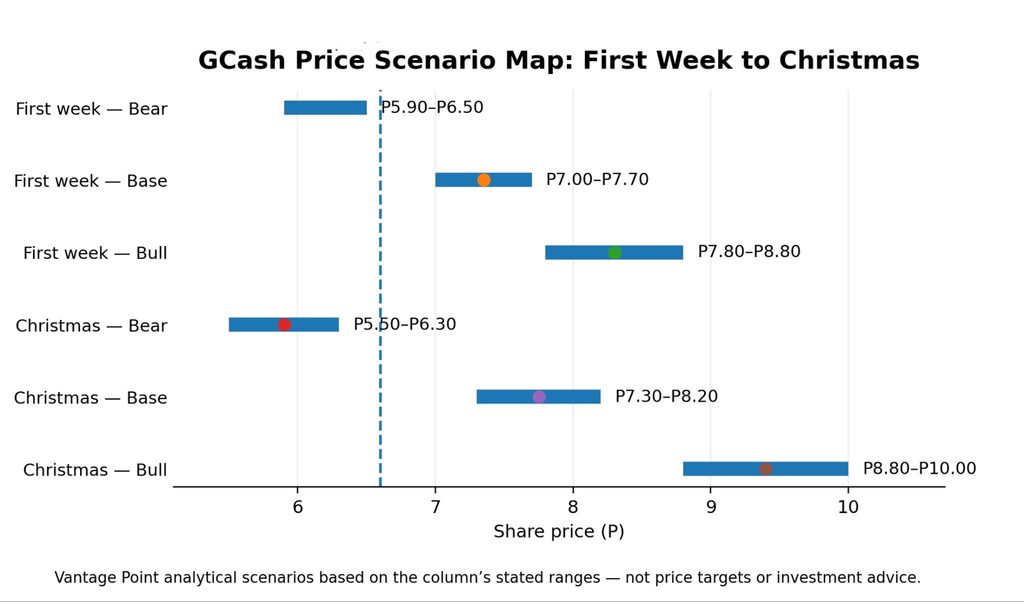
GCASH makes its formal debut on the Philippine Stock Exchange (PSE) on October 20 at P6.60. Our baseline scenario places the stock between P7.00 and P7.70 after its first full week on the boards, with roughly P7.40 serving as a sensible midpoint. That would represent a neat 12% gain from the offer price.

Under a bearish scenario, the shares could stumble toward P5.90 to P6.50. Conversely, an avalanche of pent-up demand from institutions and retail accounts could lift them toward the P7.80 to P8.80 corridor.

Unprecedented advantage

Why lean optimistic at the opening bell? Institutional bookbuilding was heavily oversubscribed, and more than 20 cornerstone investors locked in P36.5 billion in commitments. Big accounts that were scaled back or shut out during allocation often return as eager secondary-market buyers.

Moreover, GCash commands an advantage almost unprecedented for a domestic listing: an immense, captive audience. With 41.5 million monthly active users, it can present this equity offer straight to a population that already trusts its digital wallet. 

Through GStocks PH, everyday retail investors can enter the fray with a board lot of just 100 shares, requiring an accessible P660 outlay at the IPO price. (READ: Want to buy GCash shares? How retail investors can join the IPO)

Yet early excitement should never be mistaken for durable value. A good portion of retail buyers will have subscribed solely to capture a quick first-day pop. 

If GCASH swiftly marches toward P7.50 or P8.00, early participants sitting on double-digit paper gains may choose to cash out immediately. The opening week will inevitably become a tug-of-war between under allocated funds looking to accumulate shares and profit-takers eager to ring the register.

That makes October 27 (a full week after initial listing) a far more telling milestone than October 20.

If GCASH stays comfortably above P7.00 after several sessions of heavy churn, our base-to-bull thesis will gain genuine credibility. If it tests P8.00 and holds that ground despite waves of profit-taking, underlying institutional support is likely much stronger than conservative models assume.

On the flip side, if the stock slumps and lingers below its P6.60 offer price once official price-stabilization support winds down, it will serve as a stark warning that blowout bookbuilding numbers failed to translate into lasting market demand.

Then comes the bigger question dominating our inbox: Where might GCash settle once the Christmas holiday arrives?

Our valuation modeling outlines three distinct paths by year-end:

  • The Bearish Case (P5.50 – P6.30): Cooling market momentum and slowing core operations compress multiples.
  • The Base Case (P7.30 – P8.20): A balanced performance centered at P7.70, delivering a steady post-listing appreciation of roughly 17%.
  • The Bullish Case (P8.80 – P10.00): Sustained retail appetite and fresh foreign inflows push valuations back toward the original ceiling.
These boundaries are anchored strictly in valuation arithmetic. At P6.60, Mynt carries an equity value of roughly P442 billion, or approximately 25.6 times its 2025 net profit of P17.25 billion. If full-year 2026 earnings reach around P21 billion — in line with its first-half performance — earnings per share across roughly 66.9 billion post-offer shares would sit near P0.31 to P0.32. At a P7.70 midpoint, GCASH would trade at roughly 24 times prospective earnings.

While that multiple commands a premium over traditional Philippine conglomerates, it remains defensible for a dominant, profitable fintech expanding into micro-lending, savings, insurance, and investments.

Yet the bears have compelling arguments. In the first half of 2026, Mynt’s net profit grew by just 7%, while core EBITDA dipped 4% and margins narrowed to 27.3%. 

Furthermore, passive interest earned on its P68.6-billion cash balance jumped 45% to P2.56 billion, masking softening operating earnings. Serious investors must watch whether core platform revenue regains momentum rather than relying on bank deposit interest to carry the bottom line.

Markers to track

External variables could easily scramble these projections. A sudden downturn across the Philippine Stock Exchange (PSE), shifts in foreign capital flows, currency headwinds, or geopolitical shocks could overpower company-level fundamentals.

Even so, setting these benchmarks gives investors concrete markers to track. Our primary checkpoint is P7.00 to P7.70 one week in, followed by our year-end base band of P7.30 to P8.20.

Will GCash provide extra cash for Noche Buena (Christmas Eve feast)? Perhaps. But treating an initial public offering like a guaranteed holiday bonus is a dangerous mistake. 

The true test begins on October 20, when millions of Filipinos who trust GCash with their daily funds discover whether trusting it with their investment capital yields the very same satisfaction.

I welcome your views on these and other issues where decisions made in power shape the country’s economic future.

Below are some Vantage Point pieces you might have missed.

Click here for other Vantage Point articles.

Similar Posts

  • | | |

    PSX soars as KSE-100 Index jumps over 5,000 points…

    KARACHI: The Pakistan Stock Exchange (PSX) wrapped up the trading week on a bullish note, with investors driving the benchmark KSE-100 Index sharply higher amid sustained buying interest and renewed market optimism. According to the PSX’s weekly market update, the KSE-100 Index gained 5,072 points during the week, closing at 176,094 points. The strong performance reflected growing investor confidence as the market continued its upward momentum. Throughout the week, the benchmark index traded within a 4,510-point range, touching a weekly high of 179,123 points while falling to a low of 174,612 points. Analysts said the wide trading range highlighted active investor participation and healthy market activity. The rally capped off a positive week in which the stock market maintained strong momentum. On the final trading day of July, the KSE-100 Index had already climbed 546 points, setting the stage for an impressive weekly finish. Trading activity also remained robust. During the five trading sessions, investors exchanged approximately 4.15 billion shares, with the total value of transactions reaching Rs158 billion, indicating strong liquidity and continued interest from market participants. Meanwhile, the market’s overall capitalization increased by Rs477 billion over the week, reaching Rs19.755 trillion. The significant rise in market value underscores improving sentiment among investors despite ongoing economic challenges. Market experts say the latest gains reflect confidence in Pakistan’s financial markets, supported by sustained institutional buying and expectations of improving macroeconomic conditions. However, they caution that investors will continue to monitor economic indicators, corporate earnings and policy developments that could influence market direction in the coming weeks. The latest weekly performance reinforces the Pakistan Stock Exchange’s position as one of the region’s best-performing markets this year, with investors hoping the bullish trend will continue if economic stability and positive business sentiment remain intact.

  • | | |

    Business leaders, consumers demand solutions to Visayas power crisis at Cebu summit

    Repeated power interruptions have drawn concern from domestic and international clients about Cebu’s capability to support business needs, possibly affecting future transactions and partnerships, says a business leader

  • | |

    US appeals court allows thousands of social media …

    SAN FRANCISCO: A US appeals court has cleared the way for thousands of lawsuits against major social media companies, including Meta Platforms, Google parent Alphabet, TikTok owner ByteDance and Snap, rejecting an attempt by the technology firms to use federal online protections to halt litigation over allegations that their platforms are deliberately designed to keep young users hooked. The ruling was issued Monday by the 9th US Circuit Court of Appeals, which declined to immediately consider an appeal filed by Meta and TikTok challenging a lower court decision that had allowed more than 3,000 lawsuits to continue in federal court. The lawsuits, brought by parents, children, school districts, local governments and state authorities, accuse social media companies of designing products and features that encourage excessive use among children and teenagers. Plaintiffs argue that the companies were aware of potential risks associated with prolonged social media use but failed to adequately protect young users or warn families about those risks. At the center of the companies’ legal argument is Section 230 of the Communications Decency Act of 1996. The law generally protects online platforms from being held liable for content created and posted by their users. Meta and TikTok argued that the protection should also prevent lawsuits alleging that the companies failed to warn users about the allegedly addictive characteristics of their platforms. However, the appeals court determined that the companies had sought appellate review too soon. The court said Section 230 provides a defense against liability but does not give companies immunity from having to defend themselves in litigation. As a result, the companies cannot use the current appeal to stop the cases from proceeding through the lower courts. Meta’s attempt to delay multistate trial rejected The appeals court also rejected Meta’s request to postpone a major trial involving 29 US states. The case, brought by state attorneys general, accuses Meta of unlawfully collecting and using information relating to children, designing its platforms to encourage young users to remain engaged for extended periods and making misleading statements concerning the safety of its services. Meta had sought to delay the trial while its appeal concerning Section 230 was pending. The court rejected that request, meaning the proceedings can move forward as scheduled. The development represents another significant legal challenge for Meta, which has faced growing scrutiny from regulators, lawmakers and families over the impact of its platforms on children and teenagers. A Meta spokesperson declined to comment on the appeals court’s decision. TikTok representatives did not immediately respond to requests for comment. Lawyers say trials could reveal what companies knew Attorneys representing thousands of individuals and school districts involved in the federal litigation welcomed the ruling. Lawyers Lexi Hazam and Previn Warren said the decision would allow the multistate case to proceed and would also clear the path for a separate trial involving school districts that is scheduled for February. The attorneys said court proceedings could provide the public with evidence about what social media companies knew regarding the potential effects of their products on children, when they became aware of those concerns and how they responded. The lawsuits have become part of a much broader legal battle in the United States over the responsibilities of technology companies toward minors. Plaintiffs contend that social media platforms can contribute to serious problems among young people, including anxiety, depression, eating disorders and concerns about body image. They argue that companies intentionally use features such as recommendation algorithms, notifications and engagement mechanisms to encourage repeated and prolonged use. The technology companies have generally denied allegations that they deliberately designed their platforms to harm children. Thousands of cases consolidated The federal lawsuits have been centralized before US District Judge Yvonne Gonzalez Rogers in Oakland, California. The cases involve claims brought by a wide range of plaintiffs, including families, school districts, municipalities and state governments. They seek financial damages, penalties and other forms of relief from the technology companies. Meta and TikTok previously appealed rulings issued by Judge Rogers in 2023 and 2024 that largely permitted the litigation to continue. The companies also face hundreds of similar cases in state courts. Around 3,300 related cases have been consolidated in California state court, underscoring the scale of the legal challenge confronting the social media industry. Jury verdict adds pressure on technology companies The latest appeals court decision comes after several significant courtroom developments involving the alleged impact of social media on young users. In March, a Los Angeles jury found Meta and Google negligent in connection with claims that their social media products were designed in ways that could harm young people. The jury awarded $6 million to a young woman who said she became addicted to Instagram and YouTube after using the services as a child. The verdict was closely watched because it represented an early test of how juries may respond to similar allegations against major technology companies. Meta and Google have denied wrongdoing in the case and said they intend to appeal. New Mexico ruling increases scrutiny Meta has also suffered a major legal setback in New Mexico. A judge in the state recently ruled that the company had created a public nuisance and ordered it to pay $567 million into a fund intended to support teen mental-health initiatives, while also requiring the company to implement additional measures aimed at protecting young users. The New Mexico proceedings followed an earlier stage of litigation in which a jury found that Meta had misled consumers about the safety of its platforms and ordered the company to pay $375 million. Meta has rejected the allegations and indicated that it will challenge the findings through the appeals process. The growing number of lawsuits reflects increasing pressure on social media companies in the United States to explain how their platforms are developed, marketed and operated for younger audiences. The latest 9th Circuit decision does not resolve whether Meta, Google, TikTok or Snap will ultimately be held liable. Instead, it allows the underlying lawsuits to continue, potentially setting the

Leave a Reply

Your email address will not be published. Required fields are marked *