negrense web developer
| | | |

Negrense web developer proposes AI-powered transparency portal for gov’t projects

NEGROS OCCIDENTAL, Philippines — At a time when the Philippines is grappling with controversies over failed government projects and corruption in trillions of pesos in flood control spending, a young Negrense web developer is pushing for greater transparency through a digital platform that allows ordinary citizens to track where every taxpayer’s peso goes.

In just eight hours over a weekend during the third week of July, Japheth Gonzales, a 25-year-old instructor at Southland College and a resident of Barangay 1 in Kabankalan City, turned a moment of boredom and inspiration from the public’s increasing demand for greater transparency in government spending into an innovative response.
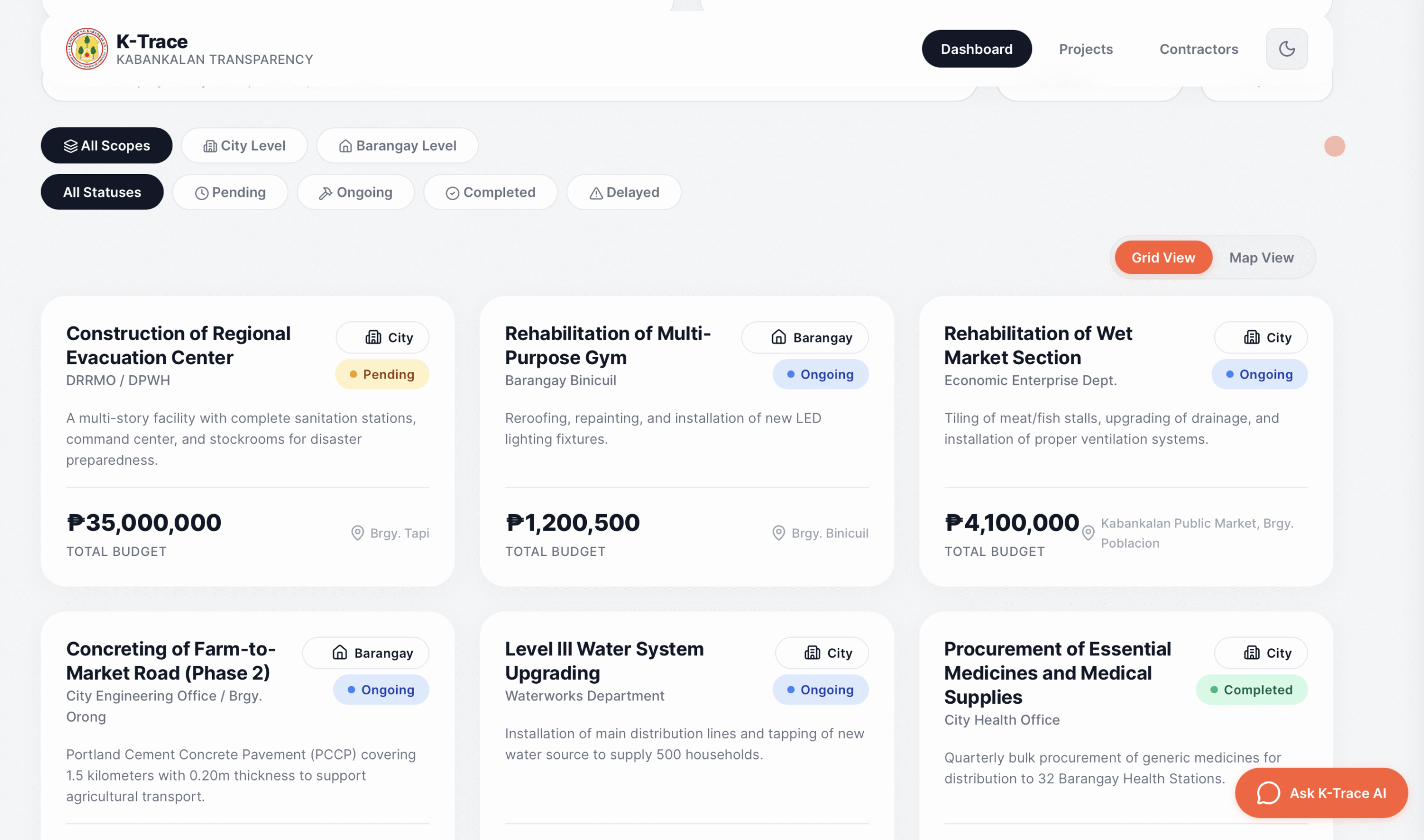
Text
K-TRACER. The transparency portal that features government projects allows users to view their corresponding budgets and track the status of the projects. 

Drawing on years of expertise in artificial intelligence (AI) — a field he began studying in 2021 — Gonzales developed a prototype transparency portal he called K-Tracer.

“It’s not about politics. It’s about transparency and accountability. As taxpayers, we have the right to know where our money goes and whether projects are actually being implemented,” Gonzales told Rappler in a mix of Hiligaynon.

The developer clarified that the current prototype uses dummy data for demonstration purposes. Even so, the platform showcases how users can monitor government projects, view their corresponding budgets, and track whether projects are ongoing, delayed, pending, or completed.

“It can help reduce doubts and misunderstandings because people can directly see how government funds are being used and where taxpayers’ money goes. It also gives people easier access to information. They can see which projects are being implemented by the government and where the budget is allocated,” Gonzales said.

“For every project, the application can display detailed information such as the budget, project items, suppliers, engineers involved, and other relevant data. It also has an AI feature that helps people quickly verify whether the government has officially approved a project,” he added.

The dashboard also includes a price comparison feature that shows each item’s prevailing market price alongside its awarded bid price, enabling users to identify any price variance.

Immutable data

To ensure records remain secure, he envisions integrating blockchain technology should any government unit adopt the platform.

He said that local government units (LGUs) do not need to seek approval from an outside organization to use blockchain, describing it as part of the software infrastructure that can be built into the system.

“Once it’s integrated, every time an authorized LGU employee enters a new project or budget, the portal can automatically encrypt and record that information on the blockchain,” he said. “The staff won’t need to do anything differently because the system handles everything in the background.” 

According to Gonzales, blockchain technology would make project records traceable and significantly reduce the risk of unauthorized editing or deletion, strengthening public trust in government data.

Kabankalons can deliver

The developer also hopes the invention would send a message that great innovation can also come from communities outside major cities.

“I also want to prove that it’s not only big cities that can develop innovative applications. People who grew up here in Kabankalan can do it too. I also hope the government will continue supporting students because many of them have the potential to contribute to technology, especially those studying computer science, computer engineering, and related fields,” Gonzales said.

“That’s one of the reasons I became a teacher — to help students develop their skills, learn new technologies, and think beyond Kabankalan toward the international level,” he added.

“I want students to realize that they don’t have to leave Kabankalan to achieve great things. They can study here, learn from their teachers and mentors, and still create technologies that can make a difference.” – Rappler.com

A version of this story was first published in Brigada News.

Similar Posts

  • |

    AI builds 16 brand-new viruses in world-first genome experiment

    Artificial intelligence has designed 16 entirely new viruses that have never existed in nature before. Researchers in the US are calling it a genuine scientific breakthrough. According to the team behind the project, these newly designed viruses are fully functional and can replicate successfully in lab conditions. Scientists are describing the achievement as a major turning point for the field. This marks the first time AI has managed to design a complete viral genome from scratch. The viruses were specifically built to target bacteria, particularly drug-resistant strains of E. coli, and pose no risk to humans. The work was led by Dr Brian Hie and his team at Stanford University. They relied on genome language models, including systems called Evo1 and Evo2, trained using data from roughly two million bacteriophages. To keep the research safe, the team deliberately excluded any genetic data linked to viruses capable of infecting humans, animals or plants. That precaution was built into the training process from the very start. Hie explained that this represents a new level of complexity for what generative AI can design. He noted that building a complete, functional genome capable of replicating inside cells was completely uncharted territory for his team. Out of thousands of AI-generated designs, researchers narrowed the list down to around 300 for lab synthesis. After testing, only 16 of those proved effective at killing antibiotic-resistant E. coli. Scientists have framed the achievement as a potential breakthrough with real medical applications ahead. Tom Ellis, a synthetic genome expert at Imperial College London, called the work impressive but pointed out its current limitations. He noted that this particular genome remains one of the simplest and smallest to design successfully. Ellis added that concerns around AI-designed pathogens are often overstated compared to more realistic risks. He explained that modifying existing pathogens through gain-of-function techniques remains a far easier and more likely biosecurity threat. Still, some researchers in the wider scientific community remain cautious about where this technology could eventually lead. Experts at the Johns Hopkins Center for Health Security warned that proper oversight for this kind of AI-driven genome design doesn’t fully exist yet. Dr Filippa Lentzos from King’s College London argued that regulation needs to focus on multiple layers, including lab safety and DNA synthesis screening, rather than restricting AI models alone.

  • | |

    Echoes from the Interstellar Dark

    NASA’s Voyager 1 probe was designed to explore the outer giant planets and send back photographs of Jupiter and Saturn. It was launched in 1977. More than eleven billion miles from Earth, floating through the icy void beyond our solar system, a tiny scrap of 1970s human ingenuity continues its lonely journey. Decades after its primary mission ended, the craft crossed the heliopause. The boundary where the sun’s protective magnetic bubble ends and true interstellar space begins. ​In recent months, engineers faced a daunting crisis. Voyager 1 began transmitting a repeating, meaningless gibberish loop of ones and zeros back to Mission Control. For a moment, scientists feared that after nearly half a century of unbroken operation, the farthest human artifact had finally succumbed to cosmic radiation and cold degradation. Yet through meticulous diagnostic work, engineers isolated a corrupt microchip. They rerouted its memory code across ancient hardware.  Hence, they successfully restored intelligible science data across the vast distance. ​Voyager 1’s survival is not just an engineering miracle; it is a profound testament to humanity’s desire to touch the unknown. ​A spindle of wire, a heart made of bronze, It drifts through the night where the quiet responds. Beyond the sun’s breath and the cradle of red, It whispers the secrets of worlds overhead. ​A Message in a Bottle Across Cosmic Waves ​Carried on the hull of Voyager 1 is the Golden Record, a gold-plated copper phonograph disc containing sounds of Earth, greetings in fifty-five languages, musical compositions from Bach to Chuck Berry, and encoded images of terrestrial life. It serves as an interstellar time capsule, intended to outlast our civilization and tell any distant intelligence who we were. ​We carved our desire on golden veneer, To prove in the darkness that someone was here. A chorus of ocean, a child’s brief greeting, Sent out to outlive every mortal heart’s beating. ​As the probe glides through the cosmic dust, its radio signal traveling at the speed of light takes over twenty-two hours to reach dish antennas on Earth. Every line of telemetry received is a faint echo from an environment no human eye will ever witness firsthand. The spacecraft operates on a diminishing power supply provided by its decaying plutonium generators. Year by year, NASA engineers shut down non-essential instruments to conserve every milliwatt of power, prioritizing the magnetometers and cosmic ray sensors that measure the interstellar medium. ​The Final Quiet Crossing ​The remaining active instruments will inevitably power down as the thermal generators fade entirely by the end of this decade. Voyager 1 will then become a silent voyager, drifting along its galactic orbit around the center of the Milky Way, unbothered by atmospheric drag or gravitational interference, lasting for millions of years. ​When the last power flickers and warmth slips away, It will glide through the night till the dawn of no day. No longer a transmitter, no longer a thread, Just a monument floating where gods used to tread. ​The triumph of retrieving clear data from Voyager 1 reminds us why we look up. Science and art stem from the same original impulse: the refusal to remain quiet in the vastness of the dark, and the drive to leave something meaningful behind before the power fades.

Leave a Reply

Your email address will not be published. Required fields are marked *