ramon ang buys
| | | | | |

Ramon Ang buys his way into Lopez Inc., which owns what he already builds

Ramon Ang has been trying to own a piece of Philippine media for more than a decade. This week, he finally got a piece of something Lopez, just not the piece anyone expected.

He has chased a broadcast network, been rumored to be behind a cable news channel, and once got close enough to a newspaper deal that the price was already being haggled over. None of those closed. What closed instead, on Monday, August 10, was a 25.68% stake in Lopez Inc., the private company that sits at the very top of the Lopez Group, bought from the family branch led by Eugenio “Gabby” Lopez III rather than negotiated with any media owner at all. 

It is not the entry point expected, and it is not the first time Ang has shown up near a Lopez-controlled business either. Media is the chapter people remember, but it is not the oldest one.

Not his first time near a Lopez asset

In October 2008, San Miguel Corporation (SMC), then a food and beer conglomerate in its early years of diversifying under Ramon Ang, bought the government’s 27% stake in Manila Electric Company (Meralco) out from under Manuel V. Pangilinan, who believed he had already secured it. Ang had flown to Cebu the weekend before the deal closed to meet GSIS president Winston Garcia directly, after GSIS’s long, public fight with the Lopez family over control of Meralco’s board. (READ: The Lopezes, presidents, and the cost of dissent)

A separate entity, Global 5000 Investment Corp., staffed by people close to San Miguel’s leadership, picked up another chunk of government shares soon after, splitting the total purchase in a way that kept it under the threshold that would have required offering the same price to Meralco’s other shareholders. 

Around the same time, Ang had also gone after another Lopez asset directly, offering a late, above-market bid for the family’s stake in Manila North Tollways Corp. after Pangilinan’s group had already all but closed that purchase. The Lopez family’s own advisers dismissed the offer as not genuine, arriving too late to be taken seriously, and turned him down.

Once the Meralco deal closed, San Miguel’s board representatives sat for a period alongside directors from the Lopez family’s own branches, including the Manolo Lopez branch, the same branch known within Lopez Inc. today as Mantes Corporation. 

Power, not media, is also where the Ramon Ang and the Lopez family’s current empires actually collide at scale. Ang runs his energy business mainly through San Miguel Global Power Holdings Corp. (SMGP) and Petron Corporation, together controlling roughly 5,057 megawatts (MW) of installed and contracted generating capacity, close to a fifth of the entire Philippine grid and more than a quarter of Luzon’s. That capacity leans heavily on coal, Masinloc, Limay, Davao Greenfield, and Mariveles among the plants SMGP owns outright, plus a contracted share of the Sual coal plant, alongside the Ilijan gas plant, now running on imported LNG, and a 1,000-MW-hour battery storage rollout across 32 sites. Petron adds the country’s largest oil refinery, in Limay, and a nationwide retail network on top of that.

Federico “Piki” Lopez, Gabby’s cousin who focused on the energy side, built First Gen Corp. (First Gen) and Energy Development Corp. (EDC) in the opposite direction, and did so publicly. First Gen’s installed capacity ran to roughly 3,500 to 3,600 MW before the family sold 60% of its gas business to Prime Infra and redirected the proceeds into pumped-storage hydro. Its pure renewable capacity today stands at about 1,764 MW, with a stated target of 13 GW by 2030. EDC alone carries 1,302.8 MW of geothermal capacity, which the company describes as the largest vertically integrated geothermal operation in the world, plus roughly 300 MW of conventional hydro and a 2,000-MW pumped-storage pipeline still under development. In 2016, under Piki, First Philippine Holdings Inc. (FPH) adopted an explicit “No to Coal” policy, ruling coal out of the group’s power strategy entirely in favor of geothermal, hydro, gas, and renewables.

Must Read

The company the Lopezes gave up Meralco for: EDC, from oil crisis child to takeover target


The company the Lopezes gave up Meralco for: EDC, from oil crisis child to takeover target

That makes the two men’s energy strategies close to opposites: Ang’s coal-and-gas-anchored, multi-fuel grid operator built for scale, Piki’s renewables-first platform built partly as a rejection of exactly the fuel mix Ang’s business depends on. Ang’s Lopez Inc. stake does not merge the two companies, or give him any direct say over First Gen’s fuel choices; the ownership sits several layers above First Gen’s own board. But it puts him, for the first time, inside the ownership structure of a power company whose entire public identity has been built in opposition to the kind of power company he runs.

The media chase: four attempts, zero completions

Ang’s pursuit of a media company has followed the same rhythm every time: serious talks, a near-agreement, and then no deal. In January 2014, he confirmed personal talks with the three founding families of GMA Network for a stake in the country’s second-largest broadcaster, offering at least 30% at a premium price. The talks stretched past a year and collapsed in June 2015. GMA’s majority shareholders had said Ang kept revising terms after they had already accepted his proposals, while Ang insisting the opposite was true. It was, by GMA’s own account, the fifth time the network had walked away from a suitor.

Before GMA, Ang had said in 2012 that he wanted a personal stake in Radio Philippines Network (RPN-9), a partly government-owned broadcaster. That did not happen either, though he reportedly built a personal investment in Solar TV Network, a blocktimer that later became a minority RPN owner. When Solar TV was renamed Nine Media Corporation and struck a deal to carry the CNN brand in the Philippines starting 2015, rumors circulated that Ang was behind the new channel. Nine Media’s own SEC filings showed no trace of him: its parent company was wholly owned by five individuals with no visible Ang connection.

The Philippine Daily Inquirer looked, briefly, like the one that would finally close. In July 2017, the Prieto family confirmed it was in talks to sell its 85% majority stake in the Inquirer Group of Companies to Ang, in his personal capacity rather than through San Miguel, and by November that year Ang told reporters the deal was done, pending clearance from the Philippine Competition Commission. It wasn’t done. Due diligence turned up receivables Ang’s team considered uncollectible, and the price was renegotiated down from an initial indicative figure before the Prietos pulled the group’s real estate out of the deal entirely, cutting the offer further to a level the family ultimately judged too low. Talks broke down for good in 2018, and the Inquirer has remained under Prieto and Pangilinan-linked ownership ever since. 

That gives Ang an unbroken record across four separate media pursuits, GMA, RPN, CNN Philippines by way of Solar TV and Nine Media, and Inquirer, in which serious, sustained negotiations never once converted into actual ownership. The political backdrop to the Inquirer talks is still worth noting for context: then-president Rodrigo Duterte spent 2017 attacking the paper over its drug-war coverage, and Ang was, by his own account and Duterte’s, a friend and campaign donor, which is part of why the near-deal drew so much attention even though it never closed. Duterte would later cite Ang’s name anyway when he told ABS-CBN it should simply sell rather than fight for its franchise renewal, apparently unaware, or unconcerned, that the Inquirer precedent he was gesturing at had fallen apart.

A footprint that already overlaps the Lopez Group 

What makes the Lopez Inc. stake different from the media chase is that Ang did not need it to gain exposure to the Lopez Group’s businesses. His own empire already sits across nearly every sector the Lopez companies operate in.

In power generation, First Gen and EDC compete in the same broad space as SMC Global Power’s gas, hydro, solar, coal, and battery storage portfolio, and Petron’s fuel refining and retail business runs alongside First Gen’s own energy interests. 

In real estate, Rockwell Land and First Philippine Industrial Park sit in the same market as San Miguel Properties and San Miguel’s large-scale reclamation and aerotropolis projects around Bulacan. In construction and infrastructure, First Balfour and ThermaPrime’s drilling business compete in a space where SMC runs Eagle Cement, Northern Cement, and a tollway and airport portfolio that includes Skyway, SLEX, TPLEX, and the new Bulacan airport

In media and telecommunications, ABS-CBN and Sky Cable sit opposite a San Miguel history that once included Liberty Telecoms and Vega Telecom before those assets were sold to PLDT and Globe, alongside SMC’s sports broadcasting interests. Even in manufacturing, First Philec‘s transformer business and San Miguel Yamamura’s packaging operations occupy adjacent industrial ground. 

The two groups have been, in effect, neighbors across almost the entire Philippine economy for years before this week.

Held against that backdrop, a 25.68% stake in Lopez Inc. reads less like an outsider buying his way into unfamiliar territory and more like the latest entry in a long-running relationship between two of the country’s most diversified conglomerates, one that has included open rivalry (power), at least one failed courtship of a Lopez asset (NLEx), a shared board table (Meralco, 2008), and now a shared shareholder registry (Lopez Inc).

Control at every level

Lopez Inc. sits above two very different kinds of empire, media and energy alike, and it holds voting control over nearly all of both, even where its economic stake has thinned to a fraction of that.

On the media side, Lopez Inc., directly and through ABS-CBN Holdings Corp., which it owns 59.5% of, commands 78.5% of ABS-CBN’s voting shares. That is close to outright control. Lopez Holdings carries a separate 53.55% economic claim on ABS-CBN through Philippine Deposit Receipts (PDRs), but no vote unless those PDRs are exercised, since the Constitution reserves voting control of mass media for Filipino owners, and Lopez Inc. is the fully Filipino entity that qualifies. Lopez Inc. holds the vote. Lopez Holdings gets most of the money.

On the energy and property side, the arithmetic runs differently. Lopez Holdings owns 60.67% of FPH outright. Lopez Inc.’s own indirect economic stake in FPH, run through its 54.74% of Lopez Holdings, comes to roughly 33%, though its practical control of FPH’s board remains total. FPH owns 67.84% of First Gen; carry the dilution one layer further and Lopez Inc.’s indirect economic stake in First Gen lands at roughly 22-23%. First Gen’s Red Vulcan vehicle holds 65% voting and 45.8% economic interest in EDC; carry it a fourth layer and Lopez Inc.’s ultimate economic interest in EDC, the asset now drawing a reported multibillion-dollar offer from an Indonesian conglomerate, comes to roughly 10%. Outside capital already fills most of what the family’s chain does not reach: PREHC, a Macquarie-and-GIC-linked vehicle, holds close to 55% of EDC’s economics; KKR holds a 19.9% economic and 14.1% voting interest inside First Gen itself; and Prime Infra, Enrique Razon’s company, already controls 60% of First Gen’s gas businesses and 67% of its new pumped-storage hydro venture, leaving First Gen a minority, non-controlling partner in both.

Control, in other words, survives every layer of this structure. Money does not. The family’s actual economic claim on its own crown jewel, the asset outsiders are currently competing to buy into, is down to roughly a tenth.
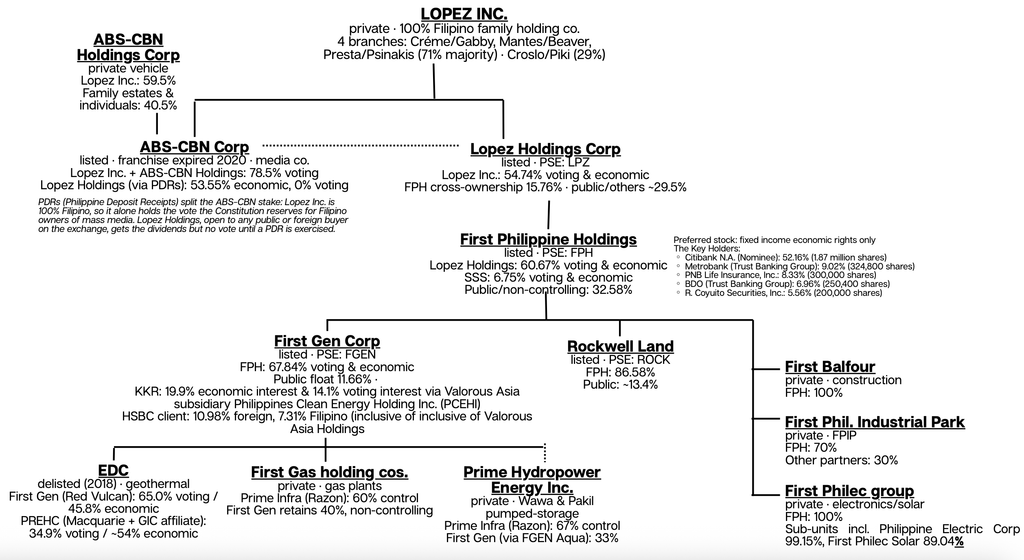
Lopez empire shareholder tree
LOPEZ INC. The Lopez empire shareholder tree. Graph by Lala Rimando
The rift was always about ABS-CBN’s money

The dispute that has consumed the Lopez family since February traces back to a single question: whether Lopez Inc. should inject roughly P2 billion into ABS-CBN to stabilize its finances after its 2020 franchise denial under the government of Rodrigo Duterte. Gabby’s branch and allied cousins pushed for the infusion; Piki opposed the plan as structured, arguing more than half the money would go to executives and insiders rather than a clear turnaround.

Must Read

EXCLUSIVE – Debt, discipline, and daring: Inside the Lopez Group’s high-risk bets 


EXCLUSIVE – Debt, discipline, and daring: Inside the Lopez Group’s high-risk bets 

The urgency behind that fight is documented in ABS-CBN’s own numbers. A complaint Piki filed with the SEC put the network’s immediate liquidity gap at roughly P1.5 billion, pointing to P8.5 billion in interest-bearing loans classified as current liabilities and due within 2026, against liquid assets of only about P7 billion. (READ: Family friend to referee? SEC’s Francis Lim has peace plan for Lopez war.)

ABS-CBN’s own 2025 annual report describes ongoing loan refinancing talks with its creditor banks and management’s assessment that it can meet its obligations over the next twelve months, without disclosing a specific rescue figure of its own.

FPH, First Gen, and Rockwell carry none of that strain. Their businesses, power generation and real estate, have continued largely undisturbed by the family fight. The disruption has stayed concentrated at the top, in Lopez Inc.’s boardroom and courtroom filings, and at ABS-CBN, the one asset in the group that needs money it does not have. 

So far, what has actually changed hands is one family branch’s stake in the private company at the very top of the pyramid, nothing more. Whether it becomes anything closer to a direct ABS-CBN rescue is a question about what Ang, and the family, do next, not about what has been confirmed so far. As of writing, whether any portion of what Ang paid for the Crème stake is meant to reach ABS-CBN,t through a future capital call, a loan, or some other mechanism, is not yet known.

Must Read

Lopez family confirms a sale inside ultimate parent firm Lopez Inc.


Lopez family confirms a sale inside ultimate parent firm Lopez Inc.

ABS-CBN’s own disclosure, filed also on August 10, backs up the “nothing more, for now” reading. After a news report on the sale prompted the Philippine Stock Exchange (PSE) to direct ABS-CBN to confirm or clarify the transaction and disclose any effect on its business, ABS-CBN responded that it is not a party to the transaction and is unable to comment on it, and that because the sale sits at the Lopez Inc. level, the company does not foresee any impact on its business, financial condition, operations, or ownership structure. That is the company’s own words, not this piece’s inference: as things stand, the sale has not touched ABS-CBN at all.

The vehicle, and who approached whom

San Miguel Corporation’s own disclosure to the exchange, filed the same day as the sale, names the vehicle: Illumina Investment Holdings Inc., a corporation wholly owned by Ang, executed a Deed of Assignment with members of Gabby Lopez’s family for the Crème Investment Corp. shares. The filing also settles a question the earlier reporting had left open: the deal was struck “upon the invitation of the ELopez Family,” San Miguel’s own language for it. Meaning, Gabby’s side approached Ang, not the other way around. 
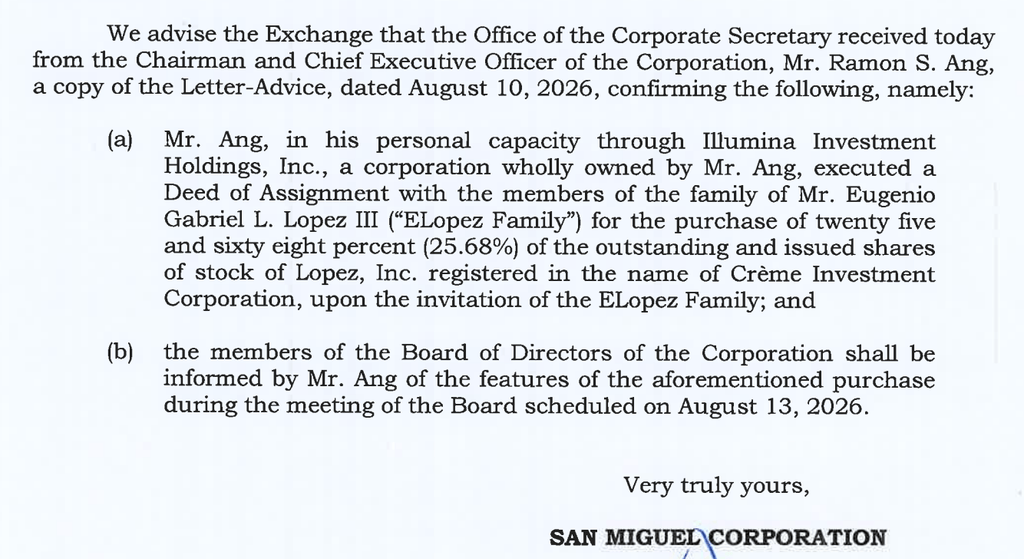
ILLUMINA INVESTMENT. San Miguel Corp. discloses to the Philippine Stock Exchange Ramon Ang’s personal investment in ultimate Lopez parent firm, Lopez Inc., on August 10, 2026. Screenshot from SMC disclosure

San Miguel’s board itself was not briefed on the details until a meeting scheduled for Thursday, August 13, three days after the deal closed, consistent with how Ang has handled his previous media-adjacent investments: personally, outside the conglomerate’s own governance process, with the board informed after the fact rather than asked beforehand.

What Ang actually bought into

Strip away the family names and the press statements, and what Ramon Ang bought on August 10 is a seat at the top of a pyramid that controls almost everything beneath it and owns less and less of it the further down the shareholder tree. He now holds a piece of a media company whose votes the family guards completely and whose bank accounts are running dry, sitting atop an energy empire the family still commands from the boardroom while owning, in real terms, a shrinking sliver of its most valuable asset, an asset a foreign conglomerate is already circling with an offer measured in billions. 

Razon is already inside the gas and hydro businesses. KKR is already inside First Gen. An Indonesian bidder is already asking about EDC. Ang did not buy his way past any of them. He bought a seat at the table one level above all of it, in a private company where the vote still belongs entirely to the family, for now, and where the money increasingly does not.

Eighteen years ago, Ang flew to Cebu on a weekend, not to take the company from the Lopez family, but to beat now Meralco chair Manuel Pangilinan to GSIS’s hostile stake before the Lopezes could broker their own exit for it. This time, he did not have to fly anywhere, or beat anyone to it.

A family feud did the work for him. One cousin wanted out, and Ramon Ang, who has been circling this family’s businesses for 18 years, was there to buy. – Rappler.com

Lala Rimando wrote about Philippine business, and managed newsrooms, including Newsbreak, ABS-CBN, Rappler, and Forbes, for over 25 years. She’s now based in La Union, taking care of her mom with dementia, and working on the multimedia biography of the late John Gokongwei.

Must Read

Buying into the Lopez empire: ABS-CBN or Lopez Inc?


Buying into the Lopez empire: ABS-CBN or Lopez Inc?

Similar Posts

  • |

    Power sector circular debt rises by Rs364 billion in FY2025-26

    ISLAMABAD: Pakistan’s power sector circular debt increased by Rs364 billion during fiscal year 2025-26, highlighting persistent weaknesses in the electricity supply chain despite substantial government subsidies and efforts to contain the buildup of unpaid liabilities. According to the circular debt report for June 2026, the increase was significantly higher than the previous year, when the debt had risen by around Rs45 billion. The latest increase represents a surge of roughly 709% year-on-year in the annual flow of circular debt. The Power Division has not yet formally uploaded the one-page circular debt report for June 2026 on its official website. The latest figures indicate that structural problems, including distribution company inefficiencies, weak bill recovery, payment disputes and delays in tariff adjustments, continue to generate fresh liabilities in the power sector. The development comes despite the government’s efforts to contain the debt through budgetary support and subsidies. IMF target and government commitments The International Monetary Fund (IMF) had permitted Pakistan to record up to Rs400 billion in circular debt flow during the year, while simultaneously requiring the government to take measures to prevent the accumulation of new liabilities and eventually bring the flow down to zero. Under the IMF programme, the government has been relying on tariff adjustments, subsidy rationalisation and other reforms to improve the financial health of the electricity sector. However, the latest increase suggests that governance and operational problems remain a major obstacle to achieving a sustainable reduction in circular debt. The government provided approximately Rs302 billion in subsidies aimed at supporting the power sector and reducing the debt burden. However, the amount was insufficient to maintain the circular debt stock at the level of Rs1.614 trillion recorded at the end of June 2025. As a result, the debt stock recorded a net increase of around Rs61 billion during the year. The Power Division had earlier stated that the federal government allocated Rs893 billion for the power sector in the FY2025-26 budget. However, around Rs98 billion of the allocated amount was not released, affecting the government’s ability to reduce the outstanding liabilities. A Power Division spokesperson said that if the entire budgeted allocation had been released, the circular debt stock could have fallen further to around Rs1.577 trillion. The funding shortfall, according to the official, contributed to the Rs61 billion increase recorded during the year. Distribution companies remain a major source of losses Inefficiencies within power distribution companies continued to be one of the biggest contributors to the accumulation of circular debt. The government incurred approximately Rs262 billion in losses during FY2025-26 because of inefficiencies in distribution companies. The amount was only around Rs3 billion lower than the previous year, indicating that little progress has been made in addressing operational weaknesses. Another Rs64 billion was added to the circular debt because of lower electricity bill recoveries. Although significant, this amount was around 51% lower than the corresponding figure recorded in the preceding year. The figures underline the financial pressure created by electricity theft, transmission and distribution losses, weak collection systems and inadequate enforcement against non-paying consumers. Privatisation of distribution companies The government has initiated the process of privatising three relatively profitable distribution companies — Faisalabad Electric Supply Company, Gujranwala Electric Power Company and Islamabad Electric Supply Company. However, the proposed privatisation is not expected to immediately resolve the broader circular debt problem because a substantial portion of sector losses originates from other distribution entities. Earlier, the government had considered a model under which profitable distribution companies would be combined with loss-making entities before privatisation. The plan, however, was subsequently abandoned in favour of offering comparatively stronger companies separately. Experts have repeatedly argued that privatisation alone cannot eliminate circular debt unless the underlying issues of electricity theft, poor recoveries, governance and operational losses are addressed across the entire distribution network. K-Electric dispute adds to debt Payment disputes with K-Electric also contributed substantially to the increase. According to the report, approximately Rs194 billion was added to the circular debt because of non-payments by K-Electric. The company’s outstanding payments are linked to a dispute concerning the delayed finalisation of its multi-year tariff by the National Electric Power Regulatory Authority. The prolonged disagreement has created financial pressure throughout the power supply chain, adding to the accumulation of unpaid liabilities. In addition, around Rs75 billion was added to the circular debt because of delays in tariff adjustments. The government, meanwhile, made payments of approximately Rs129 billion against principal loans of the power sector. Without these payments, the annual circular debt flow could have exceeded Rs600 billion, according to the figures. The Power Division also benefited from a reduction of around Rs98 billion in the circular debt flow because of subsidy payments. Interest payments add further pressure Interest charges also contributed to the accumulation of liabilities, adding around Rs14 billion to the circular debt during the fiscal year. These financing costs ultimately increase the burden on consumers because the cost of servicing the sector’s outstanding liabilities is recovered through electricity bills. Consumer groups have frequently criticised the practice, arguing that households and businesses that regularly pay their electricity bills are effectively being charged for inefficiencies, theft and non-payment elsewhere in the system. Subsidies and burden on consumers The government’s continued reliance on subsidies has helped prevent an even larger accumulation of circular debt, but it has also placed pressure on the national budget. The power sector received hundreds of billions of rupees in subsidies during the year, while the government simultaneously pursued tariff increases and other measures intended to improve cost recovery. The contrast has raised questions about whether existing policies are addressing the underlying causes of circular debt or merely shifting the burden between consumers, the federal budget and power-sector entities. The government has also been under pressure to address similar financial problems in the gas sector. Although no comparable subsidy was provided for the gas sector, the authorities were expected to prevent a further increase in its circular debt. The government reportedly refrained from passing the full reduction in gas prices on

  • |

    PBS revises import data after billions of dollars in discrepancies

    The Pakistan Bureau of Statistics (PBS) has revised the country’s monthly and annual import figures after uncovering major discrepancies in trade data, with the adjustments reaching billions of dollars over certain periods. The data revisions, which could amount to as much as $30 billion for some periods, are expected to have a notable impact on Pakistan’s Gross Domestic Product (GDP) calculations and other key economic indicators. The statistical agency has incorporated the updated import figures across several major sectors as part of the data reconciliation process. According to senior government officials, the PBS has completed a detailed report outlining the discrepancies and the methodology used to revise the import statistics. The report has been submitted to the Ministry of Finance, which is currently examining its potential implications. The ministry is expected to make the findings public by the end of August 2026. Differences emerge between PBS and SBP data The issue came to light after officials identified significant differences between import figures compiled by the PBS and corresponding data maintained by the State Bank of Pakistan (SBP). The discrepancies were initially detected while comparing Pakistan’s trade figures with China. Further scrutiny subsequently revealed differences in specific tariff lines and categories of imports that had not been fully reflected in the PBS data. Following the discovery, the Pakistan Single Window and other relevant government institutions became involved in the reconciliation process. The objective was to identify the source of the differences, verify transaction-level information and ensure that import statistics accurately reflected the country’s external trade. The matter later attracted the attention of the International Monetary Fund (IMF), which has been closely monitoring Pakistan’s economic data and statistical reporting under its reform programme. IMF seeks greater transparency The IMF had previously highlighted weaknesses in Pakistan’s procedures for collecting, compiling and consolidating import data. It called for improvements in the statistical framework and greater transparency about the scale and economic impact of the discrepancies. Under the agreed reform requirements, the PBS was tasked with publishing revised monthly and annual import statistics by the end of August 2026. The statistical agency is also expected to provide an explanation of the changes and their impact on previously reported figures. The revisions are particularly significant because imports are an important component of national accounts and external-sector statistics. Changes in import values can influence the calculation of GDP, trade balances, current account figures and other macroeconomic indicators. GDP impact under review The Ministry of Finance is examining the PBS report largely because of the potential impact of the revised import figures on national economic data. Officials are assessing how the changes could affect previously reported GDP estimates and other indicators based on import statistics. The scale of the revisions means that the exercise could result in adjustments to historical economic data, depending on how the revised figures are incorporated into the national accounts. Officials, however, are expected to provide further details once the Ministry of Finance completes its review and the PBS publishes the revised statistics. IMF review mission approaching The development comes ahead of the IMF’s next review of Pakistan’s economic reform programme. The Fund’s review mission under the country’s $7 billion Extended Fund Facility (EFF) is expected to visit Pakistan by early September 2026. The publication of revised import data before the mission’s arrival is likely to be closely watched, as strengthening the reliability and transparency of economic statistics remains an important element of Pakistan’s commitments under the IMF programme.

  • | |

    Canada announces retaliatory tariffs as trade talks with US collapse

    OTTAWA: Canada has announced plans to impose new tariffs on a range of American products in response to steep duties introduced by US President Donald Trump on Canadian goods, marking another sharp deterioration in trade relations between the two North American neighbours. Prime Minister Mark Carney said on Saturday that Canada would adopt a “dollar-for-dollar” approach to Washington’s latest tariffs. The retaliatory measures are scheduled to take effect on September 8 and will cover products including US steel, electronics, appliances, agricultural equipment, pulp and paper and other goods. The announcement came after three days of intensive negotiations between Canadian and US officials ended without a trade agreement. Both sides blamed the other for the failure to reach a breakthrough, raising fresh uncertainty over the future of the United States-Mexico-Canada trade framework. Carney vows to defend Canadian economy Speaking at a press conference in Ottawa, Carney said Canada would respond to the US measures in an effort to shield workers, farmers, businesses and families from the economic impact of the new duties. “Canada will match Washington’s new tariffs dollar for dollar,” Carney said, stressing that Ottawa could not accept the conditions put forward by the US administration. Asked whether the dispute had effectively developed into a trade war, Carney responded in stark terms, saying Canada had been attacked and therefore had to defend its economic interests. The Canadian government said its countermeasures would target a broad selection of US products. Further details, including the specific goods affected and the tariff rates, are expected to be announced in the coming days. Carney also indicated that Ottawa would introduce support programmes for Canadian industries affected by the American duties. The assistance could remain in place for several years depending on the impact of the trade measures. US-Canada negotiations break down The latest dispute follows the collapse of negotiations that had been viewed as an opportunity to prevent a further escalation in tariffs. US Trade Representative Jamieson Greer described the failed talks as a missed opportunity for Canada and said Washington would proceed with measures responding to Canadian retaliation. He also suggested that no fresh negotiations were immediately planned. The White House and offices representing the US commerce secretary and trade representative did not immediately issue a detailed response to Canada’s announcement. The breakdown has created additional uncertainty for businesses operating across the US-Canada border, particularly industries that depend heavily on integrated North American supply chains. New US duties affect key Canadian exports The latest US tariffs apply to a range of Canadian exports, including wine, furniture, dairy products, cement, clothing, fishing equipment and hockey-related products. According to the Canadian government, the new duties affect approximately $20 billion worth of Canadian exports to the United States. Unlike some previous measures, the latest tariffs do not fully exempt products traded under the existing North American trade agreement. The new duties represent a relatively small share of Canada’s overall exports to the US, but officials and industry representatives warn that individual sectors could face significant pressure. Industries such as softwood lumber, wine, manufacturing and other export-oriented businesses could experience weaker demand, higher costs and potential employment losses if the dispute continues. Candace Laing, chief executive of the Canadian Chamber of Commerce, urged companies across the country to prepare for a prolonged period of uncertainty. Dispute over vehicles and trade conditions One of the most difficult issues during the negotiations involved the treatment of larger vehicles. Canadian negotiators reportedly sought to extend preferential tariff arrangements for light-duty vehicles to medium- and heavy-duty trucks. Washington opposed the proposal, according to people familiar with the negotiations. Carney said the US position could have placed Canadian-made models at a competitive disadvantage. He specifically pointed to vehicles produced in Canada, including Ford’s F-350, F-450 and F-550 trucks and General Motors’ Silverado. The Canadian prime minister also said some US proposals touched on issues involving Canadian culture, language and sovereignty, although he did not provide further details. Ontario backs Ottawa’s position Ontario Premier Doug Ford, a prominent critic of US tariffs, welcomed Carney’s decision to reject what he described as an unfavourable agreement. Ford said the proposed terms would have harmed Ontario’s automotive, steel and manufacturing industries, adding that he supported Ottawa’s decision to retaliate rather than accept a deal that he considered damaging to the province. Ontario is particularly exposed to disruptions in US-Canada trade because of its large manufacturing and automotive sectors and its close integration with American supply chains. Canada seeks new international partnerships The escalating dispute also comes as Canada seeks to reduce its economic dependence on the United States. Nearly 70% of Canadian exports are destined for the US market, making the country particularly vulnerable to changes in American trade policy. Carney has nevertheless pledged to strengthen Canada’s relationships with other countries and explore new trade and security partnerships. The prime minister was elected on a platform that included a tougher negotiating stance toward the Trump administration. His government has maintained that Canada should defend its economic interests while looking for opportunities to expand trade beyond its southern neighbour. Public opinion has also strengthened Ottawa’s position, with polling indicating that many Canadians oppose making major concessions to Washington. Conservative Party leader Pierre Poilievre, who leads the federal opposition, also called for national unity in response to the US tariffs.

  • Thailand’s Foreign Tourist Arrivals Drop 3.2% Year-on-Year

    BANGKOK – Thailand’s foreign tourist arrivals dropped by roughly 3.2% during the first eight months of 2026. Between January 1 and August 1, the country welcomed just over 18.5 million international visitors. This marks a noticeable shift for a country that relies heavily on global travel for income. Tourism remains a massive financial driver for […]

Leave a Reply

Your email address will not be published. Required fields are marked *