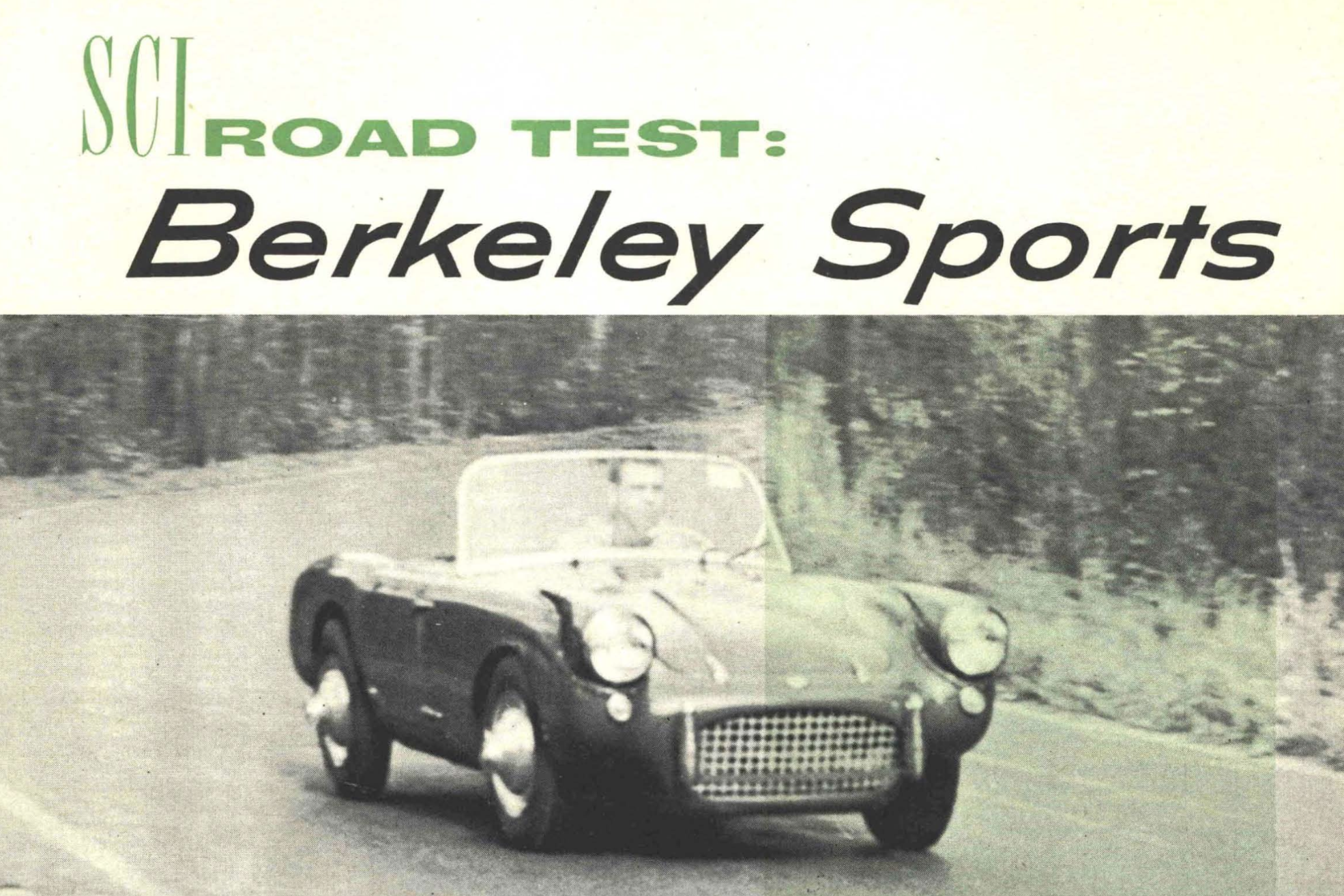
What to Know About two-Strokes of Genius: Sports Cars Illustrated on the 1958 Berkeley Sports
Obscure 1950s sports cars always get our attention—the weirder, the better—and few are quirkier than the 760-pound, motorcycle-engined, front-wheel-drive Berkley Sports. Two examples sold here last year, and, curiosity piqued, we turned to the back issues of our favorite auto magazines to learn more about these funky pocket cars. We found ourselves fascinated by this illuminating road test from the February 1958 issue of Sports Cars Illustrated (now Car and Driver), and just had to share it with the BaT community.

A little background: Berkeley Cars came about as the combined effort of British airplane engineer/designer Lawrence Bond and fiberglass travel-trailer builder Charles Panter, owner of Berkeley Coachworks. Fiberglass was innovative tech in the 1950s and 1960s, and between 1956-1960, Bond’s Sports roadsters, advertised as “the world’s lowest-priced all-sports car,” delivered an astonishing level of ingenuity, finish, and performance for a price tag of around £500.
Click above to open the article in a full-window viewer, or hit the “share” arrow to download the PDF. Individual pages can be viewed in the gallery below.
The SE328 model tested by Sports Cars Illustrated was powered by an 18-horsepower, 328cc Excelsior twin (the later SE492 featured a half-liter triple good for 30 horses). Their evaluation began in the gridlock traffic of Manhattan’s Garment District, where a passing teamster found the car so adorable he had to pick it up.

“The driver of the truck behind stepped out and said, “Small, ain’t it? I bet I can pick that thing up.” And he did! But he was quite surprised when we slipped the car into gear and eased it ahead, forcing him to run along with his hands full of car, like a reluctant barrow-pusher.”
The Berkley’s light weight wasn’t just due to its size. Lawrence Bond had worked as an aircraft engineer during World War II, and his design was the first fiberglass monocoque ever put into production. With an air-cooled two-stroke motorcycle engine driving the front wheels, there was no need for a radiator, driveshaft, rear differential, or even oil sump. Weight was further reduced by simplification: adjustable straps suspended the seat cushion, and the doors were shaped to stay shut with simple external hardware. Bond put his development budget where it was needed most: independent suspension, oversize 7″ drum brakes, a Dynastart combination starter/generator, and an insulated, watertight convertible top. The SCI team found the Berkeley to be responsive, cleverly packaged, and pretty refined for such a simple vehicle. Sure, it wasn’t fast up a hill, but it could drive 57 miles on a gallon of gas! The article is a fun read, and we encourage you to check it out.

As a coda to the road test, we did some extra research on Berkley’s competition history. After all, this fun-size sports car was its happiest at full tilt on a racing track. Stirling Moss put the early SA322 through its paces at Goodwood in September 1956, and Berkeley continued to earn their stripes by sponsoring works teams and privateers. One of those was Stirling Moss’s sister, the famed rallyist Pat Moss, who finished the 1958 Liège-Brescia-Liège in a 328cc Berkeley. Moss and teammate Ann Wisdom led the sub-500cc field until the summer’s heat began to plague the little zinger in the hills.

Rick Bekrich, shown above, impassively three-wheeled a Berkeley at Indianapolis Raceway Park in 1961. It wasn’t the first time a Berkeley had lifted its leg on the field, and they still make compelling vintage racers today.
Editorial content and images are the property of Sports Cars Illustrated (now Car and Driver) and Hearst Media.