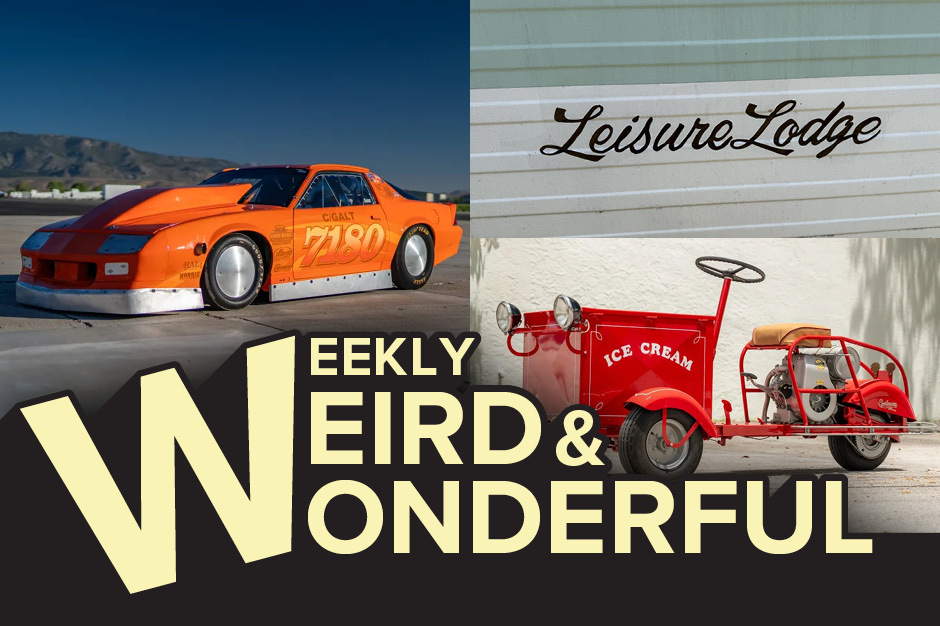
This Week’s Weird and Wonderful—June 19, 2026 You Should Know
Much like the Emancipation Proclamation itself, the observance of Juneteenth has taken some time to catch on. We here at BaT have been observing the holiday for the past several years, but we got our work done early so as not to deprive you of this Weekly Weird and Wonderful feature. Today we’ve got a few bikes and boats, some rarefied fiberglass bodywork, a couple firsts, and an interesting last, among other things.

Enjoy this week’s Weird and Wonderful, and know there’s plenty more to explore on our live auctions page when you’re done!
Ex-David Lee V8-Powered 1972 Ferrari Dino 246 GTS “Evo 3.6”


Those who have spent any time in the orbit of Ferrari collectors will know the name David Lee. This Dino was commissioned by Lee, built up by Moto Technique in Surrey, England, and combines all the best traits of the “Dino” series of mid-engine Ferraris from the 1970s and ’80s. Curvy Pininfarina bodywork—check. Covered lights—check. Fuel-injected quad-cam V8—check. But this is no mere mash-up; the motor was punched out to 3.6 liters and matched up with a custom fuel-injection system and MoTech engine management with drive-by-wire throttle control. With around 400 horsepower, brakes from a 360 Modena were required to bring it to a stop. Not that you’d want to do that, since this looks like an absolute blast to drive.


We have this Simca labeled as a French car, but the company was always Italian in spirit. It came out of Italian-born founder Henri Pigozzi’s relationship with Fiat, who funded the first Simca factory in Nanterres. Indeed, early pre-war cars were badged Simca-Fiat, and during the Second World War they were permitted to continue operating during the German occupation due to their association with the Italians. Post-war cars continued to use Fiat underpinnings, but the Italian influence was downplayed except for in the case of the Simca 8 Sport. This was Pigozzi’s Franco-Italian swan song; Michelotti, then at Stabilimenti Farina, was brought in to style a decidedly upmarket roadster and coupe with fully enveloped fenders, reminiscent of his Cisitalia 202. Around 5,000 were made between 1949–1952, and it was the last Simca model based on a Fiat chassis.
302-Powered 1960 Ford Country Sedan


Some of us at BaT contend that 1960 was the single best year for automotive design, and cars like this sleek Ford wagon really helps their case. The Country Sedan was a wagon variant of the Galaxie (sans the woodgrain worn by the Country Squire), and this look was in market for just one model year. @Huddart77‘s subtle revisions accentuate the shape of this example wonderfully, and the inside is just as pretty as the body. It’s easy to look at a completed car and say “wow, nice job!” But take a look at the “before” pictures to get a true idea of the vision and effort involved in its four-year transformation.
41-Years-Owned Modified 1980 Lambretta Jet 200


There are dozens of trophies that come with this heavily customized Lambretta from @1980Lambretta. We can’t quite make out the text, but we can assume that some of the awards are for “Most Tasteful Display of Male Nudity,” “Most James Bond-Themed Scooter” and “Thanks for Remembering Timothy Dalton.” Setting the subject matter aside (if that’s possible), the level of craft on display here is off the charts. Just check out the custom the engravings on almost every chromed surface.
Lamborghini Miura Fiberglass Clamshells & Body Tooling Parts and Group 4–Style 1977 Ferrari 308 GTB Vetroresina Project


Somewhere out there, a Pontiac Fiero owner is foaming at the mouth. This collection of fiberglass Miura clamshells and body tooling parts includes a front piece reportedly molded from a Miura, while the remaining molds are laden with various Miura tags—more than enough to pique one’s curiosity. The actual Miura was formed from aluminum and steel, but since those parts are going to be even harder to find, these fiberglass copies can at least serve as reference for a talented fabricator.


The Ferrari 308 GTB Vetroresina was Maranello’s first fiberglass-bodied road car. Carrozzeria Scaglietti crafted some 800 bodies before the factory transitioned to steel shells. This dismantled example was at one point in the process of being redone in the style of a Michelotto rally car. A Group 4 roll cage was fabricated by an outfit in Jupiter, Florida, while reproduction body panels were sourced from Makela Auto Tuning in Finland, where Group 4 rally cars themselves often came from. This project also includes a number of performance parts along with its disassembled quad-cam V8.


Merging with Studebaker turned out to be a raw deal for Packard: when they discovered that Stude’s bean counters had cooked the books, it was already too late. The last “true” Packard rolled off the assembly line in 1956, and any Packard thereafter was effectively a rebadged and slightly restyled Studebaker. The Packard marque was defunct by 1959, and the Hawk was their swan song. Based on the Studebaker Golden Hawk, the Packard version incorporated a few styling changes like a full-width “catfish” grille. Just 588 Packard Hawks were built that final year, making this one worth preserving.
1999 Toyota Epic S22 and 1976 Century Sabre 200 Gull-Wing Hardtop 50th Anniversary Edition


Toyota’s 1UZ V8 is one of the most reliable powerplants ever manufactured, full stop. After sinking $1 billion into its development, Toyota started looking outside the yellow lines for new applications to help recoup their costs. They went ahead and got their wonder-motor certified by the FAA, though our subject here resulted from the 1997 founding of their Marine Business Division to conquer the seas. The seller has owned this boat for most of its lifetime, and it appears to be holding up just as nicely as any other Toyota product built in the 1990s. Toyota’s Marine Division is still in business making Lexus-branded motor yachts for markets west of the International Date Line.


In the 1970s, road-going boats plied our Interstates, trimmed out with vinyl and chrome and woodgrain and opera windows and tinted glass. Century translated this “land yacht” style to the water, and the result was compelling. We’ve never seen gullwings on a boat before, but what’s not to love?
Fuel-Injected 1958 Pontiac Bonneville Convertible


Pontiac was often relegated to a subordinate position in the General’s ranks, but goodness knows they never stopped trying to one-up their bowtied rivals down the hall. This fuel-injected Bonnie is a case in point: Pontiac put their Rochester mechanical fuel injection onto the 370ci V8, a one-year motor that was an evolutionary predecessor to the 389, and rated it at 310 horsepower—27 more than the contemporary Corvette Fuelie.


On top of that, they kitted out their Bonneville with a wild array of accessories. This car seems to have them all: power windows, Safeguard speed alarm, power top and antenna, removable portable radio, and combination spotlights and sideview mirrors. Looking at this car is like looking at a Christmas tree—there are ornaments everywhere, and the more you stare, the more you’ll see. It seems like Harley Earl made sure that his designers put effort into every last component. Heck, even the ashtray is trick. Thanks to @Raffi for bringing this Jet Age wonder to the site.


The Micro-Power Micro-Bike (say that five times fast) is essentially the size of a cowboy hat and was marketed as the “Motorbike in a Bag” thanks to its removable handlebars. This example is powered by an air-cooled 22cc two-stroke single and weighs some 30 pounds, giving it a power-to-weight ratio not entirely unlike that of a Peel P50. Before you start daydreaming about more power, consider this—braking is accomplished Fred Flintstone-style, with the heels of your feet.
Original-Owner 1978 Ford Granada ESS V8 2-Door Sedan


Ford spent much of the mid-1970s trying to convince the American public that its Granada was the equivalent of a Mercedes-Benz with a blue oval badge. Their most overt attempt at European flare was the ESS (short for European Sports Sedan) package. Period brochures even proclaimed that it was “styled in the tradition of” such a machine. We think it looks more like a stock car, but that’s no bad thing. This example was optioned with a 302ci V8 and bears several custom touches added by @Merc_s55, who has owned it since new!
Honorable Mentions
302 V8-Powered 1965 TVR Grantura Mk III 5-Speed SCCA B Production Race Car


This angry little racer is all engine. Check out the driveshaft—it’s the size of a burrito. Hats off to the seller for being able to drive this car in what we assume is a reasonably straight line.
Single-Family-Owned, Clenet-Style, Dual-Cabin Custom Convertible

This must be where the extra lengths of driveshaft went.
2025 Cadillac Celestiq Invitation


You don’t have to RSVP to take a look at our first Cadillac Celestiq Invitation. This example of Cadillac’s flagship EV was ordered with $76,000 in bespoke options and is number 18 of just 25 produced for the model year.
Thanks for checking out this edition of the Weekly Weird & Wonderful! Follow this page to get updates when new installments post, and tell what caught your eye or what you think we’ve left out!