Understanding celebrating 4/29 with Cadillac’s Smoothest Sixties Big Block
After a month spent discussing raucous big blocks and their exploits on banked ovals and quarter-mile drag strips, we’re ready for something a little more mellow. Something smooth. Today is 4/29, but we’re not going to spill any more ink on oft-celebrated baddies like FoMoCo’s Boss ‘Nine engine or the Super Cobra Jet Lima—today, we’re talking about the Cadillac 429, found under the hood of every car that rolled out of their Clark Street plant between 1964 and 1967.


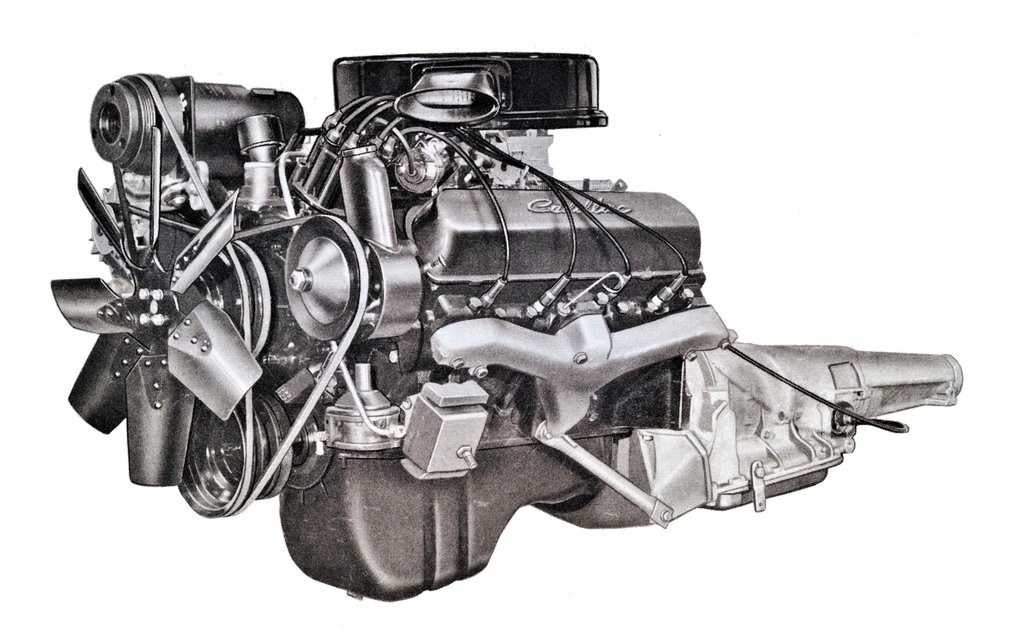
The silky 429ci stump-puller was the immediate descendant of the 390 that had been introduced in 1963, not to be confused with the older 390 used from 1959-1962 (itself the ultimate expression of the 331ci mill that introduced the OHV V8 to American buyers). The 429 was another 90-degree V8, slightly over-square with a 4.13″ bore and 4.0″ stroke. It had stronger main bearing caps, made more power, and even shed a good deal of weight over the previous generation with equipment like a hollow-cast crankshaft, aluminum pistons, and a cast aluminum front cover. Horsepower rose to a respectable 340, but the real show-stopper was the torque, stated to be a burly 480 lb-ft. at just 2,800 rpm.
Click above to open the article in a full-window viewer, or hit the “share” arrow to download the PDF.
And was it ever smooth. In their “Six Luxury Cars” comparison feature from July 1965, Car and Driver declared the 429-powered Fleetwood Brougham to be the only car in the group capable of rivaling the Mercedes 600, even though its $8,700 sticker was but a fraction of the Grosser’s $21k price tag. Furthermore, the Caddy had the best power-to-weight ratio of the cars tested and was deemed the most comfortable, best handling, best equipped, and fastest of a group that included the aforementioned Mercedes, a Jaguar 420 saloon, a Lincoln Continental, a Chrysler Imperial, and a Rolls-Royce Silver Cloud. In a similar article, Motor Trend Technical Editor Jim Wright noted that the 480 lb-ft. torque rating was on par with that of contemporary Super Stock dragsters.
Listening to the Cadillac 429, one never gets the impression that it is working hard. On startup it settles into a gentle whirring idle—a comforting sensation, like warm towels spinning in the dryer. Under load, the motor produces a deep hum as it does its work—no lumpy V8 sounds to be heard at all, so long as the exhaust is sealed up well. It was a masterpiece, but it didn’t generate attention or excitement because it wasn’t supposed to. It was meant to be a powerful but benevolent force—the hand of God, come to bring his children and their groceries safely home from the I.G.A.
In 1968, Cadillac decided that if bigger was better, then biggest would be best. They introduced the 472, which later became the 500—that got the motoring press talking. At that time, there really was “no replacement for displacement”—with tightening emissions and safety regulations, it was the only arrow left in the quiver. But the earlier 429 was designed with a more singular focus on refinement, and its character was so wholly integrated into the Cadillac experience that its presence almost disappeared. On 4/29, it definitely deserves its due.
Brochure images: lov2xlr8.no, 63/64 Cadillac Website
Car and Driver editorial content and images are the property of Hearst Media.