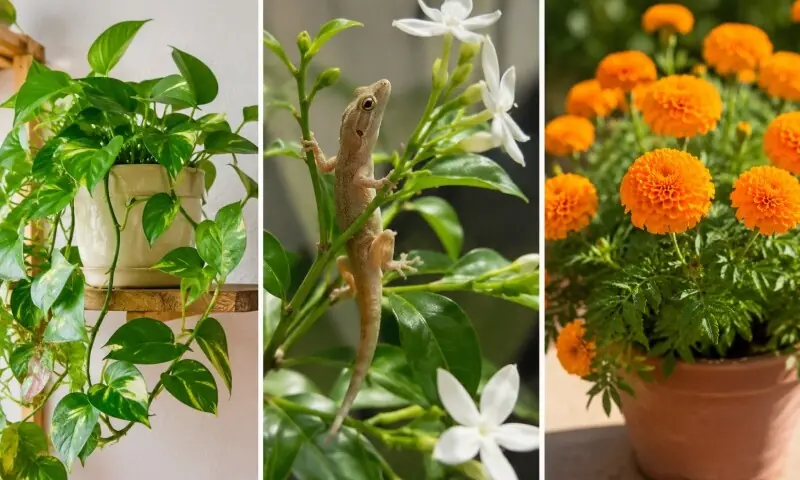
houseplants that may

3 Houseplants that may attract lizards

Lizards often appear in homes during the summer especially in kitchens bathrooms and near indoor plants.

While they are usually harmless many people find them unpleasant. They can also become a hygiene concern if they come into contact with food.

Experts say some houseplants may attract lizards because they provide cool damp and shaded places where the reptiles like to hide.

One of the most common plants is the money plant. Its large leaves and moist soil create a cool environment making it a favorite hiding place for lizards.

If the vine grows up a wall or support lizards may climb and rest among the leaves.

Another plant that may attract lizards is jasmine. The plant offers a cool leafy space and some experts believe its dense growth makes it a comfortable shelter for lizards.

Marigold plants may also attract them. Their thick leaves create shade giving lizards a safe place to hide during hot weather.

The good news is that you do not need to remove these plants. There are a few simple home remedies that may help keep lizards away.

Placing camphor tablets near plant pots is one popular method because lizards dislike their strong smell.

You can also place half an onion or a few garlic cloves near the pots as their odor may help repel lizards.

Another natural option is bay leaves whose strong scent is believed to discourage lizards from staying near plants.

Experts also recommend keeping the area around plants clean. Dry leaves weeds and garden waste can attract insects which are the main food source for lizards.

By reducing insects and maintaining good hygiene around your plants and home you can also reduce the chances of lizards appearing.

Similar Posts

  • Unbearable heat in Turbat

    Hani Rasheed Through the columns of your esteemed newspaper, I wish to highlight the unbearable heat in Turbat. Every summer, temperatures rise to dangerous levels, making life extremely difficult for residents. Students, labourers, elderly people, and patients suffer the most. Long hours of load shedding and water shortages make the situation even more unbearable. The authorities should take urgent measures to ensure an uninterrupted electricity supply, improve water availability, and plant more trees to reduce the effects of extreme heat. Public awareness about staying safe during heatwaves should also be promoted. The people of Turbat deserve timely action before this severe weather causes more health problems. I hope the concerned authorities will address this issue without delay

  • Poor condition of roads in Dasht

    I want to draw the attention of the concerned authorities to the poor condition of roads in Dasht. Many roads are broken and full of potholes. During the rainy season, they become muddy and difficult to use. The damaged roads cause traffic problems and accidents. Students, patients, farmers, and other people face great difficulties while travelling. Sometimes vehicles are also damaged because of the bad roads. I request the concerned authorities to take immediate action and repair the roads in Dasht. Good roads are necessary for the safety and development of the area. I hope that the authorities will pay attention to this serious problem.

  • Viral video highlights risky school route in India

    Millions of children around the world go to school every day but for some simply reaching the classroom can be a dangerous journey. In India a viral video has raised concerns after showing schoolchildren taking a highly risky route to get to school in Madhya Pradesh’s Vidisha district. The students reportedly have to jump across a river embankment to reach their school while strong water flows below. The dangerous journey has shocked people on social media and raised serious questions about the safety of the children. Parents and local residents say there is no safe route for the children to reach school forcing them to take the dangerous path every day. The situation becomes even more risky during the rainy season when the water level and flow increase. Locals have urged the authorities to inspect the area immediately and provide a safe and permanent route for the students instead of waiting for a tragic accident to happen.

  • | | |

    Body fat new study reveals its crucial role in met…

    A new scientific study has highlighted that body fat is much more than a source of extra weight. Researchers say fat tissue functions as an essential organ that helps regulate metabolism, stores energy, and produces hormones needed for the body’s normal functioning. According to the researchers, while excessive body fat is widely associated with conditions such as diabetes and heart disease, having too little body fat can also pose serious health risks. The findings suggest that maintaining a healthy balance of body fat is important for overall metabolic health. The study focused on a rare inherited disorder known as Familial Partial Lipodystrophy Type 2 (FPLD2). People with this condition lose fat from specific parts of the body or experience abnormal fat distribution, increasing their risk of diabetes and other metabolic disorders. A research team led by American endocrinologist Dr. Elif Oral examined patients with the condition and found that affected fat cells develop significant structural and functional abnormalities. These changes can disrupt the body’s metabolism and contribute to a range of health complications. To better understand the disease, scientists created a mouse model in which the Lamin A/C gene was switched off only in fat cells. This is the same gene known to be affected in individuals with FPLD2. The model allowed researchers to closely examine how defects in fat tissue influence the body’s metabolic processes. Researchers believe the findings could improve understanding of rare fat disorders while also opening new avenues for the development of treatments for diabetes and other metabolic diseases. The study reinforces the idea that healthy fat tissue plays a vital role in maintaining the body’s balance and overall well-being.

  • The unforgettable legacy of Raja Mehdi Ali Khan

    Twentieth-century Urdu literature and Indian cinema was shaped by figures whose creativity crossed literary traditions and popular entertainment. Among these luminaries, Raja Mehdi Ali Khan stands out as a unique persona connecting high-art literary satire and immortal Bollywood melodies. This legend was born in 1915 in the historical town of Wazirabad. Khan was an observer of culture. He inherited a formidable poetic pedigree that caused him to be one of the most celebrated humorists and lyricists of his era. Raja Mehdi Ali Khan’s literary inclinations were virtually coded into his lineage. He was related to the renowned journalist and political figure Maulana Zafar Ali Khan. He was raised in an environment saturated with verse and socio-political commentary. Moreover, his mother was a recognized poetess in her own right. She taught him a deep reverence for language and rhythmic expression from an early age. This environment nurtured his inherent talent, allowing him to absorb classical Urdu poetic conventions while developing an understated wit that would define his future work. Before making a name for himself in the cinema, Khan began his journey in print journalism. He contributed prolifically to prominent periodicals and literary magazines of the era. The names included Monthly Alamgir, Weekly Khayyam, Tehzeeb-e-Niswan and Do Phool. His early journalistic writings allowed him to polish his observational skills. Whether analyzing social norms or painting witty portraits of everyday life, his prose stood out for its accessibility and warmth. Later, he transitioned into radio broadcasting. It’s considered a medium that further refined his sense of auditory storytelling and lyrical timing. He was driven by creative ambition. Later, Khan relocated to Bombay (now Mumbai) during a transformative era for Indian cinema. His entry into the film industry marked the beginning of a golden age for Hindi film music. He partnered with legendary music composers such as Madan Mohan. Khan penned lyrics that transcended simple movie themes, capturing profound emotional truths. His songs have proved to be timeless masterpieces, continuing to resonate across generations. Among his most iconic works are: hai isi mein pyaar ki aabru wo jafa karen main wafa karun jo wafa bhi kaam na aa sake to wahi kahen ki main kya karun Raja Mehdi Ali Khan, Anpadh (1962) His celebrated catalog includes evergreen classics. Lag Jaa Gale (Woh Kaun Thi?): Widely regarded as one of the greatest romantic ballads in Hindi cinema. Aapki Nazron Ne Samjha (Anpadh): A masterpiece of subtle expression and devotion. Jhumka Gira Re (Mera Saaya): A vibrant classic in popular culture. Tu Jahan Jahan Chalega (Mera Saaya): A hauntingly beautiful exploration of love and devotion. Agar Mujh Se Mohabbat Hai (Aap Ki Khaatir): A poignant reflection on romantic commitment. What set Raja Mehdi Ali Khan apart from many of his contemporaries was his dual identity.  Film audiences revered him for his deeply romantic and melancholic lyrics. On contrary, the literary world celebrated him as an exceptionally gifted humorist and satirist. Even amidst his demanding schedule in Bombay’s competitive cinematic landscape, Khan never abandoned his literary roots. His satirical essays and humorous poems were regularly featured in leading newspapers and journals across both India and Pakistan. His humor was rarely cynical. Instead, it offered a gentle, witty critique of human flaws, societal absurdities, and the complexities of modern living. Khan proved that high literary craft could flourish alongside popular music. Raja Mehdi Ali Khan passed away leaving behind a rich archive of literary contributions and cinematic songs that continue to be sung, reimagined, and loved today. His life journey from the quiet streets of Wazirabad to the recording studios of Bombay embodies the shared cultural heritage of the Indian subcontinent. His art remains vibrant and melodious whether delivered in a literary journal or sung by iconic playback singers.  

  • | | | |

    Pakistani folklore

    Pakistani folklore is a vibrant web regional oral traditions, Sufi mystical allegories, and tribal epics across Punjab, Sindh, Balochistan, Khyber Pakhtunkhwa, and the northern mountain valleys. Punjab: Sufi Metaphors & Tragic Romances Punjabi folklore is dominated by tragic love stories (Kissa) that doubled as spiritual allegories for divine love (Ishq-e-Haqiqi). Heer Ranjha is immortalized by the poet Waris Shah. This narrative details the doomed union between Heer, a noblewoman, and Ranjha, an outcast flute player turned jogi. In case of Sohni Mahiwal, Sohni crosses the volatile Chenab River nightly using an baked earthenware pot (gharra) to meet her lover Mahiwal. One night, her sister-in-law replaces the vessel with unbaked clay. This  dissolves mid-stream, leading to Sohni’s tragic drowning. Mirza Sahiban is tale of romance, familial duty, and betrayal. The story culminated in Sahiban breaking Mirza’s arrows to protect her brothers. This act leads to Mirza’s demise. Sindh: The Seven Queens (Satt Surmyun) Sindhi lore centers around seven heroic women celebrated in Shah Abdul Latif Bhittai’s monumental Sufi compendium, the Shah Jo Risalo. Sassi (Sassi Punhun) searches the Makran desert for her abducted lover, Punhun, until the earth swallows her. Marui (Umar Marui) was abducted by King Umar. She refuses wealth and palace luxuries to remain faithful to her desert village. Moomal (Moomal Rano) operates the enchanted palace of Kak Mahal, tests suitors with magical illusions, and loses Rano to misunderstanding. Balochistan: Tribal Epics & Renunciation Baloch folklore prioritizes chivalry, tribal honor, and ascetic devotion. Hani and Sheh Mureed: The legendary hero Mureed sacrifices his marriage to Hani due to a bound oath given to Mir Chakar Rind. Mureed becomes a wandering dervish, becoming an archetype of ultimate devotion. Lulla and Granaz: Tales celebrating battlefield bravery, hospitality, and tribal allegiance. Khyber Pakhtunkhwa & Northern Valleys: Pashtun & Mountain Legends Adam Khan and Durkhanai: A Pashto romance where music plays a central role. Adam Khan’s soulful mastery of the Rabab brings the lovers together against social friction. Prince Saiful Muluk & Badri-ul-Jamal: Set in the high-altitude Kaghan Valley, a Persian prince falls in love with a fairy princess at Lake Saiful Muluk, giving the actual alpine lake its legendary name.

Leave a Reply

Your email address will not be published. Required fields are marked *