dead gas blast

32 dead as gas blast rips through Quetta coal mine

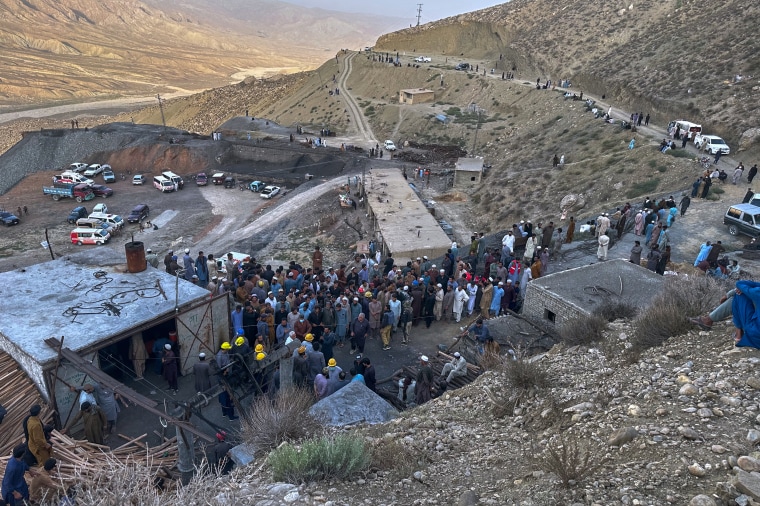
At least 32 bodies were recovered overnight from two coal mines in the Sorange coalfield near Quetta after a methane gas explosion tore through the site. The search for two more miners continued on Friday, an official told Dawn.

The explosion took place on Thursday at a private coal mine in the Sorange coalfield, about 30 kilometres northeast of Quetta. The methane gas blast set off a fire, caused the mine to collapse, and also affected a nearby mine.

Chief Inspector of Mines Balochistan Muhammad Atif told Dawn that 34 miners were inside the two mines at the time of the explosion. He said that so far 32 bodies had been recovered from both mines, and that the operation to recover the remaining two miners was continuing in the mine where the explosion originally took place.

Officials said the explosion happened on Thursday afternoon while 24 miners were working around 4,000 feet underground in the first mine. A fire broke out soon after the blast, causing parts of the mine structure to collapse. The sound of the explosion was heard across a wide area of Sorange.

A second, nearby mine was also badly affected. Twelve miners were working inside this mine when the explosion occurred. Mining engineers and workers built alternative routes to reach both affected mines, but large amounts of methane gas along with the ongoing fire made it extremely difficult to reach the bodies and the miners still trapped deep underground.

Provincial Minister for Mines and Minerals Mir Shoaib Nosherwani announced that the provincial government will pay Rs500,000 in compensation to the family of each miner who died, and Rs300,000 to every injured worker. He said an inquiry into the incident would also be carried out.

This is not the first such tragedy in the region. In June, three people were injured when explosive material used in mining accidentally went off in Quetta division’s Khanuzai area. In April, at least five coal miners were killed in two separate accidents in the Bolan and Duki coalfield areas.

Meanwhile, Khyber Pakhtunkhwa’s Shangla district is mourning the loss of 28 young coal miners who died in the blast, including 23 residents of a single village, Mian Kaly. The Shangla Coal Mine Workers Association said that almost every household in Mian Kaly is now grieving the loss of a family member.

Abid Yaar, president of the association, said Mian Kaly has become the centre of repeated coal mine tragedies. He said that of the 28 deceased workers from Shangla district, 23 were from Mian Kaly, also known as Pir Abad, two were from Kana, and one each came from Bada and Gata Bely Baba.

He said the victims were between 17 and 25 years old, and many belonged to the same families, being cousins or close relatives. He added that several of the dead were orphans whose fathers had also died in earlier coal mine accidents.

Yaar alleged that the tragedy was caused by negligence on the part of the mine administration and a lack of basic safety measures. He claimed there was no proper ventilation system in the government run mine, which led to the deadly gas explosion.

He said this was not just an accident but a lifelong trauma for the families, orphans, widows and mothers who lost their loved ones. He said these young men had gone to work in the mine only to earn a living and support their families back home.

He also said that Shangla lacks factories and other skilled job opportunities, which forces young people to risk their lives in dangerous coal mines just to make ends meet.

Family members of the victims criticised the government for failing to arrange ambulances to transport the bodies home. They said they had to bring the remains back in a van at their own expense. According to the Shangla administration, one body arrived on Friday evening, with the rest expected to arrive later that night and early Saturday morning. Three of the miners who died in the tragedy were brothers.
Similar Posts

  • |

    False rape report in Rawalpindi lands two in Polic…

    RAWALPINDI: A woman and a man have been booked by police in Rawalpindi after an alleged rape report was found to be fabricated, with the woman reportedly admitting that she made the accusation at the behest of another person. According to police, Assistant Sub-Inspector Rizwan Awan told Dhamial police station that an emergency helpline 15 call had been received from Waqar Khan, who claimed that a woman had been raped at Banni Stop. However, when police arrived, the caller was not present and his mobile phone was switched off. At the location, officers found a woman who introduced herself as Shahana Kausar. She initially alleged that a man named Shahid, who lived near Banni Stop and was known for helping people in need, had sexually assaulted her. She told police that she had approached Shahid seeking assistance. According to her account, he allegedly took her inside his house, where no one else was present, placed a pistol on a table and sexually assaulted her. She further claimed that he later gave her his phone number and asked her to contact him the following day. The woman said she subsequently asked Bykea rider Waqar Khan, who had accompanied her to Shahid’s residence, to contact emergency services. Police, however, found inconsistencies in her account and launched an inquiry. During questioning by a female police official, the woman reportedly disclosed that her real name was Musarrat Ghafoor. Police said she eventually admitted that no rape had occurred and that she had fabricated the allegation against Shahid at the direction of a person identified as Raja Riasat. She also admitted that Waqar had been asked to make the emergency call. Police have booked the two individuals for allegedly providing false information and making serious false allegations. Further investigation is under way to determine the motive behind the fabricated report and the role of others involved.

  • | |

    Freedom greatest blessing, says LHC justice at Ind…

    RAWALPINDI: Senior Justice of the Lahore High Court Rawalpindi Bench, Sadaqat Ali Khan, has described freedom as the greatest blessing and called on citizens to contribute positively to Pakistan’s progress by following the vision and principles of Quaid-e-Azam Muhammad Ali Jinnah. He was speaking at a grand Independence Day ceremony held at the premises of the Lahore High Court ( LHC) Rawalpindi Bench, attended by Justice Mirza Waqas Rauf, retired judges, senior lawyers and court officials. The ceremony began with a guard of honour for Justice Sadaqat Ali Khan, who later hoisted the national flag alongside fellow judges. Senior judicial officers, representatives of the legal community and other officials also participated in the event. Addressing the gathering, Justice Sadaqat Ali Khan said Pakistan’s independence was achieved through immense sacrifices by the Muslims of the subcontinent under the leadership of Quaid-e-Azam Muhammad Ali Jinnah. He said Independence Day was not merely a celebration of freedom but also a reminder of the determination and struggle that led to the creation of Pakistan. He paid tribute to the heroes who sacrificed their lives and resources for the country’s independence, saying their sacrifices should inspire the nation to work for Pakistan’s development and prosperity. The senior judge stressed that every citizen has a responsibility to play a constructive role in strengthening the country and advancing the ideals envisioned by Quaid-e-Azam.

  • | |

    Fresh monsoon spell to lash Pakistan from August 1…

    ISLAMABAD: Pakistan is set to receive another spell of monsoon rainfall from August 13 to 15, with the upper and central parts of the country expected to experience rain, thunderstorms and occasional heavy downpours. The Pakistan Meteorological Department said on Wednesday that monsoon currents were entering the upper parts of the country while a westerly wave was also influencing the weather system. Rain and thunderstorms are expected across parts of Kashmir and Gilgit-Baltistan. Several districts, including Neelum Valley, Muzaffarabad, Rawalakot, Bagh, Mirpur, Diamir, Astore, Skardu, Hunza and Gilgit, are likely to receive rainfall. Several areas of upper Khyber Pakhtunkhwa are also expected to experience showers. The affected districts include Dir, Chitral, Swat, Kohistan, Malakand, Shangla, Mansehra, Abbottabad, Galiyat, Peshawar, Nowshera, Mardan, Swabi and Haripur. In northeastern Punjab, rain is expected from the night of August 12 through August 15. Murree, Sialkot, Narowal, Gujrat, Gujranwala, Lahore, Kasur, Sheikhupura and Nankana Sahib are among the areas likely to receive showers. The weather system is also expected to affect Islamabad, Rawalpindi and the Pothohar region from the night of August 13 to August 15. The Met Office has forecast rain, strong winds and thunderstorms, with isolated heavy falls. Other parts of Punjab, including Sargodha, Faisalabad, Jhang, Toba Tek Singh, Sahiwal, Bahawalpur and Dera Ghazi Khan, are also likely to receive rainfall between August 12 and 15. Parts of Balochistan, including Zhob, Barkhan and Musakhel, may also experience showers. In Sindh, partly cloudy to cloudy conditions are expected in southeastern and coastal areas. Tharparkar, Umerkot and Sanghar may receive rain and thunderstorms on August 12 and 13, while hot and humid conditions are expected elsewhere in the province. The Met Office has warned of urban flooding in low-lying areas of Islamabad, Rawalpindi, Mardan, Swabi, Gujranwala, Gujrat, Sialkot and Lahore. There is also a risk of landslides in vulnerable mountainous areas of upper KP, Gilgit-Baltistan, Murree, Galiyat and Kashmir. Authorities have urged residents and visitors in these areas to remain cautious. Tourists have been advised to take extra care while travelling to mountainous regions during the wet spell. Farmers have also been asked to plan agricultural activities according to the changing weather conditions. According to the National Disaster Management Authority, 155 people have died and 460 have been injured in rain-related incidents during the ongoing monsoon season.

  • | |

    Punjab CNF seizes 24.7 tonnes of narcotics worth R…

      Lahore, August 4, 2026: The Punjab Counter Narcotics Force (CNF) has intensified its crackdown on drug trafficking across the province, achieving significant success in recent intelligence-led operations. The campaign is being carried out under the special directives of Punjab Chief Minister Maryam Nawaz Sharif as part of the government’s commitment to building a “Drug-Free, Healthy and Safe Punjab.” Over the past two weeks, the CNF conducted 85 intelligence-based operations across the divisions of Lahore, Dera Ghazi Khan, Rawalpindi, Gujranwala, Faisalabad, Bahawalpur and Sargodha. These coordinated raids targeted major drug trafficking networks operating in different parts of the province. The operations resulted in the arrest of 93 suspected drug traffickers, while authorities recovered approximately 296 kilograms of narcotics with an estimated market value of more than Rs. 53.4 million. Officials described the operations as a major step toward curbing the illegal drug trade and improving public safety. The seized narcotics included a wide range of illegal substances such as hashish, opium, cannabis (weed), crystal meth (Ice), poppy straw, cocaine, heroin and five litres of illicit liquor. In addition to narcotics, the CNF recovered a significant cache of weapons from the suspects. These included 13 pistols, two sub-machine guns (SMGs), four rifles and seven drones that investigators believe were being used to facilitate criminal activities and drug distribution. Director General of the Punjab Counter Narcotics Force, Commander Brigadier Mazhar Iqbal, said the Force’s success should not only be measured by the quantity of drugs confiscated but also by its ability to dismantle organised drug trafficking networks across Punjab. He noted that the CNF continues to rely on modern intelligence gathering, professional expertise and coordinated operational planning to identify and eliminate criminal groups involved in the narcotics trade. He further highlighted the Force’s overall performance since it became operational in August 2025. According to the Director General, the Punjab CNF has recovered a cumulative 24.7 tonnes of narcotics valued at more than Rs. 2.23 billion. He described these achievements as evidence of the provincial government’s zero-tolerance policy against narcotics and the effectiveness of its law enforcement strategy. Commander Brigadier Mazhar Iqbal also credited the Force’s progress to close coordination among various law enforcement agencies, which has strengthened efforts to combat drug trafficking and disrupt criminal organisations operating throughout the province. Reaffirming the CNF’s commitment, the Director General said the Force will continue to launch vigorous and indiscriminate operations against drug dealers and traffickers. He stressed that intelligence-driven policing, enhanced operational capabilities and sustained enforcement efforts will remain central to achieving the government’s vision of a province free from the menace of narcotics. Punjab authorities have reiterated that the fight against drugs remains a top priority, emphasizing that continued action against traffickers is essential to protecting communities, safeguarding young people and ensuring a healthier and safer future for the province.

  • | |

    Ishaq Dar, Turkish foreign minister discuss region…

      ISLAMABAD: Deputy Prime Minister and Foreign Minister Ishaq Dar held a telephone conversation with Turkish Foreign Minister Hakan Fidan on Sunday night, during which the two sides discussed recent developments in the region and reaffirmed their commitment to strengthening cooperation on issues of mutual interest. According to Pakistan’s Ministry of Foreign Affairs, the two foreign ministers agreed that dialogue and diplomacy remained the most effective means of addressing regional challenges and promoting peace and stability. The conversation took place as Pakistan continues its diplomatic engagement with regional and international partners amid the ongoing conflict involving the United States, Israel and Iran. Islamabad has increasingly emerged as an important diplomatic channel in efforts aimed at reducing tensions and encouraging negotiations between the parties. Dar has recently held discussions with several senior diplomats regarding the rapidly changing regional situation. Last week, he met US Chargé d’Affaires Natalie Baker, British High Commissioner to Pakistan Jane Marriott, Chinese Ambassador Jiang Zaidong and Pakistan’s Ambassador-designate to Sweden Ahmed Amjad Ali. During these meetings, the foreign minister exchanged views with the diplomats on regional developments and Pakistan’s efforts to contribute to peace and stability. Dar emphasized that the Islamabad Memorandum of Understanding must be implemented in both letter and spirit, describing this as the most appropriate way forward. He also reiterated Pakistan’s commitment to regional peace, security and diplomatic engagement. Dar recently held a joint press conference with Norwegian Foreign Minister Espen Barth Eide, who praised Pakistan’s role during the US-Iran conflict. Eide particularly acknowledged the efforts of Prime Minister Shehbaz Sharif, Ishaq Dar and Chief of Defence Forces Field Marshal Asim Munir during delegation-level discussions held in Islamabad. The Norwegian foreign minister said Pakistan had taken on a significant responsibility by offering Islamabad not only as a venue for negotiations but also as a facilitator between Washington and Tehran. Eide described Pakistan’s diplomatic efforts as a service to the international community and expressed strong support for the role Islamabad had assumed since the conflict began on February 28. The latest diplomatic contacts also come against the backdrop of a major regional security development: the signing of the Makkah Joint Defence Agreement by Pakistan, Saudi Arabia and Turkiye on August 7. The trilateral agreement has been described as a defensive security framework designed to strengthen collective deterrence, expand military cooperation and contribute to regional stability. The agreement has attracted considerable attention because of the growing security challenges in the region and the evolving strategic relationships among Pakistan, Saudi Arabia and Turkiye. The Makkah agreement follows the Strategic Mutual Defence Agreement signed between Pakistan and Saudi Arabia last year. That pact established a stronger bilateral security relationship and stated that aggression against either country would be regarded as aggression against both. The latest developments indicate that Pakistan is seeking to strengthen diplomatic and security partnerships while maintaining its stated preference for dialogue and peaceful resolution of regional disputes. Dar’s conversation with Fidan further reflects the close relationship between Islamabad and Ankara, particularly on regional security and diplomatic matters. Both countries have consistently emphasized the importance of cooperation, consultation and peaceful negotiations in addressing regional crises. Their latest discussion is expected to contribute to continued coordination as tensions across the region remain high.

  • | |

    Petrol price cut in Pakistan, diesel gets more exp…

    The government has announced a slight reduction in the price of petrol while increasing the price of high-speed diesel in Pakistan. The new petroleum prices will take effect from August 12, 2026, according to an official notification. Under the latest revision, the price of petrol has been reduced by Rs1.70 per litre. Following the decrease, the new petrol price has been set at Rs325.92 per litre. At the same time, consumers using diesel will face a price increase. The government has raised the price of diesel by Rs1.39 per litre, taking the new rate to Rs382.25 per litre. The notification was issued by the Ministry of Energy following the latest price recommendations under the petroleum pricing mechanism. The Oil and Gas Regulatory Authority (OGRA) determines petroleum price calculations under the mechanism established by the federal government. The latest adjustment means petrol consumers will receive a modest reduction, while diesel users will have to pay more from August 12. Before the latest revision, petrol was priced at Rs327.62 per litre, while diesel was available at Rs380.86 per litre. The new rates therefore represent a Rs1.70 reduction in petrol and a Rs1.39 increase in diesel. New petrol and diesel prices in Pakistan According to the notification, the revised rates are: Petrol: Rs325.92 per litre, down Rs1.70 Diesel: Rs382.25 per litre, up Rs1.39 The revised prices will apply from August 12, 2026, under the government’s petroleum pricing mechanism. Petroleum prices remain closely watched in Pakistan because changes in fuel costs can affect transportation expenses and the prices of goods and services. Diesel prices are particularly important for commercial transport, agriculture and other sectors that depend heavily on diesel-powered machinery and vehicles. The latest decision comes as consumers continue to monitor fuel prices amid changing international oil market conditions and domestic pricing adjustments. For motorists, the petrol reduction provides limited relief at fuel stations, while the diesel increase could add to operating costs for transporters and businesses. The government’s latest notification has therefore resulted in a mixed adjustment for consumers, with petrol becoming slightly cheaper and diesel becoming more expensive. The new Pakistan petrol price of Rs325.92 per litre and diesel price of Rs382.25 per litre will remain applicable from August 12, subject to any subsequent government revision under the petroleum pricing mechanism.

Leave a Reply

Your email address will not be published. Required fields are marked *