pakistan goods transporters
| |

Pakistan goods transporters association declares i…


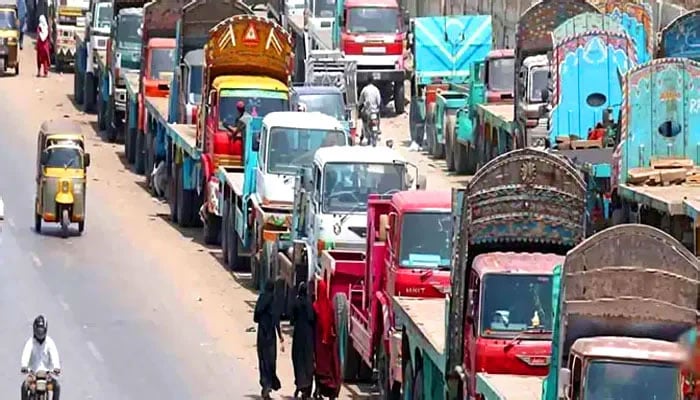
The Pakistan Goods Transporters Association has raised serious concerns over the volatile and unpredictable daily adjustments in petroleum prices, stating that such frequent fluctuations make it impossible for the transport sector to continue operations smoothly. In a press conference held in Lahore, association officials, led by President Nabeel Mahmood Tariq, articulated a series of demands and grievances that have been mounting over recent months, warning that without immediate government intervention, the entire logistics and supply chain network could face severe disruption.

Addressing the media alongside other senior office-bearers of the All Pakistan Goods Transporters Association, Nabeel Mahmood Tariq emphasized that the transportation industry is the backbone of the national economy, responsible for moving essential commodities, industrial raw materials, and consumer goods across the length and breadth of the country. However, he argued that the current pricing mechanism for petroleum products—which has seen almost daily revisions—has created an environment of extreme uncertainty for fleet operators. Unlike larger corporate entities, most truck owners and small transport companies operate on thin profit margins, and without a stable fuel pricing framework, they are unable to quote competitive rates to clients or plan their operational budgets effectively. Tariq pointed out that many transporters have already started grounding their vehicles, as each trip now carries the risk of financial loss if fuel prices rise unexpectedly mid-journey.

Beyond fuel prices, the association president laid out a comprehensive list of demands aimed at reducing the financial burden on the sector. First and foremost, he called for an immediate end to unnecessary customs checking at various inter-provincial checkpoints. According to Tariq, these intrusive and repetitive inspections not only cause long delays—sometimes stretching into hours—but also open the door to harassment and bribery, which further inflate the cost of doing business. He urged the federal and provincial governments to streamline customs procedures and adopt a more efficient, technology-driven system that would expedite the movement of goods without compromising security or revenue collection.

Another major point of contention raised by Tariq was the recent increase in toll taxes on highways and motorways. He demanded that this hike be rolled back completely, arguing that transporters are already struggling with rising maintenance costs, spare part prices, and tyre rates. The additional toll burden, he said, is simply unsustainable and forces many operators to take longer, less safe alternative routes, which ultimately hurts the overall efficiency of freight movement.

Turning his attention to provincial policies, particularly in Punjab, Tariq called for the establishment of new, modern truck terminals across the province. He noted that existing truck stands and loading points are outdated, overcrowded, and lack basic amenities for drivers and helpers. New truck yards, equipped with proper parking, resting areas, workshops, and loading/unloading facilities, would not only improve working conditions but also reduce traffic congestion in urban centers. He also strongly condemned the 300 percent increase in token tax imposed on commercial vehicles in Punjab, labeling it as punitive and counterproductive. He demanded that this excessive tax hike be withdrawn immediately, asserting that it disproportionately affects small owner-operators who form the majority of the association’s membership.

In a significant announcement, Nabeel Mahmood Tariq declared that the association fully supports the wheel-jam strike (hunger strike) called for August 8, which has been organized by various transport unions across the country to pressure the government into addressing these long-standing issues. He clarified that this is not a political move but a last-resort measure to draw attention to the existential crisis facing the transport industry. He warned that if the government fails to respond positively before that date, thousands of trucks, trailers, and tankers will park on the roads, effectively paralyzing the movement of food, medicine, fuel, and industrial goods. Such a strike, he cautioned, would have catastrophic consequences for an already fragile economy, leading to shortages, price hikes, and factory closures.

Concluding his address, Tariq appealed to Prime Minister Shehbaz Sharif and the chief ministers of all provinces to personally intervene and hold urgent consultations with transport representatives. He reiterated that the industry is not asking for subsidies or charity, but merely for a predictable policy environment, fair taxation, and the elimination of corrupt practices at checkpoints. He expressed hope that the government would act wisely and avert a crisis that benefits no one except speculators and hoarders. The press conference ended with a unanimous resolution passed by the association leaders, vowing to continue their struggle peacefully but firmly until all their legitimate demands are met. The coming days, they warned, will be decisive for the future of Pakistan’s transport sector and, by extension, its entire supply chain.

Similar Posts

  • |

    UN warns Afghanistan’s child malnutrition crisis deepens

    Afghanistan is facing a rapidly worsening malnutrition emergency as severe funding cuts leave millions without life-saving assistance, the United Nations has warned. Speaking from Kabul, the World Food Programme’s (WFP) Afghanistan Director John Aylieff said the country’s nutrition crisis is escalating at an alarming pace, with growing numbers of severely malnourished children reaching health facilities too late to receive effective treatment. He said child wasting, the deadliest form of malnutrition, has now reached critical levels in nearly one-third of Afghanistan’s provinces. According to the WFP, ongoing conflict, disruptions to trade, the return of thousands of Afghan migrants from neighbouring countries, and shrinking international aid have combined to create an unprecedented humanitarian emergency. The UN official said last year recorded the sharpest annual increase in malnutrition cases, while the situation has deteriorated even further in 2026. Children under the age of two account for around 80 percent of the most severe cases, highlighting the devastating impact on the country’s youngest and most vulnerable population. Aylieff said the WFP has only enough resources to provide treatment to one out of every seven acutely malnourished women and children this year. The remaining six are forced to leave without assistance because of a severe shortage of funds. He warned that the cries of starving children in Afghan health centres reflect a preventable tragedy that could claim countless more lives if emergency funding is not secured. The humanitarian agency also expressed concern that widespread hunger could fuel migration, instability and extremism, stressing that a stable Afghanistan remains important for regional security. Millions of Afghans have also returned from neighbouring countries, including Pakistan and Iran, over the past three years, placing additional pressure on already overstretched resources. Although this year’s harvest has improved, the gains have been overshadowed by the country’s worsening economic and humanitarian challenges. The WFP estimates that nearly 14 million Afghans are currently experiencing acute hunger. However, funding shortages have limited food assistance to only a small fraction of those in need, while preventive food distribution programmes in high-risk areas have been suspended.

  • |

    4.5-magnitude quake jolts Pakistan’s coast

      A 4.5-magnitude earthquake jolted Pakistan’s coastal region on Monday morning, with tremors recorded near Keti Bandar, according to the Pakistan Meteorological Department (PMD). The seismic activity occurred at around 8:31am, with the earthquake originating at a depth of approximately 40 kilometres beneath the surface. The PMD located the epicentre in the sea, around 156 kilometres southwest of Keti Bandar. The tremors were felt in parts of the coastal belt, prompting residents to remain alert. However, there were no immediate reports of casualties, injuries or significant damage to buildings and other infrastructure following the earthquake. The depth and offshore location of the earthquake likely reduced its impact on populated areas compared with a shallower quake occurring closer to land. Nevertheless, residents in coastal communities may have felt noticeable shaking depending on their distance from the epicentre. Seismic activity is not unusual in and around Pakistan’s coastal belt, which lies near tectonically active zones. Earthquakes in the region can occur beneath the Arabian Sea and along nearby fault systems. The meteorological department continues to monitor seismic activity and may issue further information if additional tremors or related developments are recorded. Authorities have also advised people to remain calm and follow official updates in the event of further seismic activity. No tsunami warning or major coastal emergency was reported in connection with the earthquake at the time of the initial report.

  • | |

    Rain inundates homes, shops in Rawalpindi

    Heavy rain in Rawalpindi has caused flooding in several low-lying areas, creating difficulties for residents. Water entered homes in Sadiqabad and Dhoke Elahi Bakhsh. Residents faced problems as rainwater accumulated inside residential areas. Several major roads were also affected. Rainwater collected on Murree Road, Rawal Road and Dhoke Khaba, disrupting traffic and making movement difficult. The situation became more difficult as WASA drainage teams had yet to reach some affected areas. Residents were waiting for authorities to clear the accumulated water. Water also entered shops in some areas, causing inconvenience to traders and residents. Meanwhile, the rain in Rawalpindi and Islamabad later stopped. Following the end of the rainfall, the water level in Nullah Lai began to fall. At Kattarian, the water level dropped to around 14 feet. At the Gawalmandi Bridge, the water level was recorded at around 16 feet. The rainfall has highlighted the vulnerability of low-lying areas in Rawalpindi to urban flooding. Residents have called for timely drainage operations to prevent rainwater from entering homes and businesses. The weather department has also forecast rain at some places in Punjab, Balochistan and Khyber Pakhtunkhwa. Authorities are expected to remain alert in areas vulnerable to flooding and water accumulation.

  • | |

    Whoopi Goldberg shares the secret behind her bigge…

    Whoopi Goldberg has revealed an unexpected secret behind some of the biggest roles of her career. The acclaimed actress recently explained that several of her most memorable movies came after other actors had turned the projects down. Speaking on the podcast Baby, This Is Keke Palmer, Goldberg, 70, reflected on how she landed the lead role in the 1992 comedy Sister Act. The actress revealed that the movie was originally written with Bette Midler in mind. “They wrote that for Bette Midler,” Goldberg explained, according to reports from PEOPLE and Entertainment Weekly. Midler ultimately passed on the project, opening the door for Goldberg to take on the role that would become one of her career-defining performances. (People.com⁠) How Goldberg found major opportunities Goldberg explained that she eventually developed a strategy for finding roles that other actors had rejected. She asked her agents to send her scripts that had already been turned down by other performers. That approach proved surprisingly successful. In addition to Sister Act, Goldberg landed roles in movies that had initially been developed with other stars in mind. Burglar, for example, had originally been intended for Bruce Willis, while Jumpin’ Jack Flash was initially associated with Shelley Long. (People.com⁠) Goldberg suggested that her experiences were partly connected to the limited opportunities available to Black actresses at the time. Rather than allowing those barriers to stop her, she looked for projects that had been passed over and found ways to make them her own. Sister Act became a career highlight Goldberg eventually transformed Sister Act into a showcase for her comedy and musical talents. She played Deloris Van Cartier, a nightclub singer who enters witness protection and is hidden in a convent. The film became a major success following its 1992 release, with Goldberg’s performance becoming closely associated with the movie. She returned for the 1993 sequel, Sister Act 2: Back in the Habit. (D23⁠) Midler has previously discussed why she rejected the role. She explained that she was concerned her audience would not want to see her wearing a nun’s habit. The decision ultimately gave Goldberg the opportunity to create an iconic character of her own. (People.com⁠) Goldberg’s Hollywood lesson Looking back, Goldberg’s career offers an unusual lesson about opportunities. Some of her most recognizable performances came from projects that initially seemed destined for someone else. Her story also highlights how persistence can create unexpected breakthroughs. Instead of waiting for Hollywood to offer her the obvious choices, Goldberg searched for opportunities others had overlooked. Decades later, Sister Act remains one of her signature films, proving that sometimes the role that was written for someone else can become the performance audiences remember forever.

  • | |

    Acting President of Azad Kashmir urges election co…

    Acting President of Azad Jammu and Kashmir (AJK) Chaudhry Latif Akbar has sent two letters to the Election Commission of Azad Jammu and Kashmir, demanding action over alleged security failures and irregularities reported during the polling process. In his letters, Chaudhry Latif Akbar raised serious concerns regarding the arrangements made for election security and claimed that effective security measures were not provided at several polling stations. He called for a thorough investigation into the incidents reported during the voting process and urged the Election Commission to take appropriate legal action against those found responsible. The Acting President stated that polling agents at various locations were allegedly prevented from entering polling stations, which he described as a serious violation of the electoral process. According to him, the presence of polling agents is essential to ensure transparency and maintain public confidence in elections. Chaudhry Latif Akbar further requested an inquiry into reports of firing incidents, alleged interference in the polling process, and claims that some voters were deprived of their right to cast their votes. He emphasized that all such allegations should be investigated impartially to determine the facts and ensure accountability. In one of his letters, the Acting President highlighted delays in the start of polling at Koomi Kot and Jhandgran areas. He stated that voting began late in these locations and requested that polling time be extended in the affected areas to compensate for the lost time and allow voters a fair opportunity to exercise their democratic right. He also referred to an alleged armed attack on Mumtaz Hussain Naqvi, calling for an immediate investigation into the incident. Chaudhry Latif Akbar demanded that those responsible for the attack be identified and legal proceedings be initiated against them. The Acting President stressed that all incidents reported during the election process must be examined through transparent investigations. He called upon the Election Commission to ensure that no individual or group involved in electoral violations escapes accountability. In his communication with the Election Commission, Chaudhry Latif Akbar reiterated the importance of maintaining a free, fair, and peaceful electoral environment. He stated that public trust in democratic institutions depends on ensuring that elections are conducted without intimidation, interference, or unlawful practices. The letters come amid political tensions surrounding the election process in Azad Jammu and Kashmir, where various political parties have raised concerns over alleged irregularities and security issues. Opposition parties have also questioned aspects of the polling arrangements, while authorities have maintained that necessary measures were taken to conduct peaceful elections. Chaudhry Latif Akbar’s demands reflect concerns about transparency and fairness in the electoral process. He emphasized that protecting voters’ rights and ensuring equal participation should remain the top priority of election authorities. He concluded by urging the Election Commission to conduct a comprehensive review of all reported incidents, publish the findings transparently, and take strict action against anyone found involved in misconduct. According to him, only a credible and impartial investigation can strengthen public confidence and ensure that the democratic process reflects the genuine will of the people.

  • |

    Gold prices rise for third straight session, hit two-month high

    Gold prices extended their upward momentum on Tuesday, climbing for a third consecutive session as investors turned their attention to key US inflation figures that could influence expectations for the Federal Reserve’s next interest-rate decision. The precious metal continued to attract buying interest amid renewed safe-haven demand and growing expectations that US monetary policy could become less restrictive if economic data point to a cooling economy. Spot gold gained around 1% to reach $4,432.74 per ounce by 0217 GMT, its highest level since June 5. US gold futures also advanced, rising 1.7% to $4,492.60 per ounce. Market analysts said several factors were contributing to the latest rally, including investors who had stayed on the sidelines during gold’s earlier decline and are now returning to the market as prices recover. IG market analyst Tony Sycamore said the move was partly being driven by a fear of missing out among investors who had failed to take advantage of the previous decline toward the $4,000 level. He also pointed to short-covering by speculative traders and renewed demand for gold as a safe-haven asset. Sycamore added that gold could have further room to advance over the medium term, potentially opening the way for a stronger recovery toward the $5,000-per-ounce mark. US inflation data in focus Investors are now closely watching the latest US inflation figures, with the consumer price index (CPI) scheduled for release on Wednesday and producer price data due on Thursday. The reports are expected to provide important clues about the future direction of US interest rates. Markets have already reduced expectations for further monetary tightening following weaker-than-expected US employment data released last week. The latest jobs figures raised concerns about the strength of the US economy and encouraged traders to reassess expectations for the Federal Reserve’s policy path. At its July meeting, the Federal Reserve left interest rates unchanged, although three policymakers dissented and supported an increase. The split among officials highlighted uncertainty over the appropriate direction of monetary policy as the central bank continues to balance inflation risks against signs of economic weakness. Gold generally benefits from a lower-interest-rate environment because the metal does not provide interest or other regular income. When bond yields and interest rates decline, the opportunity cost of holding non-yielding bullion becomes less significant, potentially increasing its appeal among investors. Fawad Razaqzada said that if incoming economic data continue to indicate a slowing US economy without a significant acceleration in inflation, financial markets could further reduce expectations for tighter monetary policy. Such a development could weigh on the US dollar while creating a more supportive environment for gold, he said. Geopolitical tensions add to safe-haven demand Geopolitical developments also remained an important factor in precious-metals markets. US President Donald Trump responded to Iran’s conditions for a potential peace agreement with demands of his own, including calls for compensation over people killed during wars, attacks and protests. The exchange has added uncertainty to diplomatic efforts aimed at resolving the conflict and reopening the Strait of Hormuz, a strategically important waterway for global energy shipments. Any prolonged disruption or renewed tensions around the Strait could increase concerns over global energy supplies and economic stability. Such uncertainty often encourages investors to seek traditional safe-haven assets, including gold. Analysts are therefore watching both economic indicators and geopolitical developments for signs that could influence bullion prices in the coming sessions. Other precious metals also gain Gold was not the only precious metal to advance during Tuesday’s trading. Spot silver increased by 0.9% to $66.30 per ounce, maintaining its recent strength. Platinum also moved higher, gaining 0.7% to $1,765.26 per ounce. Meanwhile, palladium rose 0.8% to $1,394.00 per ounce. With US inflation figures due later in the week, traders are expected to remain cautious while assessing whether the latest economic data will reinforce expectations for a shift toward easier monetary policy. For gold, a combination of softer US economic indicators, a potentially weaker dollar, lower interest-rate expectations and continued geopolitical uncertainty could provide additional support to prices in the near term.

Leave a Reply

Your email address will not be published. Required fields are marked *