45magnitude quake jolts
|

4.5-magnitude quake jolts Pakistan’s coast


A 4.5-magnitude earthquake jolted Pakistan’s coastal region on Monday morning, with tremors recorded near Keti Bandar, according to the Pakistan Meteorological Department (PMD).

The seismic activity occurred at around 8:31am, with the earthquake originating at a depth of approximately 40 kilometres beneath the surface. The PMD located the epicentre in the sea, around 156 kilometres southwest of Keti Bandar.

The tremors were felt in parts of the coastal belt, prompting residents to remain alert. However, there were no immediate reports of casualties, injuries or significant damage to buildings and other infrastructure following the earthquake.

The depth and offshore location of the earthquake likely reduced its impact on populated areas compared with a shallower quake occurring closer to land. Nevertheless, residents in coastal communities may have felt noticeable shaking depending on their distance from the epicentre.

Seismic activity is not unusual in and around Pakistan’s coastal belt, which lies near tectonically active zones. Earthquakes in the region can occur beneath the Arabian Sea and along nearby fault systems.

The meteorological department continues to monitor seismic activity and may issue further information if additional tremors or related developments are recorded. Authorities have also advised people to remain calm and follow official updates in the event of further seismic activity.

No tsunami warning or major coastal emergency was reported in connection with the earthquake at the time of the initial report.


Similar Posts

  • | |

    Heavy rains drench Islamabad, Rawalpindi, Lahore

    ISLAMABAD: Heavy rain lashed Islamabad and Rawalpindi, while several parts of Lahore also received showers, providing relief from hot and humid weather. The rainfall lowered temperatures in many areas, although it also caused traffic disruptions and water accumulation on some roads. The downpour began in the morning and continued intermittently in the twin cities. Residents experienced cooler weather after several days of warm and humid conditions. In Lahore, rain was reported from different localities, bringing pleasant weather to the provincial capital. According to the Pakistan Meteorological Department (PMD), a weak monsoon system is currently affecting parts of the country. The weather department said the monsoon winds are interacting with a westerly weather system, which is influencing the northern regions and increasing the chances of rainfall. The PMD has forecast that Islamabad, Punjab, Khyber Pakhtunkhwa, Gilgit-Baltistan and Azad Jammu and Kashmir are likely to receive rain at isolated places during the day. Some areas may experience moderate to heavy showers accompanied by gusty winds. The weather department has advised the public to remain cautious during periods of heavy rainfall, particularly in low-lying areas where water may accumulate. Motorists have also been urged to drive carefully on slippery roads and avoid unnecessary travel during intense downpours. Authorities are monitoring the weather situation and have asked relevant departments to stay prepared for any emergencies caused by heavy rain. Citizens have also been encouraged to follow official weather advisories and take precautionary measures where needed.

  • | | |

    Pakistan, Saudi Arabia, Turkiye set for defence de…

    Pakistan, Saudi Arabia and Turkiye are expected to sign a joint defence agreement during a trilateral summit in Saudi Arabia, according to media reports. The proposed agreement comes as tensions continue to rise across the Middle East amid the ongoing conflict involving the United States and Iran. The three countries are expected to discuss regional security, defence cooperation and efforts to promote stability. Prime Minister Shehbaz Sharif and Chief of Defence Forces Field Marshal Asim Munir arrived in Saudi Arabia on Thursday for a three-day visit. Turkish President Recep Tayyip Erdogan is also expected to join the summit. The Pakistani delegation was received in Jeddah by Makkah Deputy Governor Prince Saud bin Mishaal bin Abdulaziz and Saudi Minister of Environment, Water and Agriculture Abdulrahman Abdulmohsen Al-Fadley. Prime Minister Shehbaz and Field Marshal Munir also performed Umrah during their visit. The Foreign Office said the prime minister’s visit, scheduled from August 6 to 8, would focus on Pakistan-Saudi relations and major regional and international developments. During the visit, Shehbaz is expected to meet Saudi Crown Prince Mohammed bin Salman. Discussions are likely to cover bilateral cooperation, regional security and diplomatic efforts to reduce tensions in the Middle East. Deputy Prime Minister and Foreign Minister Ishaq Dar is also part of Pakistan’s diplomatic engagement in the region. Pakistan has been seeking a diplomatic solution to the conflict involving the United States and Iran. Islamabad has also been calling for dialogue and efforts to prevent the regional conflict from spreading further. The proposed trilateral defence arrangement would bring together three countries with longstanding military and strategic ties. It could also strengthen coordination on regional security at a time of heightened tensions. Pakistan and Saudi Arabia already have a separate mutual defence agreement signed in September 2025. Under that pact, aggression against either country is treated as aggression against both. The agreement further strengthened the two countries’ decades-old defence partnership. Pakistan has traditionally provided Saudi Arabia with military training, advisory support and other defence assistance. Saudi Arabia, in turn, has remained an important economic and financial partner for Pakistan and has provided support during periods of financial pressure. The reported trilateral agreement could expand security cooperation beyond the existing Pakistan-Saudi framework and create closer strategic coordination with Turkiye.

  • |

    China, Indonesia deepen security and economic ties

    JAKARTA: China and Indonesia opened a new round of high-level talks on Friday, with defence cooperation, regional security, political relations and trade expected to dominate discussions as Jakarta seeks to maintain strong ties with Beijing while preserving its relationship with Washington. Chinese Foreign Minister Wang Yi, visiting Jakarta for the first time in two years, met his Indonesian counterpart Sugiono before joining a “2+2” dialogue involving the two countries’ defence ministers. The talks come at a sensitive moment for Southeast Asia, where tensions in the South China Sea, competition between China and the United States and growing economic interdependence are putting pressure on regional governments to carefully balance their relationships with major powers. Wang said the new dialogue mechanism was timely as the world faced increasingly complex challenges. “Unilateralism and hegemonic acts bring serious impact on global cooperation and stability,” he said, adding that China aimed to build cooperation with Indonesia at a high level. Indonesian officials said economic issues and political relations would be among the foreign ministers’ priorities, while China said the discussions would also cover defence cooperation and international and regional affairs. Defence Cooperation Expands Chinese Defence Minister Dong Jun was welcomed with a military honour guard at Indonesia’s defence ministry, where he said the two armed forces had significant room to strengthen cooperation. “The prospects for cooperation between the two militaries are broad,” Dong said, describing the relationship as increasingly effective and higher in quality. Indonesia’s Defence Minister Sjafrie Sjamsoeddin said the countries planned to expand military activities, including joint exercises, officer exchanges and cooperation in the defence industry. He described the move as an important step in strengthening Indonesia’s defence capabilities. The discussions follow a joint naval exercise between China and Indonesia last week that drew attention because of its location east of Taiwan. Taiwan, which Beijing claims as part of China, expressed concern over the exercise. Indonesia’s navy said the activity was routine and noted that it conducts exercises not only with China but also with Japan and the United States. Defence analyst Curie Maharani said the episode highlighted how military diplomacy could serve broader strategic purposes. Indonesia, she said, had gained an important lesson about how major powers can use defence cooperation to project influence. Balancing China and Washington Jakarta’s approach reflects its long-standing “free and active” foreign policy. President Prabowo Subianto has repeatedly said Indonesia intends to remain non-aligned while maintaining friendly relations with all countries, including China and the United States. That balancing act is becoming more complicated as competition between Washington and Beijing intensifies. Indonesia also has differences with China over developments in the South China Sea. Beijing claims almost the entire disputed waterway, while Indonesia has sought to avoid becoming directly involved in broader territorial disputes between China and the Philippines, Malaysia and Vietnam. Jakarta has generally maintained a measured position, prioritising diplomacy and economic cooperation while protecting its own interests. Billions at Stake Economic ties provide another major reason for Indonesia to maintain close relations with Beijing. China contributed $3.9 billion in foreign direct investment to Indonesia during the first half of 2026, according to Indonesian figures. Chinese companies have invested heavily in industries ranging from nickel processing and steel to electric-vehicle batteries. Indonesia possesses the world’s largest nickel reserves, making it strategically important to China’s rapidly expanding electric-vehicle supply chain. Among major investors are Contemporary Amperex Technology, one of the world’s largest electric-vehicle battery makers, and Tsingshan Group, which operates nickel and steel facilities in Indonesia. However, the growing investment relationship has not been free of tension. In May, Chinese companies operating in Indonesia urged Jakarta to introduce more business-friendly policies, arguing that higher taxes and a new nickel pricing formula were increasing costs and threatening investment. The China Chamber of Commerce in Indonesia also complained of what it described as excessive regulation and enforcement, while raising allegations of corruption and extortion. The concerns underline the challenge facing both countries: expanding economic cooperation while managing disagreements over regulation, investment conditions and strategic interests. For Indonesia, Friday’s talks therefore carry significance beyond bilateral diplomacy. Jakarta is trying to strengthen its economy and defence capabilities without becoming overly dependent on either Beijing or Washington. In For China, deeper engagement with Indonesia offers an opportunity to strengthen its influence in one of Southeast Asia’s largest economies while expanding defence and economic partnerships in a strategically important region.

  • |

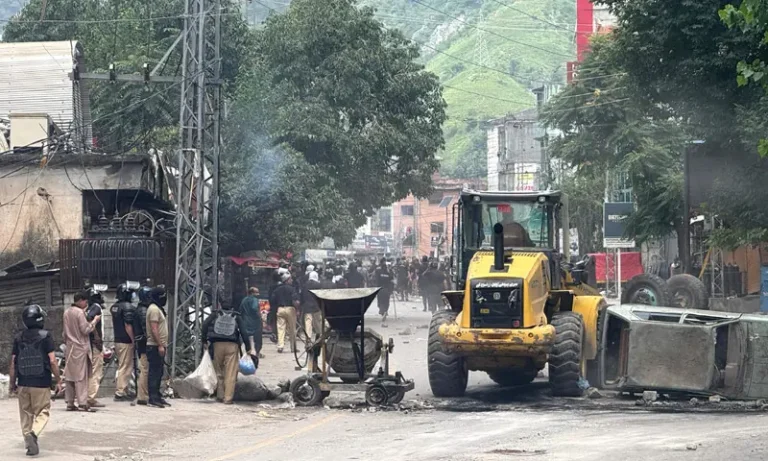
    Flash floods cut off lower Chitral

    Heavy rains have once again triggered flash floods in the Broz and Gumbas Gol streams of Lower Chitral, causing widespread damage and disrupting road connectivity. The powerful floodwaters swept away the remaining section of Gumbas Bridge, further worsening transportation problems in the area. Flood debris covered the Chitral-Peshawar Road, forcing authorities to suspend traffic. A petrol station also suffered damage as floodwaters rushed through the area. The National Highway Authority (NHA) has deployed heavy machinery to clear debris and restore the road for traffic. Meanwhile, flash floods blocked routes in Baroz Gol and Sheedi village, leaving several communities cut off from the main road network. The flooding has also disrupted communications after the main fibre-optic link was damaged, cutting internet services across affected areas. Thousands of residents remain stranded amid difficult conditions, with limited access to food, shelter and communication. The destruction has spread across a large part of Chitral. Several areas, from Sheshi Koh Valley and Drosh town in Lower Chitral to Mastuj in Upper Chitral, have suffered from damaged roads and disrupted connectivity. Authorities are continuing relief and clearance operations as heavy machinery works to reopen key routes and restore access to affected communities.

  • | |

    Former Queen bassist Barry Mitchell dies at 80, le…

    The Queen family is mourning the loss of Barry Mitchell, an early bassist who played an important role during the legendary rock band’s formative years. Mitchell died on August 17, 2026, according to reports, prompting tributes from fans and people connected to Queen. (The Sun⁠) Although Mitchell was not part of Queen’s classic lineup, his contribution came during a crucial period when the band was still finding its sound. He joined Queen in 1970 after original bassist Mike Grose left. The official Queen live archive confirms that Mitchell played the next 11 shows during the band’s earliest performing days. (Queen Online⁠) At the time, Queen consisted of Freddie Mercury, Brian May, Roger Taylor and Mitchell on bass. The group had not yet become the worldwide rock phenomenon fans know today. John Deacon would join later in 1971 and complete the classic lineup. Mitchell’s time with Queen was brief. He remained with the band for around six months before leaving in early 1971. Reports say he played approximately 13 performances, mostly in the United Kingdom. (The Sun⁠) Even though his time in the group was short, Mitchell was present while some of Queen’s earliest songs were being developed. His period with the band included work around tracks such as “Liar,” “Son and Daughter” and “Keep Yourself Alive,” giving him a unique connection to the band’s beginnings. (Queen Vault⁠) Queen’s official archivist Greg Brooks confirmed the sad news and remembered Mitchell warmly. He described the former bassist’s stories about Queen’s early years as fascinating and said he would be greatly missed. (Edinburgh Live⁠) For longtime Queen fans, Mitchell represented a piece of the band’s history that is often overlooked. Before Queen filled stadiums and produced some of rock’s most famous albums, the group was a young band playing small venues and experimenting with its musical identity. Mitchell later returned to music after spending some time away from the industry. He also remained connected with the Queen fan community, attending conventions and sharing memories from his time alongside Mercury, May and Taylor. (The Sun⁠) His death marks another poignant moment for fans looking back at Queen’s remarkable journey. While Barry Mitchell may not have been part of the lineup that eventually conquered the world, he was there when the story was only beginning. His contribution lasted just months, but his place in Queen’s history will remain part of the band’s extraordinary early chapter.

  • | | |

    Pakistani leaders praise Makkah Agreement as histo…

    Federal ministers, ministers of state, cabinet members and parliamentarians have welcomed the Makkah Agreement between Pakistan, Türkiye and Saudi Arabia. They described the agreement as a major step towards peace, security and stability in the region. The leaders said the agreement reflects a shared vision among the three countries. They said it could strengthen cooperation and improve regional security. Federal Minister Ahsan Iqbal said Pakistan had achieved a historic diplomatic success. He said the defence agreement could help open a new chapter of peace and stability in the region. Information Minister Attaullah Tarar also welcomed the agreement. He described it as a milestone for peace and security. He said the people had welcomed the development. Federal Minister Owais Leghari said the defence agreement between Pakistan, Saudi Arabia and Türkiye was a positive development. He said it would help strengthen the security of the three countries and contribute to peace in the region. Tariq Fazal Chaudhry said the agreement reflected the vision of the leadership of the three countries. He said it would further strengthen bilateral and trilateral relations. He added that the agreement could also promote unity among Muslim countries. He described it as a new source of hope for the Muslim world. Tariq Fazal Chaudhry said the agreement was an important step towards greater unity among Muslim countries. Amir Muqam said Pakistan was achieving significant diplomatic successes under the leadership of Prime Minister Shehbaz Sharif. Abdul Aleem Khan said the agreement would promote brotherhood and cooperation among Islamic countries. He congratulated the nation and the Muslim Ummah on the development. Minister of State Shaza Fatima said Pakistan was increasingly being recognised as a country committed to peace. She said the historic agreement would help strengthen Pakistan’s position internationally. Rana Sanaullah said signing the agreement in the holy city of Makkah was a matter of honour for Pakistan. He said the agreement between the brotherly countries could create new opportunities for peace and cooperation. He also praised the efforts of Prime Minister Shehbaz Sharif and Field Marshal Asim Munir in making the agreement possible. Sanaullah said stronger cooperation among Muslim countries could contribute to their development and prosperity. Daniyal Chaudhry described the Makkah joint defence agreement as a major diplomatic and security milestone for Pakistan. He said the leadership of Prime Minister Shehbaz Sharif and Field Marshal Syed Asim Munir had played an important role in achieving the historic agreement.

Leave a Reply

Your email address will not be published. Required fields are marked *