australian court rejects
| |

Australian court rejects Indian appeal in Basmati …


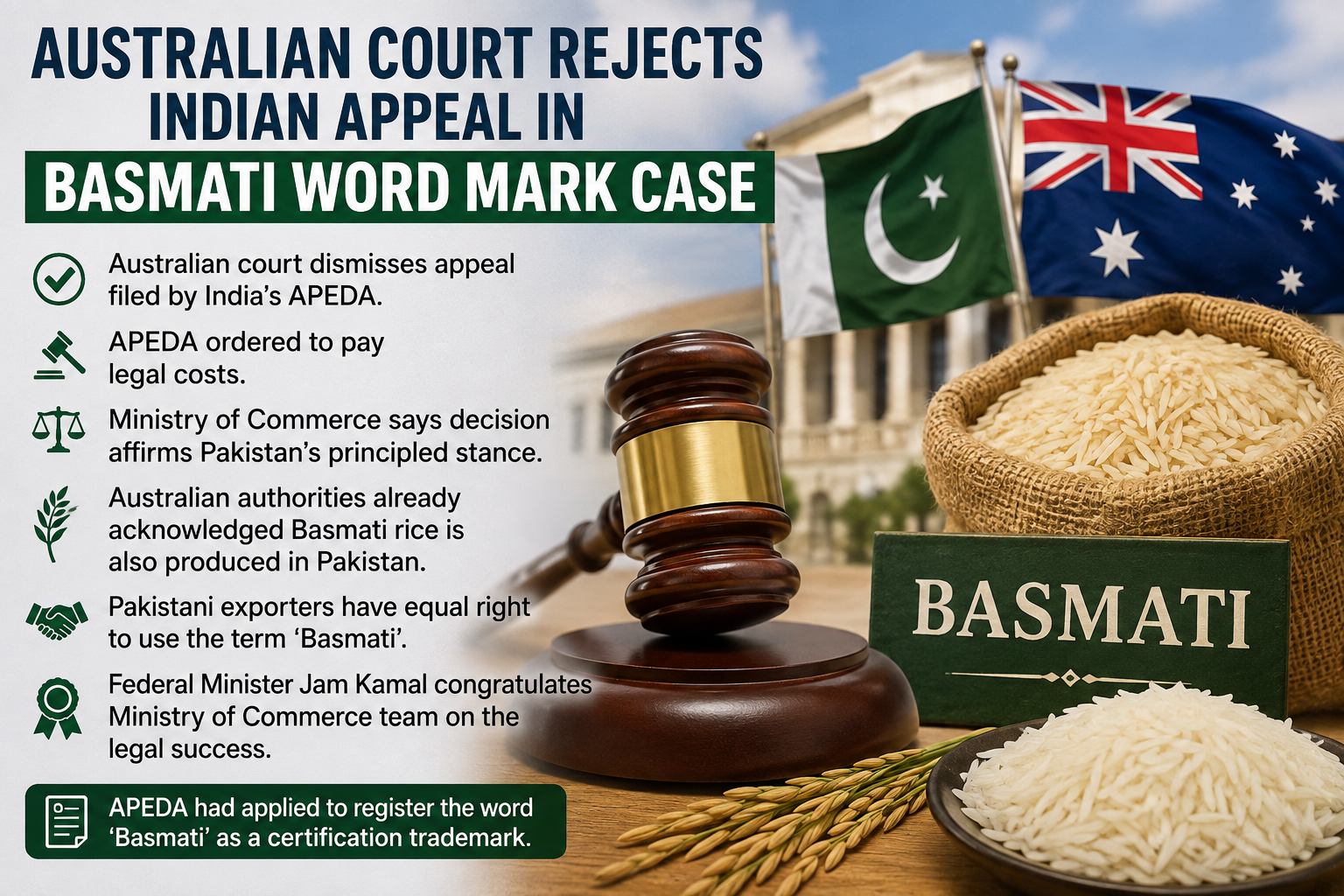
An Australian court has dismissed an appeal filed by the Agricultural and Processed Food Products Export Development Authority (APEDA) in the Basmati word mark case, marking a significant legal development for Pakistan’s rice exporters.

According to the Ministry of Commerce, the Australian court’s decision has reaffirmed Pakistan’s principled position that the term “Basmati” cannot be treated as the exclusive property of India. The ruling is being viewed by Pakistani authorities as an important legal success in protecting the rights of the country’s Basmati rice producers and exporters.

The Australian court has also ordered the Indian institution APEDA to pay the legal costs associated with the proceedings. The decision follows a legal dispute over the use and registration of the word “Basmati” in Australia.

APEDA had applied to register the word “Basmati” as a certification trademark. The application was challenged, leading to legal proceedings concerning whether the term could be claimed exclusively for Indian rice products.

Pakistan has consistently maintained that Basmati rice is also produced in Pakistan and that Pakistani exporters should have equal rights to use the name. The Ministry of Commerce said Australian authorities had already acknowledged that Basmati rice is produced in Pakistan, strengthening Islamabad’s position in the dispute.

The latest court decision has therefore been welcomed by Pakistani officials as confirmation of the country’s longstanding stance on the geographical and commercial identity of Basmati rice.

The Ministry of Commerce stated that the ruling represents an important legal victory for Pakistan because it supports the principle that Pakistani exporters should not be deprived of the right to use the term Basmati for rice produced in the country.

Federal Minister for Commerce Jam Kamal congratulated the Ministry of Commerce team on what he described as Pakistan’s legal success in the case. He appreciated the efforts of the officials and legal representatives involved in defending Pakistan’s position before the Australian authorities.

The dispute is significant because Basmati rice is an important agricultural and export commodity for both Pakistan and India. The term has considerable commercial value in international markets because consumers associate Basmati with a distinctive variety of aromatic long-grain rice.

Pakistan is among the countries known for producing and exporting Basmati rice, particularly from areas in Punjab. The country has sought greater recognition of its rights over the Basmati name in international markets, arguing that the rice is a shared agricultural heritage of the region and is produced on both sides of the border.

APEDA’s attempt to register “Basmati” as a certification trademark had raised concerns in Pakistan because exclusive registration could potentially affect Pakistani exporters’ ability to market their products using the internationally recognized name.

The Australian court’s rejection of APEDA’s appeal is consequently being seen by Pakistan as an important development in safeguarding its exporters’ commercial interests. The order requiring APEDA to pay legal costs also adds to the significance of the decision for Pakistan.

The Ministry of Commerce has emphasized that the ruling strengthens Pakistan’s position in international legal and commercial forums. Pakistani authorities are expected to continue protecting the interests of local rice growers and exporters and ensuring that they retain the right to market their Basmati rice under its recognized name.

The decision could also contribute to broader efforts to strengthen Pakistan’s agricultural exports and promote its Basmati rice in international markets.
Similar Posts

  • |

    Fact check: SRK never backed Jantar Mantar protest

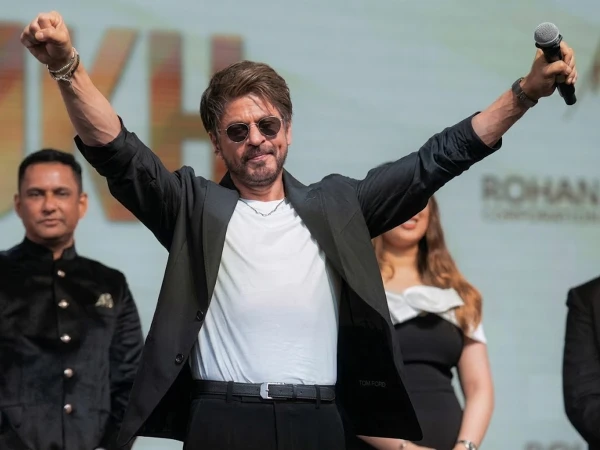
    A social media claim suggesting that Bollywood star Shah Rukh Khan publicly backed the ongoing student demonstrations at Jantar Mantar in Delhi has been found to be untrue, following verification against his official accounts. A screenshot circulating widely online alleged that the actor had voiced solidarity with the protesting students. The post claimed he described himself as standing behind them “emotionally and morally.” The image spread rapidly, and a large number of social media users took it at face value, assuming Khan had genuinely made a public statement on the matter. But a closer look at his verified profiles told a different story. Neither his official Instagram nor his X account contained any post referencing the protest. According to various reports, the mix-up likely originated from a fan-run account operating under his name, which had been posting updates related to the demonstrations. A number of users apparently mistook these fan posts for statements coming directly from the actor himself. As the fake screenshot kept circulating, other users began flagging it as inauthentic. Comments pushing back on the claim appeared across social platforms. One person simply labeled it “Fake.” Another echoed the sentiment, writing, “This is fake.” A third user challenged those sharing it, asking why they were “spreading fake news” when the actor “has not posted anything.” Yet another dismissed it in Hindi, writing “Fake hai.” For his part, Shah Rukh Khan has stayed silent on the protest altogether. His attention, based on available reports, remains directed toward his upcoming release, ‘King’, rather than commentary on the demonstrations. The protests themselves have drawn considerable attention, pulling in thousands of participants. The gathering followed the larger ‘Chalo Sansad’ march, which appears to have been a catalyst for the broader movement. At this point, there is no confirmed or verified statement from Shah Rukh Khan addressing the protest in any capacity. Until his official channels indicate otherwise, claims attributing such remarks to him should be treated as unverified and, based on current evidence, false.

  • |

    Nadeem Omar re-elected Karachi cricket chief

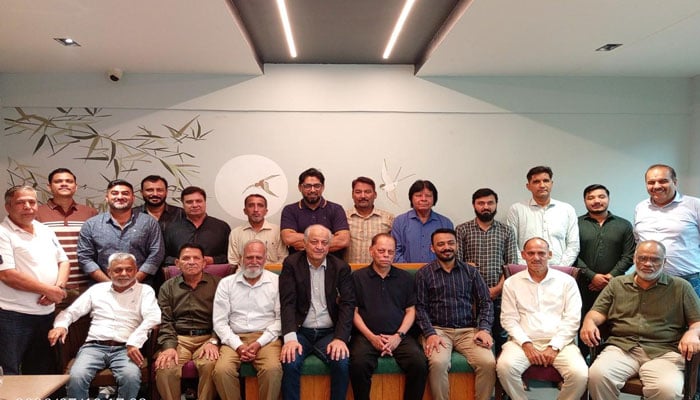
    Nadeem Omar has been re-elected as President of the Regional Cricket Association (RCA) Karachi, securing a third consecutive term after being elected unopposed. His latest victory extends his leadership of Karachi’s regional cricket body for another three years. The election concluded with a unanimous result, as the Nadeem Omar panel secured all 15 votes cast by eligible voters. With the clean sweep, Omar completed a hat-trick of victories, having now won the presidential election for the third time in a row. The election also saw Ali Hussain elected as Secretary of the Regional Cricket Association Karachi. Like Omar, he received all 15 votes and will serve a three-year term. Following the announcement of the results, the newly elected president and secretary thanked the club representatives, voters and members of their panel for expressing confidence in their leadership. They described the unanimous support as a sign of trust from Karachi’s cricket community. Nadeem Omar said his team would continue working to strengthen cricket across the city. He pledged to promote transparency, merit and accountability in the administration of regional cricket while ensuring that decisions are made in the best interest of the game. He said one of the administration’s top priorities would be the development of young cricketers through improved coaching programmes, better facilities and increased opportunities at the grassroots level. He added that identifying and supporting talented players from local clubs would remain a key focus during the next three years. Ali Hussain also reaffirmed the new administration’s commitment to improving the overall structure of cricket in Karachi. He said efforts would be made to enhance coordination with clubs, organise competitive tournaments and create a stronger pathway for emerging players to progress to higher levels of the game. The newly elected leadership stressed that all stakeholders, including clubs, coaches, players and cricket organisers, would be taken on board to strengthen the regional cricket system. They said cooperation among all parties would help improve standards and produce more talented cricketers for domestic and international competitions. Speaking after his re-election, Nadeem Omar said the victory belonged not only to him but to every club and cricket enthusiast who had placed their confidence in his leadership

  • |

    Three reasons Haroon is winning hearts in Aik Mohabbat Aur

    Haroon Malik has emerged as one of the most admired characters in Aik Mohabbat Aur because of his thoughtful personality and balanced approach to relationships. Rather than being portrayed as a flawless hero, Haroon is shown as an ordinary man who makes mistakes, learns from them, and grows through his experiences. His realistic nature has made him relatable to viewers, and several of his actions have highlighted positive values that are often missing in television dramas. A genuine bond with Pari One of Haroon’s most heartwarming qualities is the relationship he shares with Pari. Instead of trying to immediately take on the role of a father figure, he focuses on becoming someone she can trust and enjoy spending time with. He treats her with kindness, patience, and respect, allowing their connection to develop naturally. Haroon listens to Pari, joins in her playful moments, and makes her feel valued without expecting anything in return. Their relationship is built on friendship, understanding, and trust rather than obligation. This gentle approach allows Pari to accept him on her own terms, making their bond feel authentic and emotionally touching. Standing up for Maham Another defining moment for Haroon is the way he handles Maham’s difficult situation. While others choose to ignore her emotional struggles or dismiss them as private family matters, Haroon recognizes that she deserves to be heard. Instead of blindly supporting his brother, Faris, he acknowledges Maham’s pain and encourages the family to confront the real issues. Haroon also challenges his parents to understand that providing financial security alone does not excuse harmful behavior. He emphasizes that emotional well-being is equally important and that remaining silent in the face of abuse only allows the problem to continue. His willingness to hold both his brother and family accountable demonstrates maturity, fairness, and compassion. Respecting Khushbakht’s emotions Haroon’s relationship with Khushbakht Naaz is another reason audiences appreciate his character. Although he develops strong feelings for her, he never pressures her to return his affection immediately. Instead, he patiently gives her the time and space she needs to process her emotions. Even after their marriage, Haroon expresses his care through thoughtful actions rather than dramatic declarations. He values small moments of happiness and understands that love cannot be forced. His calm and respectful approach helps Khushbakht gradually become comfortable with him, especially after the emotional challenges she has experienced in the past. Rather than demanding love, Haroon chooses to earn trust through consistency, patience, and genuine kindness. This refreshing portrayal of romance has resonated with many viewers, setting him apart from more traditional television heroes. As Aik Mohabbat Aur continues, Haroon’s character proves that strength can be found in empathy, respect, and emotional intelligence. His relationships with Pari, Maham, and Khushbakht showcase a man who values understanding over control and compassion over pride. These qualities not only make him an engaging character but also reflect the evolving storytelling seen in modern Pakistani dramas. Written by Faiza Iftikhar and directed by Farooq Rind, Aik Mohabbat Aur features a talented cast including Ahad Raza Mir, Maya Ali, Samiya Mumtaz, Noorul Hasan, Munazza Arif, Saqib Sameer, Omair Rana, Hajra Yamin, Sachal Afzal, Fajar Sheikh, Qudsia Ali, Shamyl Khan, Abbas Ashraf, Rehan Sheikh, Dodi Khan, and several other notable actors.

  • |

    Tanzid Hasan hits century as Bangladesh dominate Australia

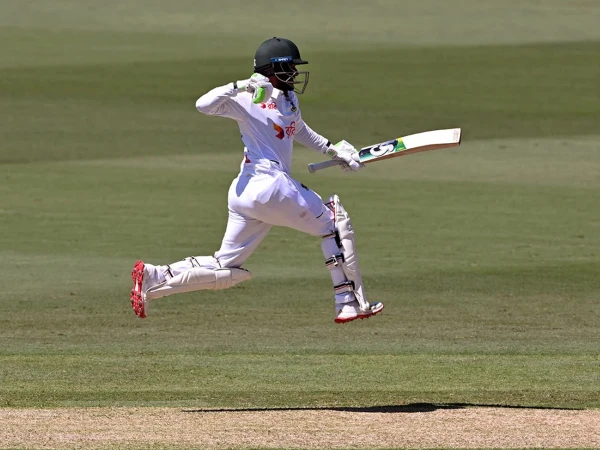
    Bangladesh strengthened their grip on the Darwin Test against Australia on Friday as opener Tanzid Hasan produced a memorable maiden Test century to put the visitors in a commanding position after the second day. Bangladesh finished the day on 351 for six, securing a valuable 153-run lead and leaving Australia facing an uphill battle in the opening Test. The biggest highlight was Tanzid, who marked only his second Test appearance with a composed century. The young opener spent nearly five hours at the crease, facing 197 deliveries and striking eight boundaries and one six on his way to three figures. His innings provided Bangladesh with the foundation they needed against a strong Australian attack. Tanzid first combined with Mominul Haque to build a 102-run partnership for the second wicket. He then continued Bangladesh’s progress alongside captain Najmul Hossain Shanto, with the pair adding another 93 runs. Shanto played a valuable supporting role before falling for 84, but Bangladesh refused to surrender their advantage despite Australia finding some success with the new ball. Australia managed to take three quick wickets with the second new ball, raising hopes of a late collapse. However, Mehidy Hasan Miraz and Hasan Mahmud responded with disciplined batting to frustrate the hosts. The pair remained unbeaten at the close, putting together an important 43-run partnership for the seventh wicket and ensuring Bangladesh ended the day firmly in control. For Australia, Josh Hazlewood, Mitchell Starc and Pat Cummins claimed one wicket each, but their efforts were not enough to prevent Bangladesh from establishing a substantial advantage. Tanzid’s century was particularly significant given his limited Test experience. Having played only his second match in the format, he showed patience and maturity against one of the world’s most respected bowling attacks. With Bangladesh already 153 runs ahead and four wickets still in hand, Australia face a crucial third day in Darwin. The hosts will need early breakthroughs to prevent Bangladesh from turning their advantage into a potentially decisive position.

  • | |

    Naqvi makes surprise visit to NCCIA headquarters, …

    ISLAMABAD: Federal Interior Minister Mohsin Naqvi made an unannounced visit to the under-construction headquarters of the National Cyber Crime Investigation Agency (NCCIA) in Islamabad and expressed concern over the slow pace of development work. During his inspection, Naqvi reviewed the progress of the headquarters upgrade project and questioned officials about the delays. A worker informed the minister that only nine workers were currently assigned to the site and that construction activities had remained suspended for several days. Expressing dissatisfaction over the situation, Naqvi contacted the relevant authorities on the spot and instructed them to immediately accelerate construction work. He stressed the need for timely completion of the project and directed officials to ensure that progress was maintained. The surprise inspection comes as the government seeks to strengthen the country’s institutional capacity to tackle cybercrime through the NCCIA.

  • | |

    SBP appoints 10 primary dealers for FY27

    KARACHI: The State Bank of Pakistan (SBP) has appointed 10 financial institutions as Primary Dealers (PDs) and two institutions as Special Purpose Primary Dealers (SPDs) for the fiscal year 2026-27. The appointments will strengthen the government’s domestic borrowing programme and support the country’s financial market. The government continues to rely heavily on domestic borrowing to finance its fiscal requirements. In this system, primary dealers play an important role by participating in government debt auctions and helping raise funds through Treasury Bills and Pakistan Investment Bonds. According to the central bank, United Bank Limited (UBL), National Bank of Pakistan (NBP), and Bank Alfalah secured the top three positions among primary dealers during the fiscal year 2025-26. Their rankings were based on overall performance in government securities auctions and market activities. The 10 institutions selected as Primary Dealers for FY2026-27 are United Bank Limited, National Bank of Pakistan, Bank Alfalah, Habib Bank Limited, Habib Metropolitan Bank, MCB Bank, The Bank of Punjab, Pak Oman Investment Company, JS Bank, and Citi Bank NA Pakistan Branch. The State Bank has also appointed the Central Depository Company of Pakistan Limited (CDC) and the National Clearing Company of Pakistan Limited (NCCPL) as Special Purpose Primary Dealers for the new fiscal year. The appointments were made after evaluating applications submitted by financial institutions under the eligibility criteria laid down in the Primary Dealer System Rules. The central bank had invited applications for the new fiscal year through a circular issued earlier this year. Primary dealers are responsible for purchasing government securities directly from the central bank during auctions. They then distribute these securities among commercial banks, financial institutions and other investors. Their participation ensures that government borrowing operations continue without disruption. These institutions also play an important role in the secondary market by providing liquidity and facilitating the buying and selling of government securities. Their presence helps improve market efficiency and contributes to transparent price discovery. The role of primary dealers has become increasingly important as Pakistan continues to depend on domestic sources to meet its financing needs. Through their participation in debt auctions, they help the government raise funds while supporting stability in the country’s financial system.

Leave a Reply

Your email address will not be published. Required fields are marked *