
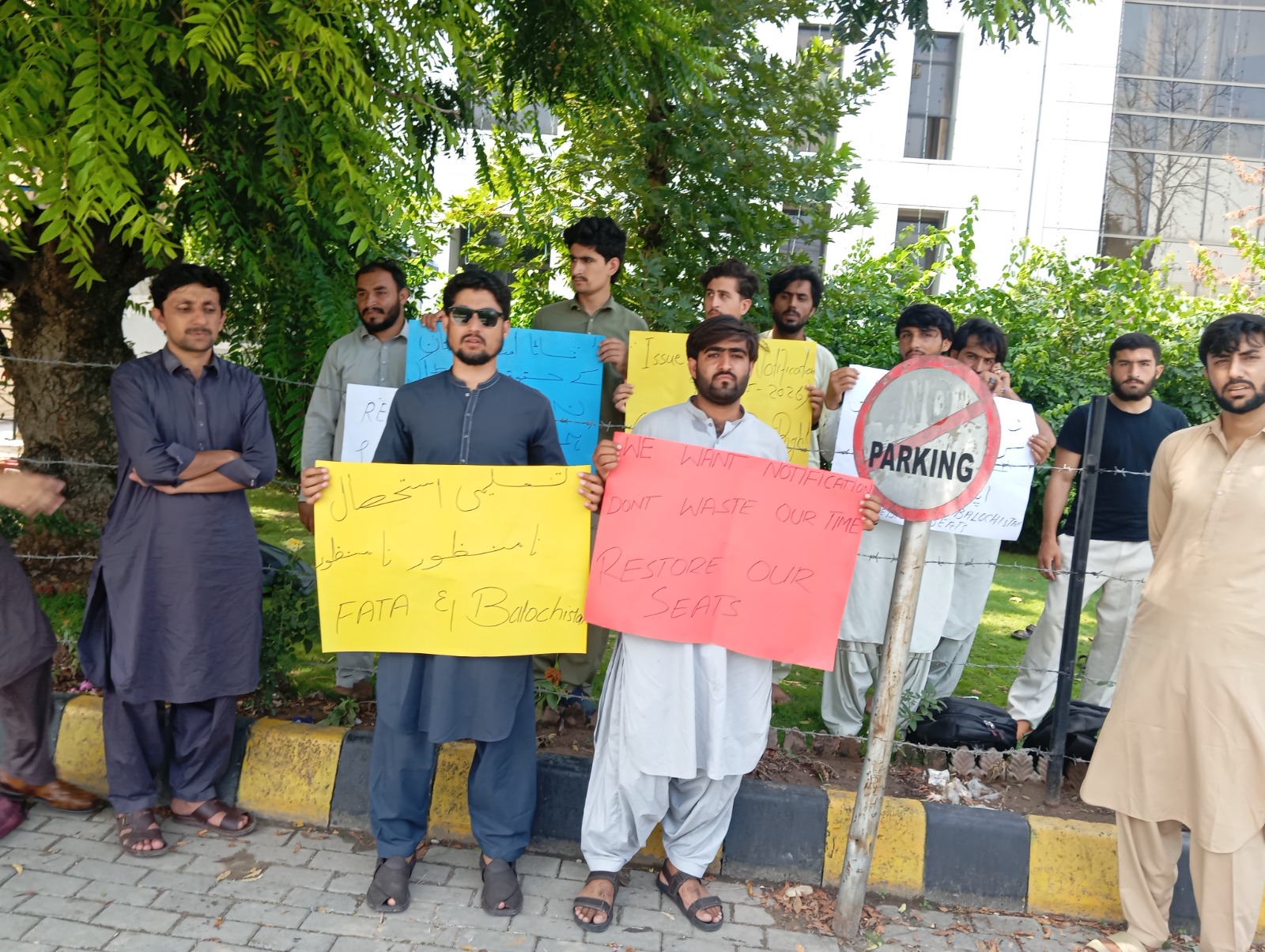
former fata balochistan

Former FATA, Balochistan students protest over medical seats

Islamabad: Students from former FATA and Balochistan have been protesting outside the Pakistan Medical and Dental Council (PMDC) for around a week, stating their medical and dental seat issue remains unresolved despite repeated meetings, provincial proposals and a PMDC decision allowing increased intake in public medical colleges. Protesters say they expected hundreds of seats under a federal education programme but are still waiting for a clear notification covering their admissions.

Among the protesting students named are Usman Afridi, Allah Yar and Shafi ud Din. Muhammad Rehan, a student from South Waziristan, said the federal government through the Higher Education Commission had been providing medical and dental education opportunities to students from former FATA and Balochistan.

He said 333 MBBS and BDS seats had been provided each year under the programme in previous years. Rehan claimed that the same number of seats had not been made available to students this time.

According to his account, PMDC initially told the students that it did not hold a separate quota of 333 seats and that provincial governments would have to identify available seats before PMDC could consider approval.

Students then approached the governments and medical education authorities in Khyber Pakhtunkhwa and Balochistan. Rehan said Khyber Pakhtunkhwa identified 375 additional seats while Balochistan proposed another 36 medical seats.

He said the students expected PMDC to approve these seats for their current admission session but the matter had still not been settled. Official documents in the file support that Khyber Medical University submitted a proposal for a major increase in seats for students from former FATA.

The KMU proposal listed additional seats in several public medical colleges. It proposed 50 additional seats each at Saidu Medical College, Gomal Medical College, Bannu Medical College, Bacha Khan Medical College, Nowshera Medical College, Gajju Khan Medical College and KMU Institute of Medical Sciences.

It also proposed 25 additional seats at KMU Institute of Dental Sciences. The total proposed increase under the KMU plan was 375 seats. Khyber Medical University said the colleges proposed for increased intake had been examined for faculty, infrastructure, teaching hospitals, equipment and other requirements.

KMU stated that the institutions were capable of supporting the proposed increase and asked PMDC to approve the seats for the relevant session. Balochistan also submitted a separate proposal for 36 additional MBBS seats. According to the document, Bolan Medical College was proposed for 21 additional seats.

Five seats each were proposed at Jhalawan Medical College, Loralai Medical College and Kech Medical College. The Balochistan Health Department said the proposal would support educational equality and help address the shortage of medical professionals in underserved regions.

The combined proposals from Khyber Pakhtunkhwa and Balochistan therefore amount to 411 additional seats. However, whether all of those seats must be reserved specifically for students from former FATA and Balochistan is a central issue in the dispute.

Students say they were expecting a fixed quota under the HEC programme. PMDC documents in the file show a somewhat different arrangement. PMDC approved an increase in student intake capacity across recognised public medical colleges, subject to inspections and compliance with its standards.

The regulator said colleges seeking increased intake would have to meet requirements on infrastructure, faculty and accreditation. It also made clear that the increased intake was not a relaxation of minimum medical education standards.

The PMDC decision further stated that where the approved capacity of a public medical college is increased, the relevant provincial or regional government may reserve an appropriate quota within those additional seats for students under the HEC scholarship programme for former FATA and Balochistan.

The document says the provincial government and HEC would determine the method for nomination, allocation and admission under the quota. The PMDC notification therefore does not state in the provided text that every province must reserve a fixed number of 333 or 300 seats.

Instead, it allows provincial governments to earmark an appropriate quota from approved enhanced capacity. This difference appears to be at the heart of the current dispute. Students say they were promised a specific number of seats.

The formal PMDC notification in the provided documents speaks more broadly about increased capacity and allows provinces to determine an appropriate HEC quota within that capacity.

Rehan also claimed that a PMDC Council meeting had agreed to approve 300 seats for students of former FATA and Balochistan. He said students were later repeatedly told that a notification would be issued soon but it did not come in the form they expected.

He also claimed that students have recordings of conversations with senior PMDC officials regarding promises about the notification. These claims are statements made by the protesting student and the provided documents do not independently establish the contents of the alleged recordings.

Official PMDC documents do confirm that the Council approved increased intake capacity in recognised public medical colleges across Pakistan. The decision stated that expanding capacity would give more deserving students access to medical education and strengthen Pakistan’s future health workforce.

However, this approval remained subject to PMDC assessment and compliance with required standards. An earlier Khyber Pakhtunkhwa meeting regarding former FATA students also shows that the issue had been under discussion for some time.

The meeting reviewed an overall capacity figure of 333 seats and discussed how additional opportunities could be created for students from former FATA. Officials were told that PMDC was willing in principle to consider increased seats if the required documents and formal requests were completed.

KMU was directed to survey medical colleges and submit the required information to PMDC. The meeting record dacuments also states that the support initiative for former FATA students was described as continuing until 2031.

Students are now demanding that PMDC issue a clear decision and allow the enhanced seats to apply to their current admission session. They argue that provincial governments and universities have already carried out the work required to identify additional capacity and that further delay could cost them an academic year.

Similar Posts

  • | |

    AJK election commission revises third-phase pollin…

    The Azad Jammu and Kashmir Election Commission has revised the schedule for the third phase of the Legislative Assembly elections. Polling in Poonch and Sudhanoti districts has been postponed. The election commission has now decided to hold the third phase in Bagh and Haveli districts. Under the earlier schedule, polling was planned for August 10. Voting was expected to take place across 11 seats in four districts of the Poonch division. The election authorities have now changed the plan. The new schedule will cover constituencies in Bagh and Haveli. The first two phases of the AJK elections have already been completed. The first phase was held on July 27 in the Mirpur Division. The second phase took place on August 2 in the Muzaffarabad Division. The elections are being closely watched because of the political contest between the Pakistan Muslim League-Nawaz and the Pakistan Peoples Party. The PML-N has emerged as the leading party in the first two phases. Its leaders have claimed that the party has secured enough support to form the next AJK government. In the second phase, voting was held in 21 constituencies. Nine seats were located in the Muzaffarabad Division. Twelve seats were reserved for Kashmiri refugees settled in different parts of Pakistan. According to unofficial and provisional results, the PML-N won 15 of the 21 seats. The PPP secured the remaining six seats. The PML-N had also performed strongly during the first phase. Unofficial results showed the party winning nine constituencies. The PPP won four seats. The election process has also been accompanied by allegations of irregularities and violence. The PPP has questioned the fairness of the elections and accused the authorities of failing to ensure a transparent process. PPP Chairman Bilawal Bhutto-Zardari has strongly criticised the election process. He described the polls as unfair and alleged that violence and irregularities affected the voting. Bilawal also said the PPP would continue its political struggle despite the party’s performance in the elections. He claimed that the federal government would face political challenges in the future. The PML-N has rejected the allegations. PML-N leader and Prime Minister’s Adviser on Political Affairs Rana Sanaullah challenged the PPP to present evidence of electoral irregularities before the election commission. He said accusations should be supported by evidence. He also accused the PPP of promoting allegations of rigging from the beginning of the election process. The revised schedule has now shifted attention towards Bagh and Haveli. The election authorities are expected to provide further details about polling arrangements and the dates for voting in the postponed constituencies.

  • | |

    Flash floods hit DG Khan, hundreds rescued

    By MIR Hunbal Birmani   DG Khan: Heavy rains in the Sulaiman Range have caused flash flooding in several small and large hill torrents in Sakhi Sarwar and adjoining areas, creating difficulties for tourists returning from Mubarki, Yakbai and other tourist destinations, as well as travellers and residents of tribal areas, in crossing the waterways. Taking notice of the situation, Deputy Commissioner and Senior Commandant Dera Ghazi Khan Muhammad Usman Khalid directed an immediate rescue operation under the supervision of Political Assistant Koh-e-Sulaiman Ameer Taimoor. The Border Military Police (BMP) mobilised its personnel and vehicles and reached various routes affected by the hill torrents to rescue stranded tourists, travellers, women, children and residents of tribal areas, along with their belongings, and shift them to safe locations. On the instructions of Deputy Commissioner Muhammad Usman Khalid, BMP personnel also helped private vehicles and motorcycles cross the flooded hill torrents. At some locations, motorcycles and luggage were carried on their shoulders to help people reach safer places. During the rescue operation, the valuable belongings and vehicles of tourists and travellers were also safely moved to secure locations. The BMP team also transported a woman who was on her way to hospital for delivery in an official vehicle. Due to the timely actions of the district administration and the BMP, hundreds of tourists, travellers and local residents were rescued from difficulties caused by the flash floods and shifted to safe places Deputy Commissioner Muhammad Usman Khalid said that, in accordance with the special instructions of Punjab Chief Minister Maryam Nawaz Sharif, all necessary arrangements had been completed in view of the monsoon rains. Teams of the district administration, Border Military Police, Baloch Levies and other relevant departments had been deployed at important routes near the hill torrents to ensure an immediate response to any emergency situation. He urged citizens and tourists to avoid going near hill torrents during rainfall and to follow the instructions issued by the administration. “The protection of the lives and property of the people is the top priority of the district administration,” he said. While on other hand , Senior officials on Thursday visited hill torrent structures and flood-prone areas in Rajan pur district to review the situation and preparedness measures. The visit was conducted by commissioner Dera Ghazi Khan ch.Ashfaq , Chief Engineer Irrigation, Dera Ghazi Khan, the Superintending Engineer Irrigation, Additional Deputy Commissioner Revenue Rajan pur, Assistant Commissioners of Jam pur and Rajan pur, the In-charge of Rescue 1122, and other relevant officials. The officials inspected the Kaha Hill Torrent siphon at RD-145 and Pull Pathan Camp at Tayyab Drain. According to officials, a peak discharge of 40,000 cusecs was recorded at Darrah, the originating point of the Kaha Hill Torrent, yesterday. However, a major portion of the floodwater dissipated during its passage, and only around 2,000 cusecs had reached RD-145 so far. The Irrigation Department has established eight camps in the area, equipped with the necessary machinery, equipment and manpower to deal with any emergency situation. Teams of the District Administration Rajan pur, Irrigation Department and Rescue 1122 are actively monitoring the situation and remain vigilant.

  • | | |

    Naqvi tells tycoons: Stop funding politicians

    Federal Minister Mohsin Naqvi has called for sweeping structural reforms, warning that Pakistan cannot overcome its long-standing economic and governance challenges without fundamental changes to the country’s political and administrative systems. Speaking at the First Pakistan Investment Summit in Islamabad, Naqvi said the existing governance structure has become outdated and is no longer capable of meeting the country’s growing economic needs. He cautioned that without meaningful reforms, Pakistan could still be facing the same problems a decade from now. Addressing business leaders and investors, the minister said responsibility for the current state of affairs does not rest solely with politicians. He argued that the business community also plays a significant role in sustaining the existing system by financing political campaigns. Naqvi urged business leaders to stop funding political parties during elections and instead push for greater transparency, accountability and institutional reforms. He said reducing financial dependence on wealthy donors could help strengthen democratic institutions and improve governance. The minister also stressed the need to reduce Pakistan’s reliance on foreign loans. He said the country must focus on generating domestic resources, expanding investment and building a stronger economic foundation through long-term planning. Calling for national unity, Naqvi urged political parties to set aside differences and work together on a comprehensive reform agenda. He said lasting economic stability can only be achieved through collective decision-making and institutional improvements. Other speakers at the summit also highlighted the need for major administrative reforms. They argued that changes in governance structures, including decentralisation and stronger regional administration, could improve service delivery and reduce governance challenges. Business leader S.M. Tanvir said structural weaknesses continue to slow economic progress and called for fresh leadership and institutional reforms to strengthen the country’s administrative framework. Participants also expressed concern over Pakistan’s social and economic indicators. They noted that a large segment of the population continues to live below the poverty line, while unemployment remains a major challenge, particularly among young people. Several speakers said temporary welfare measures alone cannot address the country’s long-term economic issues. They called for policies that create sustainable employment opportunities, promote merit-based recruitment and equip young people with the skills needed to participate in the economy

  • | |

    Sindh solar project to benefit 275,000 families

    Karachi: Sindh Senior Minister for Information, Transport, and Mass Transit Sharjeel Inam Memon has announced that the Sindh government’s Rs18.2 billion Solar Home System Project will provide clean and affordable energy to 275,000 deserving families across the province. In a statement issued on Tuesday, Memon said the initiative, launched under the guidance of Pakistan Peoples Party (PPP) Chairman Bilawal Bhutto Zardari, is a major step toward expanding access to renewable energy, particularly for low-income households and remote communities. According to the minister, the project will benefit 132,000 off-grid families living in areas without access to the national electricity network, while 143,000 on-grid families facing electricity-related challenges will also receive solar home systems. Each beneficiary family will be provided with a 180-watt solar panel, batteries, a central control unit, a charge controller, mobile charging facility, electric fans, and LED lights. The comprehensive package is designed to meet basic household energy needs while reducing dependence on conventional electricity sources. Sharjeel Memon said the project is progressing rapidly, with more than 15,000 solar home system kits already distributed across various districts of Sindh. He added that the government aims to complete the distribution to all 275,000 eligible families by June 2027. The senior minister described the initiative as more than just an electricity project, saying it represents a significant welfare program aimed at improving the quality of life for economically disadvantaged families. He noted that access to reliable and clean energy would help reduce household expenses, improve living standards, and support sustainable development across the province. The Sindh government views the solar project as an important investment in renewable energy and social welfare, aligning with broader efforts to promote clean energy solutions and provide long-term relief to vulnerable communities.

  • | |

    AI-generated Independence Day song released by Pla…

    ISLAMABAD: An AI-generated Independence Day song released by Pakistan’s Ministry of Planning, Development and Special Initiatives has sparked widespread debate, with critics questioning the government’s decision to rely on artificial intelligence instead of showcasing the country’s creative talent. The song, shared by Federal Minister for Planning Ahsan Iqbal on social media, is dedicated to Pakistan’s youth and draws inspiration from the poetry and philosophy of Allama Muhammad Iqbal, particularly the themes of Khudi (selfhood) and the Shaheen (eagle), symbols of confidence, resilience, and ambition. In his message accompanying the release, Ahsan Iqbal said Pakistan’s future depends on a generation of young people who embrace knowledge, innovation, entrepreneurship, and hard work. He described the song as part of the government’s URAAN Pakistan initiative, which promotes reforms and development projects under the country’s 5Es National Economic Transformation Plan. Despite its patriotic message, the AI-produced music video has drawn criticism from artists, commentators, and social media users, many of whom argue that the government missed an opportunity to support Pakistan’s musicians, composers, filmmakers, and other creative professionals. Critics say that celebrating Independence Day with an AI-generated production sends the wrong message at a time when local artists continue to seek greater recognition and opportunities. The release has also reignited broader discussions about the growing use of artificial intelligence in the creative industry. Many artists around the world have voiced concerns that AI-generated content could reduce opportunities for writers, musicians, actors, and visual creators while raising questions about copyright, digital identity, and fair compensation. In Pakistan, similar concerns have emerged in recent months as actors and performers have warned about contracts involving AI-generated digital replicas and voice cloning. Industry professionals argue that stronger safeguards are needed to protect artists from unauthorized use of their work and likeness. The Planning Ministry’s latest campaign has therefore become more than just an Independence Day release. It has evolved into a wider conversation about the balance between embracing new technology and preserving the value of human creativity, with many calling for future national campaigns to highlight the work of Pakistan’s own artists alongside technological innovation.

  • | |

    AJK gears up for second phase of elections

    Preparations are in full swing for the second phase of the Azad Jammu and Kashmir (AJK) Legislative Assembly elections, with polling scheduled for August 2 across Muzaffarabad Division and 12 refugee seats. The second phase will cover the three districts of Muzaffarabad Division—Muzaffarabad, Neelum and Jhelum Valley—as well as 12 constituencies reserved for Kashmiri refugees residing in Pakistan. According to election authorities, a total of 890,621 registered voters are eligible to cast their ballots in the nine constituencies of Muzaffarabad Division. Of these, 427,955 are male voters, while 381,666 are female voters. To facilitate polling, 1,483 polling stations have been established across the division. District Muzaffarabad, which has five constituencies, will have 1,205 polling stations. District Neelum, comprising two constituencies, will have 278 polling stations, while 328 polling stations have been set up in the two constituencies of Jhelum Valley. A total of 208 candidates are contesting the nine seats in Muzaffarabad Division, making the second phase a closely watched electoral contest. Meanwhile, Kashmiri refugees living in Pakistan will also cast their votes for 12 refugee constituencies, evenly divided between six Jammu seats and six Valley seats. The Jammu refugee constituencies include LA-34 Jammu-I through LA-39 Jammu-VI, while the Valley refugee constituencies comprise LA-40 Valley-I through LA-45 Valley-VI. The Azad Jammu and Kashmir Election Commission will announce the results of all 12 refugee constituencies after the completion of polling. Authorities have said all necessary arrangements have been finalised to ensure a peaceful, transparent and orderly voting process during the second phase of the elections.

Leave a Reply

Your email address will not be published. Required fields are marked *