former fata balochistan

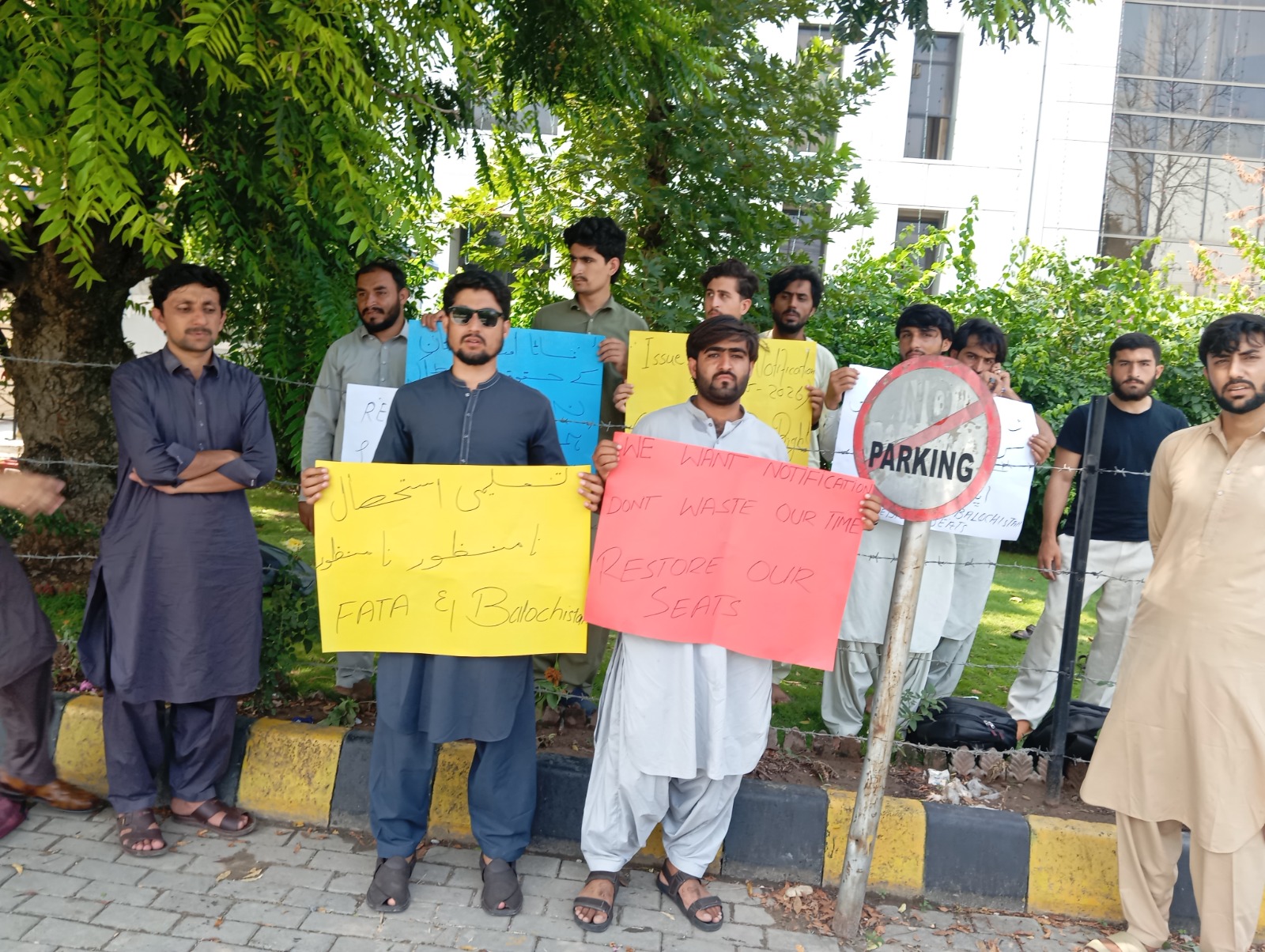
Former FATA, Balochistan students protest over medical seats

Islamabad: Students from former FATA and Balochistan have been protesting outside the Pakistan Medical and Dental Council (PMDC) for around a week, stating their medical and dental seat issue remains unresolved despite repeated meetings, provincial proposals and a PMDC decision allowing increased intake in public medical colleges. Protesters say they expected hundreds of seats under a federal education programme but are still waiting for a clear notification covering their admissions.

Among the protesting students named are Usman Afridi, Allah Yar and Shafi ud Din. Muhammad Rehan, a student from South Waziristan, said the federal government through the Higher Education Commission had been providing medical and dental education opportunities to students from former FATA and Balochistan.

He said 333 MBBS and BDS seats had been provided each year under the programme in previous years. Rehan claimed that the same number of seats had not been made available to students this time.

According to his account, PMDC initially told the students that it did not hold a separate quota of 333 seats and that provincial governments would have to identify available seats before PMDC could consider approval.

Students then approached the governments and medical education authorities in Khyber Pakhtunkhwa and Balochistan. Rehan said Khyber Pakhtunkhwa identified 375 additional seats while Balochistan proposed another 36 medical seats.

He said the students expected PMDC to approve these seats for their current admission session but the matter had still not been settled. Official documents in the file support that Khyber Medical University submitted a proposal for a major increase in seats for students from former FATA.

The KMU proposal listed additional seats in several public medical colleges. It proposed 50 additional seats each at Saidu Medical College, Gomal Medical College, Bannu Medical College, Bacha Khan Medical College, Nowshera Medical College, Gajju Khan Medical College and KMU Institute of Medical Sciences.

It also proposed 25 additional seats at KMU Institute of Dental Sciences. The total proposed increase under the KMU plan was 375 seats. Khyber Medical University said the colleges proposed for increased intake had been examined for faculty, infrastructure, teaching hospitals, equipment and other requirements.

KMU stated that the institutions were capable of supporting the proposed increase and asked PMDC to approve the seats for the relevant session. Balochistan also submitted a separate proposal for 36 additional MBBS seats. According to the document, Bolan Medical College was proposed for 21 additional seats.

Five seats each were proposed at Jhalawan Medical College, Loralai Medical College and Kech Medical College. The Balochistan Health Department said the proposal would support educational equality and help address the shortage of medical professionals in underserved regions.

The combined proposals from Khyber Pakhtunkhwa and Balochistan therefore amount to 411 additional seats. However, whether all of those seats must be reserved specifically for students from former FATA and Balochistan is a central issue in the dispute.

Students say they were expecting a fixed quota under the HEC programme. PMDC documents in the file show a somewhat different arrangement. PMDC approved an increase in student intake capacity across recognised public medical colleges, subject to inspections and compliance with its standards.

The regulator said colleges seeking increased intake would have to meet requirements on infrastructure, faculty and accreditation. It also made clear that the increased intake was not a relaxation of minimum medical education standards.

The PMDC decision further stated that where the approved capacity of a public medical college is increased, the relevant provincial or regional government may reserve an appropriate quota within those additional seats for students under the HEC scholarship programme for former FATA and Balochistan.

The document says the provincial government and HEC would determine the method for nomination, allocation and admission under the quota. The PMDC notification therefore does not state in the provided text that every province must reserve a fixed number of 333 or 300 seats.

Instead, it allows provincial governments to earmark an appropriate quota from approved enhanced capacity. This difference appears to be at the heart of the current dispute. Students say they were promised a specific number of seats.

The formal PMDC notification in the provided documents speaks more broadly about increased capacity and allows provinces to determine an appropriate HEC quota within that capacity.

Rehan also claimed that a PMDC Council meeting had agreed to approve 300 seats for students of former FATA and Balochistan. He said students were later repeatedly told that a notification would be issued soon but it did not come in the form they expected.

He also claimed that students have recordings of conversations with senior PMDC officials regarding promises about the notification. These claims are statements made by the protesting student and the provided documents do not independently establish the contents of the alleged recordings.

Official PMDC documents do confirm that the Council approved increased intake capacity in recognised public medical colleges across Pakistan. The decision stated that expanding capacity would give more deserving students access to medical education and strengthen Pakistan’s future health workforce.

However, this approval remained subject to PMDC assessment and compliance with required standards. An earlier Khyber Pakhtunkhwa meeting regarding former FATA students also shows that the issue had been under discussion for some time.

The meeting reviewed an overall capacity figure of 333 seats and discussed how additional opportunities could be created for students from former FATA. Officials were told that PMDC was willing in principle to consider increased seats if the required documents and formal requests were completed.

KMU was directed to survey medical colleges and submit the required information to PMDC. The meeting record dacuments also states that the support initiative for former FATA students was described as continuing until 2031.

Students are now demanding that PMDC issue a clear decision and allow the enhanced seats to apply to their current admission session. They argue that provincial governments and universities have already carried out the work required to identify additional capacity and that further delay could cost them an academic year.

Similar Posts

  • | | | | |

    Iran condemns Ukraine’s Caspian Sea strike as te…

    TEHRAN: Iran has strongly condemned a Ukrainian attack on an Iranian commercial vessel in the Caspian Sea, saying the incident killed one sailor and injured another, and warning that the strike could further widen the Russia-Ukraine conflict. Iran’s Foreign Ministry said the vessel was hit early Saturday, causing an explosion that resulted in the casualties. Tehran described the incident as an “act of aggression” and said the attack violated the principles of the UN Charter. Iran also summoned Ukraine’s chargé d’affaires to formally register its protest over the incident, according to reports. The diplomatic move underscored Tehran’s growing concern over what it described as the expansion of the Ukraine war into areas far beyond the main battlefield. The Iranian ministry said Tehran had never intervened in the Russia-Ukraine conflict and warned that the attack could contribute to the spread of insecurity and violence. It also said Iran would not hesitate to defend its national interests and security, holding Ukraine responsible for what it called the consequences of its actions. The Ukrainian account, however, presents a different picture. Ukrainian President Volodymyr Zelensky said Ukrainian forces had targeted a Russian warship and vessels allegedly being used to transport military cargo linked to Iran in the Caspian Sea. Kyiv has accused Moscow of supporting Iran and has increasingly focused on supply routes connected to Iranian military assistance. The Caspian Sea has become an increasingly sensitive strategic area amid the wider regional and international tensions. Any expansion of military operations there could carry diplomatic consequences for Iran, Ukraine and Russia. For Tehran, the reported death of an Iranian sailor has added a new layer of tension to an already volatile international situation. For Kyiv, strikes against vessels suspected of carrying military-related cargo are part of efforts to disrupt support networks linked to Russia and Iran. The incident now raises questions over whether the confrontation will remain limited to diplomatic protests or lead to further escalation between Tehran and Kyiv.

  • | |

    ECP begins Islamabad local polls preparations

    The Election Commission of Pakistan (ECP) has started the delimitation process for holding local government elections in Islamabad. The commission said the formal process will begin on August 1, 2026, and will continue until October 13, 2026. The delimitation of constituencies is a major step before announcing the election schedule. An ECP spokesperson said that after the completion of the delimitation process and publication of the final constituencies, the commission will consult the federal government regarding the date for Islamabad’s local government elections. The spokesperson also shared updates about local government elections in Punjab and Khyber Pakhtunkhwa. In Punjab, delimitation authorities have been directed to submit their decisions to the relevant committees by August 7. The final delimitation list for the province will be published on August 17. The ECP said it is fully prepared to conduct local government elections in Punjab after completing all necessary legal requirements and consultations. Regarding Khyber Pakhtunkhwa, the commission said delimitation has been completed in 23 districts, while work is continuing in seven more districts. The spokesperson said the ECP held discussions with the Khyber Pakhtunkhwa chief secretary and local government secretary on July 14 about the election schedule. Provincial authorities were given additional time after requesting support for completing arrangements. The commission said recent amendments to the Khyber Pakhtunkhwa Local Government Act created legal issues that affected the delimitation process. The ECP informed the provincial government about these concerns and sought cooperation to resolve the matter. The spokesperson said the commission has faced delays in local government elections because federal and provincial governments often change local government laws close to election dates. He said the ECP has repeatedly completed delimitation exercises and prepared election schedules, but changes in legal frameworks affect the process. The commission recommended that major changes to local government laws and boundaries should be completed at least one year before elections. It said this would help ensure a smooth and timely electoral process.

  • |

    Pakistan’s FIA defends AI profiling and phone checks at airports despite constitutional privacy concerns

    Pakistan’s Federal Investigation Agency (FIA) has defended its use of artificial intelligence tools and mobile phone checks at airports to combat organised human smuggling, following public backlash over immigration checks. Additional Director-General for Immigration Nouman Siddiqui stated that AI-assisted profiling targets high-risk travel patterns, such as first-time visitors travelling to countries like Senegal, Malawi, or Cyprus with no clear family or employment ties, and that phone inspections occur only in select cases linked to smuggling networks. The FIA cited thousands of recent instances where citizens failed to return from visit visas, emphasizing that proactive measures are necessary to protect genuine travellers and prevent international reputational damage. However, legal experts warn that the agency is exceeding its authority. Immigration lawyer Umar Gilani noted that while officers can inspect travel documents, compelling passengers to unlock smartphones constitutes search and seizure, which legally requires a formal criminal investigation. Gilani argued that forcing access to personal devices violates the right to privacy under Article 14 of Pakistan’s constitution, calling for an independent immigration tribunal to oversee official decisions and safeguard fundamental rights.

  • | |

    Bilawal Bhutto Zardari says Pakistan’s independe…

      Pakistan Peoples Party (PPP) Chairman Bilawal Bhutto Zardari has said that Pakistan has completed 79 years of independence and that the country will celebrate the centenary of its independence 21 years from now, in 2047. In a video message issued on the occasion of Independence Day, Bilawal Bhutto Zardari reflected on the meaning of Pakistan’s independence and emphasized that freedom was not simply about acquiring a separate territory. According to him, the creation of Pakistan represented a broader promise of rights and dignity for its people. Bilawal said that independence should be understood as more than the establishment of a geographical homeland. He described it as a commitment made to the people of Pakistan and to the regions and states that chose to become part of the country at the time of its creation. He said that this commitment was subsequently incorporated into Pakistan’s Constitution and has continued to be reaffirmed over the years. According to Bilawal, the constitutional promise represents an important responsibility for successive generations and should not remain limited to political speeches or written documents. The PPP chairman stressed that the younger generation has an important role to play in fulfilling this promise. He said it is the responsibility of the present generation to ensure that the constitutional guarantees and principles associated with Pakistan’s founding vision reach every household by 2047, when the country will mark 100 years of independence. Bilawal’s remarks came as Pakistan celebrated its 79th Independence Day with nationwide ceremonies, flag-hoisting events and public celebrations. The day is observed every year on August 14 to commemorate Pakistan’s independence from British rule in 1947. In his message, Bilawal focused on the relationship between independence, constitutional rights and the responsibilities of citizens. He suggested that the true meaning of freedom lies not only in national sovereignty but also in ensuring that citizens are able to enjoy their fundamental rights. He further emphasized the importance of remembering the commitments associated with the creation of Pakistan while looking toward the country’s future. As Pakistan approaches its centenary in 2047, he called for collective efforts to translate constitutional principles into meaningful improvements in the lives of ordinary citizens. According to Bilawal, fulfilling the promise of Pakistan is a responsibility shared by every generation. He said the country’s future depends on ensuring that the principles of rights and justice are reflected in the everyday lives of people across the country. The PPP chairman also extended his greetings to the nation on Independence Day and expressed his hopes for Pakistan’s continued progress and prosperity. Concluding his message, Bilawal Bhutto Zardari reaffirmed his commitment to Pakistan and expressed the slogan “Pakistan Khappay, Pakistan Paindabad,” conveying a message of support for the country’s unity, stability and lasting prosperity. His Independence Day message centered on the idea that Pakistan’s journey should be viewed not only through the achievement of independence but also through the fulfillment of the rights and aspirations that accompanied the country’s creation. With 2047 approaching as the centenary year of Pakistan’s independence, Bilawal called on the current generation to work toward realizing the constitutional promise for every citizen and household. His message highlighted the importance of connecting the ideals associated with independence to the everyday realities of the Pakistani people.

  • | |

    US publication praises Pakistan’s digital financ…

    A US publication has praised Pakistan’s efforts to modernise its financial system, saying the country is steadily strengthening its position in the global digital financial landscape through reforms and technological innovation. The article highlighted Pakistan’s initiatives to promote digital transformation and said the country has the potential to play a meaningful role in the evolving global digital economy. It also commended the vision of Pakistan Virtual Assets Regulatory Authority (PVARA) Chairman Bilal Bin Saqib, stating that Pakistan must actively position itself within the international digital financial system to benefit from emerging technologies and new economic opportunities. According to the publication, the future will belong to countries that make swift decisions and implement reforms without delay. It noted that Pakistan has the opportunity to emerge as a leader in the digital economy by embracing innovation and adopting forward-looking policies. The article further stated that governments can no longer rely solely on traditional bureaucratic systems. Instead, they must adopt the speed, flexibility and innovation-driven approach of technology startups to remain competitive in a rapidly changing global environment. It added that digital assets are becoming the foundation of the future financial infrastructure and countries investing in digital finance today will be better positioned for long-term economic growth and global competitiveness. The publication’s remarks come as Pakistan continues to promote digital payments, financial technology and cashless transactions as part of its broader strategy to modernise the economy and expand financial inclusion.

  • Pakistan discovers lithium in underground brine

    Islamabad – Oil and Gas Development Company Limited (OGDCL) has achieved a major scientific milestone by confirming the presence of lithium in underground formation water (brine) in Pakistan for the first time. The concentration is reported to be comparable to that found in some of the world’s well-known lithium-bearing geothermal brines. According to sources, the discovery was made during advanced geochemical analysis of formation water obtained from a successfully tested high-temperature geothermal well under OGDCL’s pilot geothermal program. Senior OGDCL officials told The News that this is the first discovery of its kind in Pakistan. With this achievement, Pakistan has joined the list of countries exploring geothermal brine as a potential source of lithium. Lithium is considered a critical mineral in the global transition to clean energy. It is an essential component in electric vehicle (EV) batteries, large-scale energy storage systems and a wide range of advanced technologies.

Leave a Reply

Your email address will not be published. Required fields are marked *