norway praises pakistans
| |

Norway FM praises Pakistan’s role in easing US-I…

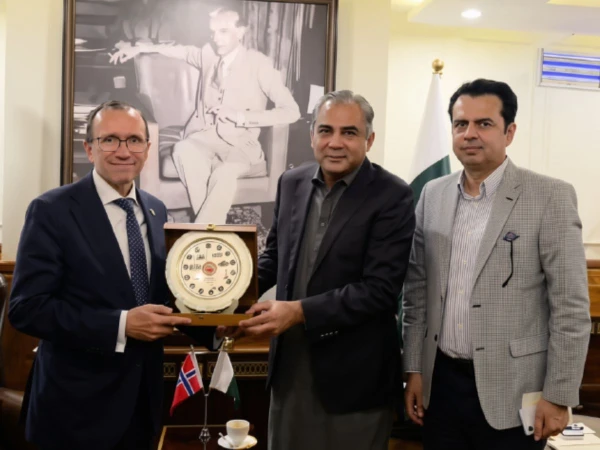
ISLAMABAD: Norwegian Foreign Minister Espen Barth Eide met Interior Minister Mohsin Naqvi in Islamabad on Friday, with the two sides discussing bilateral relations, regional developments and opportunities to expand cooperation in several key areas.

The meeting focused on strengthening collaboration between Pakistan and Norway in counterterrorism, combating illegal immigration, police training and mutual legal assistance. The officials also exchanged views on the security situation in Afghanistan and the activities of banned organisations operating from its territory.

Naqvi said Pakistan had adopted a zero-tolerance policy against illegal immigration and highlighted measures taken by the country to curb the issue. He said Pakistan’s efforts had contributed to a 47 per cent decline in illegal immigration to Europe, adding that the European Union had also acknowledged the effectiveness of these measures.

The interior minister stressed the importance of expanding legal migration channels as part of efforts to tackle illegal immigration.

Discussing Afghanistan, Naqvi said Pakistani security concerns remained linked to the continued use of Afghan territory by militant groups for attacks against Pakistan. He called for stronger international cooperation to eliminate terrorism and said the global community must work collectively to address the threat.

During the meeting, Foreign Minister Eide praised Pakistan’s constructive and active efforts to help reduce tensions between the United States and Iran. He also appreciated the contribution of the Pakistani community living in Norway, noting its growing role in politics, healthcare and other sectors.

Naqvi described the Norwegian foreign minister’s visit as an important opportunity to further strengthen relations between the two countries and expand cooperation in areas of mutual interest.

Minister of State for Interior Talal Chaudhry, the federal interior secretary and other senior officials also attended the meeting.

Moreover, A high-level Norwegian delegation led by Foreign Minister Espen Barth Eide met Pakistan’s Chief of Army Staff and Chief of Defence Forces, Field Marshal Syed Asim Munir, at General Headquarters (GHQ) in Rawalpindi on Thursday.

According to the Inter-Services Public Relations (ISPR), the meeting focused on matters of mutual interest, regional security and Pakistan-Norway bilateral relations.

During the meeting, Field Marshal Asim Munir presented Pakistan’s perspective on global peace and regional stability. He stressed the need for greater cooperation and joint efforts to address emerging security challenges.

The two sides also discussed the evolving security environment in the region and the importance of strengthening coordination between Pakistan and Norway.

The Norwegian foreign minister acknowledged the role of the Pakistan Armed Forces in contributing to regional peace and stability.

Both sides expressed their commitment to further strengthening bilateral relations and expanding cooperation, particularly in the fields of defence and security.

The meeting comes as Pakistan continues to engage with international partners on regional security, peace and broader strategic issues. The discussions with the Norwegian delegation provided an opportunity for both countries to explore avenues for deeper institutional and defence-related engagement.

The two sides reaffirmed their resolve to maintain regular engagement and enhance cooperation in areas of mutual interest.
Similar Posts

  • | | |

    Pakistan rejects EU GSP+ report, defends reform re…

    Pakistan has expressed disappointment over the European Union’s latest assessment of the country’s performance under the Generalised Scheme of Preferences Plus (GSP+), saying the report does not accurately reflect the scale of reforms implemented over the past several years. Speaking during the weekly media briefing, Foreign Office spokesperson Tahir Andrabi said Pakistan appreciates that the report acknowledges the country’s legislative progress and continued implementation of the 27 international conventions linked to the GSP+ programme. However, he said the overall assessment presents an unbalanced picture by placing greater emphasis on areas where progress has been slower while overlooking broader reforms. Andrabi said Pakistan has introduced wide-ranging legal, administrative, and institutional reforms since joining the GSP+ scheme in 2014. He maintained that these reforms have strengthened governance, improved labour protections, promoted human rights, and supported sustainable economic development. The spokesperson described GSP+ as one of the most important pillars of Pakistan’s economic partnership with the European Union. He said the preferential trade arrangement has played a significant role in boosting exports, creating employment opportunities, increasing women’s participation in the workforce, reducing poverty, and supporting economic growth. He reaffirmed Pakistan’s commitment to constructive dialogue with the European Commission and other European institutions. According to Andrabi, the government remains fully committed to implementing international conventions and continuing reforms aimed at meeting its obligations under the GSP+ framework. He also highlighted that Pakistan’s cooperation with the European Union extends beyond trade. Both sides continue to work together in areas including climate resilience, migration, regional security, counterterrorism, development, connectivity, education, and economic cooperation. During the same briefing, the Foreign Office also rejected allegations made in a recent Amnesty International report regarding Pakistani military strikes in Kabul earlier this year. Andrabi said Pakistan completely rejects the claims, arguing that the report contains serious allegations without credible evidence. He maintained that any military action taken by Pakistan was carried out solely in self-defence and targeted terrorist hideouts and logistical facilities. He said the operations were conducted only after other options had been exhausted and fully complied with the principles of necessity, distinction, proportionality, and precaution under international law. He added that Pakistan exercised restraint despite facing repeated cross-border terrorist attacks. The spokesperson urged the international community to focus greater attention on militant groups operating from Afghan territory. He said organisations such as the Tehreek-i-Taliban Pakistan (TTP), the Baloch Liberation Army (BLA), and other affiliated groups continue to maintain bases and carry out attacks against Pakistan from across the border. Andrabi called on the Afghan Taliban authorities to fulfil their international commitments by preventing terrorist organisations from using Afghan territory for attacks against neighbouring countries. He said the continued presence of militant groups poses a serious threat to regional peace and security. The Foreign Office reiterated that Pakistan reserves the right to take all necessary measures to defend its sovereignty, territorial integrity, and the safety of its citizens. Andrabi said no responsible state can ignore repeated attacks on its people and security forces.

  • | |

    Three injured as rival MQM-P groups clash at party…

    KARACHI: Internal differences within Muttahida Qaumi Movement-Pakistan (MQM-P) intensified on Sunday after supporters of two rival factions allegedly clashed outside the party’s Bahadurabad headquarters in Karachi, leaving at least three people injured. According to reports, tensions between supporters of the groups associated with MQM-P Chairman Khalid Maqbool Siddiqui and senior leader Mustafa Kamal escalated following a party meeting. The confrontation turned violent as workers allegedly exchanged slogans, engaged in physical fighting, and pelted stones at each other. Witnesses also reported aerial firing near the Bahadurabad headquarters during the unrest, creating panic in the area. Three people sustained injuries during the clashes. Senior MQM-P leader Dr Farooq Sattar said the dispute erupted after a meeting of party leaders at the Bahadurabad office. Speaking to the media, he alleged that supporters of one faction assaulted MPA Ejaz-ul-Haq and party leader Zakir. He further claimed that party leaders Mangla Sharma and Sabeen Ghori were also mistreated during the incident. MQM-P leader Amin Ul Haque alleged that one party worker was injured in the firing, while several others suffered injuries due to stone-pelting. He also claimed that extensive vandalism took place inside the party office and that the office’s DVR recording system was taken away. Amin Ul Haque said the matter had reached a point where it could no longer be ignored and called the incident deeply concerning for the party. Meanwhile, Dr Farooq Sattar later arrived at the Bahadurabad headquarters following the clashes as senior party leaders attempted to assess the situation and address the growing internal crisis.

  • | |

    FIA launches unit to hunt dark web criminals

    The Federal Investigation Agency (FIA) has established a dedicated unit to investigate criminals operating through the dark web. The move is aimed at strengthening Pakistan’s ability to deal with hidden online criminal networks. The new unit has been set up at the FIA’s National Command and Control Centre (NC3) in Islamabad. It will use advanced technology and digital investigation techniques to identify suspects who use encrypted platforms to conceal their identities. FIA Director General Dr Usman Anwar said the unit would focus on criminal networks involved in activities that fall under the agency’s jurisdiction. Investigators will also examine suspicious digital transactions, including those involving cryptocurrencies. A major focus will be networks involved in producing fake documents. Such documents can be used to facilitate human trafficking and illegal migrant smuggling. The unit will also investigate other forms of cyber-enabled crime linked to the dark web. The dark web is a hidden part of the internet. Its websites are not normally indexed by standard search engines. Access often requires specialised software and knowledge. Criminals can use these systems to hide their identities and locations. The technology has also been misused for illegal trade, cybercrime and other criminal activities. Authorities face additional challenges because many dark web networks operate across national borders. Criminals can also use cryptocurrency to make financial transactions more difficult to trace. The FIA plans to address these challenges through modern digital investigation tools and greater coordination between specialised teams. The new unit will work closely with the FIA’s cryptocurrency investigation unit. Both units will operate under the same facility and share technical expertise. Investigators will use blockchain forensic techniques to examine cryptocurrency transactions. These techniques can help authorities analyse transactions and potentially connect anonymous or pseudonymous digital addresses with real-world identities. Open-source intelligence will also be used to support investigations. Officials said digital evidence gathered from different sources could help strengthen criminal cases. Investigators will track aliases, usernames and pseudonyms used by suspected criminals across online marketplaces, forums and other hidden platforms. The information will be used to build detailed profiles of suspected offenders. Authorities can then use the evidence to identify suspects and pursue legal action. NC3 Director Dr Athar Waheed explained the basic structure of the internet. He said it is commonly divided into three broad layers: the surface web, deep web and dark web. The surface web includes websites that can be found through regular search engines. News websites, social media platforms, blogs and online shopping sites are examples. The deep web contains online material that search engines do not index. This includes private databases, email accounts, banking systems, academic resources and internal organisational networks. Much of the deep web is legitimate. Users normally need passwords, subscriptions or specific permissions to access such content. The dark web is a smaller and deliberately hidden section of the deep web. It uses technologies designed to provide greater anonymity. Tor is one of the technologies commonly associated with accessing dark web services. It routes internet traffic through multiple volunteer-operated relays, making it more difficult to identify the original source. The FIA’s new unit will seek to overcome these anonymity measures through digital forensics, intelligence gathering and technological investigation.

  • |

    Iranian lawmaker questions Saudi defence pact with Pakistan, Türkiye

    TEHRAN: Iranian parliamentarian Ebrahim Rezaei has questioned whether Saudi Arabia’s new defence agreement with Pakistan and Türkiye can guarantee the Kingdom’s security. Rezaei, a member of Iran’s Parliament National Security and Foreign Policy Committee, made the remarks in a social media post. He said Saudi Arabia should understand that the agreement with Pakistan and Türkiye would not provide the level of protection Riyadh had failed to obtain despite decades of reliance on the United States. Rezaei described the agreement as a “paper pact” and urged Saudi Arabia to reconsider its policies so that it would not have to seek security guarantees from other countries. His comments came shortly after Saudi Arabia, Pakistan and Türkiye signed a joint defence agreement in Makkah. The agreement was signed amid concerns over potential attacks on Saudi Arabia by Iran-aligned militias in Iraq and Yemen. Saudi officials have reportedly warned of such security threats. Under the new agreement, an attack against any one of the three countries will be considered an attack against all three. The pact aims to strengthen defence cooperation and develop joint capabilities among Saudi Arabia, Pakistan and Türkiye. A trilateral defence summit was held at Al-Safa Palace in Makkah, attended by Saudi Crown Prince Mohammed bin Salman, Turkish President Recep Tayyip Erdogan and Pakistani Prime Minister Shehbaz Sharif. According to Pakistan’s Foreign Office, the three leaders signed the agreement, formally described as the Makkah Defence Joint Agreement.

  • | |

    Hassan Murtaza slams alleged AJK rigging

    Pakistan Peoples Party (PPP) Central Punjab General Secretary Hassan Murtaza has accused the ruling Pakistan Muslim League-Nawaz (PML-N) of rigging in the Azad Jammu and Kashmir (AJK) elections. Murtaza said the election process was marred by serious violations of the electoral code of conduct. He alleged that the rules were repeatedly ignored during polling. He made these remarks while addressing a press conference in Lahore. Murtaza also criticised the role of the Election Commission during the elections. He alleged that the commission failed to perform its duties impartially. According to him, it appeared to be acting like an election agent instead of an independent institution. The PPP leader strongly criticised the PML-N over the election results. He accused the party of setting a new example of electoral manipulation. “You steal the mandate of whoever you want,” Murtaza said while criticising the PML-N. He also referred to former prime minister Nawaz Sharif’s statements about AJK. Murtaza said Sharif was now visiting Kashmir and calling for himself to be made prime minister. The PPP leader said the current political situation in AJK was also linked to the sacrifices and political role of the PPP. Murtaza said that if Nawaz Sharif was able to go to Kashmir today and demand the prime minister’s position, it was partly because of the PPP’s political contribution. The PPP leader also raised serious concerns over violence during the polling process. He said a PPP worker was killed on election day. Murtaza described the incident as a serious matter that would remain part of the political record. He said history would record what happened during the elections. It would also establish who was responsible for the violence and who lost his life. The allegations came after the PML-N emerged as the leading party in the first phase of the AJK elections. The party secured nine seats, according to the results cited in the report

  • | |

    War leaves Gaza zoo animals malnourished

    GAZA/CAIRO: The war in Gaza has taken a heavy toll on animals, with shortages of food, medicine and vaccines leaving many of them weak and malnourished. At a zoo near the Nuseirat refugee camp, visitors found animals showing clear signs of the difficult conditions. A lion remained largely inactive inside its cage, while chimpanzees sat quietly in their enclosure. The zoo is being operated by Mahmoud Gomaa, who has worked to keep the animals alive despite the continuing crisis. He previously ran a zoo in Rafah but was forced to leave the area after Israeli military operations reached the city in 2024. Gomaa said saving the animals became a priority for him during the war. He moved the surviving animals from one location to another before eventually settling in Nuseirat, where he reopened the zoo earlier this year. He said he had faced enormous difficulties in finding food and providing basic care for the animals. Before the war, Gaza had several zoos that housed wild and exotic animals. The conflict, however, has made maintaining such facilities extremely difficult. Veterinarians say the shortage of suitable food has affected the animals’ health. Some zoo owners have been forced to feed animals frozen meat because fresh food is difficult to obtain. The war has also caused direct losses among Gaza’s animals. When Gomaa left Rafah, he said he had to abandon three lions, several crocodiles and African ostriches. When he later returned, he found only the bones of the crocodiles and ostriches. The lions had also disappeared. Animal welfare experts say the impact of war extends beyond food shortages and physical injuries. Continuous explosions, aircraft noise and fighting can cause severe stress among animals. Veterinarian Amir Khalil, who has visited Gaza with the animal welfare organisation Four Paws, said animals can detect sounds and disturbances that humans may not notice. He said the constant conflict creates fear and extreme stress for them. Despite the harsh conditions, the zoo has become a temporary place of relief for some children. Children visiting the facility were able to interact with parrots and smaller monkeys. For many, it offered a rare opportunity to step away from the destruction surrounding them. Residents say children have few places left where they can play. Large parts of Gaza have been reduced to rubble, while many families continue to live in tents. The zoo therefore serves a purpose beyond displaying animals. It provides children with a brief moment of normality amid a devastating humanitarian crisis. Yet keeping the facility operating remains a major challenge. Limited supplies, damaged infrastructure and the continuing conflict threaten both the animals and the people caring for them.

Leave a Reply

Your email address will not be published. Required fields are marked *