crimean residents struggle
|

Crimean residents struggle with power cuts as Ukrainian strikes disrupt daily life

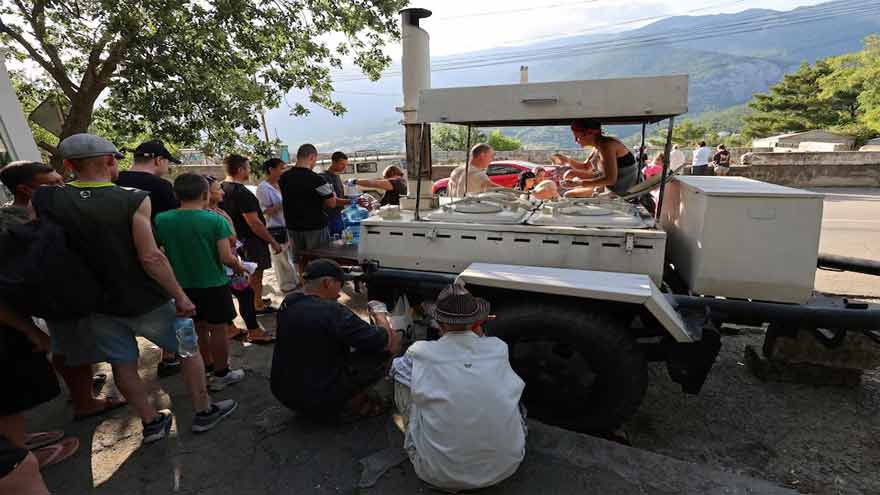
Residents across Crimea are facing growing hardship after repeated Ukrainian attacks on energy infrastructure disrupted electricity and fuel supplies across the peninsula. Long power outages have forced many families to rely on community kitchens for hot meals as daily life becomes increasingly difficult.

Crimea, which Russia annexed from Ukraine in 2014, has experienced months of pressure on its energy network following Ukrainian strikes targeting power plants and other strategic facilities. Ukrainian officials say the campaign is aimed at weakening Russia’s military capabilities and bringing the effects of the war closer to Russian controlled territory. The attacks come as Ukraine continues to endure regular missile and drone strikes on its own cities since Russia launched its full scale invasion in 2022.

In the town of Massandra, local authorities have organised public meal services for residents who are unable to cook because of prolonged electricity cuts. Large pots of buckwheat and reheated canned beef are prepared each day and distributed to around 200 people. Officials say many households depend entirely on electric stoves, leaving them without a way to prepare food when the power goes out.

Massandra town administration head Oksana Madyud said the community kitchens were set up to support families facing ongoing disruptions. She explained that many residents have no alternative cooking methods and need access to hot meals until electricity supplies become more stable. Local workers continue preparing food every day to help elderly residents and vulnerable families cope with the difficult conditions.

The prolonged outages have created serious challenges for many people, particularly those living in high rise apartment buildings. Marina, a local resident, said she was forced to search for a gas stove and fuel cylinders after losing electricity in her apartment. She explained that climbing down from her tenth floor flat has become painful because of a leg injury, yet she had little choice because her home has only an electric cooker that cannot be used during blackouts.

Another resident, Alexandra, said she had spent ten days without electricity before power was finally restored. She joined the queue for a hot meal after being drawn by the smell of freshly prepared food. Although electricity had returned that afternoon, she remained uncertain whether the supply would continue once she reached home, reflecting the uncertainty many families now face.

Fuel shortages have added to the difficulties across towns and cities in Crimea, making transport and everyday activities more challenging. The continuing disruption has increased pressure on local authorities to provide emergency support while residents adjust to frequent interruptions in essential services.

As the conflict between Russia and Ukraine continues, civilians on both sides are increasingly feeling the consequences. While Ukraine says its strikes are intended to weaken Russia’s military infrastructure, residents in Crimea are left dealing with power shortages, limited fuel supplies and an uncertain daily routine as the war continues to affect civilian life far from the front lines.
Similar Posts

  • |

    Turkish parliament passes landmark law to advance PKK peace process

    Turkey’s parliament passed a law on Monday establishing a legal framework for the disbandment of the outlawed Kurdistan Workers’ Party (PKK), marking a major step toward ending a decades-old conflict that has killed tens of thousands. The legislation provides legal protections for many former militants who have not committed specific crimes and facilitates the suspension of prison sentences for some people convicted of PKK membership, paving the way for their reintegration into society. The law was approved by a 468-vote majority in the 600-seat parliament after securing support from President Tayyip Erdogan’s ruling AK Party, its nationalist MHP allies, and the pro-Kurdish DEM Party. This measure represents the most concrete step taken by Ankara in the peace process since jailed PKK leader Abdullah Ocalan called on the group in February 2025 to disarm and disband. Following Ocalan’s call, the PKK announced in May 2025 that it would end its armed struggle, leading to a symbolic ceremony in northern Iraq two months later where a group of militants burned their weapons. The PKK launched its insurgency in 1984, leading to a conflict that has killed over 40,000 people, placed a heavy economic burden on southeast Turkey, and fuelled decades of political and social division. This new legislation specifically addresses the long-standing question of how to manage thousands of PKK members as the organisation dismantles its military and organizational structures. The current public peace initiative began in October 2024 when MHP leader Devlet Bahceli unexpectedly suggested that Ocalan could address parliament to announce the PKK’s dissolution. A parliamentary commission established in August 2025 subsequently heard testimony from politicians, officials, and civil society groups before recommending legislation to oversee disarmament and reintegration. While the law addresses reintegration, it does not by itself resolve broader Kurdish demands regarding expanded political and cultural rights, anti-terrorism amendments, or the detention status of Ocalan. The Turkish government frames the initiative as a pathway toward creating a “terror-free Turkey,” whereas Kurdish politicians emphasize that achieving lasting peace requires broader democratic and legal reforms.

  • |

    Myanmar offensive clears path for Russia-backed po…

    DAWEI, Myanmar: Myanmar’s military has deployed hundreds of troops into the country’s southern Tanintharyi region in an offensive aimed at clearing areas earmarked for a Russia-backed special economic zone, according to resistance fighters and a local activist familiar with developments in the area. The campaign around the Dawei Special Economic Zone (SEZ), which includes plans for a deep-sea port and power plant on the Andaman Sea, represents one of the clearest signs yet that Myanmar’s military-backed government is prepared to use force to revive a long-delayed project seen as a potential alternative trade route to the Strait of Malacca. The offensive also comes as Myanmar’s leadership intensifies diplomatic efforts to attract foreign investment. Junta chief-turned-President Min Aung Hlaing promoted the Dawei project during a recent visit to Thailand and discussed its prospects again this week during talks with Russian President Vladimir Putin in Moscow. Villages Caught in Military Push Since July, hundreds of soldiers have reportedly moved into Tanintharyi, a region bordering Thailand where the Dawei project is located. Their advance has triggered repeated clashes with local resistance groups, according to two sources. “The military is advancing its columns and conducting area-clearance operations. Some villages and homes have been burned down,” Saw Dah Ko of the Tanintharyi Region People’s Defence Force told Reuters. A second resistance fighter, operating with the Dawei District No.1 battalion under the shadow National Unity Government, said troops had burned homes in at least three villages and killed three aid workers helping displaced communities. The civil society group MAGGA Initiative said the three aid workers were detained and killed after encountering a military column in Yebyu Township on July 9. Reuters was unable to independently verify the accounts. Myanmar’s government and Russia’s embassy in Myanmar did not respond to requests for comment. Conflict monitor ACLED said the offensive had involved a column of about 700 soldiers advancing into surrounding areas, with raids on villages and reports of civilian deaths. The military’s campaign has reportedly been supported by air and naval attacks, according to local sources, putting pressure on loosely organised resistance groups. “They enter the region, and once reinforced by the navy, they launch offensives into the villages situated within the deep sea port project area,” said Min Lwin Oo of the Democracy Movement Strike Committee. A Strategic Project The push around Dawei is part of the military’s wider effort to regain territory and strategic border areas lost to opposition groups following the 2021 coup that plunged Myanmar into civil war. The conflict has killed an estimated 100,000 people and displaced more than 3.5 million, according to humanitarian and conflict assessments. The military-backed government has sought to strengthen its control while pursuing projects that could bring investment and strategic partnerships. The Dawei SEZ is among the most ambitious. Originally launched in 2008 as a joint venture with Thailand, the project was intended to create a major industrial and transport hub linking Southeast Asia with markets in East and West Asia. However, construction stalled in 2013 amid local opposition and funding difficulties. In early 2021, shortly before the military takeover, authorities moved to terminate agreements covering nine projects in the initial construction phase and said they would seek new partners. Russia has now emerged as a key potential supporter. Russia Sees Gateway to Asia At a business forum in Moscow this week, Tanintharyi Chief Minister Zaw Naing Oo promoted Dawei as a faster route for regional trade. State media quoted him as saying cargo could reach its destinations four to six days faster through Dawei than by travelling through the Strait of Malacca. The proposed port is also around 45 kilometres from Myanmar’s major offshore gas fields, adding to its strategic appeal. Russian Prime Minister Mikhail Mishustin said Russian companies were interested in working with the Dawei SEZ, potentially expanding trade and creating employment opportunities for small and medium-sized businesses. For Moscow, the project could offer more than commercial returns. A person familiar with Russian thinking said the port could provide Russia with greater access to Southeast Asian markets and a foothold in the Indian Ocean region. But the source cautioned that Myanmar remains a high-risk investment destination. “The risk in Myanmar is still very high,” the source said, adding that Russian investment would need strong connectivity with Thailand for the project to make economic sense. A Project With High Stakes The Dawei development could reshape trade routes across the region if it is successfully revived. Its location on the Andaman Sea offers a potential route that could reduce reliance on the heavily used Strait of Malacca. For Myanmar’s military leadership, restoring control over the surrounding territory is therefore closely linked to its ambitions for the project. For local communities, however, the military advance has brought renewed fear and displacement. The fate of Dawei now rests on a difficult balance between geopolitics, investment and security — with the proposed port’s future increasingly tied to the outcome of Myanmar’s continuing civil war.

  • | |

    Bessent says Hormuz shipping deal with Iran could …

    US Treasury Secretary Scott Bessent said on Tuesday that a deal to reopen the Strait of Hormuz to normal shipping traffic could be reached within a day or two, as diplomatic activity intensified across the Gulf region. Speaking in a television interview, Bessent said American officials are in active discussions with Iranian counterparts and expressed optimism about a near term breakthrough. “There is a chance we may have a deal today or tomorrow,” he said, adding that the goal is to move toward a more normalized posture in the conflict. Asked whether any agreement would let Iran charge ships a toll for using the waterway, Bessent said he expects the outcome to guarantee freedom of movement rather than a fee based system. He noted that vessel traffic through the strait has picked up in recent days despite lingering danger, and predicted that energy prices would ease once a deal takes hold. His comments followed a report from The New York Times saying Iran and Oman have moved close to an arrangement that would restore commercial shipping through the strait. Under the terms described in that report, inbound vessels would travel through a corridor close to the Iranian coast while outbound ships would use a route nearer Oman. Iranian officials told the newspaper that no formal tolls would apply, though they said a service charge tied to environmental protection, cargo security and staffing costs would be split evenly between Tehran and Muscat. A US official pushed back on that characterization, calling the Iranian version inaccurate and insisting any temporary shipping lanes would not need Iranian sign off or involve fees. The report also noted that some Pentagon officials worry the arrangement could look like a concession to Tehran, while some Iranian officials privately questioned whether it would actually stop further American strikes. Qatar’s Foreign Ministry said Tuesday that mediators including Doha, Pakistan and Oman continue to coordinate closely to bridge the gap between Washington and Tehran, exchanging draft proposals between the two sides. Ministry spokesperson Majed Al Ansari said there is still no clear timeline for a final agreement, and Qatar separately called for a return to normal conditions in the strait while diplomacy continues. Tension over the waterway remained visible even as talks progressed. A dry bulk carrier called the Minoan Pioneer, sailing under the Liberian flag, was struck by an unidentified projectile near Oman’s coast on Tuesday, according to maritime security sources. The strike reportedly hit the engine room and sparked a fire in the crew’s living quarters, forcing the entire crew to abandon ship. One crew member, the vessel’s third engineer, was reported missing. The ship’s Greece based operator did not immediately respond to requests for comment. The incident followed an earlier report from the UK Maritime Trade Operations center, which said a separate cargo vessel had broadcast that it was hit by an unknown projectile about 20 nautical miles northeast of Khasab, Oman. No group has claimed responsibility for either strike, and authorities have opened an investigation. In Tehran, President Masoud Pezeshkian used a televised address to reject reports that he had offered his resignation amid the ongoing standoff with Washington. “If I were going to resign, I would announce it publicly,” he said, denying any rift with Supreme Leader Ali Khamenei or the armed forces and insisting the leadership is working in full coordination. He separately said Iran intends to defend its territorial integrity but has no interest in expanding the conflict, while claiming Iranian missile and drone strikes had disrupted US military goals during a recent 17 day period of fighting. The regional picture grew more complicated elsewhere. Yemen’s Houthi movement claimed responsibility for a drone strike on Najran Airport in southern Saudi Arabia, with military spokesman Yahya Saree saying the attack struck its target accurately. He described the strike as retaliation for alleged Saudi drone incursions over Yemen’s Saada and Hajjah provinces and warned that further violations would draw a response. Saudi authorities had not commented on the claim as of Tuesday. In Lebanon, a seventh round of direct negotiations with Israel opened in Rome under American sponsorship, continuing talks tied to a framework agreement the two sides signed in June covering a phased Israeli withdrawal from Lebanese territory in exchange for Lebanese army deployment and the disarming of armed factions, a clear reference to Hezbollah. Hezbollah Secretary General Naim Qassem used a speech at an Arbaeen commemoration in Baalbek to criticize the talks, saying they have delivered only “shame, humiliation, despair and repeated concessions” for Lebanon. He accused Lebanese President Joseph Aoun of acting with bias rather than serving as a unifying figure and argued that only the earlier US brokered truce between Washington and Tehran had kept Israeli strikes at bay. Financial markets showed relief at the signs of diplomatic movement. Brent crude futures fell about 7 percent to near $83.77 a barrel on Monday, while the Dow Jones Industrial Average closed at a record high. Asian stocks and oil prices ticked higher again on Tuesday. In a Truth Social post, Trump described Iran’s leadership as “unbelievably duplicitous” while claiming more talks were scheduled for the near future. He also reasserted that the US Navy maintains full control over the strait, writing that nothing passes through unless Washington allows it. The exchange fits a broader pattern that has defined the conflict since it began roughly five months ago under the codename Operation Epic Fury. Trump has repeatedly threatened major military escalation only to step back and cite diplomatic openings, while Iran has publicly refused direct talks with Washington since a memorandum of understanding both sides signed collapsed in early July. Washington maintains that June’s memorandum obligated Iran to open the Strait of Hormuz to shipping, while Tehran insists the agreement preserved its authority over traffic through the waterway, a disagreement that continues to sit at the center of the standoff.

  • |

    Narine’s quiet advice helped Tariq silence the noise on his action

    Pakistan spinner Usman Tariq has shared how a call from West Indies great Sunil Narine helped him push through one of the toughest stretches of his career, as questions swirled around the legality of his bowling action. Tariq broke into international cricket last year, earning his debut against South Africa after a string of impressive performances for Trinbago Knight Riders in the Caribbean Premier League. Since then, his unconventional action has become a talking point almost every time he takes the ball. The 28-year-old has repeatedly had to defend himself, after both England batter Tom Banton and Australian all-rounder Cameron Green appeared to signal suspicion over a possible throw during separate matches. ICC regulations allow bowlers to straighten their arm by up to 15 degrees mid-delivery, and Tariq maintains he stays well within that limit. He puts the unusual look of his action down to the natural structure of his elbow rather than anything illegal. He made a similar point earlier this year while playing in the ILT20, explaining that his elbow simply does not allow him to straighten his arm fully, regardless of how his action might appear from the outside. The debate resurfaced ahead of Pakistan’s blockbuster clash with India at the ICC Men’s T20 World Cup 2026, when parts of the Indian media suggested he was being held back from earlier games purely to keep him fresh for that one fixture. The theory did not hold up for long, since Tariq had already featured in Pakistan’s second T20I against Australia before the tournament, and he went on to play his part throughout the World Cup. Speaking with former Pakistan batter Fawad Alam, Tariq revealed that Narine had called him directly during the most intense period of criticism. According to Tariq, the two spoke for close to 30 minutes, with Narine telling him to tune out the noise, stay consistent with his cricket, and remember that critics were only targeting him because they struggled to counter his bowling. Tariq’s action has been reported twice across his career, and both times he was cleared after review. The most recent clearance followed testing at an ICC-accredited biomechanics laboratory, where he bowled 24 deliveries for analysis before being given the green light to continue.

  • | |

    US publication praises Pakistan’s digital financ…

    A US publication has praised Pakistan’s efforts to modernise its financial system, saying the country is steadily strengthening its position in the global digital financial landscape through reforms and technological innovation. The article highlighted Pakistan’s initiatives to promote digital transformation and said the country has the potential to play a meaningful role in the evolving global digital economy. It also commended the vision of Pakistan Virtual Assets Regulatory Authority (PVARA) Chairman Bilal Bin Saqib, stating that Pakistan must actively position itself within the international digital financial system to benefit from emerging technologies and new economic opportunities. According to the publication, the future will belong to countries that make swift decisions and implement reforms without delay. It noted that Pakistan has the opportunity to emerge as a leader in the digital economy by embracing innovation and adopting forward-looking policies. The article further stated that governments can no longer rely solely on traditional bureaucratic systems. Instead, they must adopt the speed, flexibility and innovation-driven approach of technology startups to remain competitive in a rapidly changing global environment. It added that digital assets are becoming the foundation of the future financial infrastructure and countries investing in digital finance today will be better positioned for long-term economic growth and global competitiveness. The publication’s remarks come as Pakistan continues to promote digital payments, financial technology and cashless transactions as part of its broader strategy to modernise the economy and expand financial inclusion.

  • | |

    Pakistan Embassy in Ankara marks Kashmir Exploitat…

    The Embassy of Pakistan in Ankara commemorated Kashmir Exploitation Day with national spirit and dignity, reaffirming Pakistan’s unwavering support for the people of Indian Illegally Occupied Jammu and Kashmir (IIOJK) and their right to self-determination. The event marked seven years since India’s August 5, 2019, decision to revoke the special constitutional status of Jammu and Kashmir. Participants reiterated solidarity with the Kashmiri people and called for a peaceful resolution of the dispute in accordance with United Nations Security Council resolutions. The ceremony was attended by prominent Turkish political leaders, diplomats, academics, members of parliament, representatives of think tanks, members of the diplomatic corps, media personnel, and members of the Pakistani and Turkish communities. The event began with the recitation of the Holy Quran, followed by special messages from President Asif Ali Zardari and Prime Minister Shehbaz Sharif. The messages reaffirmed Pakistan’s support for the Kashmiri people’s struggle and urged the international community to play an effective role in implementing UN Security Council resolutions on the Kashmir dispute. Chairman of the Geopolitical Foresight Institute, retired Major General Goray Alpar, highlighted the strategic and geographical importance of Jammu and Kashmir. He said the people of Pakistan and Türkiye share deep historical, cultural, and brotherly ties. He also warned that India’s unilateral actions, constitutional changes, and attempts to use shared water resources as political leverage could threaten peace and stability across the region. SESRIC Director General and former Turkish minister Zehra Zümrüt Selçuk reaffirmed the Organisation of Islamic Cooperation’s principled stance on the Kashmir issue. She said a just and lasting solution could only be achieved by allowing the people of Kashmir to exercise their right to self-determination in line with UN Security Council resolutions. She also drew parallels between the situations in Kashmir and Palestine, urging the international community to fulfil its responsibilities in pursuing a fair and durable solution. Turkish parliamentarian and Deputy Chairman of the Felicity Party, Mustafa Kaya, strongly criticised India’s policies in Indian-administered Kashmir, describing them as “demographic terrorism.” He said efforts to alter the region’s demographic composition, deprive local residents of land rights, and implement settlement policies similar to those seen elsewhere would not suppress the Kashmiri people’s aspirations for freedom. In his concluding remarks, Pakistan’s Ambassador to Türkiye, Dr. Yousaf Junaid, thanked the Turkish government and people for their continued support on the Kashmir issue. He alleged that India was pursuing a policy of demographic change in the region by issuing millions of domicile certificates to non-local residents while maintaining restrictions on independent media and continuing state repression. The ambassador said India’s unilateral constitutional measures could not change the internationally recognised disputed status of Jammu and Kashmir. He stressed that lasting peace, security, and stability in South Asia depended on a just resolution of the Kashmir dispute and reiterated Pakistan’s call for a free, fair, and impartial UN-supervised plebiscite to allow the Kashmiri people to determine their political future.

Leave a Reply

Your email address will not be published. Required fields are marked *