|

Turkish parliament passes landmark law to advance PKK peace process

Turkey’s parliament passed a law on Monday establishing a legal framework for the disbandment of the outlawed Kurdistan Workers’ Party (PKK), marking a major step toward ending a decades-old conflict that has killed tens of thousands.

The legislation provides legal protections for many former militants who have not committed specific crimes and facilitates the suspension of prison sentences for some people convicted of PKK membership, paving the way for their reintegration into society.

The law was approved by a 468-vote majority in the 600-seat parliament after securing support from President Tayyip Erdogan’s ruling AK Party, its nationalist MHP allies, and the pro-Kurdish DEM Party.

This measure represents the most concrete step taken by Ankara in the peace process since jailed PKK leader Abdullah Ocalan called on the group in February 2025 to disarm and disband.

Following Ocalan’s call, the PKK announced in May 2025 that it would end its armed struggle, leading to a symbolic ceremony in northern Iraq two months later where a group of militants burned their weapons.

The PKK launched its insurgency in 1984, leading to a conflict that has killed over 40,000 people, placed a heavy economic burden on southeast Turkey, and fuelled decades of political and social division.

This new legislation specifically addresses the long-standing question of how to manage thousands of PKK members as the organisation dismantles its military and organizational structures.

The current public peace initiative began in October 2024 when MHP leader Devlet Bahceli unexpectedly suggested that Ocalan could address parliament to announce the PKK’s dissolution.

A parliamentary commission established in August 2025 subsequently heard testimony from politicians, officials, and civil society groups before recommending legislation to oversee disarmament and reintegration.

While the law addresses reintegration, it does not by itself resolve broader Kurdish demands regarding expanded political and cultural rights, anti-terrorism amendments, or the detention status of Ocalan.

The Turkish government frames the initiative as a pathway toward creating a “terror-free Turkey,” whereas Kurdish politicians emphasize that achieving lasting peace requires broader democratic and legal reforms.

Similar Posts

  • |

    Cristiano Ronaldo marries Georgina after 8-year love story

    Cascais, Portugal: Football superstar Cristiano Ronaldo and his longtime partner Georgina Rodríguez have officially turned nearly a decade of love into marriage, marking a new chapter in one of the world’s most closely followed celebrity relationships. The 41-year-old Portuguese football icon and 32-year-old Spanish-Argentine model tied the knot in a private civil ceremony in Cascais, Portugal, on August 11, with their five children reportedly present for the intimate occasion. The couple confirmed the news through a simple but powerful social media post. Ronaldo shared a photograph showing the couple’s hands together, with their wedding bands clearly visible, alongside the caption “C❤️G”. The understated announcement quickly sent fans around the world into celebration mode. The wedding comes exactly one year after Rodríguez announced their engagement in August 2025, displaying her striking oval-shaped diamond ring and declaring that she would say “yes” to Ronaldo in this life and every life. Their love story began in 2016, when Rodríguez was working as a sales assistant at a Gucci store in Madrid. Their relationship soon grew beyond the fashion world, and they made their first major public appearance together at the Best FIFA Football Awards in Zurich in January 2017. Over the years, the pair built a family life away from Ronaldo’s demanding football career. They share five children: twins Eva Maria and Mateo, daughters Alana and Bella, and Ronaldo’s eldest son, Cristiano Jr. Their journey has also included profound personal hardship. In 2022, the couple announced the heartbreaking death of Bella’s twin brother, Ángel, shortly after his birth. The tragedy became one of the most difficult moments of their relationship, with the couple supporting each other through the loss. Now, after years of shared memories, family milestones and public attention, Ronaldo and Rodríguez have officially become husband and wife. For fans who have followed their journey since its early days, the wedding represents the long-awaited finale to a love story that began quietly in a Madrid fashion store and eventually captured global attention.

  • | |

    JI expands nationwide protest over fuel levy and i…

    ISLAMABAD: Jamaat-e-Islami (JI) held protest sit-ins in several major cities on Monday for the second consecutive day, intensifying its campaign against high petroleum levies, rising inflation and increased utility bills. The protests were organised in Karachi, Lahore, Peshawar and other cities across the country. The party said its demonstrations would continue until the government addresses its demands. Addressing a sit-in in Lahore, JI Emir Hafiz Naeemur Rehman described the protests as the beginning of a broader nationwide movement. He said the party had prepared a strategy to expand the campaign and expressed satisfaction with the participation in different parts of the country. JI leaders criticised the government over the growing financial burden on ordinary citizens. They argued that higher fuel-related charges have contributed to increased prices of essential goods and made household expenses more difficult to manage. In Karachi, a JI demonstration was held outside the Governor House. Party leaders accused the government of relying excessively on petroleum levies and taxes to generate revenue. JI Karachi women wing leader Javed Fahim called on the government either to withdraw what she described as unnecessary financial burdens or face stronger public resistance. She warned that the party could expand its sit-ins to major roads across Karachi if its demands were not accepted. JI Karachi Emir Monem Zafar Khan said the party’s demands included a reduction in fuel prices and a forensic audit of independent power producers (IPPs). He said controlling inflation should be among the government’s top priorities and argued that ordinary citizens were bearing the impact of rising fuel costs, electricity bills and prices of daily-use commodities. The protests come after the government recently increased the petroleum levy on diesel by Rs1 per litre, taking it to Rs77.28. The levy on petrol remained at Rs80 per litre, while the levy on kerosene was unchanged at Rs20.36 per litre. JI leaders said they would continue mobilising supporters across the country and would consider further expanding the protest movement if their demands were not met.

  • |

    Iran appoints former revolutionary guards chief Mohsen Rezaei to National Security Council

    TEHRAN: Iran has appointed veteran military and political figure Mohsen Rezaei to a senior position within the country’s Supreme National Security Council (SNSC), replacing Mohammad Baqer Zolqadr and bringing one of the Islamic Republic’s most prominent former Revolutionary Guards commanders back into a central security role. The appointment was announced late Sunday by the office of Iranian President Masoud Pezeshkian’s deputy director of communications. No official explanation was immediately provided for the change, and it remains unclear whether Rezaei’s appointment will result in any significant shift in Iran’s security or foreign policy. Rezaei, 71, has extensive experience in Iran’s military, security and political institutions. He served as commander of the Islamic Revolutionary Guard Corps (IRGC) from 1981 until 1997, a period that included most of the Iran-Iraq war. His return to a prominent security position comes at a particularly sensitive time for Iran, amid continuing tensions with the United States and Israel, as well as uncertainty surrounding the security of the strategically important Strait of Hormuz. The SNSC is one of Iran’s most important institutions for coordinating national security and foreign policy. Although the council is formally chaired by the elected president, it brings together senior military, intelligence and government officials, along with representatives of Supreme Leader Mojtaba Khamenei. Major strategic decisions ultimately remain subject to the authority of the supreme leader. Zolqadr’s short tenure ends Zolqadr had been appointed secretary of the SNSC only in late March. He took over the position following the death of his predecessor, Ali Larijani, who was killed in an air strike during the conflict involving Iran, the United States and Israel. Unlike Zolqadr, Rezaei has maintained a considerably higher public profile over the course of his political career and has frequently spoken on major domestic, economic and foreign-policy issues. In a separate decree issued Sunday, Supreme Leader Mojtaba Khamenei appointed Rezaei as his representative to the SNSC. The decree referred to Rezaei’s extensive experience, including his service during the 1980-1988 Iran-Iraq war. Hardline politician Saeed Jalili also serves as the supreme leader’s representative on the council. The same decree appointed Zolqadr as Khamenei’s political adviser, suggesting that his departure from the SNSC leadership does not represent a complete withdrawal from the country’s senior political establishment. Rezaei’s long political career Rezaei’s career has extended well beyond the military. After leaving his post as IRGC commander, he served for more than two decades as secretary of Iran’s Expediency Discernment Council, an influential body involved in resolving disputes between state institutions and advising the supreme leadership. He later entered the executive branch, serving as vice president for economic affairs from 2021 to 2023 during the administration of former President Ebrahim Raisi. Rezaei also holds a doctorate in economics from the University of Tehran. Despite his academic background, much of his professional life has been spent within Iran’s military, security and political establishment. His appointment therefore places an experienced figure with a long history in Iran’s national security apparatus at the center of a council responsible for coordinating some of the country’s most consequential strategic decisions. Strait of Hormuz remains key issue The leadership change comes as Tehran continues discussions over the future of shipping through the Strait of Hormuz, a critical international energy route. Iranian Foreign Minister Abbas Araqchi said Saturday that Tehran and Oman were nearing an understanding on a possible new shipping route through the strait. The waterway has faced severe disruption during months of conflict and escalating regional tensions. However, Iranian officials have indicated that reopening the route would depend on broader conditions being met. These reportedly include demands related to US compensation for Iran and an end to what Tehran describes as American threats and aggression. Zolqadr had previously outlined several demands, including an end to US threats against Iran, the cessation of military action against Iran and its regional allies, the lifting of sanctions and blockade measures, and the release of Iranian assets. The demands highlight the wider diplomatic and security challenges facing Tehran as it attempts to manage relations with Washington while dealing with continuing regional instability. Policy direction remains uncertain The replacement of Zolqadr by Rezaei does not necessarily indicate an immediate change in Iran’s foreign-policy direction. The SNSC operates within a broader political system in which the supreme leader has ultimate authority over major matters of national security and international affairs. However, Rezaei’s extensive military background and long involvement in Iran’s senior political institutions could make his appointment significant, particularly as Tehran navigates negotiations, military tensions and economic pressure.

  • | |

    LHC rejects PTI plea for Minar-e-Pakistan rally

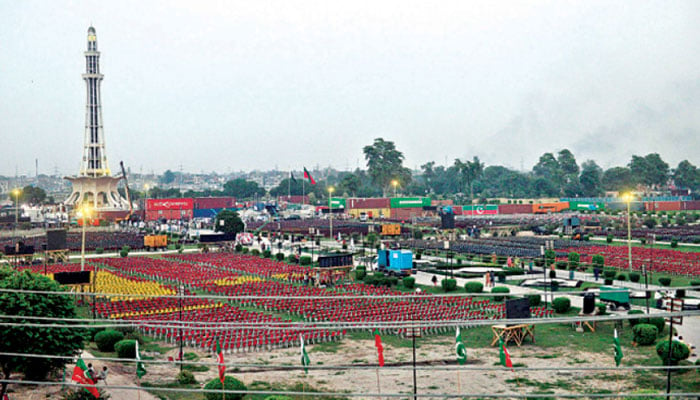
    The Lahore High Court has dismissed a petition filed by Pakistan Tehreek-e-Insaf (PTI) seeking permission to hold a public gathering at Minar-e-Pakistan. Justice Mirza Waqas Rauf announced the written decision on a petition filed by Mian Usman Akram. The petitioner had asked the court to allow the party to hold a rally at Minar-e-Pakistan. He argued that refusing permission for the gathering violated the constitutional right to peaceful assembly. The petition referred to Article 16 of the Constitution. The article protects the right of citizens to assemble peacefully and without arms, subject to reasonable restrictions imposed by law. The court, however, noted that the right to peaceful assembly does not mean that every gathering can be held without following the relevant legal procedure. Under the applicable law, permission for a public gathering is granted through the relevant administrative authorities. The deputy commissioner is responsible for considering such requests and issuing an NOC where required. During the proceedings, the government’s lawyer informed the court that a meeting had already been held under the deputy commissioner to consider the PTI’s request. The meeting reviewed the security and law and order situation in the area. Officials recommended that the proposed rally should not be allowed because of security concerns. The written judgment also noted the nature of Minar-e-Pakistan as a public place. The court observed that the site is regularly visited by citizens for recreational and other public activities. According to the government’s submission, the deputy commissioner had already taken a decision on the PTI’s application. The request for permission to hold the rally was rejected on August 3. The court observed that the administrative authority had already decided the matter. Therefore, the petition could not be entertained as a request for permission that was still pending before the deputy commissioner. The Lahore High Court consequently dismissed the petition.

  • | |

    Olivia Dean celebrates record-breaking music milestone

    British singer-songwriter Olivia Dean has added another major achievement to her growing career after performing before nearly 97,000 fans at Lollapalooza 2026, marking her first time headlining a music festival in the United States. The 27-year-old artist shared the milestone on social media, describing the experience as emotional and unforgettable. She admitted feeling overwhelmed before taking the stage and thanked fans and her team for their continued support throughout her musical journey. Dean delivered an energetic performance that received an enthusiastic response from the massive crowd, making her American festival debut one of the standout moments of this year’s event. The latest success comes only days after Dean celebrated another landmark achievement in the United Kingdom. Her duet with British singer Sam Fender, “Rein Me In,” has officially become the longest-running number one single in UK chart history, setting a new national record. During her performance at Lollapalooza, Dean took a moment to acknowledge the historic accomplishment and shared her excitement with the audience. She then welcomed Sam Fender to the stage, where the pair performed “Rein Me In” together for the first time in the United States. The chart-topping track is a re-recorded duet from Fender’s third studio album, People Watching. Released in June 2025, the song climbed to the top of the UK Singles Chart in early 2026 before going on to achieve its record-breaking run.

Leave a Reply

Your email address will not be published. Required fields are marked *