germany faces icj
| |

Germany faces ICJ hearing over Nicaragua’s Gaza …

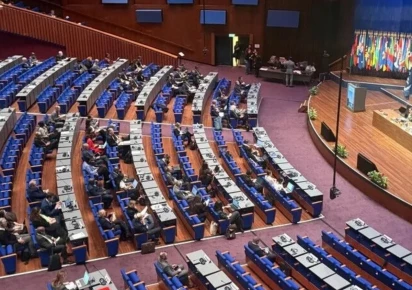
THE HAGUE: The International Court of Justice (ICJ), the United Nations’ highest judicial body, has announced that it will hold public hearings in September to examine Germany’s preliminary objections in a case filed by Nicaragua over alleged violations of international law related to the occupied Palestinian territory, particularly the Gaza Strip.

According to an official statement issued by the court, the hearings will take place from September 7 to September 10 at the Peace Palace in The Hague. The proceedings will focus solely on Germany’s objections to the court’s jurisdiction and the admissibility of parts of Nicaragua’s legal claims before the case can move forward on its merits.

Nicaragua initiated the case on March 1, 2024, accusing Germany of breaching its obligations under the Genocide Convention, the 1949 Geneva Conventions, their Additional Protocols and other principles of international humanitarian law.

The Central American nation argues that Germany has failed in its duty to help prevent genocide by continuing political, financial and military support for Israel during the conflict in Gaza. Nicaragua also claims Germany’s decision to suspend funding for the United Nations Relief and Works Agency for Palestine Refugees (UNRWA) contributed to worsening the humanitarian situation.

According to Nicaragua, the ongoing conflict, which began in October 2023, has created what it describes as a recognized risk of genocide against the Palestinian population in Gaza, making all states party to the Genocide Convention responsible for taking preventive measures.

Germany formally challenged the case on October 21, 2025, filing preliminary objections that argue the ICJ does not have jurisdiction to hear the dispute. Berlin also contends that several of Nicaragua’s claims are legally inadmissible. Under ICJ procedures, consideration of the main case has been suspended until the court decides whether it has the authority to proceed.

The hearing schedule provides Germany with the first opportunity to present oral arguments on September 7, followed by Nicaragua on September 8. Germany will return for a second round on September 9, while Nicaragua will deliver its final submissions on September 10.

The case is being closely watched by governments, legal experts and international human rights organizations, as the court’s eventual ruling on jurisdiction could determine whether one of the most closely followed legal disputes arising from the Gaza conflict proceeds to a full hearing on its merits.

Similar Posts

  • | | | |

    Trump says Hormuz reopening near, warns Iran of consequences

    US President Donald Trump has said the Strait of Hormuz could reopen “very soon” as diplomatic efforts with Iran continue, while warning that Tehran would face a strong military response if negotiations fail. Speaking during an interview with Fox News, Trump expressed optimism about the ongoing talks, saying discussions had made significant progress. He claimed Iranian representatives had requested negotiations at a time when the United States was preparing for a large-scale military operation. According to Trump, Washington agreed to engage in dialogue after receiving signals from Tehran that it was willing to negotiate. He stressed that the United States remains committed to preventing Iran from acquiring nuclear weapons and said abandoning the talks would have serious consequences. The US president said negotiators spent the entire day in discussions and described the atmosphere as positive. He added that a successful agreement could help restore normal shipping through the Strait of Hormuz, one of the world’s most important energy routes. Trump also suggested that reopening the strategic waterway would ease pressure on global energy markets. He said lower oil prices could eventually translate into cheaper fuel costs for consumers and urged energy companies to reduce gasoline prices if market conditions improve. Speaking later to reporters in California, Trump said developments with Iran were moving in the right direction and indicated that greater clarity on the negotiations could emerge within the next 48 hours. Diplomatic efforts are reportedly being supported by regional mediators, including Oman and Qatar. Discussions are focused on restoring safe maritime navigation through the Strait of Hormuz while reducing tensions between Washington and Tehran. However, Iranian officials have maintained that progress depends on an end to US threats and continued respect for Iran’s sovereignty. The Strait of Hormuz is a vital global shipping lane through which a significant share of the world’s oil and liquefied natural gas exports passes. Any disruption to traffic through the waterway has immediate consequences for international energy markets and global trade. Financial markets reacted positively to reports of progress in the negotiations. Oil prices declined while Asian stock markets advanced on expectations that a diplomatic breakthrough could reduce regional tensions and restore uninterrupted shipping. Meanwhile, reports from Israel indicated growing concern over Washington’s diplomatic approach. Some Israeli officials reportedly believe the United States is prioritising a negotiated settlement with Iran, although no official Israeli government statement has confirmed those claims.

  • | |

    Saudi Defense Minister holds urgent talks with Trump

    Saudi Defense Minister Prince Khalid bin Salman held an urgent meeting with US President Donald Trump as Riyadh sought to convey a special message from Saudi Crown Prince Mohammed bin Salman to the American leadership, according to US media reports. The meeting came amid heightened tensions in the Middle East, with Saudi Arabia reportedly pushing for de-escalation while also stressing its readiness to defend its territory and interests. Earlier, during a meeting with US Vice President JD Vance, Prince Khalid said Saudi Arabia wanted to reduce tensions with Iran. He reportedly argued that Iran-backed Iraqi militias had crossed a red line by attacking critical infrastructure and energy facilities, leaving Riyadh with no choice but to respond. However, the Saudi defense minister stressed that the military action in Iraq did not reflect a desire to escalate the regional conflict. He said the operation aimed to demonstrate that Saudi Arabia remains prepared to defend itself when necessary. Prince Khalid also reportedly told Vance that Israeli Prime Minister Benjamin Netanyahu was pushing for greater confrontation with Iran, while Saudi Arabia preferred a path of de-escalation, which it considers more beneficial for regional stability and its own interests. According to US media reports citing sources familiar with the discussions, Saudi Arabia also intended its strikes in Iraq to send a message to Yemen’s Houthi movement. Prince Khalid reportedly told the US vice president that Saudi Arabia has the capability to deal with the Houthis on its own and does not currently need direct US intervention on the issue. The Saudi defense minister also said Riyadh continues to engage in talks with the Houthis, indicating that Saudi Arabia remains open to diplomatic efforts alongside its military preparedness. The meetings highlight Riyadh’s attempt to balance military deterrence with diplomatic engagement as tensions involving Iran, Israel, Iraqi militias and the Houthis continue to shape the security situation across the region.

  • 40,000 Stranded Tourists Return Home Safely from Thailand

    BANGKOK — More than 40,000 tourists stranded in Thailand by flight disruptions in the Middle East have safely returned home, aided by the Civil Aviation Authority of Thailand’s (CAAT) temporary approval for tour operators in originating countries to send charter flights to retrieve them, the Tourism Authority of Thailand (TAT) announced. Passengers to/from Thailand Urged […]

  • | |

    Ahaan Panday, Sharvari film gets release date

    A major update has emerged about Ahaan Panday and Sharvari’s upcoming untitled film with director Ali Abbas Zafar. Yash Raj Films has officially announced that the romantic action entertainer will hit cinemas on March 26, 2027, during the Good Friday weekend, giving fans a release date for one of Bollywood’s most anticipated upcoming projects. The film marks the first on-screen collaboration between Ahaan Panday and Sharvari. Directed by Ali Abbas Zafar and backed by Aditya Chopra under the Yash Raj Films banner, the project has been generating significant buzz since it went on floors earlier this year. The announcement has further heightened expectations following Ahaan’s successful debut and Sharvari’s growing popularity in the industry. Apart from Ahaan and Sharvari, the film also features Bobby Deol and Aaishvary Thackeray in pivotal roles. According to reports, the project is a romantic action drama that blends high-octane action sequences with an emotional love story. Much of the film has been shot across the United Kingdom, with the makers aiming to deliver a visually grand cinematic experience. The announcement comes at a time when Ahaan Panday’s career is receiving widespread attention after the success of Saiyaara. Industry insiders believe Yash Raj Films is positioning the young actor as one of its next leading stars, with the Ali Abbas Zafar directorial expected to further establish him in Bollywood. Sharvari, meanwhile, continues to strengthen her impressive film lineup. The actress has earned praise for her recent performances and is currently attached to several major productions. Her pairing with Ahaan has already sparked curiosity among moviegoers, with many eager to see the fresh on-screen chemistry between the two stars. For Ali Abbas Zafar, the film marks his reunion with Yash Raj Films after years. The filmmaker previously delivered successful films for the studio and is returning with another large-scale commercial entertainer. Fans are expecting the director’s signature blend of action, romance and emotionally driven storytelling. The official release date announcement has been welcomed enthusiastically on social media, with fans expressing excitement about the cast and the collaboration between Yash Raj Films and Ali Abbas Zafar. Although the film’s title remains under wraps, the latest update confirms that audiences can expect to see Ahaan Panday and Sharvari together on the big screen on March 26, 2027, making it one of the most awaited Bollywood releases of the year.

  • | |

    PTI chairman barrister Gohar Says Noreen Niazi’s…

    Rawalpindi: Pakistan Tehreek-e-Insaf (PTI) Chairman Barrister Gohar Ali Khan has clarified that the recent statement made by Noreen Niazi regarding the “Battle of Truth” (Maarka-e-Haq) does not reflect the official policy of the party. Speaking to the media in Rawalpindi, Barrister Gohar emphasized that the remarks were Noreen Niazi’s personal views and should not be interpreted as PTI’s official position. During the media interaction, Barrister Gohar said that every Pakistani takes pride in the country’s success in what he described as the Maarka-e-Haq. He stressed that Pakistan’s defense is strong and capable of protecting the country from any external threat. According to him, the nation remains united when it comes to safeguarding its sovereignty, and no enemy has the ability to defeat Pakistan. Addressing questions about Noreen Niazi’s comments, Barrister Gohar explained that, according to the information available to him, the interview in question had actually been recorded around three months ago. He stated that the remarks expressed during that interview represented Noreen Niazi’s personal opinion and not the official stance of Pakistan Tehreek-e-Insaf. He reiterated that the party’s policies are determined through its official leadership and decision-making process, not through individual statements. The PTI chairman further said that the party has consistently been trying to improve the overall political atmosphere in the country. He noted that political leaders should avoid reopening old controversies and instead focus on reducing tensions. According to Barrister Gohar, this is a time for restraint and reconciliation rather than confrontation. He remarked that everyone should avoid revisiting past disputes if the goal is to create a more stable political environment. Speaking about the current political climate, Barrister Gohar also referred to comments made by Jamiat Ulema-e-Islam (F) chief Maulana Fazlur Rehman. He pointed out that the senior politician had already clarified his earlier remarks. Barrister Gohar observed that, during emotional speeches, public figures may sometimes say things that they later need to explain. However, he added that if a statement is incorrect, it should be acknowledged as such regardless of who made it. He further emphasized that certain sensitive matters should not be discussed publicly if doing so could worsen the political situation. According to him, some issues are better left untouched in order to help the country move toward greater political stability and national harmony. He urged political leaders and stakeholders to exercise caution in their public statements and avoid comments that could increase tensions. Barrister Gohar also spoke about PTI’s position regarding the upcoming Azad Jammu and Kashmir (AJK) elections. He stated that, at present, the party’s official decision is to boycott the elections. However, he indicated that the decision is not necessarily final and could be reviewed if political conditions improve in the future. He revealed that there had been internal discussions within the party about reconsidering the boycott. According to Barrister Gohar, some members believed that PTI should revisit its decision and participate in the elections. Nevertheless, he explained that the party leadership could not reach a consensus on changing the existing policy. As a result, the decision to boycott the AJK elections remains in place for now. The PTI chairman concluded by reiterating the party’s commitment to promoting political stability and constructive dialogue. He stressed that while differences of opinion are a normal part of politics, all political actors should prioritize national unity and work toward creating an environment that supports peace, democratic processes, and institutional stability.

  • |

    Oil prices tumble to three-week low as Trump delays Iran strike

    LONDON: Global oil prices recorded their sharpest single-day decline in weeks on Monday, falling to a three-week low after US President Donald Trump stepped back from plans for a military strike against Iran, raising hopes that diplomatic efforts could ease tensions and prevent disruptions to energy supplies from the Gulf. International benchmark Brent crude dropped 7 percent, or $6.35, to settle at $83.77 per barrel, while US West Texas Intermediate (WTI) crude fell 5.1 percent, losing $4.33 to close at $80.34 per barrel. The decline marked Brent’s weakest closing level since mid-July. Market analysts said the drop was also influenced by the expiry of the higher-priced September Brent contract, with the less expensive October contract becoming the new front-month benchmark. Investor sentiment shifted sharply after Trump announced that he had postponed military action against Iran, saying he wanted to allow time for diplomacy aimed at reaching an agreement that could reduce regional tensions and potentially increase Iranian oil exports. The possibility of additional crude entering global markets eased concerns over supply shortages, prompting traders to sell oil futures and pushing prices lower. However, Tehran quickly dismissed suggestions that negotiations with Washington were underway. Iranian Foreign Ministry spokesman Esmail Baghaei said there were no talks taking place with the United States and no meetings had been scheduled. He added that Iran had no plans to host foreign delegations or send negotiators abroad in the coming days. Trump, meanwhile, maintained that discussions with Iran were in progress and warned Tehran of serious consequences if it failed to reach an agreement aimed at ending the ongoing confrontation. Analysts call market reaction excessive Energy analysts said oil markets appeared to react strongly to political rhetoric rather than confirmed developments. According to analysts at energy consultancy Ritterbusch and Associates, the steep decline in crude prices reflected what they described as an overreaction by investors to Trump’s comments suggesting that an agreement with Iran could be imminent. They noted that the US president has repeatedly made strong statements regarding Iran before later softening his position, creating significant volatility in energy markets. Analysts also observed that Trump’s public calls for lower fuel prices in the United States have frequently weighed on oil markets by reducing expectations of sustained price increases. During Monday’s trading session, US gasoline and diesel futures also declined by nearly 5 percent, reflecting broader weakness across the energy sector. Shipping routes remain under pressure Despite hopes for diplomacy, concerns over maritime security in the Middle East continued to influence market sentiment. Shipping data showed that six Saudi-flagged supertankers altered their routes in recent days, avoiding the Gulf of Aden and instead sailing around southern Africa after Yemen’s Iran-backed Houthi movement threatened to target Saudi vessels. At the same time, some oil tankers continued to transit the region. Two Saudi oil tankers successfully crossed the Bab el-Mandeb Strait over the weekend, while vessel movements through the Strait of Hormuz slowed following reports of attacks on commercial shipping. The Strait of Hormuz remains one of the world’s most strategically important energy chokepoints, carrying roughly one-fifth of global oil trade before hostilities between the United States, Israel and Iran escalated earlier this year. A Panama-flagged tanker transporting Russian naphtha also reportedly abandoned plans to pass through the Bab el-Mandeb, choosing the longer route around Africa due to security concerns. Russia boosts maritime security Russia announced on Monday that it was strengthening security measures for commercial shipping in the Azov-Black Sea region while working to expand alternative export routes, following increased attacks on vessels linked to the conflict in Ukraine. As one of the world’s largest crude producers and a leading member of the OPEC+ alliance, Russia remains a key player in global energy markets. Disruptions to exports from the Gulf, Russia and Kazakhstan have continued to limit global oil supplies throughout the year, preventing previously announced OPEC+ production increases from fully reaching international markets. In a separate development, OPEC+ approved a production quota increase of approximately 188,000 barrels per day beginning in September. Although the move is intended to gradually raise output, analysts believe geopolitical risks and transportation disruptions could continue to limit the actual flow of additional crude to global buyers.

Leave a Reply

Your email address will not be published. Required fields are marked *