
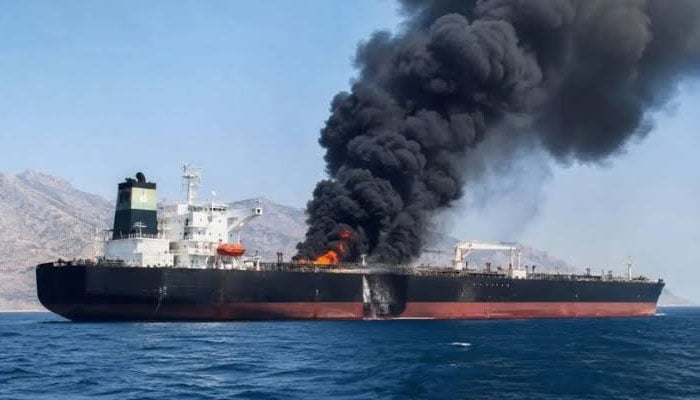
oil tanker hit
| | |

Oil tanker hit near Oman coast, engine room damage…

MUSCAT: A commercial oil tanker came under attack off the coast of Oman on Saturday after being struck by an unidentified weapon, raising fresh concerns over maritime security in one of the world’s busiest energy shipping corridors.

According to the United Kingdom Maritime Trade Operations (UKMTO), the incident occurred approximately 11 nautical miles northeast of Lima, a coastal area in Oman. The organization said the vessel was hit by an unknown weapon, causing damage to its engine room.

The impact reportedly left the tanker without propulsion, forcing the crew to deal with a loss of control while emergency procedures were initiated. Despite the damage, no casualties or injuries have been reported, and all crew members are believed to be safe.

Authorities have not yet identified the source of the attack or disclosed the identity and flag of the vessel. Maritime security agencies are closely monitoring the situation as investigations continue.

The latest incident comes at a time of heightened tensions across regional waters, where commercial vessels have increasingly faced security threats. Shipping companies operating in the Gulf and nearby sea lanes have been urged to remain vigilant and follow updated security guidance while transiting through the area.

The waters surrounding Oman, particularly routes connecting the Gulf of Oman and the Arabian Sea, are vital for global energy supplies, carrying millions of barrels of crude oil and petroleum products every day. Any disruption in these sea lanes has the potential to affect international shipping and energy markets.

Maritime analysts say even isolated attacks can increase insurance costs, delay cargo movements and intensify concerns among global shipping operators.

Omani authorities and international maritime organizations are expected to release further details once the investigation progresses. Meanwhile, commercial vessels in the region continue to receive security advisories as officials assess the circumstances surrounding the latest attack.

Similar Posts

  • A Long War Ahead: Diplomacy, Nerves, and a Region …

    The Middle East appears to be entering a prolonged phase of strategic tension—one defined not only by the possibility of conflict, but by a high-stakes battle of nerves accompanied by intense diplomatic maneuvering. The American Centcom has briefed the president about the next phase of attacks that Centcom thinks will decaptilze the Iranian power. They warn that they will target the Iranian power plants and with meeting Israeli pm natanyahu also assured and second the trump decision. In response the Iranian also ready to attack in Israeli power plants and in Gcc American bases. So a long war ahead. At the center of this evolving landscape stands Mohammed bin Salman (MBS), whose regional vision and leadership now face one of their most critical tests.   Over the past decade, the Gulf Cooperation Council (GCC), under Saudi Arabia’s influence, aligned itself closely with the United States. This alignment brought undeniable short-term gains: an influx of multinational corporations, the emergence of technology hubs, ambitious infrastructure projects like NEOM, and a rebranding of the Gulf as a global tourism and investment destination. These developments projected an image of modernity and economic diversification—an intentional shift away from rigid conservatism.   However, beneath this transformation lies a deeper geopolitical calculation. The United States sought not only economic engagement but strategic positioning in the Middle East, particularly in the context of its long-standing rivalry with Iran. By encouraging normalization with Israel through frameworks like the Abraham Accords, Washington aimed to consolidate a regional bloc that could counterbalance Tehran.   This strategy, while effective in shaping alliances, also came at a cost. Iran was increasingly portrayed in Western narratives as rigid, anti-modern, and resistant to democratic values. Whether accurate or exaggerated, this portrayal contributed to its diplomatic isolation. Yet, Iran has not remained passive. Instead, it has adopted a dual-track approach—maintaining a posture of resistance while keeping diplomatic channels open. This calculated balance has allowed Tehran to assert its relevance in any future regional order.   Recent developments suggest that the initial cohesion within the GCC may be more fragile than it appeared. Trust built over decades can erode rapidly under pressure, and shifting geopolitical realities have exposed underlying vulnerabilities. If Iran successfully convinces regional actors that its inclusion is essential for stability, it could reshape the Middle Eastern power structure in its favor.   Meanwhile, other key players—Pakistan, Qatar, and Turkey—have attempted to position themselves as mediators. However, their efforts have been slow and, at times, constrained by their own strategic dependencies. Qatar has shown willingness to facilitate dialogue, but Turkey’s independent stance and Pakistan’s cautious approach—often influenced by its ties with Washington—have limited the effectiveness of a unified diplomatic front.   The question, then, is whether diplomacy can still alter the trajectory. Iran’s willingness to engage, even while projecting strength, indicates that a negotiated outcome remains possible. If Tehran can compel regional actors, including Saudi Arabia, to broaden the dialogue and incorporate Turkey into a more inclusive framework, it may shift the balance away from confrontation.   For the United States, the situation presents no clear path to victory. Military escalation risks triggering a wider, multi-stage conflict that could engulf the entire region, placing GCC states in a precarious position. What may have once been framed as a strategic contest could evolve into a prolonged struggle driven by perceptions of credibility and prestige.   In this volatile environment, the risk is not just war—but a drawn-out cycle of escalation and retaliation. Iran, despite sustained pressure, appears increasingly resilient, with its strategic resolve hardening over time. Conversely, the Gulf states must reassess whether their current alignments serve long-term stability or merely short-term gains.   Ultimately, the region stands at a strong moment. The path forward will depend not only on military power but on the success of diplomacy in bridging deep-seated divides. There remains a possibility—however uncertain—that actors like China and Russia could play a crucial role in de-escalation. But trump also hinted that both assured him their neutrality during Iran war. The drones however allegedly counter thinks a Russian help under the war table. If such efforts succeed, they may prevent the Middle East from sliding into a conflict whose consequences would extend far beyond its borders.

  • | |

    Ahaan Panday, Sharvari film gets release date

    A major update has emerged about Ahaan Panday and Sharvari’s upcoming untitled film with director Ali Abbas Zafar. Yash Raj Films has officially announced that the romantic action entertainer will hit cinemas on March 26, 2027, during the Good Friday weekend, giving fans a release date for one of Bollywood’s most anticipated upcoming projects. The film marks the first on-screen collaboration between Ahaan Panday and Sharvari. Directed by Ali Abbas Zafar and backed by Aditya Chopra under the Yash Raj Films banner, the project has been generating significant buzz since it went on floors earlier this year. The announcement has further heightened expectations following Ahaan’s successful debut and Sharvari’s growing popularity in the industry. Apart from Ahaan and Sharvari, the film also features Bobby Deol and Aaishvary Thackeray in pivotal roles. According to reports, the project is a romantic action drama that blends high-octane action sequences with an emotional love story. Much of the film has been shot across the United Kingdom, with the makers aiming to deliver a visually grand cinematic experience. The announcement comes at a time when Ahaan Panday’s career is receiving widespread attention after the success of Saiyaara. Industry insiders believe Yash Raj Films is positioning the young actor as one of its next leading stars, with the Ali Abbas Zafar directorial expected to further establish him in Bollywood. Sharvari, meanwhile, continues to strengthen her impressive film lineup. The actress has earned praise for her recent performances and is currently attached to several major productions. Her pairing with Ahaan has already sparked curiosity among moviegoers, with many eager to see the fresh on-screen chemistry between the two stars. For Ali Abbas Zafar, the film marks his reunion with Yash Raj Films after years. The filmmaker previously delivered successful films for the studio and is returning with another large-scale commercial entertainer. Fans are expecting the director’s signature blend of action, romance and emotionally driven storytelling. The official release date announcement has been welcomed enthusiastically on social media, with fans expressing excitement about the cast and the collaboration between Yash Raj Films and Ali Abbas Zafar. Although the film’s title remains under wraps, the latest update confirms that audiences can expect to see Ahaan Panday and Sharvari together on the big screen on March 26, 2027, making it one of the most awaited Bollywood releases of the year.

  • |

    Fauzia Haimani finishes fourth Ironman challenge

    Fauzia Haimani has done it again. The Pakistani athlete, who is based in Canada, has completed her fourth full Ironman triathlon. This latest finish came at the Ironman event held in Ottawa, where she once again showed off her fitness and endurance. The Ironman is widely considered one of the toughest challenges in endurance sports. It is not a single race. It is three gruelling events combined into one long day. Athletes start with a 3.8-kilometre swim. From there, they move straight into a 180-kilometre cycling stretch. The event then wraps up with a full 42.2-kilometre marathon. All three legs happen back to back, with no rest days in between. Completing all three takes serious physical and mental preparation. Fauzia finished the entire course in 15 hours, 22 minutes, and 35 seconds. Her swim alone took 1 hour and 45 minutes. She then moved on to cycling, completing that portion in 7 hours and 7 minutes. The final stretch, the marathon, took her 6 hours and 11 minutes to finish. This is not new territory for her. Fauzia has completed the full Ironman challenge three times before this latest finish. She first did it in 2021. She returned to complete it again in 2024, and once more in 2025. That makes this her fourth full Ironman overall. Her endurance résumé does not stop there. Alongside the full Ironman races, Fauzia has also completed the half Ironman challenge five separate times. Together, these accomplishments paint the picture of an athlete who has built real consistency in one of the most demanding sports out there. Events like these require months of training. Long swims, long rides, and long runs all need to be built up gradually. Athletes also have to manage nutrition, pacing, and recovery carefully to make it through such a demanding single-day event. Fauzia’s latest finish adds another achievement to her growing list. It also reflects the kind of discipline and determination it takes to keep coming back to one of the hardest physical challenges an athlete can attempt. Her continued participation in international endurance events also highlights the presence of Pakistani athletes on demanding global sporting stages, even outside more commonly covered sports.

  • |

    Harry sees Invictus Games as chance to reconnect with King Charles

    Prince Harry reportedly views next year’s Invictus Games in Birmingham as a genuine opportunity to repair his strained relationship with King Charles. The event is said to hold deep personal significance for him. According to RadarOnline, organisers of the Invictus Games are planning to invite the monarch to attend next year’s edition. Insiders claim the Duke of Sussex sees the homecoming event as a meaningful chance to grow closer to his father. A source told the outlet that Harry views the Birmingham Games as one of the most significant moments he’s experienced in years. According to the insider, bringing Invictus back to Britain carries deep personal weight for him. The source explained that Harry is determined to make the event a landmark occasion, one that celebrates both the organisation’s achievements and the servicemen and women it was created to support. That ambition, they said, remains central to his motivation. Beyond the event itself, insiders suggest there’s an added layer of significance given where things currently stand between Harry and his father. According to the source, Harry believes Invictus offers a rare setting where Charles could attend without the visit becoming solely about their relationship. The insider explained that the competitors would remain the true focus of the occasion throughout. At the same time, father and son could appear together in support of a cause they both understand and care about. That dynamic, sources suggest, could offer a low-pressure opportunity for the two to reconnect. Rather than a formal reconciliation attempt, the setting would allow any interaction between them to unfold naturally within a broader, shared purpose. For Harry, insiders say, the Games represent more than just an athletic event. They are being viewed as a potential turning point in a relationship that has remained visibly strained in recent years. Whether King Charles ultimately accepts the invitation remains to be seen. If he does, though, the Birmingham Games could become one of the more closely watched royal moments of the coming year.

  • |

    Women’s T20 Asia Cup 2026 likely to be held in UAE

    DUBAI: The Women’s T20 Asia Cup 2026 is expected to be staged in the United Arab Emirates, with participating teams reportedly being informally notified about the tournament window ahead of the official announcement by the Asian Cricket Council (ACC). According to cricket media reports, the ACC is expected to confirm both the venue and the complete schedule in the coming days. The tournament is likely to run from August 28 to September 13, featuring eight of Asia’s leading women’s cricket teams. The competing nations are expected to include Pakistan, India, Sri Lanka, Bangladesh, Nepal, Malaysia, Thailand and hosts UAE, promising an exciting contest as teams battle for continental supremacy ahead of future ICC events. The UAE has emerged as the frontrunner to host the tournament due to its world-class cricket infrastructure, favorable playing conditions and extensive experience in organizing major international events. Several global tournaments have previously been held in the Emirates, making it a reliable venue for multinational competitions. The tournament is expected to showcase some of Asia’s biggest women’s cricket stars, with traditional rivals Pakistan and India likely to attract significant attention if they meet during the competition. Meanwhile, the Board of Control for Cricket in India has already announced India’s squad for the tournament. Veteran batter Harmanpreet Kaur will continue to lead the Indian side as captain, reflecting the board’s confidence in her leadership and experience. Other participating teams are also expected to finalize and announce their squads in the coming weeks as preparations gather pace. With the official schedule still awaited, anticipation continues to build among cricket fans across Asia. The Women’s Asia Cup is regarded as one of the region’s premier tournaments and provides teams with valuable international competition while helping them prepare for upcoming global events. If confirmed, the UAE will once again become the center of Asian cricket, hosting another high-profile tournament that promises thrilling matches, emerging talent and intense regional rivalries.

  • | |

    UAE resumes visit visas for Pakistanis

    The United Arab Emirates (UAE) has resumed issuing visit visas to Pakistani citizens applying through registered travel agents, ending months of uncertainty for travelers and offering fresh hope to families, tourists and business visitors. The move has been confirmed by travel industry representatives and a UAE Embassy official, who said visit visas for holders of ordinary Pakistani passports are once again being processed through authorized travel agencies. The resumption comes after months of delays, stricter scrutiny and a higher rejection rate that had created difficulties for thousands of Pakistani applicants. Although UAE authorities repeatedly maintained that no blanket ban had been imposed on Pakistani nationals, many travelers experienced lengthy processing times and uncertainty over visa approvals. Travel experts say the biggest improvement has been seen in family applications. Pakistani citizens traveling with family members or visiting relatives in the UAE are reportedly receiving faster responses than before, reflecting a more streamlined processing system. Officials from the travel industry also noted that tourism-related bookings have started to recover as confidence returns. Passenger traffic between Pakistan and Dubai, which had dropped significantly during recent regional tensions and stricter visa checks, has begun to increase in recent weeks, although it remains below previous peak levels. Applicants seeking a UAE visit visa are advised to apply only through registered travel agents and ensure all required documents are complete. A valid passport, recent photographs, proof of accommodation or an invitation from a host, return travel arrangements and evidence of sufficient financial resources are among the documents generally required for processing. Industry representatives believe applicants with complete and genuine documentation are more likely to receive approvals, while family applications currently appear to have stronger prospects.

Leave a Reply

Your email address will not be published. Required fields are marked *