thailand braces severe

Thailand Braces For Severe Weather

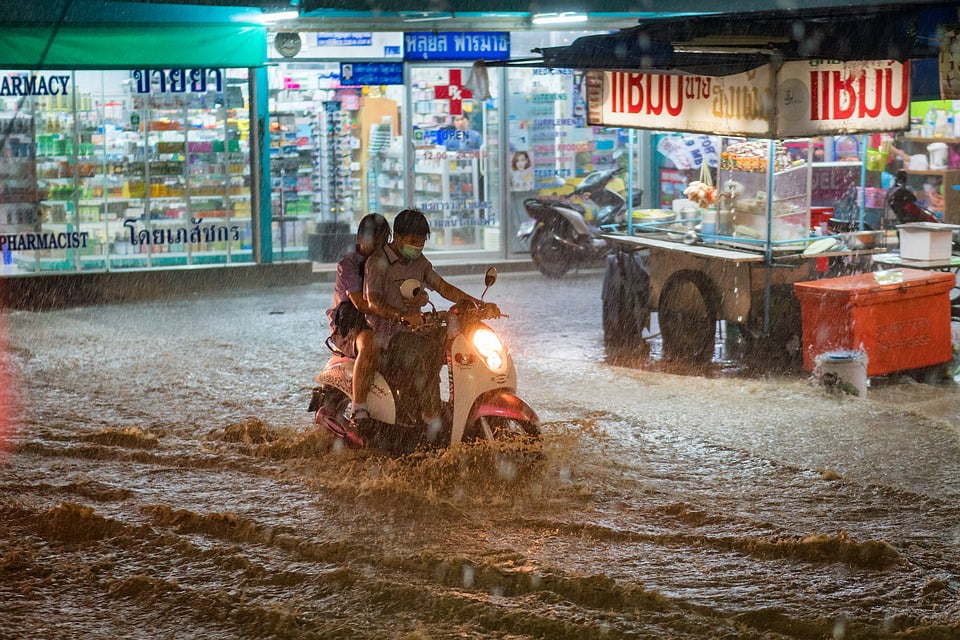
BANGKOK, Thailand — The Thai Meteorological Department has issued severe weather warnings, forecasting very heavy rainfall across the northern and upper northeastern regions of the country, which carries a high risk of flash flooding and dangerous water runoff in several provinces.

Meteorological Department Issues Storm Alert For Multiple Regions

The department reported on Sunday that a relatively strong southwestern monsoon is currently dominating the Andaman Sea, Thailand, and the Gulf of Thailand. This active monsoon trough is projected to persist from Monday through Saturday, stretching across Myanmar, the upper northern territories of Thailand, and upper Laos, before connecting with a low-pressure area situated over Vietnam. This complex meteorological setup is expected to bring continuous and intense precipitation to the affected landmasses.

The accumulation of heavy rain is expected to trigger flash floods, rapid surface runoff, and overflowing waterways. While the North and upper Northeast face the most direct impact from the severe downpours, the western parts of the North, the Central Plains, and the Eastern region are also on high alert for potential flooding and related water hazards. Local authorities in these vulnerable areas are being urged to monitor water levels and prepare for potential emergency responses.

In addition to the terrestrial flood risks, the department has issued a strict maritime advisory for the upper Andaman Sea due to the deteriorating sea conditions. Operators of small boats are strongly advised to keep their vessels ashore until Friday. The powerful monsoon winds are expected to generate rough seas, with wave heights estimated to reach between two and three meters, posing significant dangers to maritime navigation and coastal activities.

Violent Storms Topple Power Poles Across Thailand, Leaving One Dead and Dozens Injured

Residents in the forecasted impact zones are encouraged to stay informed through official meteorological updates, secure their properties against potential water damage, and heed the directives of local disaster mitigation agencies. The Meteorological Department will continue to monitor the evolving weather patterns and will issue further bulletins as the monsoon trough and low-pressure systems develop over the coming days.

-Thailand News (TN)

Similar Posts

  • NACC Finds 44 Ex-Move Forward MPs Guilty Over Lese-Majeste Amendment Bid

    BANGKOK – Thailand’s National Anti-Corruption Commission (NACC) has unanimously ruled that 44 former MPs of the now-dissolved Move Forward Party committed serious ethical violations by proposing a bill to amend the country’s lèse-majesté law. Ex-Move Forward MPs to appoint executive committee of a new party The NACC’s decision, announced today, will be forwarded to the […]

  • Thai Tourism Operators Urge Government To Revise Indian Visa Policy

    PHUKET, Thailand — The private sector across Thailand’s premier Andaman coast provinces has formally petitioned the government to urgently revise the visa policy for Indian nationals, warning that current regulations could cost the country up to 8 billion baht in lost revenue during the upcoming high season. The coalition, comprising 13 major organizations including the […]

  • | | |

    Health minister offers accountability after PIMS t…

    ISLAMABAD: Federal Health Minister Mustafa Kamal has offered himself for accountability following the deaths of newborns in a fire at the Pakistan Institute of Medical Sciences (PIMS), as criticism over the tragedy intensified. Speaking to the media outside PIMS on Wednesday, Kamal said he had placed himself before Prime Minister Shehbaz Sharif for accountability and would accept whatever decision the premier makes. “I have presented myself before Prime Minister Shehbaz Sharif for accountability. He is my boss and will decide my fate,” the minister said. Kamal also assured that action would be taken against anyone found responsible for negligence or any other mistake linked to the incident. The minister said preliminary CCTV footage had provided investigators with an indication of how the fire started. According to him, the footage showed a spark near an air conditioner at around 6:38am. People were seen leaving the area shortly afterwards. He said the presence of oxygen in the ward caused the flames to intensify rapidly. Kamal maintained that the government would not conceal any information related to the incident and that those responsible would be dealt with according to the findings of the investigation. The minister faced protests and angry reactions from people gathered outside the hospital while speaking to reporters. The situation became tense, forcing him to leave the premises. The tragedy has triggered demands for a transparent investigation and accountability of all officials and staff whose actions or omissions may have contributed to the deaths. Pakistan Peoples Party (PPP) Senator Sherry Rehman also called for the health minister’s resignation, saying serious questions had emerged about emergency arrangements at the hospital. Rehman claimed that the emergency department’s door was locked after the fire and that people had to break windows to gain access. She also questioned the reported absence of doctors at the scene. The PPP senator said her party was not seeking to politicise the tragedy but had a responsibility to ask questions about the circumstances that led to the loss of newborn lives. “The minister responsible should resign,” Rehman said. Another senior PPP leader, Nayer Hussain Bokhari, said the Health Ministry must answer questions surrounding the incident. He argued that holding only a single secretary responsible would not be sufficient if the investigation identifies wider administrative failures. The incident has placed renewed focus on safety measures, emergency preparedness and accountability at major public hospitals. Authorities are expected to determine the exact cause of the fire and establish whether negligence, equipment failure or administrative shortcomings contributed to the deaths.

  • | | |

    IHC asked to frame rules for social media use by c…

    ISLAMABAD: The Islamabad High Court has been petitioned to direct the federal government to introduce legislation and a comprehensive regulatory framework governing social media access by children below the age of 16. The petition, filed by advocates Muhammad Jalal Haider and Yahya Farid Khawaja, calls for a reliable age-verification system to prevent minors from creating or operating social media accounts without appropriate safeguards. The petitioners argue that children face growing risks online, including cyberbullying, harassment, exposure to inappropriate material and other forms of digital harm. They have urged the government to establish clear policies covering children’s digital rights, privacy and physical and psychological safety. They have also sought specific legal responsibilities for social media companies, including stronger safeguards for minors and the creation of an institutional mechanism dedicated to protecting children in the digital environment. The petition refers to measures adopted or proposed in countries including Australia, France, Britain, New Zealand and Spain, where authorities have considered age limits, parental consent and age-verification requirements for children’s social media use. Citing the United Nations Convention on the Rights of the Child and General Comment No. 25, the petitioners maintain that protecting children’s best interests is a legal responsibility of the state rather than merely a policy choice. They argue that the absence of an effective age-verification mechanism leaves minors exposed to online dangers and makes it difficult to enforce protections designed specifically for children. The Ministry of Information Technology and Telecommunication, Ministry of Information and Broadcasting, Ministry of Interior, Ministry of Law and Justice, Pakistan Telecommunication Authority and Pakistan Electronic Media Regulatory Authority have been named as respondents. Punjab Assembly Resolution The development follows a resolution submitted to the Punjab Assembly last month calling for restrictions on social media accounts operated by children under 16 without parental consent. The resolution, moved by Punjab lawmaker Sarah Ahmad, urged the provincial government to recommend federal legislation aimed at regulating minors’ access to social media and strengthening online protection. It highlighted concerns over cyberbullying, online exploitation, inappropriate content, digital addiction and psychological distress among children, stressing that safeguarding their physical, mental and moral development is a responsibility of the state. The resolution proposed prohibiting children below 16 from creating or maintaining social media accounts without verified parental or legal guardian consent. It also called on the PTA to develop and enforce effective age-verification mechanisms across platforms operating in Pakistan. It further recommended holding social media companies accountable for child-safety standards, including the timely removal of harmful content and measures to provide a safer online environment for minors.

  • | | | |

    Why Lahore sinks whenever it rains in the city? 

    The rain on July 22 almost sank most parts of Defence Housing Authority. Those low-lying areas of the city were also under water. And this happened as the city was lashed with 343 millimetres of rain for two days, according to the Provincial Disaster Management Authority (PDMA). That spell has gone and when you are reading these lines, the city is undergoing a second rain spell. Pakistan’s Meteorological Department has issued a fresh weather advisory, warning that another active monsoon spell is expected from July 29 to August 5 across much of the country. The department said rain, wind and thundershowers, along with scattered heavy to very heavy rainfall, may trigger urban flooding, flash floods and landslides in vulnerable areas. This will keep the residents of low-lying areas, mainly of Lahore’s south, and DHA on the toe. Reacting to this advisory, environmental activist Rafay Alam explained why cities like Lahore keep flooding every monsoon season, and what is really behind the crisis. He said the Met Department had already notified that rain would continue for two days and people were warned in advance that urban flooding would take place, not just in Lahore, but in several cities across Punjab, including Gujranwala and Sialkot. He then pointed to last year’s floods for comparison. “Those floods were caused by heavy rains in the northern areas of the country, which caused rivers to swell,” he said. On top of that, India had released water from the Pong Dam and Bhakra Dam. He said a gate at the Madhopur headworks also broke, causing water levels in the Ravi river to rise sharply. Alam said the situation today is different. The flooding happening now is not caused by river floods or dam releases. Instead, it is simply due to heavy rainfall occurring within Pakistan itself. He said that if people read the Met Department’s advisory carefully, the heaviest rain in the coming days is expected in the northern areas once again, not directly over Lahore. He advised people to check whether they live in low lying or high lying areas, since this makes a big difference during heavy rain. However, he said that the real issue lies in the sheer intensity of rainfall being recorded now. “Some areas have received around 150 millimetres of rain within just a few hours,” he said. He added that 20 or 30 years ago, when the drainage systems and infrastructure in these areas were built, climate change was never part of the planning. Nobody at that time imagined that such intense rainfall could happen within just a few hours. As a result, the old infrastructure simply cannot handle the kind of rain Pakistan is now experiencing. Dr Farid A Malik, a resident of Defence Phase 5, witnessed the entire flood attack first hand. He said that when he was growing up in the 1950s, 1960s and 1970s, rainwater never used to stand in Lahore. At that time, he said, the city was much smaller and the population was far lower, yet even then, the city did not face standing water after rainfall the way it does today. “Whenever the rain would stop, we children used to go out on our bicycles looking for standing water, just for fun. And there were really only two places where water would collect. One was near Shahdara, and another was near the Do Moriya Pul area close to the railway station. That area of Shahdara was a low lying area,” he said. He recalled that in the 1970s, when Zulfiqar Ali Bhutto’s government came into power, and the People’s Party had a lot of support from that area of Lahore at the time, the government promised that they would install pumps in Shahdara and set up a proper system to drain the water out. And they actually did this. Heavy duty pumps were installed in Shahdara, and they used to successfully drain the water out. Dr Farid said the sewerage system Lahore has today simply cannot handle rainwater, because the amount of water that comes with heavy rain is very large, and the system does not have the capacity to handle that much water. He explained there are two separate problems here. First, the underground sewerage system is not cleaned properly. The pipes, whether four feet wide or six feet wide, have become clogged with scaling inside them over time. So even though a pipe might be four or six feet in diameter, the actual open space left for water to pass through has shrunk down to just one or two feet, meaning the whole system does not flow properly. Second, even if the sewerage system was clean, it still cannot handle rainwater on top of regular sewage. For this reason, Lahore used to have separate storm drains, called nalas in Urdu, which carried rainwater away separately into the Ravi river. Because of this separate system, rainwater never used to accumulate in the city. He said this has changed because storm drains have been blocked, either through neglect or construction on top of them. “An entire market has been built on top of a storm drain along Hall Road,” he said, adding that similar encroachment has happened along the Ravi river itself. Last year, water that should have gone into the river ended up flowing into housing societies instead. Dr Farid also pointed out that when Lahore had open drains instead of an underground sewerage system, the drainage actually worked better. Since the city moved underground, cleaning has become irregular, flow has suffered, and pumping stations work only some of the time. He said Lahore’s expansion added to the problem, since new areas were given sewerage systems but no proper storm drain network for rainwater. DHA, he said, expanded in phases over the years without any master plan covering how sewage and rainwater would both be managed. Speaking about his own neighbourhood, Dr Farid said there is a pumping station near the Sui Gas Society area of Defence that pumps sewage water

  • Thai FM Seeks US Tariff Exemption at ASEAN Summit Talks

    MANILA, Philippines / BANGKOK, Thailand — Thai Foreign Minister Sihasak Phuangketkeow has formally requested assistance from US Secretary of State Marco Rubio to secure an exemption for Thailand from a newly proposed 12.5 percent tariff on imports, a measure currently slated to affect Thailand and 59 other nations. The diplomatic engagement took place on the […]

Leave a Reply

Your email address will not be published. Required fields are marked *