russian missile strike
|

Russian missile strike kills 9 in Kyiv

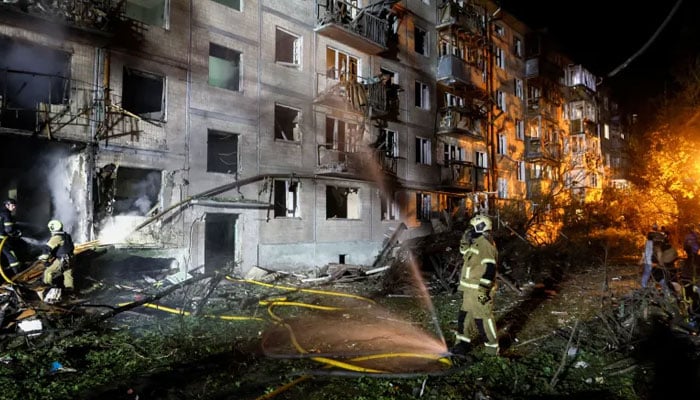
At least nine people were killed and 23 others injured after Russia launched a missile attack on Ukraine’s capital, Kyiv, on Saturday morning, according to Ukrainian emergency authorities.

The Ukrainian Emergency Service said the casualties included two young boys. Officials also reported that one of the injured victims remained in critical condition as rescue and emergency teams continued their operations across the affected areas.

The missile strike caused extensive damage to several buildings and triggered fires at multiple locations in the capital. Emergency workers rushed to the scene to extinguish the fires, secure damaged structures and search through piles of debris for survivors. Rescue teams continued clearing the rubble in an effort to locate anyone who might still be trapped beneath collapsed sections of buildings.

The attack added to growing concerns over the security situation in Kyiv, which has faced an increase in Russian missile and drone strikes in recent months. Ukrainian authorities have repeatedly warned that Russian attacks continue to pose a serious threat to civilians as well as critical infrastructure.

The latest assault also renewed Ukraine’s calls for stronger air defence capabilities. Kyiv has been pressing its Western allies to provide additional advanced defence systems and ammunition, arguing that stronger air protection remains essential to defending major cities and strategic facilities from Russian missile and drone attacks.

Ukraine has particularly sought additional Patriot air defence systems, which can intercept certain types of high-speed missiles and provide protection against aerial threats. Ukrainian officials have consistently described air defence as one of their most urgent military requirements as the conflict continues.

Meanwhile, US President Donald Trump said discussions are continuing over the possibility of providing Ukraine with technology linked to the production of Patriot missile systems. Trump indicated that talks remain ongoing but made clear that Washington has not yet reached a final decision on the matter.

The issue is significant for Ukraine, which has sought to strengthen its ability to defend its territory while reducing its dependence on foreign supplies. Access to advanced air defence technology could potentially help Kyiv expand its defensive capabilities and respond more effectively to repeated missile attacks.

The latest strike comes as the war between Russia and Ukraine continues to put civilians and urban centres at risk. Kyiv remains a key target, and Ukrainian officials have repeatedly appealed to international partners for greater military support and stronger air defence measures to protect the capital and other major population centres.

Similar Posts

  • |

    Japan protests as Putin visits disputed Kuril Islands

    Japan issued a strong protest on Thursday following Russian President Vladimir Putin’s visit to Iturup, an island within the disputed Kuril Islands chain claimed by both nations. According to Russian state media, the visit represents Putin’s first in-person trip to the archipelago. Japanese Foreign Minister Toshimitsu Motegi reiterated Tokyo’s position, stating that the islands are inherently Japanese territory under both historical context and international law. The territorial row over the four southernmost islands, which Japan refers to as the Northern Territories and Russia calls the Southern Kurils, has prevented the two countries from signing a formal World War II peace treaty. The Soviet Union seized the chain in 1945 and subsequently expelled roughly 17,000 Japanese residents. During his itinerary on Iturup, known in Japan as Etorofu, Putin inspected a local fish-processing plant and sampled regional seafood following his observation of naval drills in Russia’s Far East. The strategically located island also houses a primary Russian military air base. Bilateral relations between Moscow and Tokyo have grown increasingly strained in recent years, particularly following Japanese sanctions imposed over the ongoing war in Ukraine.

  • | | |

    For key diplomacy Erdogan urges Trump to keep Iran…

    ANKARA: Turkish President Recep Tayyip Erdogan has urged US President Donald Trump to keep diplomatic channels with Iran open, stressing that continued dialogue could help ease regional tensions. During a telephone conversation, Erdogan and Trump discussed bilateral ties as well as the ongoing conflicts involving Iran and Gaza, according to the Turkish presidency. The two leaders also exchanged views on defence agreements involving Pakistan and Saudi Arabia, amid growing regional security concerns. Erdogan told Trump that diplomacy should be given every opportunity and said Turkey was prepared to contribute to efforts aimed at maintaining dialogue with Iran. The Turkish president also raised concerns over the situation in Gaza, saying Israel’s military actions against Palestinians were continuing at a time when the second phase of a proposed peace plan was expected to begin. The call comes as Ankara continues to advocate diplomatic engagement to prevent further escalation and promote political solutions to conflicts across the region.

  • |

    Myanmar offensive clears path for Russia-backed po…

    DAWEI, Myanmar: Myanmar’s military has deployed hundreds of troops into the country’s southern Tanintharyi region in an offensive aimed at clearing areas earmarked for a Russia-backed special economic zone, according to resistance fighters and a local activist familiar with developments in the area. The campaign around the Dawei Special Economic Zone (SEZ), which includes plans for a deep-sea port and power plant on the Andaman Sea, represents one of the clearest signs yet that Myanmar’s military-backed government is prepared to use force to revive a long-delayed project seen as a potential alternative trade route to the Strait of Malacca. The offensive also comes as Myanmar’s leadership intensifies diplomatic efforts to attract foreign investment. Junta chief-turned-President Min Aung Hlaing promoted the Dawei project during a recent visit to Thailand and discussed its prospects again this week during talks with Russian President Vladimir Putin in Moscow. Villages Caught in Military Push Since July, hundreds of soldiers have reportedly moved into Tanintharyi, a region bordering Thailand where the Dawei project is located. Their advance has triggered repeated clashes with local resistance groups, according to two sources. “The military is advancing its columns and conducting area-clearance operations. Some villages and homes have been burned down,” Saw Dah Ko of the Tanintharyi Region People’s Defence Force told Reuters. A second resistance fighter, operating with the Dawei District No.1 battalion under the shadow National Unity Government, said troops had burned homes in at least three villages and killed three aid workers helping displaced communities. The civil society group MAGGA Initiative said the three aid workers were detained and killed after encountering a military column in Yebyu Township on July 9. Reuters was unable to independently verify the accounts. Myanmar’s government and Russia’s embassy in Myanmar did not respond to requests for comment. Conflict monitor ACLED said the offensive had involved a column of about 700 soldiers advancing into surrounding areas, with raids on villages and reports of civilian deaths. The military’s campaign has reportedly been supported by air and naval attacks, according to local sources, putting pressure on loosely organised resistance groups. “They enter the region, and once reinforced by the navy, they launch offensives into the villages situated within the deep sea port project area,” said Min Lwin Oo of the Democracy Movement Strike Committee. A Strategic Project The push around Dawei is part of the military’s wider effort to regain territory and strategic border areas lost to opposition groups following the 2021 coup that plunged Myanmar into civil war. The conflict has killed an estimated 100,000 people and displaced more than 3.5 million, according to humanitarian and conflict assessments. The military-backed government has sought to strengthen its control while pursuing projects that could bring investment and strategic partnerships. The Dawei SEZ is among the most ambitious. Originally launched in 2008 as a joint venture with Thailand, the project was intended to create a major industrial and transport hub linking Southeast Asia with markets in East and West Asia. However, construction stalled in 2013 amid local opposition and funding difficulties. In early 2021, shortly before the military takeover, authorities moved to terminate agreements covering nine projects in the initial construction phase and said they would seek new partners. Russia has now emerged as a key potential supporter. Russia Sees Gateway to Asia At a business forum in Moscow this week, Tanintharyi Chief Minister Zaw Naing Oo promoted Dawei as a faster route for regional trade. State media quoted him as saying cargo could reach its destinations four to six days faster through Dawei than by travelling through the Strait of Malacca. The proposed port is also around 45 kilometres from Myanmar’s major offshore gas fields, adding to its strategic appeal. Russian Prime Minister Mikhail Mishustin said Russian companies were interested in working with the Dawei SEZ, potentially expanding trade and creating employment opportunities for small and medium-sized businesses. For Moscow, the project could offer more than commercial returns. A person familiar with Russian thinking said the port could provide Russia with greater access to Southeast Asian markets and a foothold in the Indian Ocean region. But the source cautioned that Myanmar remains a high-risk investment destination. “The risk in Myanmar is still very high,” the source said, adding that Russian investment would need strong connectivity with Thailand for the project to make economic sense. A Project With High Stakes The Dawei development could reshape trade routes across the region if it is successfully revived. Its location on the Andaman Sea offers a potential route that could reduce reliance on the heavily used Strait of Malacca. For Myanmar’s military leadership, restoring control over the surrounding territory is therefore closely linked to its ambitions for the project. For local communities, however, the military advance has brought renewed fear and displacement. The fate of Dawei now rests on a difficult balance between geopolitics, investment and security — with the proposed port’s future increasingly tied to the outcome of Myanmar’s continuing civil war.

  • |

    India’s Independence Day faces protests and boycotts

    NEW DELHI: India’s Independence Day celebrations were met with protests, shutdowns and boycott calls in several regions on Saturday, including Indian Illegally Occupied Jammu and Kashmir (IIOJK) and parts of the country’s northeast. Several political, community and regional groups called for strikes and non-participation in official celebrations, with some organisations observing the day as a “Black Day”. In IIOJK, boycott and shutdown calls were reported ahead of the celebrations. Security was significantly increased in Srinagar, with additional personnel deployed around key locations and routes leading to the main Independence Day venue. The protests and boycott calls were also reported in several northeastern states, including Assam, Nagaland, Manipur and Arunachal Pradesh. In Nagaland, Naga nationalist groups observed August 14 as their own Independence Day, recalling the Naga National Council’s declaration of independence in 1947. The groups continue to emphasise their separate political identity and longstanding demand for self-determination. Naga leader Thuingaleng Muivah reiterated that his group would not compromise on its demands concerning sovereignty, a separate flag and constitution. The Naga Students’ Federation also opposed the mandatory singing of Vande Mataram, citing concerns related to religious freedom and freedom of conscience. In Manipur, several organisations called a 12-hour general strike and shutdown. Black flags were reportedly displayed in parts of the state as groups urged people to stay away from official celebrations. Similar boycott calls were issued in Assam and neighbouring areas. Security forces were placed on alert around sensitive locations and border regions amid concerns over possible disruptions. The developments came as India held nationwide celebrations marking its Independence Day, with Prime Minister Narendra Modi leading the main ceremony in New Delhi. Meanwhile, India’s opposition also remained divided over the official celebrations. Congress president Mallikarjun Kharge and Leader of the Opposition Rahul Gandhi did not attend Modi’s ceremony. Their absence was linked to continuing political differences, including disagreements over seating arrangements and protocol.

  • |

    Tyler Boebert got arrested in Colorado

    Tyler Boebert is the 21-year-old eldest son of Republican U.S. Representative Lauren Boebert. He was taken into custody in Garfield County, Colorado, on serious allegations regarding the sexual exploitation of a minor. The Garfield County Sheriff’s Office confirmed that deputies executed an arrest warrant on Sunday, August 9, following a multi-agency investigation involving local law enforcement and the 9th Judicial District Attorney’s Office. Authorities booked the suspect into the Garfield County Jail before he was released the same day after posting a $10,000 bond. According to law enforcement records, the charges were from an investigation into incidents that originated around early January 2024. Court documents indicate that authorities examined allegations involving the unauthorized recording and digital distribution of explicit material depicting a 17-year-old girl. Investigators allege that explicit media recorded when Tyler Boebert was 18 years old was circulated on an online social media profile. The formal charges outlined by prosecutors include three felony counts of sexual exploitation of a child alongside two counts of contributing to the delinquency of a minor. In response to the news of her son’s arrest, Representative Lauren Boebert released a public statement emphasizing her family’s commitment to addressing the legal proceedings while expressing personal support for her eldest child. “I love my son,” the congresswoman stated. We take these allegations very seriously and pray for everyone affected during this challenging time. This recent arrest represents the second major legal complication for Tyler Boebert. In February 2024, police in Rifle, Colorado, arrested him in connection with a wave of local vehicle and property thefts. That prior case involved accusations of unlawful possession of personal identification documents. It led to criminal charges and a plea agreement that included probation and community service obligations. During that previous incident, Representative Boebert similarly issued a statement calling attention to the personal hurdles her son faced under public scrutiny. The developments have attracted widespread media interest. Congresswoman Boebert’s prominent national profile and legislative platform is one reason. She is representing Colorado’s 4th Congressional District. Boebert has positioned herself as a staunch conservative voice in Washington. Notably, she played a central role in forcing a House discharge petition designed to compel the U.S. Department of Justice to publicly release investigative records associated Jeffrey Epstein. Her aggressive legislative push on that issue caused notable political friction with federal authorities and the White House.   The criminal charges against her son have intensified public and political scrutiny around her family. All because of Boebert’s vocal public stance on child protection, transparency and federal accountability in sex crime investigations. Local prosecutors in Garfield County maintain that the investigation into the allegations remains active. They stayed with initial court appearances scheduled as the legal process moves forward.

  • |

    Indonesia earthquake death toll reaches 54

    Rescue teams in eastern Indonesia are preparing to intensify operations after a powerful earthquake killed at least 54 people and damaged hundreds of homes across East Nusa Tenggara. Authorities said the search for people who may still be trapped under collapsed structures would continue on Monday. Rescue officials are also preparing helicopters for aerial surveillance and equipment to remove people from damaged buildings. The earthquake has been followed by nearly 1,600 aftershocks in the affected province, according to local officials. A magnitude 5.6 tremor was also recorded in the region on Monday morning, adding to fears among residents who have been reluctant to return to their homes. The disaster has disrupted Independence Day celebrations across parts of Indonesia. Thousands of residents have been evacuated and many are staying in temporary shelters, tents and other open areas because of concerns about further tremors. Indonesia’s disaster management agency said the earthquake had damaged about 500 houses. Landslides also blocked roads in several areas, including Sikka and Manggarai, making it more difficult for emergency teams to reach affected communities. Survivors have reported shortages of basic necessities, including clean water, food and medical assistance. In one affected village, residents said children had developed diarrhoea because of poor access to safe drinking water. Some injured and vulnerable residents are being treated at makeshift medical facilities. Health authorities are preparing emergency field hospitals and say specialist doctors, including neurosurgeons and orthopaedic surgeons, are needed to treat people suffering from head injuries and broken bones. Authorities are also preparing aircraft to transport food, tents and other relief supplies to communities cut off by damaged roads and landslides. Rescue officials said there were no confirmed reports of missing people at the time of their latest update. However, search teams are continuing to inspect damaged areas to ensure that no survivors remain trapped beneath the rubble. The earthquake has deeply affected local communities, with many residents prioritising safety over the country’s Independence Day celebrations. Some families have moved to higher ground after fearing that further tremors could trigger additional hazards. Indonesia has experienced several major earthquakes in recent years. The latest disaster is being described as the country’s deadliest since a devastating 2022 earthquake in West Java claimed hundreds of lives. With aftershocks continuing and access to some areas still difficult, emergency authorities are focusing on rescue operations, medical treatment and the delivery of essential supplies to affected communities.

Leave a Reply

Your email address will not be published. Required fields are marked *