|

US war on iran costs $37.5bn so far: Pentagon

The United States has spent 37.5 billion dollars on its war against Iran to date, US Defence Secretary Pete Hegseth told lawmakers at a Senate Appropriations Committee hearing in Washington, while calling on Congress to approve additional funding for the conflict.

The statement comes six months ahead of midterm elections, where Democrats lead in public opinion polls and are attempting to link the unpopular war with broader economic affordability concerns.

Hegseth stated that the 37.5 billion dollar figure covers specific operational aspects of the war as well as anticipated expenditures through September 30, though the exact calculations used by the Pentagon were not detailed.

The funding request follows President Donald Trump’s call for nearly 90 billion dollars in supplemental funding last month, primarily for the Iran conflict, setting up legislative friction with lawmakers who express frustration over the war’s trajectory and communication.

Both Democratic and Republican members of Congress criticised the administration for a lack of transparency since US and Israeli military operations against Iran began on February 28.

Senator Patty Murray warned that the president’s severe threats against civilian infrastructure risk war crimes and a prolonged conflict, while Senator Kirsten Gillibrand criticised contradictory statements from the administration regarding the duration and scope of the war.

Hegseth warned lawmakers that without an urgent influx of capital, military training operations would need to be curtailed.

Chairman of the Joint Chiefs of Staff General Dan Caine acknowledged that while service members would receive their pay, the Pentagon could face challenges covering equipment maintenance and investments in future capabilities due to strains on its nearly 1 trillion dollar budget.

In response, Hegseth urged Congress to approve not only the supplemental package but also a 1.5 trillion dollar defence budget for 2027, describing any failure to fund the department at that level as the single greatest threat to national security.

The appeal for funds follows the breakdown of a fragile ceasefire earlier in the month, leading to daily reciprocal strikes between US and Iranian forces.

US troop casualties have risen to 18 killed and approximately 430 injured, including 100 wounded since July 7, though the Pentagon noted that 96 per cent of those injured have returned to active duty.

Meanwhile, President Trump has threatened to expand targets to include Iranian energy plants, bridges, the Kharg Island oil hub via ground forces, and the deep-underground Pickaxe Mountain nuclear-linked facility, stating that a strike on the mountain site would occur in the near future.

Similar Posts

  • | |

    PITB IT certification scheme crosses 20,000 applic…

    LAHORE: The Punjab Information Technology Board (PITB) has crossed a major milestone in its Global IT Certifications Program, attracting more than 20,000 applications since the initiative was launched in September 2024. The achievement was highlighted during a progress review meeting chaired by PITB Chairman Faisal Yousaf, where senior officials assessed the program’s implementation and future direction. The meeting was attended by Director General e-Governance Sajid Latif, Director of the Skills Development Wing Chaudhry Ahmed Islam, and other senior officials. Discussions focused on the pace of application processing, candidate and certification verification, as well as the reimbursement system designed to support successful participants. Officials informed the meeting that the eligibility of nearly 11,000 applicants has already been verified through a dedicated online portal developed by PITB. Payment verification has been completed for approximately 1,350 candidates, while certification verification has been finalized for around 1,150 applicants, paving the way for reimbursement of certification costs. According to the briefing, 662 candidates have so far received full reimbursement of their certification fees. The payments were transferred directly to their bank accounts after successful completion of internationally recognized IT certifications and the verification of their credentials. The Global IT Certifications Program is aimed at equipping Punjab’s youth with internationally recognized digital qualifications, helping them strengthen their professional skills, improve employment prospects, and compete in the rapidly evolving global technology sector. Speaking during the meeting, Chairman Faisal Yousaf said the strong response from aspiring professionals reflects the increasing demand for internationally recognized digital expertise. He noted that, in line with the evolving needs of the IT industry, PITB has expanded the initiative to include 125 globally recognized IT certifications, offering young Pakistanis broader opportunities to develop competitive careers in the international digital economy. PITB has encouraged interested individuals to apply for the program through its official online portal, where details regarding eligibility, available certifications, and the registration process are available.

  • | | |

    Israeli rabbi sparks outrage with denial of Palest…

    JERUSALEM: An Israeli chief rabbi has sparked widespread controversy after reportedly denying the existence of the Palestinian people and asserting that Gaza and the occupied West Bank belong exclusively to Jews. Chief Rabbi David Yosef was quoted as saying that there was no Palestinian nation in the past and that Palestinians have no rights to the land. His reported remarks have drawn attention amid the continuing conflict in Gaza and growing international concern over the humanitarian situation. Yosef also reportedly claimed that Gaza and cities in the West Bank belong to Jews and suggested that Gaza would eventually be destroyed and populated by Jewish people. The comments come as Israeli military operations in Gaza continue, with Palestinian officials reporting further deaths and injuries. The conflict has caused widespread destruction, displacement and a severe humanitarian crisis. The remarks have also renewed scrutiny of developments in the occupied West Bank, where tensions between Palestinians and Israeli settlers remain high. According to reports, Palestinian residents and farmers in areas including Hebron have faced incidents involving Israeli settlers. One reported incident involved a Palestinian farmer’s donkey being tied to a vehicle and dragged, resulting in the animal’s death. The latest statements have added to concerns over rhetoric surrounding the future of Palestinian territories. Palestinian leaders and rights advocates have long opposed attempts to deny Palestinian national identity or rights, while the international community continues to debate the political future of Gaza and the West Bank. The comments also come as diplomatic efforts over the conflict remain under intense scrutiny. The humanitarian situation in Gaza has made the question of civilian protection and the future governance of the territory increasingly urgent. For Palestinians, statements denying their existence or connection to their homeland are particularly sensitive, coming after decades of conflict, displacement and political uncertainty. The controversy surrounding Yosef’s remarks is therefore likely to fuel further debate over Palestinian rights, Israeli settlement policies and the prospects for a lasting political settlement in the region.

  • | | |

    Rising energy costs expand trade deficit

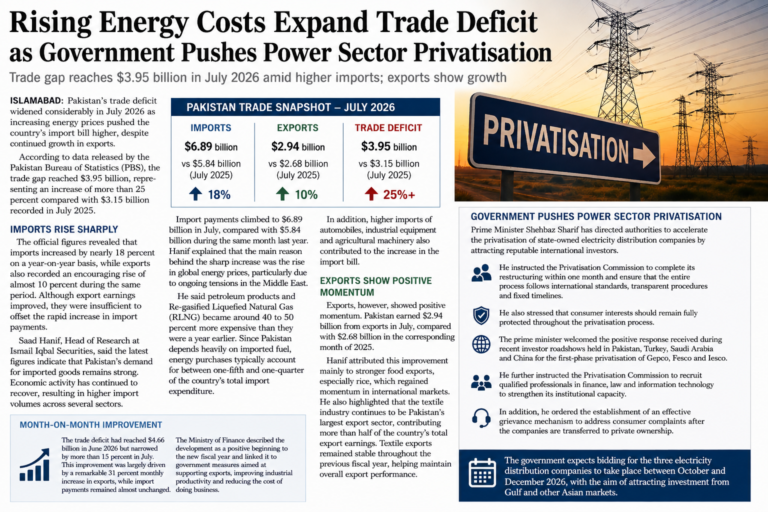
      Pakistan’s trade deficit widened considerably in July 2026 as increasing energy prices pushed the country’s import bill higher, despite continued growth in exports. According to data released by the Pakistan Bureau of Statistics (PBS), the trade gap reached $3.95 billion, representing an increase of more than 25 percent compared with $3.15 billion recorded in July 2025. The official figures revealed that imports increased by nearly 18 percent on a year-on-year basis, while exports also recorded an encouraging rise of almost 10 percent during the same period. Although export earnings improved, they were insufficient to offset the rapid increase in import payments. Saad Hanif, Head of Research at Ismail Iqbal Securities, said the latest figures indicate that Pakistan’s demand for imported goods remains strong. According to him, economic activity has continued to recover, resulting in higher import volumes across several sectors. He noted that the country’s reliance on imported products has remained significant despite efforts to improve the trade balance. Import payments climbed to $6.89 billion in July, compared with $5.84 billion during the same month last year. Hanif explained that the main reason behind the sharp increase was the rise in global energy prices, particularly due to ongoing tensions in the Middle East. He said petroleum products and Re-gasified Liquefied Natural Gas (RLNG) became around 40 to 50 percent more expensive than they were a year earlier. Since Pakistan depends heavily on imported fuel, energy purchases typically account for between one-fifth and one-quarter of the country’s total import expenditure. In addition, higher imports of automobiles, industrial equipment and agricultural machinery also contributed to the increase in the import bill. Exports, however, showed positive momentum. Pakistan earned $2.94 billion from exports in July, compared with $2.68 billion in the corresponding month of 2025. Hanif attributed this improvement mainly to stronger food exports, especially rice, which regained momentum in international markets. He also highlighted that the textile industry continues to be Pakistan’s largest export sector, contributing more than half of the country’s total export earnings. Textile exports remained stable throughout the previous fiscal year, helping maintain overall export performance. When compared with the previous month, Pakistan’s trade position showed some improvement. The trade deficit had reached $4.66 billion in June 2026 but narrowed by more than 15 percent in July. This improvement was largely driven by a remarkable 31 percent monthly increase in exports, one of the strongest monthly gains recorded in recent years, while import payments remained almost unchanged. The Ministry of Finance described the development as a positive beginning to the new fiscal year and linked it to government measures aimed at supporting exports, improving industrial productivity and reducing the cost of doing business. Meanwhile, Prime Minister Shehbaz Sharif has directed authorities to accelerate the privatisation of state-owned electricity distribution companies by attracting reputable international investors. During a review meeting in Islamabad, he instructed the Privatisation Commission to complete its restructuring within one month and ensure that the entire process follows international standards, transparent procedures and fixed timelines. He also stressed that consumer interests should remain fully protected throughout the privatisation process. The prime minister welcomed the positive response received during recent investor roadshows held in Pakistan, Turkey, Saudi Arabia and China for the first-phase privatisation of Gepco, Fesco and Iesco. He further instructed the Privatisation Commission to recruit qualified professionals in finance, law and information technology to strengthen its institutional capacity. In addition, he ordered the establishment of an effective grievance mechanism to address consumer complaints after the companies are transferred to private ownership. The government expects bidding for the three electricity distribution companies to take place between October and December 2026, with the aim of attracting investment from Gulf and other Asian markets.

  • | |

    Pakistan takes helm of UN disarmament conference, …

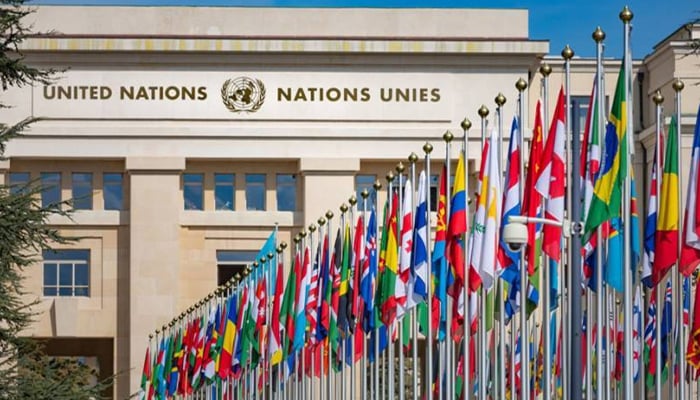
    GENEVA: Pakistan is set to assume the presidency of the United Nations Conference on Disarmament on Monday, taking on a key diplomatic role in international efforts to advance arms control and global security. Tahir Andrabi, Pakistan’s representative, has arrived in Geneva to take charge of the presidency and will chair important sessions of the Conference during his tenure. He will continue performing his responsibilities as spokesperson for Pakistan’s Ministry of Foreign Affairs alongside his new assignment. As president, Andrabi will be responsible for steering the Conference’s proceedings in an organised, balanced and consensus-driven manner. Pakistan is expected to focus on facilitating dialogue among member states and helping move discussions forward on key disarmament issues. During his tenure, Andrabi will also oversee the preparation of the Conference’s annual report, which will be presented to member states for consideration and approval. Diplomatic sources said Pakistan will subsequently engage in negotiations aimed at securing agreement on a resolution based on the annual report. The resolution is expected to be taken up by the UN General Assembly for approval in November. Pakistan’s presidency provides Islamabad with an opportunity to play a prominent role in international discussions on disarmament while promoting dialogue, consensus and multilateral cooperation on global security challenges.

Leave a Reply

Your email address will not be published. Required fields are marked *