shubman gill returns
|

Shubman Gill returns to No.1 in ICC ODI batting rankings

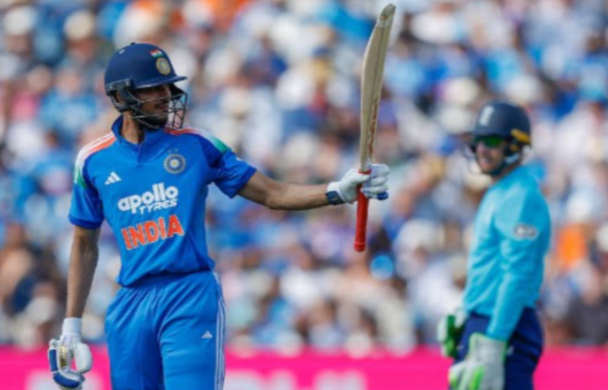
India captain Shubman Gill has reclaimed the No.1 position in the ICC Men’s ODI batting rankings after an outstanding run of form in the recently concluded three-match ODI series against England.

The right-handed opener produced another impressive performance with the bat, scoring a total of 188 runs across the series. His consistency at the top of the order helped him climb back to the summit of the rankings, marking the third time in his international career that he has occupied the top spot among ODI batters.

Gill’s return to the top was also influenced by New Zealand batter Daryl Mitchell, who missed the final two matches of his team’s ODI series against the West Indies because of injury. Mitchell’s absence prevented him from adding to his ranking points, allowing Gill to move ahead in the latest ICC update.

The latest rankings also featured significant movements in both the batting and bowling charts across ODI and T20I cricket.

Namibia spinner Bernard Scholtz emerged as one of the biggest gainers in the ODI bowling rankings. The experienced left-arm spinner climbed five places to seventh after delivering a series of impressive performances during Namibia’s ICC Men’s Cricket World Cup League 2 tri-series campaign in Utrecht against Nepal and the Netherlands. His consistent wicket-taking ability played a crucial role in Namibia’s successful campaign and earned him a place among the world’s leading ODI bowlers.

Meanwhile, India’s teenage batting sensation Vaibhav Sooryavanshi continued his remarkable rise on the international stage. The youngster was named Player of the Series after a brilliant display in India’s T20I series against Zimbabwe. He scored 151 runs in just three innings while maintaining a stunning strike rate of 196.10, underlining his aggressive approach at the crease.

Having played only six T20 internationals so far, Sooryavanshi made one of the biggest jumps in the latest rankings, soaring 230 places to reach 48th in the ICC Men’s T20I batting rankings. His rapid progress highlights his growing reputation as one of India’s most exciting young talents.

India also enjoyed success elsewhere in the T20I batting rankings. Tilak Varma moved up two places to sixth after continuing his consistent performances in the shortest format, while Shreyas Iyer climbed seven positions to reach 24th following a productive series.

The bowling rankings also witnessed notable changes. Zimbabwe fast bowler Blessing Muzarabani gained 10 places to move into 26th position after delivering impactful performances with the new ball. India leg-spinner Ravi Bishnoi also registered one of the biggest improvements of the week, jumping 31 places to claim the 41st spot in the T20I bowling rankings.

The latest ICC rankings reflect recent performances across international cricket, with several players making significant progress through consistent displays. While Gill’s return to the top of the ODI batting rankings remains the biggest headline, the rise of emerging talents such as Sooryavanshi and the continued progress of bowlers like Scholtz, Muzarabani and Bishnoi highlight the growing competition across all formats of the game.

Similar Posts

  • |

    Senior Ghana opposition leader jailed for 20 years over illegal mining

    A Ghanaian court has sentenced senior opposition politician Bernard Antwi Boasiako to 20 years in prison with hard labour after finding him guilty of illegal mining related offences, triggering a strong political reaction and renewed debate over the country’s fight against unlawful mining. Boasiako, widely known as Chairman Wontumi, is the Ashanti regional chairman of the opposition New Patriotic Party and the first high profile politician to be convicted since Ghana launched a nationwide crackdown on illegal mining in 2017. In addition to the prison sentence, the court ordered him to pay fines exceeding 10,000 dollars. Reports from the courtroom said Boasiako appeared visibly stunned as the verdict and sentence were announced. He had denied all charges throughout the trial. The court found him guilty of transferring mineral rights without official approval and facilitating unlicensed mining operations through his company, Akonta Mining. Prosecutors argued that the company allowed two individuals to carry out mining activities on its concession without the required authorisation from the Ministry of Lands and Natural Resources. The ruling has sparked anger within the New Patriotic Party, which described the conviction as politically motivated. Party officials accused the government of selectively targeting opposition figures while ignoring evidence they believe would have cleared Boasiako of wrongdoing. NPP General Secretary Justin Kodua Frimpong criticised the judgement and said the campaign against illegal mining would lose credibility if it focused only on political opponents. He confirmed that the party’s legal team has already started the appeal process in an effort to overturn the conviction. Illegal mining, commonly known in Ghana as galamsey, has remained one of the country’s biggest environmental challenges for years. The activity has polluted rivers, damaged forests and destroyed large areas of farmland despite repeated government efforts to stop it. As Africa’s largest gold producer, Ghana has struggled to balance economic interests with environmental protection. Successive governments have launched military operations and stricter enforcement measures to curb illegal mining, but the practice continues to spread in many parts of the country. Environmental activists welcomed the court’s decision, describing it as a major step towards greater accountability. They argued that the conviction sends a clear message that politicians and influential business figures are not above the law when it comes to environmental crimes. Adib Saani, Executive Director of the Jatikay Centre for Human Security and Peace Building, said the verdict demonstrates the importance of holding powerful individuals accountable if Ghana hopes to protect its forests, rivers and natural resources from further destruction. The case is expected to remain politically sensitive as Boasiako’s legal appeal moves forward. It also places renewed attention on Ghana’s campaign against illegal mining, with many observers watching closely to see whether similar cases involving influential figures will be pursued in the future.

  • |

    Indian activist Sonam Wangchuk ends 26-day hunger strike

    Indian environmentalist and social activist Sonam Wangchuk has ended his 26-day hunger strike after holding discussions over the ongoing nationwide protests against alleged examination paper leaks. However, demonstrations demanding the resignation of Education Minister Dharmendra Pradhan are continuing across India. Wangchuk announced his decision through a post on social media, saying he ended the fast after lengthy negotiations and concerns that the situation could lead to further violence. He said he would soon explain the conditions that led to his decision in a separate video message. The 59-year-old activist had been fasting since June 28 in support of a youth-led protest movement that accuses the government of failing to prevent repeated examination paper leaks. Protesters have demanded the resignation of the education minister after alleged leaks in medical college entrance examinations forced millions of students to retake the tests. Shortly before Wangchuk’s announcement, Prime Minister Narendra Modi addressed the nation and pledged stronger legal action against those responsible for examination fraud. He described the paper leak scandal as a serious issue affecting the future of hundreds of thousands of students and said the government would introduce tougher legislation to combat such crimes. Modi also announced plans to speed up court proceedings against those involved in examination fraud, adding that the issue would be discussed by the federal cabinet. While outlining the government’s response, he did not comment on demands for the education minister’s resignation. Despite Wangchuk ending his fast, thousands of protesters continue to gather at New Delhi’s Jantar Mantar and in several other cities. Demonstrators say they will maintain their peaceful campaign until the education minister steps down and comprehensive reforms are introduced to restore transparency and fairness in India’s examination system. The protests have become one of the biggest public challenges faced by Prime Minister Modi’s government since beginning its third term. Tensions have risen in recent days after clashes between police and protesters. Security forces used tear gas and batons to stop demonstrators attempting to march towards parliament, leading to widespread criticism from rights organisations over the handling of the protests.

  • | | |

    Karachi colleges ban tobacco, vapes and drug use u…

    Karachi: The Directorate of College Education Karachi has imposed a ban on the use of tobacco products and drugs in colleges across the city, aiming to create a healthier and drug-free educational environment. According to an official notification issued by the Directorate, the use of cigarettes, vapes, nicotine pouches, paan, and gutka has been strictly prohibited within college premises. The ban will come into effect immediately, with college principals instructed to ensure compliance and maintain a tobacco-free environment inside their institutions. Authorities have directed college administrations to take necessary steps to prevent students and staff from using prohibited substances on campus. The Directorate of College Education has also contacted deputy commissioners to help control the sale and use of tobacco products and drugs around college areas. The move aims to extend monitoring beyond campuses and reduce access to such substances near educational institutions. Officials said the decision is part of efforts to promote student health and prevent the growing use of harmful substances among young people. College administrations will be responsible for implementing the new restrictions and taking action against violations. The notification comes as health experts continue to highlight the harmful effects of tobacco, nicotine products, and drug use, particularly among youth.

  • |

    Acting US Attorney General rescinds $1.8 billion initiative to clear path for Senate confirmation

    Acting US Attorney General Todd Blanche has issued an official order rescinding the controversial $1.8 billion “Anti-Weaponisation Fund”, resolving a key point of friction ahead of his confirmation vote before the Senate Judiciary Committee. The action follows extended negotiations with Republican Senators John Cornyn and Thom Tillis, who had withheld support for the nomination pending written assurances that the initiative would be permanently discarded. Although Blanche previously indicated in Congressional testimony that the department would not move forward with the program, lawmakers sought a formal rescission to prevent its potential revival. The directive also clarifies terms surrounding a related legal settlement, stipulating that provisions concerning tax audit protections apply exclusively on a retroactive basis to open claims active at the time of the agreement and do not extend to future tax filings.

  • |

    England name 16-man squad for first two Tests against Pakistan

    England have unveiled their 16-member squad for the first two Tests of their three-match series against Pakistan, with Joe Root set to lead the side after Ben Stokes’ retirement. The first Test will begin on August 19 at Headingley in Leeds, marking the start of what promises to be a closely watched series between the two sides. Root has been handed the captaincy once again following Stokes’ retirement, placing the experienced batter at the centre of England’s plans against Pakistan. England have also welcomed back several familiar faces. Dan Lawrence, Ollie Pope, Brydon Carse and Sam Cook have returned to the squad, adding experience and depth to the team. However, England will be without Jacob Bethell, who has been ruled out of the Pakistan series because of a right knee injury. With Root back in charge and several key players returning, England will look to make a strong start at Leeds before the teams move on to the second Test. Pakistan will be hoping to challenge England’s home advantage and seize an early lead in the three-match contest. England Squad Joe Root (C), Jofra Archer, Gus Atkinson, Shoaib Bashir, Harry Brook, Brydon Carse, Sam Cook, Jordan Cox, Ben Duckett, Matthew Fisher, Emilio Gay, Dan Lawrence, Ollie Pope, Ollie Robinson, Jamie Smith and Josh Tongue.

  • |

    China rejects US sanctions on research institutions

    China has strongly opposed a US decision to place several Chinese research institutions on a sanctions list. Beijing criticised the move on Wednesday. It accused Washington of using national security concerns to restrict scientific and technological cooperation between the two countries. A spokesperson for China’s Ministry of Commerce said Beijing would take necessary steps to protect the legitimate rights and interests of its research institutions. The spokesperson also said China wanted to maintain a stable environment for normal scientific exchanges and cooperation with international partners. Beijing accused the United States of repeatedly expanding the definition of national security. It said Washington had created discriminatory barriers against Chinese institutions. China also criticised what it described as the politicisation and weaponisation of scientific research. According to Beijing, such policies could damage cooperation between researchers and universities in both countries. The Chinese government said the US measures were against the broader global trend of international cooperation in science and technological innovation. Beijing urged Washington to withdraw what it called unjustified accusations against Chinese research institutions. China also called on the United States to correct its policies as soon as possible. It demanded fair, just and non-discriminatory treatment for Chinese research organisations. The dispute comes amid wider tensions between Washington and Beijing over technology, trade and national security. The United States has increasingly tightened restrictions on Chinese access to advanced technologies. Semiconductor manufacturing has become a major area of competition between the two countries. China is also working to expand its domestic semiconductor industry. Beijing aims to reduce its dependence on advanced foreign chips affected by US export restrictions. Last week, the US Department of Defence updated a list of foreign institutions it considers involved in “problematic activities”. The updated list included Chinese defence-related academies and several universities. Shanghai-based Fudan University was also among the institutions added to the list. The latest move is likely to add another point of tension to already strained US-China relations. Beijing has repeatedly opposed US measures targeting Chinese companies, universities and research organisations. Washington, meanwhile, has maintained that its restrictions are linked to national security and technology concerns.

Leave a Reply

Your email address will not be published. Required fields are marked *