
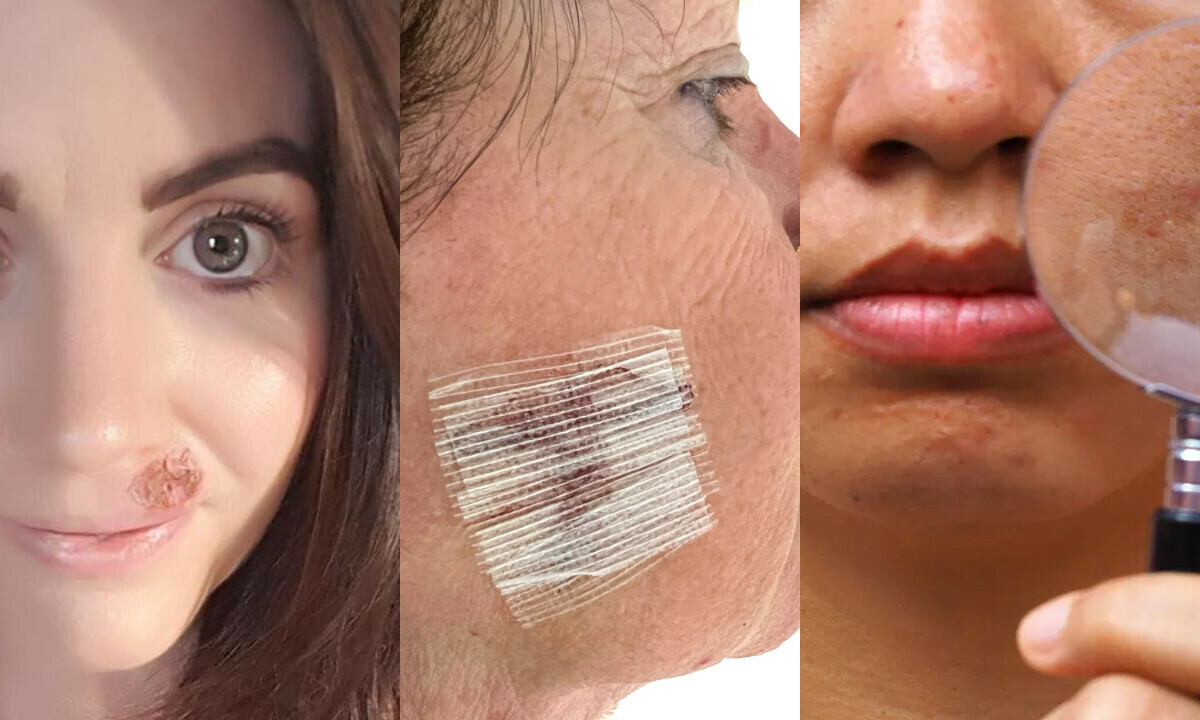
skin cancer warning

Skin Cancer warning signs

Skin cancer is one of the most common cancers in the world affecting millions of people every year.

It often begins with small changes on the skin that may look harmless causing many people to ignore them.  However spotting these early signs and getting medical advice quickly can help save lives.

According to the World Health Organization (WHO) around 330,000 new cases of melanoma the deadliest type of skin cancer were reported worldwide in 2022.

About 60,000 people died from the disease that year.

Harvard trained dermatologist Dr. Daniel Sugai says people should pay close attention to any unusual skin changes. if a pimple bump or sore on your face does not heal within a month it should be checked by a dermatologist.

A spot that keeps bleeding or does not heal can also be a warning sign of skin cancer.

Dr. Sugai says these symptoms may point to basal cell carcinoma the most common type of skin cancer.

In the United States alone about 3.6 million cases are diagnosed each year. This cancer may appear as a shiny or clear bump a rough or scaly patch or a dark brown black or bluish spot on the skin.

He also explained that basal cell carcinoma grows from cells that create new skin cells.  These cancer cells often develop tiny tree like blood vessels which can make the affected area bleed more easily.

In people with darker skin tones the cancer may appear as a pigmented or darker colored spot.

Experts say any new mole spot sore or skin change that does not heal should never be ignored.

Early diagnosis and treatment greatly improve the chances of successful treatment and can help prevent the cancer from becoming more serious.

Similar Posts

  • |

    Dubai Airport introduces passport-free AI immigration system

    If you want to travel abroad, you usually need considerable time at the airport for passport checks, identity verification and other procedures. Imagine being able to board your flight without showing your passport, identity documents or ticket. It would save a lot of time. It may sound unbelievable but this has become possible at an airport in a Muslim country due to Artificial Intelligence (AI) technology. At Dubai Airport, AI technology helps passengers complete immigration procedures at high speed. The new system was first introduced in September 2025 for passengers boarding flights. However, now immigration procedures have also been made faster for passengers arriving from other countries at Dubai Airport. The new system uses AI, biometric cameras and flight data to complete the verification of passengers and their luggage within seconds. This technology allows up to 10 passengers to pass through border control simultaneously. Passengers walking through the red-carpeted Terminal 3 no longer need to show travel documents or stop for manual checks. They only need to complete registration before arriving at Dubai Airport so that their passport details and facial images can be identified. The system completes passenger clearance in just 3.4 seconds. According to Dubai Airports CEO Paul Griffiths, the airport has invested in camera technology allowing passengers to enter or leave the country without carrying a passport, passing through gate readers or facing difficulties during the process. He further stated that the new technology is currently being tested on first-class passengers and will gradually be made available to all passengers.

  • UK approves myqorzo for rare heart disease

    The UK has approved a new medicine called Myqorzo to treat obstructive hypertrophic cardiomyopathy (oHCM) a rare heart condition that can block blood flow from the heart. The approval was granted by the UK’s medicines regulator on Thursday. At the same time the National Institute for Health and Care Excellence (NICE) recommended that eligible adults in England and Wales should receive the treatment through the NHS. oHCM causes the heart muscle to become unusually thick making it harder for the heart to pump blood around the body. Around 1 in every 500 people in the UK has hypertrophic cardiomyopathy (HCM) and about half of the cases are inherited. NICE recommends Myqorzo for adults with symptoms of oHCM who are classified as NYHA Class II or III. The medicine can be used together with standard treatments or on its own if other medicines are not suitable.  Around 6,600 patients are expected to benefit from the treatment. Myqorzo belongs to a group of medicines called cardiac myosin inhibitors the same class as Bristol Myers Squibb’s Camzyos. It works by relaxing the heart muscle reducing the blockage and helping the heart pump blood more effectively.

  • Natural sugar may help cancer spread, study finds

    A new study has revealed that fructose (natural sugar) consumed as part of the daily diet may help certain types of cancer spread throughout the body. According to the study published in the scientific journal Nature Aging, cancer cells that survive chemotherapy do not remain inactive. Instead, they release fructose which activates other cancer cells allowing them to leave their original location and spread to other parts of the body. Experts say that excessive consumption of sugary drinks and beverages containing high levels of fructose may also increase the risk of cancer spreading even in patients who are not undergoing chemotherapy. The study further found that fructose causes changes inside cancer cells that make it easier for them to move from one part of the body to another. The research was conducted on ovarian cancer but experts believe that a similar process could also occur in pancreatic, colorectal and liver cancers.

  • High sugar diet may harm people with asthma

    Eating too much sugar is widely known to increase the risk of type 2 diabetes and high blood pressure.  Now new research suggests that it may also make asthma symptoms worse. A study published in the journal Nutrients found that a high sugar diet can increase inflammation in the lungs making asthma attacks more likely in people with the condition. The research was carried out on mice. Scientists gave the animals their normal food along with sweetened milk. Within just two weeks the mice showed higher levels of lung inflammation. According to the researchers this is one of the first studies to show how quickly excess sugar can worsen inflammation linked to asthma. Asthma is a long term disease that affects the airways and makes breathing difficult.  Although there is no cure the condition can be managed with proper treatment and healthy lifestyle choices. During an asthma attack the airways become swollen and the muscles around them tighten. This can cause coughing wheezing chest tightness and shortness of breath making everyday activities harder. The researchers said that when children eat too much sugar people usually worry about tooth decay or weight gain but rarely think about its possible effects on asthma. They added that the findings support the idea of limiting sugar intake especially for people living with asthma. According to the researchers too much sugar may affect the immune system and trigger inflammation which can make asthma symptoms more severe.

  • Tracing the spiritual legacy of “Nanak Se Nankana”

    In the fertile plains of Punjab lies a landscape quietly layered with centuries of devotion, miracle tales, and interfaith kinship. This sanctuary of green fields was known as Rai-Bhoi-Di-Talwandi. The time long before the bustling town of Nankana Sahib bore its current name. It was overseen by Rai Bhoi Bhatti, a local Muslim landlord whose family had influence over the region. Yet, history transitioned irreversibly in 1469. It was in this soil that Guru Nanak Dev Ji, the founder of Sikhism, was born to Mehta Kalu and Mata Tripta. Rai Bular Bhatti (Rai Bhoi’s descendant) renamed the settlement Nankana Sahib in his honor. He was basically moved by the extraordinary spiritual wisdom radiating from the young child. Thus began a historical and spiritual trajectory known throughout the subcontinent as Nanak Se Nankana. The sacred evolution of a man into a timeless sanctuary. What makes Nankana Sahib uniquely enchanting is that the entire geography operates as a living storyboard. The city’s trees, fields, and lanes are strongly knitted  into local folklore. And each folklore is  marked by a Gurdwara commemorating young Nanak’s childhood and early enlightenment. Gurdwara Janam Asthan is the crown of the holy city. This magnificent marble compound stands at the site of Guru Nanak’s ancestral home. It was originally built as a small sanctum by his descendants. Later transformed into a grand complex surrounded by reflective Sarovars (holy pools) during the reign of Maharaja Ranjit Singh. According to popular regional legend, a young Nanak was sleeping out in the open pastures while tending to his father’s cattle. As the afternoon sun shifted, a large cobra slithered out and expanded its hood above his face to shade him from the blistering heat. Rai Bular Bhatti witnessed this miracle from his horse and then showed his devotion for Nanak. The ancient Jal (Mal) tree under which the event occurred still casts its shade today at Gurdwara Malji Sahib. Local folklore recalls a peasant complaining that Nanak’s roaming cattle had ruined his crops. Yet, when officials inspected the field, the damaged green stalks had miraculously grew back whole and undamaged. Gurdwara Kiara Sahib stands today atop that very field. When young Nanak returned from a nearby market town having spent his father’s money entirely on feeding hungry sadhus (Sacha Sauda or the True Bargain), he feared his father’s anger. He hid beneath a large, canopy-like tree whose drooping branches resembled a tent (tambu). Nearby stands Patti Sahib, where a seven-year-old Nanak astounded his teacher by writing an acrostic poem on the alphabet explaining divine truths instead of mere grammar. Beyond the miraculous legends of childhood, Nankana Sahib carries profound historical lore. It weathered the turbulent Sikh Empire era. The city witnessed the heroic sacrifices of the 1921 Akali Movement reform at Janam Asthan. It also survived the painful demographics shifts of the 1947 Partition. Today, the journey of Nanak Se Nankana remains an emotional pilgrimage. Every year during Gurpurab (Guru Nanak’s birth anniversary), thousands of pilgrims from across the globe cross borders to converge on these quiet lanes. The devotees step through the grand archways of Gurdwara Janam Asthan and touch the dust of Nankana to their foreheads. They aren’t just visiting a building. They are retracing a historical path that transformed a quiet Punjab meadow into a sanctuary of universal love, humility, and timeless unity.  

  • |

    British driver sets hydrogen vehicle speed record at 654 km/h

    British driver and former Royal Air Force pilot Andy Green has set a new world land-speed record using a hydrogen-powered vehicle. According to foreign media reports, 64-year-old Andy Green drove the hydrogen-powered vehicle at 406 miles per hour (654 km/h) at the Bonneville Salt Flats in Utah, USA making it the fastest speed ever achieved by a vehicle of this type. According to the report, the HydroMax is equipped with two hydrogen engines that generate a combined 1,600 horsepower. 20-year-old record broken The new HydroMax vehicle more than doubled the previous world record of 185.5 miles per hour, set in 2004 by a hydrogen-combustion vehicle. Twenty years ago at the same location, the same company’s diesel-powered vehicle, DieselMax set a world record by reaching 350 miles per hour (563 km/h). Only person to break sound barrier on land Andy Green has already made history in motorsports. In 1997, he drove the jet-powered ThrustSSC to a speed of 763 miles per hour (1,228 km/h) breaking the sound barrier on land. Andy Green remains the only person to have broken the sound barrier in a land vehicle.

Leave a Reply

Your email address will not be published. Required fields are marked *