launches digital transformation
|

KP launches digital transformation policy & roadmap 2030 to accelerate e-governance

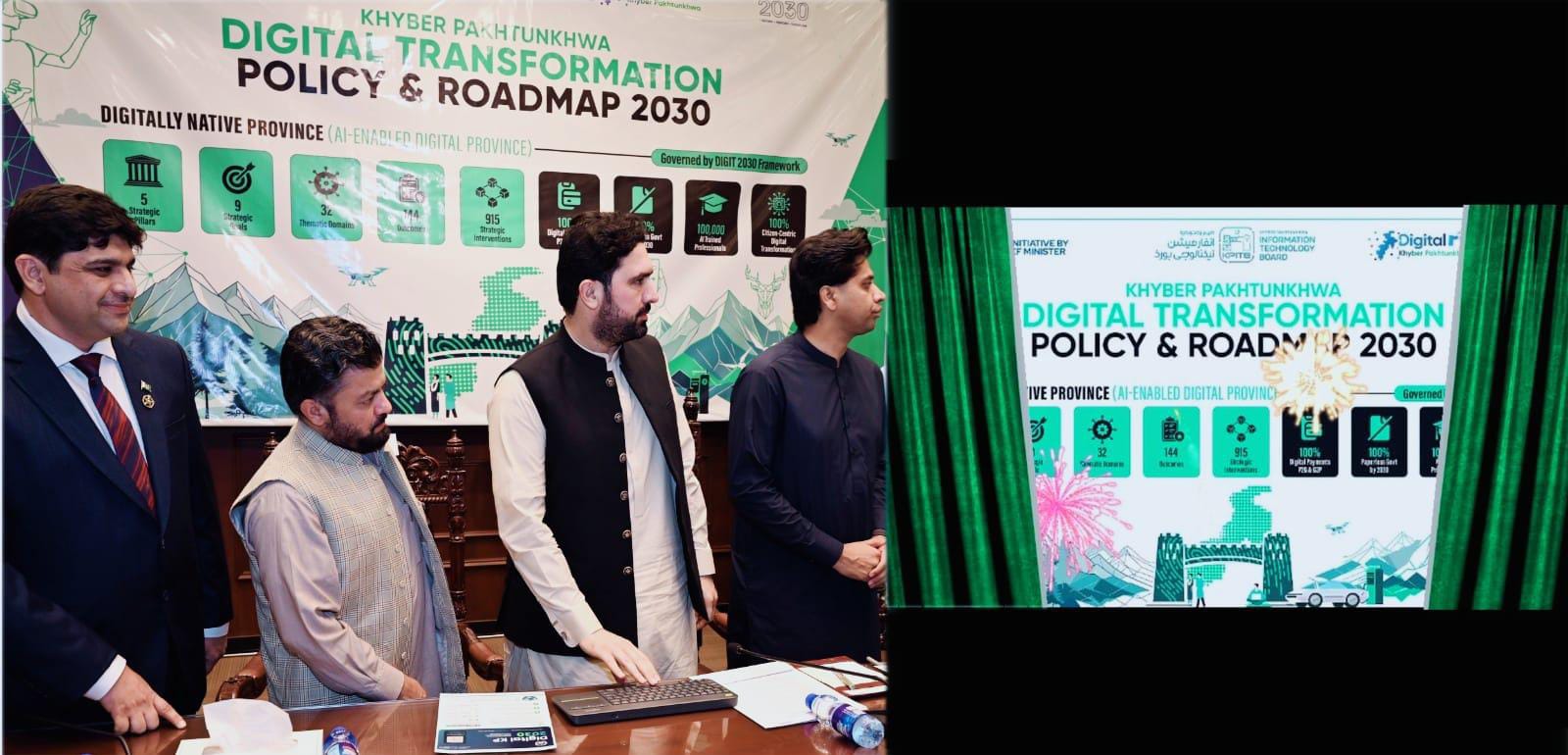
PESHAWAR: Chief Minister Khyber Pakhtunkhwa Muhammad Suhail Afridi has officially launched the Khyber Pakhtunkhwa Digital Transformation Policy and Roadmap 2030, describing it as a landmark initiative aimed at establishing transparent governance, improving public service delivery, and building a sustainable digital economy across the province.

Speaking at the launch ceremony at the Chief Minister’s House in Peshawar, the chief minister said the policy is among Pakistan’s most comprehensive digital transformation frameworks and provides a long term roadmap for modernising governance through innovation, technology, and digital reforms.

He said the provincial government is committed to implementing the vision of “Digital Khyber Pakhtunkhwa” and praised the Khyber Pakhtunkhwa IT Board and other stakeholders for preparing the roadmap through extensive consultations, international best practices, and future-oriented planning.

The Digital Transformation Policy and Roadmap 2030 is built on five strategic pillars, nine core objectives, 32 thematic domains, and 915 strategic interventions. It includes clear implementation timelines, institutional responsibilities, and a comprehensive monitoring framework to ensure effective and sustainable execution.

The chief minister said the introduction of paperless governance and digital reforms would significantly improve transparency, accountability, efficiency, and service delivery. He added that reducing human intervention in administrative processes would strengthen merit, transparency, and accountability.

Under the roadmap, public services will be digitised in phases and made citizen centric, enabling people to access government services and information through a single digital platform. The initiative is also expected to reduce unnecessary visits to government offices, particularly benefiting residents of remote areas.

Highlighting the importance of artificial intelligence and emerging technologies, Afridi said the government would equip more than 100,000 young people with AI and advanced digital skills, creating new opportunities in employment, freelancing, entrepreneurship, and investment while strengthening the provincial economy.

He added that digitisation would not only improve governance but also reduce government expenditure, ensure more efficient use of public resources, minimise paper consumption, and contribute to environmental protection through greener administrative practices.

Referring to the province’s fiscal performance, the chief minister said the government collected Rs150 billion in revenue during the previous fiscal year against a target of Rs129 billion, without imposing any new taxes. For the current fiscal year, the revenue target has been set at Rs180 billion, with expectations of reaching Rs200 billion through improved governance and financial management.

During a detailed briefing, officials informed participants that the policy also includes measures to promote green ICT procurement, environmentally sustainable digital infrastructure, carbon footprint reduction, and the establishment of a carbon credit registry to support Khyber Pakhtunkhwa’s transition towards a modern and environmentally responsible digital economy.
In line with the policy’s digital-first approach, the roadmap has not been issued as a printed publication.

Instead, all policy documents have been made available through a QR code, demonstrating the government’s commitment to digital accessibility and paperless governance.

Similar Posts

  • | |

    Hilaria Baldwin shares hilarious parenting mix-up …

    Hilaria Baldwin is embracing the chaos of life as a mother of seven, admitting that raising a large family often leads to funny and unforgettable moments. During a recent interview, the wellness entrepreneur shared that keeping track of seven children can sometimes become so overwhelming that she occasionally mixes up their names, something many parents can relate to. Speaking candidly about family life, Hilaria laughed as she confessed that there are days when she accidentally calls one child by another’s name. She explained that with so many busy schedules, school activities and daily routines, moments of confusion are almost inevitable. “It’s just part of having a big family,” she joked, adding that her children have learned to laugh about the mix-ups rather than take them seriously. According to Hilaria, the occasional mistake has become a normal part of life in the Baldwin household. The 42-year-old shares seven children with actor Alec Baldwin, and together they have built a lively home filled with constant activity. While caring for such a large family may seem overwhelming from the outside, Hilaria says she and Alec have found a system that works well for them. She revealed that parenting is very much a team effort. Rather than assigning one parent to every responsibility, the couple divides tasks depending on the day’s schedule. Whether it’s preparing meals, helping with homework, attending school events or putting the children to bed, they support each other to ensure everything gets done. Hilaria explained that flexibility has become the key to managing their household. Some days Alec takes on more responsibilities, while on other days she steps in to handle the majority of the family’s needs. Their ability to communicate and adapt has helped them navigate the demands of raising seven children together. The author also acknowledged that parenting is rarely perfect. She said there are moments of exhaustion, unexpected challenges and plenty of laughter along the way. Instead of striving for perfection, she believes it’s more important to create a loving environment where children feel supported and understood. Her honest comments resonated with many parents online, who praised her willingness to discuss the realities of family life rather than presenting an unrealistic image of perfection. Many social media users admitted they also mix up their children’s names, even in much smaller families. Hilaria has frequently shared glimpses of her home life on social media, offering followers a look at both the joyful and challenging moments of parenting. Her latest interview continues that tradition, highlighting the humor that often comes with raising a large family. Despite the occasional name mix-up, Hilaria made one thing clear: every moment with her children is meaningful. While life with seven kids can be hectic, she says the laughter, love and unforgettable memories make every challenge worthwhile. Her candid reflections offer a reminder that even celebrity families experience the same everyday parenting moments as everyone else.

  • | | |

    Rising energy costs expand trade deficit

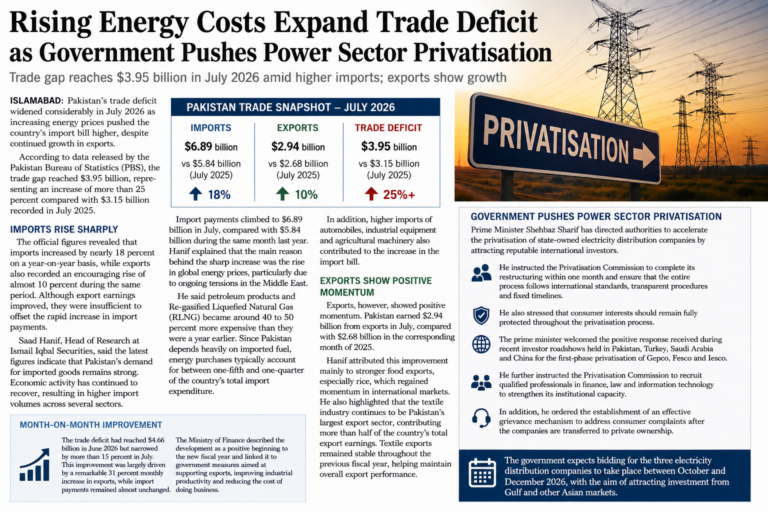
      Pakistan’s trade deficit widened considerably in July 2026 as increasing energy prices pushed the country’s import bill higher, despite continued growth in exports. According to data released by the Pakistan Bureau of Statistics (PBS), the trade gap reached $3.95 billion, representing an increase of more than 25 percent compared with $3.15 billion recorded in July 2025. The official figures revealed that imports increased by nearly 18 percent on a year-on-year basis, while exports also recorded an encouraging rise of almost 10 percent during the same period. Although export earnings improved, they were insufficient to offset the rapid increase in import payments. Saad Hanif, Head of Research at Ismail Iqbal Securities, said the latest figures indicate that Pakistan’s demand for imported goods remains strong. According to him, economic activity has continued to recover, resulting in higher import volumes across several sectors. He noted that the country’s reliance on imported products has remained significant despite efforts to improve the trade balance. Import payments climbed to $6.89 billion in July, compared with $5.84 billion during the same month last year. Hanif explained that the main reason behind the sharp increase was the rise in global energy prices, particularly due to ongoing tensions in the Middle East. He said petroleum products and Re-gasified Liquefied Natural Gas (RLNG) became around 40 to 50 percent more expensive than they were a year earlier. Since Pakistan depends heavily on imported fuel, energy purchases typically account for between one-fifth and one-quarter of the country’s total import expenditure. In addition, higher imports of automobiles, industrial equipment and agricultural machinery also contributed to the increase in the import bill. Exports, however, showed positive momentum. Pakistan earned $2.94 billion from exports in July, compared with $2.68 billion in the corresponding month of 2025. Hanif attributed this improvement mainly to stronger food exports, especially rice, which regained momentum in international markets. He also highlighted that the textile industry continues to be Pakistan’s largest export sector, contributing more than half of the country’s total export earnings. Textile exports remained stable throughout the previous fiscal year, helping maintain overall export performance. When compared with the previous month, Pakistan’s trade position showed some improvement. The trade deficit had reached $4.66 billion in June 2026 but narrowed by more than 15 percent in July. This improvement was largely driven by a remarkable 31 percent monthly increase in exports, one of the strongest monthly gains recorded in recent years, while import payments remained almost unchanged. The Ministry of Finance described the development as a positive beginning to the new fiscal year and linked it to government measures aimed at supporting exports, improving industrial productivity and reducing the cost of doing business. Meanwhile, Prime Minister Shehbaz Sharif has directed authorities to accelerate the privatisation of state-owned electricity distribution companies by attracting reputable international investors. During a review meeting in Islamabad, he instructed the Privatisation Commission to complete its restructuring within one month and ensure that the entire process follows international standards, transparent procedures and fixed timelines. He also stressed that consumer interests should remain fully protected throughout the privatisation process. The prime minister welcomed the positive response received during recent investor roadshows held in Pakistan, Turkey, Saudi Arabia and China for the first-phase privatisation of Gepco, Fesco and Iesco. He further instructed the Privatisation Commission to recruit qualified professionals in finance, law and information technology to strengthen its institutional capacity. In addition, he ordered the establishment of an effective grievance mechanism to address consumer complaints after the companies are transferred to private ownership. The government expects bidding for the three electricity distribution companies to take place between October and December 2026, with the aim of attracting investment from Gulf and other Asian markets.

  • | | |

    South Korean energy firm seeks PM Shehbaz’s …

    A South Korean state-owned energy company has appealed directly to Prime Minister Shehbaz Sharif, claiming that prolonged regulatory delays have placed its planned $1 billion investment in Pakistan’s hydropower sector at serious risk. In a letter addressed to the prime minister, Korea South-East Power Co. Ltd. (KOEN) said it had spent nearly a decade developing two run-of-the-river hydropower projects on the Swat River in Khyber Pakhtunkhwa but remains unable to move forward because of unresolved regulatory approvals. The company, a subsidiary of Korea Electric Power Corporation (KEPCO), is developing the 229-megawatt Asrit Kedam and 238-megawatt Kalam Asrit hydropower projects. Together, the projects represent an investment of approximately $1 billion, with the company already investing around $25 million in feasibility studies, surveys, and other preparatory work. According to KOEN, the projects have met all major government requirements since development began in 2016. The company signed a memorandum of understanding with the Khyber Pakhtunkhwa government, obtained letters of intent from the Pakhtunkhwa Energy Development Organization (PEDO), completed feasibility studies, secured a power generation licence from the National Electric Power Regulatory Authority (Nepra), and maintained all required financial guarantees. Despite fulfilling these requirements, KOEN said the tariff determination for the projects has remained pending for nearly three years. The company noted that Nepra conducted a public hearing on its tariff petition in July 2023, but a final decision has yet to be issued. The company said it repeatedly approached Nepra and later appealed to the Nepra Appellate Tribunal, which directed the regulator to decide the tariff matter. However, KOEN claims that the tribunal’s order has still not been implemented. Adding to its concerns, the company said both hydropower projects have been excluded from the draft Indicative Generation Capacity Expansion Plan (IGCEP) 2025–35. KOEN warned that if the revised plan is approved without the projects, its proposed investment could remain stalled indefinitely. In its appeal, the company urged the prime minister to intervene and ensure a timely tariff determination while allowing the projects to continue under Pakistan’s Power Generation Policy 2015, the framework under which the investment was originally made. KOEN also stated that it understands Pakistan’s current surplus electricity generation and is willing to align the commercial operation of the projects with the country’s future energy requirements rather than adding unnecessary capacity. The issue comes as Pakistan and South Korea continue discussions aimed at strengthening bilateral trade and investment ties through a proposed Comprehensive Economic Partnership Agreement (CEPA). Analysts say resolving regulatory bottlenecks will be crucial for maintaining investor confidence and attracting future foreign direct investment into Pakistan’s energy sector.

  • UO eyes smart university transformation through agenting AI

    In line with the vision of the Honorable Prime Minister of Pakistan and the Honorable Chief Minister of the Punjab to promote digital transformation and innovation in higher education, the University of Okara (UO) has initiated efforts to explore the adoption of Artificial Intelligence (AI) agents for academic and administrative operations. As part of this initiative, a high-level delegation comprising the Vice Chancellor of the Punjab Tianjin University of Technology (PTUT), Prof. Dr. Adeel Akram, and Chief Executive Officer of GalaxAI Solutions, Sheraz Waheed, visited the UO on Thursday. GalaxAI Solutions is an Islamabad-based technology company working on Sovereign AI infrastructure for Pakistan’s higher education sector. A meeting of the university’s academic heads and IT team was held under the chairmanship of the Vice Chancellor, Prof. Dr. Sajjad Mubin. During the session, the PTUT delegation delivered a comprehensive presentation on AI agents, highlighting their potential applications in admissions management, campus administration, academic support, and day-to-day institutional operations. Addressing the participants, Prof. Mubin appreciated the PTUT team for visiting the UO to share their expertise and practical insights into emerging AI technologies. He described PTUT as a rapidly progressing institution and reiterated his vision of transforming the UO into a smart university through the integration of cutting-edge artificial intelligence solutions. Speaking on the occasion, Prof. Dr. Akram emphasized that AI has the potential to significantly enhance efficiency across teaching, research, governance, and administrative functions. He noted that intelligent AI agents can help universities streamline routine processes, improve decision-making, and deliver better services to students and faculty. The meeting concluded with an understanding that PTUT will submit a formal proposal for the transfer and implementation of the AI technology at the University of Okara. The proposal will be reviewed by the University’s relevant authorities and statutory bodies, and any future implementation will be subject to the completion of all required approvals.

  • | |

    US publication praises Pakistan’s digital financ…

    A US publication has praised Pakistan’s efforts to modernise its financial system, saying the country is steadily strengthening its position in the global digital financial landscape through reforms and technological innovation. The article highlighted Pakistan’s initiatives to promote digital transformation and said the country has the potential to play a meaningful role in the evolving global digital economy. It also commended the vision of Pakistan Virtual Assets Regulatory Authority (PVARA) Chairman Bilal Bin Saqib, stating that Pakistan must actively position itself within the international digital financial system to benefit from emerging technologies and new economic opportunities. According to the publication, the future will belong to countries that make swift decisions and implement reforms without delay. It noted that Pakistan has the opportunity to emerge as a leader in the digital economy by embracing innovation and adopting forward-looking policies. The article further stated that governments can no longer rely solely on traditional bureaucratic systems. Instead, they must adopt the speed, flexibility and innovation-driven approach of technology startups to remain competitive in a rapidly changing global environment. It added that digital assets are becoming the foundation of the future financial infrastructure and countries investing in digital finance today will be better positioned for long-term economic growth and global competitiveness. The publication’s remarks come as Pakistan continues to promote digital payments, financial technology and cashless transactions as part of its broader strategy to modernise the economy and expand financial inclusion.

  • DG Khan Board announces matric position holders 2026

    The Board of Intermediate and Secondary Education Dera Ghazi Khan has announced the position holders for the annual matriculation examinations. Chairman Professor Dr. Abdul Raouf revealed the names of the top achievers, extending congratulations to the position holders and their parents. The announcement ceremony was attended by Board Secretary Abdul Rehman Choudhry, Controller of Examinations Professor Muzaffar Hussain, and other officials. The formal declaration of the matriculation annual examination results is scheduled for August 6. In the overall board-wide ranking, Abdullah Salim from Layyah secured the first position with an impressive 1191 marks. Mir Mujtaba from Taunsa Sharif claimed the second position with 1190 marks, while the third position was shared jointly by Farwa Ahmed from Muzaffargarh, Mirab Zahra from Layyah, and Syed Muhammad Jon Abbas from Layyah, each achieving 1189 marks. In the Science Group for boys, Abdullah Salim from Layyah topped the board with 1191 marks. The second position went to Mir Mujtaba from Taunsa Sharif with 1190 marks, and Syed Muhammad Jon Abbas Naqvi from Government Model Higher Secondary School Layyah secured the third position with 1189 marks. In the Science Group for girls, Farwa Ahmed from Muzaffargarh and Mirab Zahra from Layyah shared the first position with 1189 marks each. Ayesha Aamna and Shawaal Ijaz jointly claimed the second position with 1188 marks, while Umaima Abbas from Government Girls High School Layyah and Kashaf Saeed from Taunsa Sharif tied for the third position with 1187 marks each. In the General Group for boys, Muhammad Safdar from Rajanpur topped the list with 1136 marks, followed by Habib Ahmed from Centre of Excellence (Boys) Rojhan, Rajanpur, who secured 1135 marks. Muhammad Sohail from Layyah took the third position with 1073 marks. In the General Group for girls, Aiman Farooq from Centre of Excellence Girls Muzaffargarh achieved the first position with 1134 marks, Ajwa Naseer from the same institution secured the second position with 1129 marks, and Suwaira Fida Hussain also from Centre of Excellence Girls Muzaffargarh claimed the third position with 1128 marks. Overall, female students dominated the position holder list with nine positions, while male students secured six positions. Government institutions accounted for eight of the positions, private institutions claimed five, and two positions went to private candidates.

Leave a Reply

Your email address will not be published. Required fields are marked *