launches digital transformation
|

KP launches digital transformation policy & roadmap 2030 to accelerate e-governance

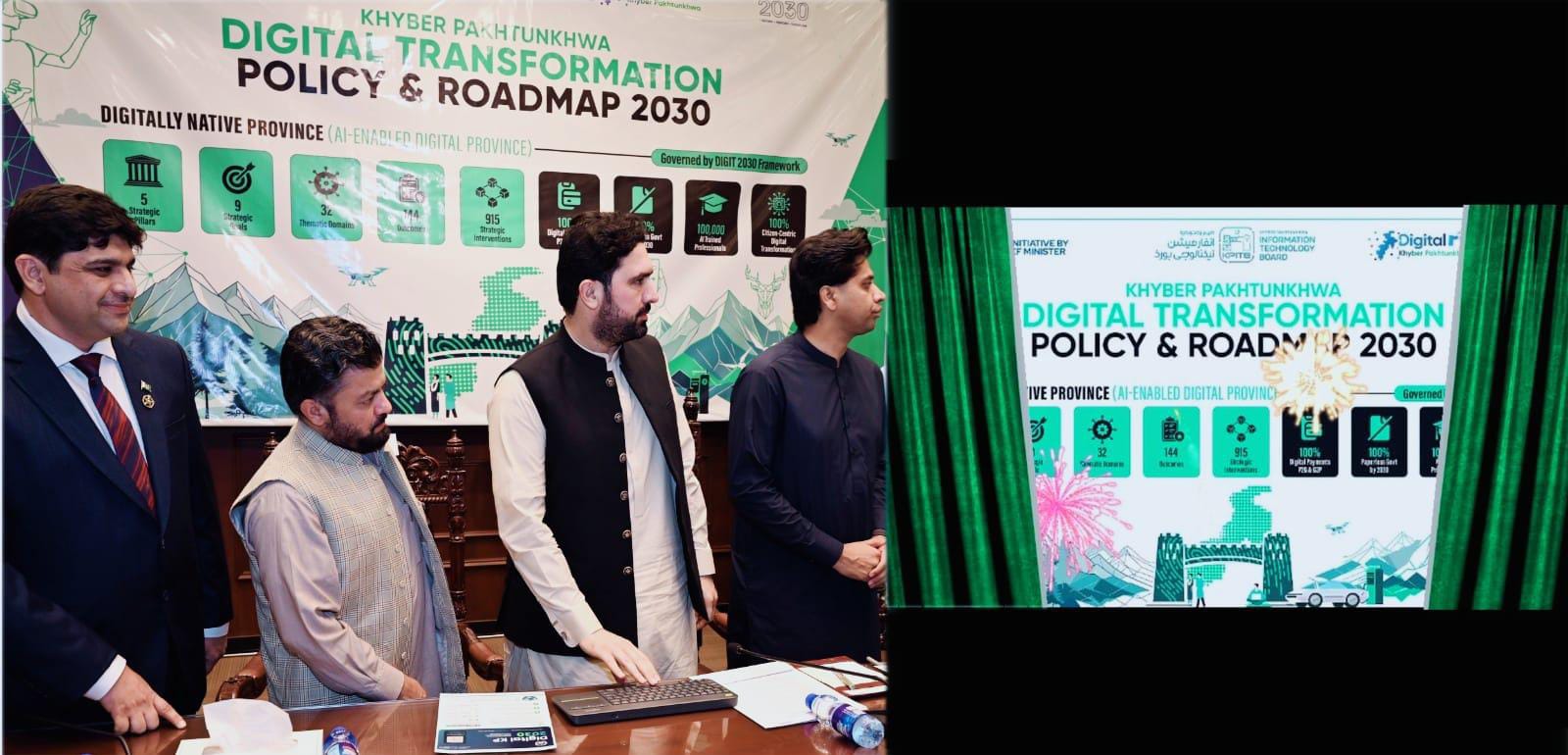
PESHAWAR: Chief Minister Khyber Pakhtunkhwa Muhammad Suhail Afridi has officially launched the Khyber Pakhtunkhwa Digital Transformation Policy and Roadmap 2030, describing it as a landmark initiative aimed at establishing transparent governance, improving public service delivery, and building a sustainable digital economy across the province.

Speaking at the launch ceremony at the Chief Minister’s House in Peshawar, the chief minister said the policy is among Pakistan’s most comprehensive digital transformation frameworks and provides a long term roadmap for modernising governance through innovation, technology, and digital reforms.

He said the provincial government is committed to implementing the vision of “Digital Khyber Pakhtunkhwa” and praised the Khyber Pakhtunkhwa IT Board and other stakeholders for preparing the roadmap through extensive consultations, international best practices, and future-oriented planning.

The Digital Transformation Policy and Roadmap 2030 is built on five strategic pillars, nine core objectives, 32 thematic domains, and 915 strategic interventions. It includes clear implementation timelines, institutional responsibilities, and a comprehensive monitoring framework to ensure effective and sustainable execution.

The chief minister said the introduction of paperless governance and digital reforms would significantly improve transparency, accountability, efficiency, and service delivery. He added that reducing human intervention in administrative processes would strengthen merit, transparency, and accountability.

Under the roadmap, public services will be digitised in phases and made citizen centric, enabling people to access government services and information through a single digital platform. The initiative is also expected to reduce unnecessary visits to government offices, particularly benefiting residents of remote areas.

Highlighting the importance of artificial intelligence and emerging technologies, Afridi said the government would equip more than 100,000 young people with AI and advanced digital skills, creating new opportunities in employment, freelancing, entrepreneurship, and investment while strengthening the provincial economy.

He added that digitisation would not only improve governance but also reduce government expenditure, ensure more efficient use of public resources, minimise paper consumption, and contribute to environmental protection through greener administrative practices.

Referring to the province’s fiscal performance, the chief minister said the government collected Rs150 billion in revenue during the previous fiscal year against a target of Rs129 billion, without imposing any new taxes. For the current fiscal year, the revenue target has been set at Rs180 billion, with expectations of reaching Rs200 billion through improved governance and financial management.

During a detailed briefing, officials informed participants that the policy also includes measures to promote green ICT procurement, environmentally sustainable digital infrastructure, carbon footprint reduction, and the establishment of a carbon credit registry to support Khyber Pakhtunkhwa’s transition towards a modern and environmentally responsible digital economy.
In line with the policy’s digital-first approach, the roadmap has not been issued as a printed publication.

Instead, all policy documents have been made available through a QR code, demonstrating the government’s commitment to digital accessibility and paperless governance.
Similar Posts

  • |

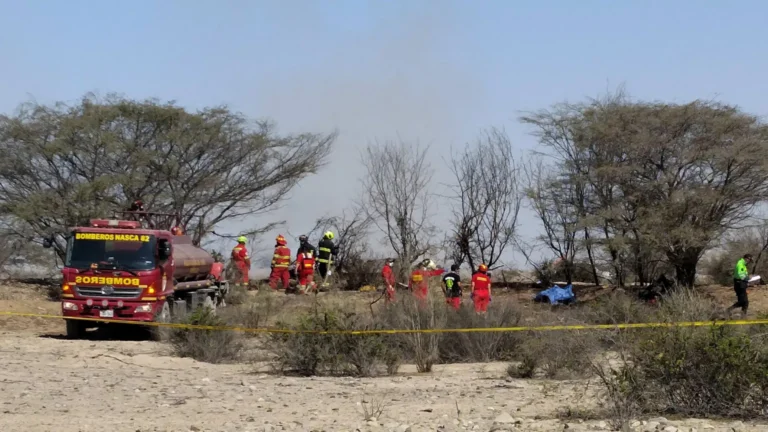
    Tourist plane crash in Peru kills 13

    LIMA: A tourist aircraft crashed in southern Peru on Saturday, killing all 13 people on board during a sightseeing flight over the world-famous Nazca Lines, authorities confirmed. The aircraft, identified as a Cessna Caravan C-208, was carrying 11 foreign tourists and two pilots when it went down near the Nazca archaeological site shortly after taking off from Pisco Airport. According to officials, the passengers included seven Italian nationals, two Germans and two Spaniards. Emergency responders rushed to the crash site, but there were no survivors. Police and rescue teams launched recovery operations immediately after the accident. Authorities said the impact completely destroyed the aircraft, making rescue efforts impossible. Investigators have begun examining the wreckage to determine what caused the crash. The Nazca Lines, a UNESCO World Heritage Site, attract thousands of visitors every year. The enormous ancient geoglyphs, etched into the desert more than 1,500 years ago, are best viewed from the air, making sightseeing flights a popular tourist activity. Local authorities expressed deep sorrow over the tragedy and extended condolences to the victims’ families. The airline operating the flight said it would cooperate fully with investigators and review its flight operations in line with directives from aviation authorities. The accident is the latest in a series of aviation incidents involving sightseeing flights over the Nazca Lines. Similar crashes in previous years have raised concerns about the safety of tourist flights in the region. Officials said a full investigation is underway to establish the exact circumstances behind the fatal crash.

  • | |

    World Cup conspiracies weaponised as Javier Milei blames foreign leftists for online backlash

    Following Argentina’s defeat by Spain in the World Cup final, President Javier Milei has alleged that a coordinated, foreign-funded anti-Argentina campaign was launched to undermine his nation and its football team. The far-right libertarian president claimed during a radio interview that the US Democratic party, alongside the governments of Mexico and Brazil, financed widespread online hostility, fan racism accusations, and rumours of favorable treatment towards Lionel Messi’s squad. Milei specifically targeted Brazilian President Luiz Inácio Lula da Silva, alleging that Brazil provided the largest share of funding for these attacks, a statement he reiterated while attending a campaign launch for far-right senator Flávio Bolsonaro in São Paulo. The president’s claims come amidst online friction and high-profile international criticism, including an Instagram post by actor Samuel L. Jackson urging fans not to support Argentina due to historical racism in the country. Whilst digital communications researchers acknowledge a genuine surge of transnational hostility online, experts note there is no public evidence supporting Milei’s claims of an organised international funding plot. Instead, political analysts view the narrative as a calculated tactic to stoke culture wars and divert public attention away from domestic corruption scandals, rising unemployment, and the severe impact of his austerity measures, which have pushed the administration’s popularity to its lowest level since taking office.

  • |

    Germany pledges justice as Berlin attack shocks nation

    BERLIN, July 26: German authorities have launched a major investigation after a vehicle drove into a crowd near a Pride event in Berlin, killing one person and injuring 16 others. The incident took place late Saturday night in the Tiergarten area, close to Berlin’s Brandenburg Gate. The location was near the route of Christopher Street Day, one of Europe’s largest annual LGBTQ Pride celebrations. Emergency services said eight people were seriously injured. Three of them were in critical condition. Police have identified a man they describe as being known to authorities and linked to the Islamist scene. They released his photograph and appealed to the public for information about his whereabouts. Authorities said the suspect was believed to be around 1.90 metres tall, slim and had black hair. He was reportedly last seen wearing a black hooded top and white trousers. Police have not yet established whether the suspect acted alone. Investigators are also examining reports that more than one person may have left the vehicle after it stopped. Some of those injured reportedly suffered stab wounds, adding another element to the investigation. The vehicle eventually came to a stop after striking a tree in the Tiergarten. Police later found it empty and began searching for the person or people believed to have been involved. The remaining Christopher Street Day activities were cancelled following the attack. German Interior Minister Alexander Dobrindt condemned the incident as a cowardly attack on people who had been peacefully celebrating. He said authorities would work to establish what happened and identify those responsible. Officials have not yet provided a clear motive for the attack. Several details also remain under investigation, including the exact sequence of events and whether more than one person was involved. The incident has also placed additional pressure on Chancellor Friedrich Merz’s coalition government. The attack comes ahead of important state elections and amid a heated political debate over immigration, public security and extremism. Germany’s far-right Alternative for Germany party quickly reacted to the incident. Its leaders called for stronger action against religious extremism and warned against violence and intolerance. Authorities are continuing their search for the suspect. Police have urged anyone with relevant information to contact them as the investigation continues.

  • July’s buck moon peaks this week, and wildfire smoke may turn it orange

    This week brings July’s full moon, known as the buck moon, which reaches peak illumination at 10:36 a.m. ET on Wednesday, according to The Old Farmer’s Almanack. Even though the exact peak passes quickly, the moon will look full to the naked eye for about a day on either side of that moment, so there is no rush to catch it at the precise minute. Viewing conditions will differ depending on where you are. Those in the Northern Hemisphere will see the moon sitting relatively low in the sky, while Southern Hemisphere viewers get a higher vantage point, though still not as high as what June’s full moon offered, according to EarthSky. Astrologically, this year’s buck moon falls under Aquarius, though it is worth noting that the zodiac sign does not necessarily match the constellation the moon is actually passing through. Noah Petro, who heads the Planetary Geology, Geophysics and Geochemistry Lab at NASA’s Goddard Space Flight Center, said there is flexibility in how and where people view it, as long as they find a spot away from bright city lights with a clear line of sight to the sky. Viewers in the Northeast and Upper Midwest may notice something different this time around: the moon appearing more orange or red than usual. That’s being linked to smoke drifting down from wildfires burning in Canada, which has settled into the atmosphere as a haze. Pamela Gay, a senior scientist at the Planetary Science Institute, explained that the same smoky layer responsible for dimming daytime skies is also what’s tinting the moon’s color. As for the name itself, “buck moon” refers to the time of year when male deer begin growing new antlers. Other cultures have their own names for this particular full moon. The Dakota call it the moon of ripe chokecherries, while the Cree know it as the feather-moulting moon. Petro also drew a connection to NASA’s Artemis II mission, which sent four astronauts on a flight around the moon back in April, describing moments like this full moon as a reminder of humanity’s ongoing connection to what is happening on the moon itself. Looking ahead, five more full moons remain on the calendar for 2026, with November and December set to bring supermoons, when the moon reaches its closest approach to Earth.

  • |

    Kashmir activist and journalist released on bail after years in custody

    Indian authorities have released Kashmiri human rights activist Khurram Parvez and journalist Irfan Mehraj on bail after they spent years in custody under terrorism related charges. Their families confirmed that both men were released from a prison in New Delhi late on Wednesday following a court order, although strict bail conditions will keep them in the capital while their trial continues. Parvez, a well known human rights defender and programme coordinator of the Jammu Kashmir Coalition of Civil Society, was arrested by India’s National Investigation Agency in November 2021 from his home in Srinagar. Mehraj, a freelance journalist who also worked with the same rights organisation, was arrested in 2023. Both men have been charged under India’s anti terrorism laws with allegedly financing terrorism and promoting separatist activities. The legislation allows authorities to detain suspects for long periods without trial and has frequently been criticised by rights organisations for its broad powers. Although they have now been granted bail, their freedom remains limited. Court conditions require both Parvez and Mehraj to stay in New Delhi during the legal proceedings. They are not permitted to return to Kashmir and must arrange their own accommodation in the capital while attending court hearings. Indian investigators had challenged the decision to grant bail, but a higher court upheld the order. The Jammu Kashmir Coalition of Civil Society has spent many years documenting alleged human rights violations in the region. The organisation has published reports on cases involving torture, unlawful killings, enforced disappearances, and unmarked graves in areas affected by the long running conflict. Its work has often drawn international attention and placed it at the centre of debates over human rights in Kashmir. Parvez has received support from several international human rights organisations that have repeatedly called for his release. In 2023, the United Nations Working Group on Arbitrary Detention described his arrest as retaliation for his human rights activities. The UN experts said the detention appeared intended to silence both Parvez and wider civil society efforts in Kashmir. The case has also renewed attention on press freedom in the region. Journalists working in Indian administered Kashmir have reported increasing restrictions, surveillance, and legal action since the Indian government revoked the region’s special constitutional status in 2019. Several media workers and activists say they have faced questioning, arrests, or pressure while reporting on political and security issues. The Indian government maintains that its actions are necessary to combat terrorism and protect national security. Officials argue that the anti terrorism laws are an essential tool in dealing with militant groups operating in the region. However, critics say the legislation has increasingly been used against journalists, activists, and civil society members who peacefully document human rights concerns. Government figures show that more than 3,600 people were arrested under anti terrorism laws in Kashmir between 2019 and 2023. More than half of those detained remain in prison while awaiting legal proceedings, highlighting concerns over lengthy pre trial detention. The release of Parvez and Mehraj has been welcomed by rights advocates, but legal proceedings against both men continue. They will remain in New Delhi under the conditions set by the court until their trial reaches its conclusion. Their cases are expected to remain closely watched by international human rights organisations and press freedom groups as they continue to raise concerns about civil liberties and legal protections in Indian administered Kashmir.

  • | |

    HEC Chief calls for education, research to become …

    ISLAMABAD: Higher Education Commission (HEC) Chairman Dr Niaz Ahmed has called for a major shift in Pakistan’s approach to higher education and research, saying universities must become central to the country’s economic, technological and social development. Speaking about his recent nearly two-week visit to China, Dr Niaz Ahmed said Pakistan could learn valuable lessons from China’s development model, particularly its close cooperation among universities, industry, research institutions and the government. The HEC chairman visited China with a delegation of senior vice chancellors from leading Pakistani universities on the instructions of the prime minister and at the invitation of Chinese education authorities and academic institutions. During the visit, Pakistani and Chinese universities discussed joint and dual-degree programmes, faculty and student exchanges, collaborative research and greater opportunities for Pakistani students to pursue higher education in China. He said efforts were also underway to strengthen the CPEC Consortium of Universities and establish 10 Sinology Centres in Pakistan. The Higher Education Commission has been asked to nominate 10 Pakistani universities for the initiative. Dr Niaz said his meetings with Chinese universities and research organisations showed that universities there function as more than degree-awarding institutions. They are closely connected with industry and government, helping develop new technologies, solve industrial problems, support startups and prepare skilled workers for emerging economic needs. He noted that research in China is increasingly focused on turning knowledge into practical solutions, new products and economic opportunities rather than simply increasing the number of research publications. The HEC chairman said China’s rapid progress in artificial intelligence, robotics, automation and digital technology was particularly striking. These technologies, he observed, have moved beyond laboratories and are now being used in factories, transportation, hotels and urban services. He also highlighted China’s rapidly expanding electric vehicle industry, saying the transformation demonstrated the importance of developing technology rather than simply consuming it. According to him, countries that build their own technological capabilities will be better positioned to compete in the future. Dr Niaz attributed China’s progress not only to investment and technology but also to discipline, punctuality, hard work and a clear national vision. He said the country’s experience demonstrated how coordinated efforts by government institutions, universities, industries and citizens could produce lasting national development. Reflecting on Pakistan’s traditional focus on Western academic models, he said his visit had strengthened his belief that China offers an important Asian development experience that Pakistan should study carefully. He stressed, however, that Pakistan should adapt successful practices to its own circumstances rather than simply copy the Chinese system. The HEC chairman said Pakistani universities now needed to examine whether they were merely producing degree holders or actually developing human capital capable of contributing to the national economy. He called for curricula to be aligned with future employment needs, with greater emphasis on artificial intelligence, data science, automation and other emerging fields. Universities, he said, must also strengthen faculty capabilities and build closer relationships with industry. Dr Niaz further stressed that research should focus on solving national and industrial problems, developing technologies and creating business opportunities rather than remaining limited to academic publications. After returning from China, he said, he shared his observations with university leaders across Punjab, Sindh, Balochistan, Azad Jammu and Kashmir, Gilgit-Baltistan and the federal capital. The objective was to encourage universities to reconsider their approaches to curriculum development, research, faculty training and industry partnerships. He said Pakistan already possesses a large network of universities, talented researchers and a young population, but these strengths need to be supported by a clear national strategy and sustained investment. “The real strength of a nation lies not only in roads, buildings and factories, but also in knowledge and human capital,” Dr Niaz said, stressing that Pakistan’s journey towards developed-country status must begin in university classrooms and research laboratories and eventually translate into stronger industries, a more productive economy and greater national prosperity.

Leave a Reply

Your email address will not be published. Required fields are marked *