amnesty international condemns
|

Amnesty international condemns violence against youth in India


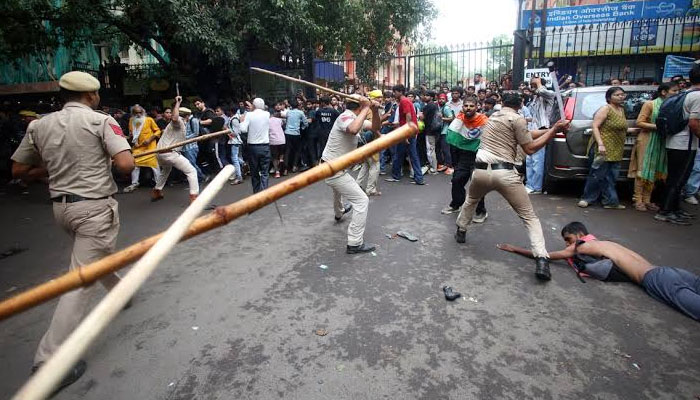
Global human rights organization Amnesty International has strongly condemned the use of force against young people in India, expressing serious concern over reports of violence during recent demonstrations. The organization has urged Indian authorities, particularly the police, to immediately stop using excessive force against peaceful protesters and to uphold the fundamental rights guaranteed under international human rights law.

In a statement, Amnesty International said it was deeply concerned about the suppression of peaceful dissent in India. According to the organization, young demonstrators exercising their right to express their opinions were met with unnecessary and excessive force by law enforcement agencies. Amnesty stressed that the right to peaceful assembly and freedom of expression are essential democratic freedoms that must be protected, not restricted.

The human rights group further stated that authorities imposed several measures to prevent protesters from reaching the Parliament House, where many intended to demonstrate peacefully. Barricades were reportedly erected across key routes leading to the area, limiting public movement and restricting access to the protest site. Such actions, Amnesty argued, hindered citizens’ ability to exercise their democratic rights and raised concerns about the government’s handling of peaceful public gatherings.

Amnesty International also criticized the suspension of public services during the protests. According to the organization, metro services were disrupted and mobile internet access was temporarily shut down in several areas. The group noted that internet shutdowns and transport restrictions not only affect demonstrators but also disrupt the daily lives of ordinary citizens, limiting communication, access to information, and emergency services. Amnesty has repeatedly argued that blanket internet restrictions are inconsistent with international human rights standards and should only be used under exceptional and legally justified circumstances.

The organization emphasized that the use of batons (lathi charge), tear gas shelling, and other crowd-control measures should always comply with the principles of necessity, legality, and proportionality. It maintained that law enforcement officials should prioritize dialogue and de-escalation over the use of force, especially when dealing with peaceful assemblies.


Amnesty International has called on the Indian government to conduct an immediate, independent, and impartial investigation into allegations of excessive police force, including reports of baton charges and shelling against protesters. The organization said that any officials found responsible for violating human rights should be held accountable through transparent legal processes.

The human rights body reiterated that governments have a responsibility to protect the rights of all citizens, including young people who participate in peaceful demonstrations. It urged Indian authorities to respect freedom of expression, freedom of assembly, and access to information while ensuring that policing practices remain consistent with international human rights obligations.

Amnesty International concluded by emphasizing that safeguarding democratic freedoms is essential for maintaining public trust and strengthening the rule of law. The organization called on Indian authorities to take immediate steps to protect the rights of peaceful protesters, ensure accountability for any abuses, and prevent similar incidents from occurring in the future.
Similar Posts

  • | | |

    Trump claims US controls Iran’s finances 

    WASHINGTON: US President Donald Trump has claimed that Washington has control over Iran’s financial resources as the conflict between the United States and Iran continues. In an interview, Trump said the US was effectively acting as a banker for Iran. He claimed Washington had control over a large amount of Iranian money. Trump also described Iran’s economic situation as extremely difficult. He alleged that the country was facing very high inflation and that its currency had lost much of its value. The US president further claimed that Iran was struggling to pay its soldiers and suggested that the economic pressure could become increasingly difficult for Tehran to sustain. Trump outlined several possible approaches toward Iran. He said Washington could maintain the current economic pressure, launch further military action or rely more heavily on financial measures. He said his main objective in the conflict was to prevent Iran from acquiring a nuclear weapon. Trump also claimed that US military action had stopped Tehran from obtaining such a capability. Qatar urges reopening of Strait of Hormuz Meanwhile, Qatar said talks between Iran and Oman on arrangements for reopening the Strait of Hormuz had reached an advanced stage. Qatari Foreign Ministry spokesman Majed Al-Ansari said the negotiations had reached a critical point. He expressed hope that the strategically important waterway would reopen as soon as possible. Qatar said it supports diplomatic efforts aimed at reducing tensions and resolving the dispute. Iran and Oman have been discussing legal and technical arrangements for the resumption of maritime traffic through the strait. Shipping activity in the area has been disrupted following the military confrontation between Iran and the United States. Tehran has linked the reopening of the waterway to the resolution of disputes surrounding what it describes as US violations of a June memorandum of understanding. Araghchi says US sought negotiations Iranian Foreign Minister Abbas Araghchi has claimed that Washington eventually sought negotiations with Tehran after initially demanding Iran’s unconditional surrender. Speaking during a televised press conference, Araghchi said the US had initially taken a hard-line position but later sought talks. He claimed that the change demonstrated Iran’s ability to withstand military and political pressure. Araghchi also said Iran had surprised countries around the world by resisting the United States. The Iranian foreign minister said Washington had support from Israel and several Western countries during the conflict. He also discussed the situation with German Foreign Minister Johann Wadephul during a telephone conversation. According to Iranian state media, Araghchi told his German counterpart that the insecurity in the Strait of Hormuz was the result of US and Israeli military actions against Iran. He briefed Wadephul on Iran’s discussions with Oman regarding the creation of a safe route for maritime traffic through the strategic waterway. The two officials also discussed bilateral relations and wider regional and international developments. Araghchi called on the international community to hold Washington accountable for what he described as the security and economic consequences of the disruption in the Strait of Hormuz. He maintained that lasting security in the waterway would require an end to what Tehran considers US military aggression, maritime restrictions and violations of previous commitments.

  • | |

    Houthis claim attack on Saudi Tanker as US Naval b…

    Yemen’s Houthi rebels have claimed responsibility for targeting a Saudi oil tanker in the Red Sea with ballistic missiles, alleging the vessel violated a blockade on Saudi ports announced by the group last week . The Houthi military spokesman identified the ship as the NCC Ghazal, stating it had been “forced to turn back” after ignoring warnings. This attack is the latest in a series of maritime operations by the Iran-aligned group, which previously claimed to have targeted two Saudi tankers, the Encelia and Layla, and to have forced around ten ships to retreat . In a related development, the US Central Command (CENTCOM) announced on Tuesday that it has redirected 18 commercial vessels, disabled two, and boarded two others as part of its ongoing naval blockade against Iran . The intensified maritime operations come amid a complex regional conflict involving US-Iran hostilities, with CENTCOM stating there are more than 20 ships currently supporting military operations in the Middle East . The Houthi actions and the US naval blockade add new layers of tension to the region’s shipping lanes, critical for global energy supplies, and coincide with broader diplomatic efforts to de-escalate the wider conflict.

  • |

    Daniel Siad, modelling scout with ties to Epstein,…

    Daniel Siad, a modelling scout whose name appeared nearly 2,000 times in the Epstein files released by the US Department of Justice, was found dead at his home outside Paris on Wednesday, prosecutors said. His body was reportedly discovered in the kitchen by a woman staying with him, and a neighbor reportedly attempted CPR without success. Siad’s death comes amid a wide-ranging probe into human trafficking and tax fraud opened in February following the release of the Epstein files. Since the investigation began, 24 women have come forward as victims or witnesses of alleged acts committed by Siad or others, Paris prosecutor Laure Beccuau said in a statement. As part of the probe, Siad had been subjected to special scrutiny, though he had repeatedly proclaimed his innocence. Siad’s lawyer, Arab-Tigrine, told Reuters that Siad had asked on several occasions to be heard by French judicial authorities, but that no action was taken. She confirmed that Siad had died of a heart attack. Siad is the second man publicly linked to Epstein who has died in France. In 2020, French authorities arrested modelling agent Jean-Luc Brunel after allegations he procured women for Epstein. Brunel was found hanged in his prison cell in 2022, having spent 14 months in custody awaiting trial on charges of rape of minors and sexual harassment. He denied the charges, along with any participation in Epstein’s sex trafficking. The Epstein files, released by the US Department of Justice, have revealed extensive connections between the late financier and individuals in the modelling and entertainment industries. Epstein, who died in prison in 2019 while awaiting trial on sex trafficking charges, had a long history of exploiting young women and maintaining a network of powerful associates. The release of these documents has reignited debates about accountability and the extent of Epstein’s influence. Siad’s death raises questions about the circumstances surrounding his passing and the ongoing investigation into his activities. His lawyer’s statement that he had sought to be heard by authorities suggests a desire to clear his name, but his sudden death has left many unanswered questions. The French authorities have not yet released further details about the investigation into Siad’s activities, but the probe continues as more victims and witnesses come forward. The deaths of Brunel and Siad have drawn attention to the high-profile individuals connected to Epstein who have died under unusual circumstances. While both men denied the allegations against them, their deaths have fueled speculation about the extent of Epstein’s network and the pressure faced by those connected to him. As the investigation continues, the public will be watching closely for any further developments in the case. Siad’s death marks another chapter in the ongoing saga of the Epstein scandal, which has exposed the dark underbelly of the modelling and entertainment industries and raised questions about the accountability of those who enabled Epstein’s crimes. The investigation into Siad’s activities and the broader network of individuals connected to Epstein is likely to continue, with the hope of bringing justice to the victims and shedding further light on the extent of Epstein’s influence.

  • |

    EU calls emergency meeting following mass migrant crossings into Ceuta

    The European Union has convened an emergency meeting after 22 member states issued a joint letter demanding coordinated action to strengthen the bloc’s external borders following the arrival of 60,000 migrants in Spain’s North African enclave of Ceuta. The influx has triggered severe political friction within the EU, leading Italy, Finland, and Denmark to suspend or question passport-free Schengen travel arrangements with Spain. Spanish Prime Minister Pedro Sánchez condemned the unilateral measures as unlawful and selfish, maintaining that border control was fully restored within 48 hours and preventing onward movement into continental Europe. EU officials confirmed the death toll from the crossing attempt has risen to at least 67 while the vast majority of individuals who entered the enclave have since returned to Morocco. The joint letter addressed to EU leadership stresses that uncoordinated responses risk creating a perception that illegal entry into the bloc is possible, which would encourage further crossing attempts across member states. In response to the crisis, Spanish authorities have installed floating security barriers off the Ceuta coastline while working alongside international partners to secure the border perimeter.

  • |

    Why did Zelensky sack his Army Chief?

    Ukrainian President Volodymyr Zelensky has removed the country’s top military commander, General Oleksandr Syrskyi, in a major change to Ukraine’s military leadership as the war with Russia enters its fifth year. The decision comes during a difficult period for Ukraine, where fighting continues on several front lines and pressure is mounting on the government to improve military performance. General Syrskyi had been serving as Commander-in-Chief of the Armed Forces of Ukraine. He was responsible for leading the country’s military operations against Russian forces. President Zelensky announced that General Mykhailo Drapatyi will replace him as the new army chief. In his statement, Zelensky thanked Syrskyi for his service and praised Ukrainian soldiers for defending the country. However, he said Ukraine now needs a “reset” in military leadership to strengthen operations, improve coordination among commanders and address challenges related to troop mobilisation and battlefield management. The leadership change comes only a few days after Zelensky removed Defence Minister Mykhailo Fedorov from office. That decision sparked public protests in the capital, Kyiv, with many people expressing concern about changes in the country’s defence leadership while the war is still ongoing. Who is Oleksandr Syrskyi? General Oleksandr Syrskyi is one of Ukraine’s most experienced military officers. He was born in Russia in 1965 when both Russia and Ukraine were part of the former Soviet Union. During his early military career, he served in Soviet forces before choosing to remain in Ukraine after it became an independent country in 1991. Over the years, Syrskyi rose through the ranks of the Ukrainian military. In 2014, he led Ukrainian forces during fighting against Russian-backed separatists in eastern Ukraine. When Russia launched its full-scale invasion of Ukraine in February 2022, Syrskyi became one of the country’s most important military commanders. He played a leading role in defending the capital, Kyiv, from Russian attacks during the early weeks of the war. His leadership was widely praised, and he later received Ukraine’s highest national honour, the title of “Hero of Ukraine.” He was also credited with planning Ukraine’s successful counteroffensive in the Kharkiv region in 2022. During that operation, Ukrainian forces regained control of several key cities that had been occupied by Russian troops. Why was he removed? President Zelensky has not accused Syrskyi of any wrongdoing. Instead, he said the leadership change is aimed at improving Ukraine’s military strategy as the war continues. Reports suggest there had been disagreements within Ukraine’s defence leadership over military reforms, mobilisation policies and battlefield planning. Former Defence Minister Mykhailo Fedorov had previously criticised Syrskyi, saying some reforms were progressing too slowly. The appointment of General Mykhailo Drapatyi is seen as an attempt to bring fresh leadership and improve cooperation between military commanders and government officials. Ukraine has changed several military leaders This is not the first time Ukraine has replaced senior defence officials since the war began. In September 2023, Defence Minister Oleksii Reznikov left office after corruption allegations involving the defence ministry. In February 2024, General Valerii Zaluzhnyi, who was one of Ukraine’s most popular military commanders, was replaced by Syrskyi as commander-in-chief. Several other senior officers have also been reassigned as Ukraine continues to adjust its military leadership during the conflict. Russia has also changed its commanders Russia has also replaced several top military officials since launching its invasion of Ukraine. The commander of Russia’s Black Sea Fleet was removed after the sinking of the warship Moskva in 2022. Major General Ivan Popov was dismissed after publicly criticising Russia’s military strategy. General Sergey Surovikin, who once commanded Russia’s aerospace forces, was also removed following the failed Wagner Group rebellion in 2023. Why does this matter? Military leadership plays a crucial role in any war. Commanders make important decisions about troop movements, battlefield tactics, defence planning and military operations. Ukraine hopes the appointment of General Drapatyi will strengthen its armed forces at a time when Russia continues to launch attacks across different regions. The change also reflects Kyiv’s effort to improve military efficiency and prepare for future operations

  • |

    Lavrov rules out immediate Ukraine ceasefire

    Russian Foreign Minister Sergei Lavrov has ruled out the possibility of an immediate ceasefire in Ukraine, arguing that any truce must form part of a long-term and sustainable settlement rather than serve as a temporary pause in the conflict. In an interview with Russian state television, Lavrov said Moscow would continue to take stronger measures against Western support that, according to Russia, strengthens Ukraine’s military capabilities. He accused Western countries of prolonging the war by providing Kyiv with military and other forms of assistance. Lavrov maintained that Russia would only consider a ceasefire if it could lead to a lasting political solution. He said an immediate halt to fighting would not address what Moscow considers the underlying causes of the conflict and could allow Ukraine to strengthen its forces and resume hostilities later. The Russian foreign minister also accused the United States of involvement in attacks against Russia. His remarks came as Moscow seeks clarification from the US State Department over alleged American intelligence cooperation with Ukraine. Despite the escalating rhetoric, Lavrov said Russia had not rejected dialogue with representatives of US President Donald Trump. He indicated that Moscow remained open to discussions with Trump’s envoys, suggesting that diplomatic channels between Washington and Moscow remain available. Lavrov’s comments highlight the difficult path toward a ceasefire as Russia and Ukraine continue to disagree over the conditions for ending the war. Moscow has repeatedly called for a settlement that addresses its security demands, while Kyiv and its Western allies have pushed for a durable peace that preserves Ukraine’s sovereignty and security.

Leave a Reply

Your email address will not be published. Required fields are marked *