governor kundi attends

Governor Kundi attends Independence Day ceremony at Cadet College Battarasi

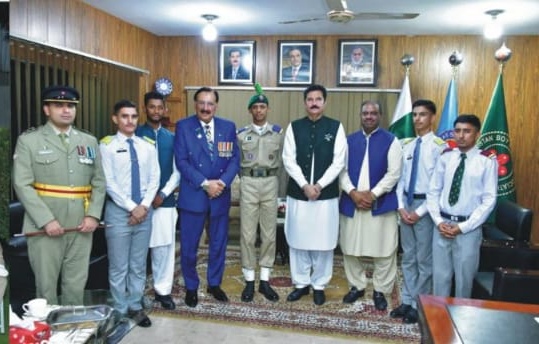
MANSEHRA: A grand Independence Day ceremony was held at Pakistan Scouts Cadet College Battarasi, Mansehra, with Khyber Pakhtunkhwa Governor Faisal Karim Kundi as the chief guest.

Governor Faisal Karim Kundi hoisted the national flag, cut the Independence Day cake and inaugurated a tree plantation campaign. He also visited the Martyrs’ Memorial, where special prayers were offered for the security, stability and progress of the country.

Principal Pakistan Scouts Cadet College Battarasi Brigadier (Retd) Abdul Hafeez, Adjutant Captain Hussain, Professor Ikram Sarwar, faculty members, cadets and other guests attended the ceremony.

Addressing the gathering, Governor Faisal Karim Kundi said he was delighted to participate in the Independence Day ceremony at the college. He said Pakistan came into existence on August 14 after the people of the subcontinent made immense sacrifices for the establishment of the country.

The governor paid tribute to the Pakistan Army and security forces, saying their sacrifices had enabled the nation to live a free and peaceful life. He said Pakistan Scouts Cadet College Battarasi was playing an important role in promoting education, while its graduates were serving the country in various fields and contributing to national development.

Addressing the cadets, Governor Kundi urged them to utilize their abilities and energies for the progress and prosperity of Pakistan. He said they would soon enter practical life and should play their role in strengthening the country, while remaining ready to make every sacrifice for the national interest.

He said the cadet college was not only providing quality education but was also playing an important role in character building, discipline and training of students. He assured the students that he would make every possible effort to address their issues and appreciated the college administration for its services in providing quality education and training.

Speaking on the occasion, Principal Brigadier (Retd) Abdul Hafeez welcomed the governor and other guests. He said Pakistan was facing various challenges and hostile elements were attempting to undermine the country, but the security forces had always rendered exemplary services for the defence of the nation.

He said that with the Pakistan Army standing firm, no enemy could dare look towards Pakistan with hostile intentions.

The principal said Pakistan Scouts Cadet College Battarasi was established by former Prime Minister Shaheed Mohtarma Benazir Bhutto with the objective of preparing future leaders and talented individuals to serve the country. Thousands of students had graduated from the institution and were now serving Pakistan in different fields.

Brigadier (Retd) Abdul Hafeez expressed gratitude to Governor Faisal Karim Kundi for attending the ceremony at short notice and urged the cadets to devote their energies to education, discipline and character building.

Similar Posts

  • | |

    FIA launches unit to hunt dark web criminals

    The Federal Investigation Agency (FIA) has established a dedicated unit to investigate criminals operating through the dark web. The move is aimed at strengthening Pakistan’s ability to deal with hidden online criminal networks. The new unit has been set up at the FIA’s National Command and Control Centre (NC3) in Islamabad. It will use advanced technology and digital investigation techniques to identify suspects who use encrypted platforms to conceal their identities. FIA Director General Dr Usman Anwar said the unit would focus on criminal networks involved in activities that fall under the agency’s jurisdiction. Investigators will also examine suspicious digital transactions, including those involving cryptocurrencies. A major focus will be networks involved in producing fake documents. Such documents can be used to facilitate human trafficking and illegal migrant smuggling. The unit will also investigate other forms of cyber-enabled crime linked to the dark web. The dark web is a hidden part of the internet. Its websites are not normally indexed by standard search engines. Access often requires specialised software and knowledge. Criminals can use these systems to hide their identities and locations. The technology has also been misused for illegal trade, cybercrime and other criminal activities. Authorities face additional challenges because many dark web networks operate across national borders. Criminals can also use cryptocurrency to make financial transactions more difficult to trace. The FIA plans to address these challenges through modern digital investigation tools and greater coordination between specialised teams. The new unit will work closely with the FIA’s cryptocurrency investigation unit. Both units will operate under the same facility and share technical expertise. Investigators will use blockchain forensic techniques to examine cryptocurrency transactions. These techniques can help authorities analyse transactions and potentially connect anonymous or pseudonymous digital addresses with real-world identities. Open-source intelligence will also be used to support investigations. Officials said digital evidence gathered from different sources could help strengthen criminal cases. Investigators will track aliases, usernames and pseudonyms used by suspected criminals across online marketplaces, forums and other hidden platforms. The information will be used to build detailed profiles of suspected offenders. Authorities can then use the evidence to identify suspects and pursue legal action. NC3 Director Dr Athar Waheed explained the basic structure of the internet. He said it is commonly divided into three broad layers: the surface web, deep web and dark web. The surface web includes websites that can be found through regular search engines. News websites, social media platforms, blogs and online shopping sites are examples. The deep web contains online material that search engines do not index. This includes private databases, email accounts, banking systems, academic resources and internal organisational networks. Much of the deep web is legitimate. Users normally need passwords, subscriptions or specific permissions to access such content. The dark web is a smaller and deliberately hidden section of the deep web. It uses technologies designed to provide greater anonymity. Tor is one of the technologies commonly associated with accessing dark web services. It routes internet traffic through multiple volunteer-operated relays, making it more difficult to identify the original source. The FIA’s new unit will seek to overcome these anonymity measures through digital forensics, intelligence gathering and technological investigation.

  • |

    SEF, Sindh Boy Scouts launch initiative to expand scouting across Foundation-assisted schools*

    KARACHI: The Sindh Education Foundation (SEF), Government of Sindh has initiated a collaboration with the Sindh Boy Scouts Association by holding a Group Scout Leadership Seminar aimed at promoting leadership, discipline and community service among students enrolled in Foundation Assisted Schools. The seminar, held at the Sindh Boy Scouts Association headquarters in Karachi, brought together representatives from 32 Foundation Assisted Schools, including head teachers, faculty members and students. The event was attended by SEF Managing Director Gahanwer Ali Laghari, Deputy Managing Director Shahpara Rizvi, Regional Head Karachi Ashfaque Hussain Meerani, senior directors, assistant directors and other officials. The Sindh Boy Scouts Association was represented by Provincial Scout Secretary Syed Akhter Meer, and other office-bearers. Addressing the seminar, Provincial Scout Secretary Syed Akhter Meer welcomed the participation of SEF schools and said introducing students to the history and values of scouting would encourage them to become part of a global movement focused on leadership, character building and service. He also recalled the support extended to the scouting movement by the late Prof Dr Anita Ghulam Ali during her tenure at SEF, saying it was encouraging to witness the Foundation continuing the same commitment under the leadership of Managing Director Gahanwer Ali Laghari. Participants were also briefed on the history of the scouting movement in Sindh, its achievements and future roadmap through a presentation highlighting the organisation’s contribution to youth development. Former senior bureaucrat Ghulam Ali Pasha said leadership and discipline could not be developed through classroom education alone, stressing that scouting provides young people with practical exposure to teamwork, responsibility and community service. He described such initiatives as essential for preparing students to become confident and responsible leaders. Speaking on the occasion, SEF Managing Director Gahanwer Ali Laghari said the Foundation’s mandate extended beyond improving access to education and academic outcomes. “Alongside quality education, we want our students to develop leadership, discipline and a sense of responsibility. Through scouting, they will have an opportunity to become part of an international movement that promotes these values,” he said. Laghari announced that SEF and the Sindh Boy Scouts Association would jointly organise a series of scouting activities across Foundation Assisted Schools throughout the province. He said the initiative had been launched with schools in Karachi and would gradually be expanded to all SEF-supported schools. “Our objective is to engage the entire network of Foundation Assisted Schools, and we are hopeful that within the next one-and-a-half years, scouting activities will be introduced across the province,” he added. The initiative is expected to provide students with greater opportunities for leadership development, teamwork and community engagement alongside their academic education.

  • | |

    Judge walks out after uproar in Aleema case

    RAWALPINDI: An anti-terrorism court judge in Rawalpindi left the courtroom after expressing anger over repeated disruptions during the hearing of a case against PTI founder Imran Khan’s sister, Aleema Khan. The case relates to a case registered over the November 26 protest. The hearing turned tense when the prosecution began questioning Aleema Khan and her witness about property-related matters. During the proceedings, prosecutor Zaheer Shah questioned Aleema Khan’s witness, Fatahullah Barky, about whether he was aware of alleged properties owned by Aleema Khan abroad. Defence lawyer Faisal Malik immediately objected. He argued that the question was not relevant to the case being heard by the court.The prosecutor then questioned Aleema Khan directly about alleged properties in Dubai and New Jersey. Aleema Khan rejected the allegations. She said she did not own any illegal property.She maintained that the properties had been described as benami assets in an earlier legal dispute. The prosecutor then asked whether the Supreme Court had imposed a fine on her in connection with the alleged benami properties. Aleema Khan replied that former chief justice Saqib Nisar had issued a decision that, according to her, was contrary to the law. She further claimed that a tribunal later cleared her in the matter. The prosecutor also asked whether she had paid a Rs30 million fine following the Supreme Court’s orders.Aleema Khan said that Rs29.4 million had been deposited. She added that the tribunal subsequently cleared her. During the hearing, Aleema Khan asked the court to record her statement. The court began recording her statement. However, the defence counsel raised another objection.The repeated objections and arguments created a noisy situation inside the courtroom. Judge Amjad Ali Shah expressed strong displeasure over the disruption. He questioned the defence counsel over the objection and said that if the accused wanted her statement recorded, there was no reason for the court not to record it.The judge’s remarks came as arguments continued between the prosecution and defence. The situation eventually became so tense that Judge Amjad Ali Shah left his seat and walked out of the courtroom. The proceedings were subsequently disrupted and the hearing was adjourned.Further proceedings in the case will take place on a later date. The hearing highlighted tensions between the prosecution and defence over the relevance of questions being asked during the proceedings

  • | | |

    PTI protest in Karachi triggers clashes, arrests a…

    KARACHI: Supporters of Pakistan Tehreek-e-Insaf (PTI) staged a protest near Fawara Chowk in Karachi to express solidarity with the party’s founder, leading to clashes with police and widespread traffic disruptions across the city. According to reports, PTI workers pelted police with stones during the demonstration. In response, police used tear gas and baton charges to disperse the protesters. The unrest forced nearby businesses to shut down, while commuters and residents faced significant inconvenience. Police detained several PTI leaders and workers, including PTI Sindh Secretary General Dr Masroor Sial. The protest caused severe traffic congestion around Governor House, Metropole, and Shaheen Complex. Authorities closed multiple roads to traffic, including the stretch from M.R. Kiani Road to Fawara Chowk and Din Muhammad Wafai Road. The route from Coast Guard to Regal Chowk and Sarwar Shaheed Road was also closed. In addition, the road from M.T. Khan Road towards PIDC remained blocked. Traffic restrictions were also imposed on both tracks of Zamzama Street and Khayaban-e-Shamshir, as well as both sides of Sir Shah Suleman Road from Quba Masjid, Ghareebabad, to Liaquatabad. Motorists were advised to use alternative routes as authorities worked to manage the situation.

  • | |

    Experts call for gender-responsive water policies …

    LAHORE: The growing impact of water insecurity and climate change on women took center stage at a dialogue titled “Women and Water,” jointly organized by Women in Struggle for Empowerment (WISE) and the University of Home Economics, Lahore. The event brought together academics, development professionals, and civil society representatives to advocate for inclusive and gender-responsive water governance in Pakistan. Addressing the gathering, Vice Chancellor of the University of Home Economics, Prof. Dr. Zaib-un-Nisa, underscored the urgent need to tackle water pollution, plastic waste, and inadequate water treatment systems. She stressed that sustainable solutions require greater investment in scientific water management, wider adoption of rainwater harvesting, improved household water storage, advanced recycling technologies, and university-led awareness campaigns to encourage responsible water use. Executive Director of WISE, Bushra Khaliq, said that Pakistan’s water challenges cannot be effectively addressed without recognizing their disproportionate impact on women and girls, who often bear the greatest burden of water scarcity. She emphasized the importance of drawing lessons from organizations working directly in urban water management and called for stronger collaboration among government institutions, academia, civil society, and local communities. She also urged policymakers to ensure women’s voices, experiences, and leadership are fully integrated into water governance at every level. Speaking on the occasion, Dr. Iram Rubab, Head of the Sociology Department at the University of Home Economics, described water as a multidimensional issue linked to health, agriculture, family welfare, livelihoods, sociology, and environmental sustainability. She encouraged interdisciplinary dialogue and collaborative research, noting that adopting a gender perspective in water management leads to more effective identification of challenges and practical solutions, particularly as women remain the primary managers of household water resources. The participants agreed that addressing Pakistan’s growing water crisis requires policies that not only strengthen water management but also recognize the vital role of women in ensuring sustainable and equitable access to this essential resource.

  • | |

    FCC issues written verdict in 50-year-old land dis…

    Pakistan’s Federal Constitutional Court has issued a detailed written judgment in a land dispute that has remained unresolved for nearly five decades. The ruling addresses a long-standing legal conflict over land ownership and tenancy rights, overturning previous decisions and restoring the legal status of the land as it existed before 1996. The court declared the 2008 judgment of the Lahore High Court null and void. It also set aside the orders issued by the Federal Land Commissioner in 1996, ruling that those decisions were not legally sustainable. The verdict marks a significant development in one of the country’s oldest land-related legal disputes. Chief Justice Aminuddin Khan authored the 25-page judgment, outlining the legal reasoning behind the court’s decision. The ruling carefully reviewed the history of the case, the relevant land laws, and the constitutional principles governing property rights and administrative authority. According to the judgment, the legal status of the disputed land has been restored to what it was before the Federal Land Commissioner’s 1996 orders. The court held that the rights of tenant farmers, commonly referred to as muzareen, must remain protected in accordance with the Land Regulations of 1972. These regulations were introduced to safeguard the lawful rights of tenants and regulate land that had been taken into government custody. The court emphasized that once land disputes have been finally decided through due legal process, they cannot be reopened or reconsidered without a valid legal basis. The judgment stated that the principle of finality in judicial decisions is essential for maintaining certainty and stability in the legal system. The ruling explained that under the 1972 Land Regulations, various pieces of land had been taken into government possession. Decisions regarding those acquisitions had already attained final legal status after being decided by the competent authorities and courts. However, in 1996, approximately twenty years after those decisions had become final, the Federal Land Commissioner declared the earlier government acquisition orders invalid. The Constitutional Court held that the commissioner lacked the legal authority to reopen and overturn matters that had already reached finality under the law. The judgment also noted that the Lahore High Court, in its 2008 decision, had upheld the Federal Land Commissioner’s orders. After reviewing the legal record, the Constitutional Court concluded that the High Court’s decision was based on an incorrect interpretation of the law and therefore could not be allowed to stand. By restoring the pre-1996 legal position, the court reaffirmed the protection of tenant farmers’ rights under the 1972 regulations while reinforcing the importance of respecting final judicial and administrative decisions. Legal experts believe the ruling could influence the resolution of similar land disputes involving historical claims and government-acquired property. The case was heard by the Federal Constitutional Court following the enactment of the 27th Constitutional Amendment, under which the matter came within the jurisdiction of the newly established court. The judgment is expected to serve as an important legal precedent for future constitutional and land-related cases, particularly those involving administrative powers, property rights, and the principle that finalized legal disputes should not be reopened without lawful justification.

Leave a Reply

Your email address will not be published. Required fields are marked *