
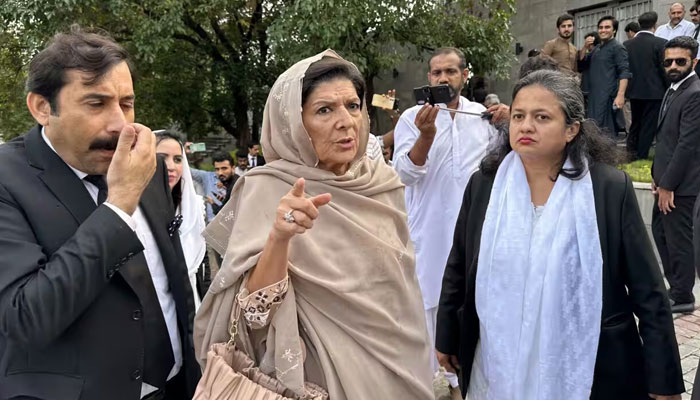
judge walks out
| |

Judge walks out after uproar in Aleema case

RAWALPINDI: An anti-terrorism court judge in Rawalpindi left the courtroom after expressing anger over repeated disruptions during the hearing of a case against PTI founder Imran Khan’s sister, Aleema Khan.

The case relates to a case registered over the November 26 protest. The hearing turned tense when the prosecution began questioning Aleema Khan and her witness about property-related matters.

During the proceedings, prosecutor Zaheer Shah questioned Aleema Khan’s witness, Fatahullah Barky, about whether he was aware of alleged properties owned by Aleema Khan abroad.

Defence lawyer Faisal Malik immediately objected. He argued that the question was not relevant to the case being heard by the court.The prosecutor then questioned Aleema Khan directly about alleged properties in Dubai and New Jersey.

Aleema Khan rejected the allegations. She said she did not own any illegal property.She maintained that the properties had been described as benami assets in an earlier legal dispute.

The prosecutor then asked whether the Supreme Court had imposed a fine on her in connection with the alleged benami properties.

Aleema Khan replied that former chief justice Saqib Nisar had issued a decision that, according to her, was contrary to the law. She further claimed that a tribunal later cleared her in the matter.

The prosecutor also asked whether she had paid a Rs30 million fine following the Supreme Court’s orders.Aleema Khan said that Rs29.4 million had been deposited. She added that the tribunal subsequently cleared her.

During the hearing, Aleema Khan asked the court to record her statement.

The court began recording her statement. However, the defence counsel raised another objection.The repeated objections and arguments created a noisy situation inside the courtroom.

Judge Amjad Ali Shah expressed strong displeasure over the disruption. He questioned the defence counsel over the objection and said that if the accused wanted her statement recorded, there was no reason for the court not to record it.The judge’s remarks came as arguments continued between the prosecution and defence.

The situation eventually became so tense that Judge Amjad Ali Shah left his seat and walked out of the courtroom.

The proceedings were subsequently disrupted and the hearing was adjourned.Further proceedings in the case will take place on a later date.

The hearing highlighted tensions between the prosecution and defence over the relevance of questions being asked during the proceedings


Similar Posts

  • |

    Austin Reaves’ Lakers future faces fresh trade questions

    LOS ANGELES: Austin Reaves has just secured a massive new contract with the Los Angeles Lakers, but his long-term future in Hollywood could still become a major talking point after the franchise made sweeping changes to its roster this summer. The Lakers have entered a new era with their focus increasingly centred on Luka Doncic, while the departure of LeBron James has changed the shape and direction of the team. Reaves, meanwhile, remains an important part of the Lakers’ plans. The 28-year-old guard re-signed with Los Angeles in late June on a four-year, $180 million contract, including a player option in the final season. The deal appeared to confirm that the Lakers viewed Reaves as a key piece alongside Doncic. His contract also reportedly gives Los Angeles greater financial flexibility moving forward, including the possibility of pursuing another player with the non-taxpayer mid-level exception next summer. But the Lakers’ subsequent move for centre Walker Kessler has complicated the picture. Los Angeles acquired Kessler from the Utah Jazz in July, reportedly committing significant draft capital in the process. The move reflects the Lakers’ desire to secure a long-term defensive presence in the frontcourt, but it also reduced the number of valuable assets available to the franchise. That situation has prompted NBA insider Zach Lowe to raise an intriguing possibility: Reaves could eventually become a trade candidate. Lowe argued that the Lakers paid heavily for Kessler and now have fewer tradeable assets with which to reshape the roster. “There’s no question that they overpaid for him,” Lowe said, suggesting the Lakers may eventually have to decide whether the current roster is good enough or whether they need to pivot by moving Reaves. The logic behind the speculation is straightforward. Doncic is now firmly positioned as the franchise cornerstone, making it highly unlikely that Los Angeles would consider moving him. Reaves, however, could command significant interest around the league if the Lakers eventually decide they need additional draft capital or another major piece. That does not mean a trade is imminent. In fact, Reaves could be more important to the Lakers than ever during the upcoming season. With James no longer in the picture, the team will need additional scoring, playmaking and leadership around Doncic. Reaves has already demonstrated that he can thrive in a high-pressure environment, evolving from an undrafted player into one of the Lakers’ most valuable contributors. His new contract suggests the organisation believes he can play an important role in its next chapter. Yet NBA roster building can change quickly. If the Lakers struggle to build a championship-calibre supporting cast around Doncic, Reaves’ value could become a tempting trade asset — particularly because the team has already sacrificed considerable draft capital to acquire Kessler. For now, Reaves remains a Laker and an important part of the franchise’s post-LeBron era. But with Doncic at the centre, Kessler anchoring the future frontcourt and the Lakers’ trade assets significantly reduced, one question is beginning to emerge: Could Austin Reaves ultimately become the price Los Angeles pays to build its next championship team?

  • | |

    Sania claims Imad ignored unborn baby’s heartbeat

    Sania Ashfaq, the former wife of Pakistani cricketer Imad Wasim, has made a series of fresh allegations about their marriage, divorce and family life, claiming she faced emotional distress, family pressure and coercion during their relationship. Speaking in a recent interview, Sania, who is currently living in the United Kingdom as a single mother with her three children, shared details about her marriage and its eventual breakdown. She said she first met Imad Wasim online and described him as kind, caring and supportive during the early stages of their relationship. According to her, the couple later married, after which she left the UK and moved to Pakistan, distancing herself from her family and friends. Sania alleged that their relationship changed after marriage due to increasing interference from Imad’s family. She claimed his behaviour would change whenever he was with family members and that they consistently supported him during disagreements. She said her first pregnancy was a happy period for the couple and recalled that they performed Umrah together in 2024. However, she claimed that difficulties emerged during her second pregnancy, prompting her to keep the news hidden for some time because of previous pressure related to terminating a pregnancy. According to Sania, tensions escalated after Imad informed his mother about the pregnancy. She alleged that family disputes intensified and eventually led to serious marital conflict. She further claimed that she felt isolated throughout the marriage because her own family remained in the UK. Sania also alleged that she received threats during her pregnancy and said the situation continued to deteriorate. Sania claimed that Imad later proposed relocating to the UK so the family could start a new life together. She said she agreed, believing their relationship could improve. However, she alleged that after arriving in Britain, Imad informed her through legal representatives that he intended to end the marriage before leaving her at her mother’s home. She said she endured months of emotional distress while trying to save the marriage and claimed she continued receiving legal correspondence during that period. Sania also alleged that she supported Imad during a difficult period in his life and remained committed to the relationship despite ongoing challenges. Discussing one of the most emotional moments of her interview, Sania claimed that Imad had arranged a medical appointment related to terminating her pregnancy. She alleged that although a doctor allowed him to hear the unborn baby’s heartbeat, he still insisted on proceeding with the abortion. According to her, she was three months pregnant at the time. She claimed she was given an injection, lost consciousness and later discovered that the pregnancy had been terminated. Sania said the incident remains the most painful experience of her life and that she does not believe she will ever be able to forgive it. She added that her main focus now is raising her children and praying for their success and well-being.

  • |

    Electricity tariff may rise by Rs2.50 per unit as July FCA pushes recovery above Rs34bn

    ISLAMABAD: Electricity consumers across Pakistan could face an additional burden of around Rs2.50 per unit as the government moves to recover more than Rs34 billion through the July 2026 monthly Fuel Charges Adjustment (FCA), according to sources. The proposed increase is expected to affect consumers of distribution companies (Discos) as well as K-Electric, with the final adjustment to be determined by the National Electric Power Regulatory Authority (Nepra) after reviewing the relevant power purchase and generation costs. Sources said the expected positive FCA for July has largely been driven by higher electricity consumption during the peak summer season and greater reliance on expensive generation sources. Among the key factors behind the anticipated increase are the use of liquefied natural gas (LNG) procured from the spot market and furnace oil to meet additional electricity requirements, particularly during periods of high demand. June FCA already approved The expected July adjustment comes after Nepra approved a positive FCA of Re0.7503 per unit for electricity consumed in June 2026. The adjustment was lower than the Rs1.20 per unit sought by the Central Power Purchasing Agency-Guaranteed (CPPA-G). Under the FCA mechanism, variations in fuel costs and other electricity generation and purchase-related expenses are passed on to consumers through periodic adjustments. For July, CPPA-G will submit its relevant claims to Nepra, which will examine the costs and determine the admissible adjustment before issuing separate decisions for the respective distribution companies. Multiple costs to be examined The regulator is expected to assess several components included in the FCA claim before determining the final amount recoverable from consumers. Separate adjustments will subsequently be calculated for each Disco after taking into account electricity purchased through CPPA-G, bilateral arrangements with small power producers and captive power producers, as well as electricity supplied under net-metering arrangements. The final impact on consumers could therefore vary depending on the individual power procurement mix and applicable tariff structure of each distribution company. Expensive generation raises concerns The expected tariff increase has emerged at a challenging time for Pakistan’s industrial sector, where electricity prices remain a major concern for manufacturers and exporters. Industrial consumers are already facing pressure from elevated production costs, while exporters are also dealing with uncertainty caused by deteriorating security and economic conditions in the Middle East. The latest FCA discussion has also brought the issue of partial-loading charges under scrutiny. During a recent hearing, Nepra raised questions over approximately Rs4.9 billion in partial-loading costs and asked CPPA-G to explain the reasons behind the additional expenditure and measures being considered to control it. Solar power changes demand pattern CPPA-G told the regulator that the partial-loading charges were not primarily the result of inefficient operation by power plants. Instead, the agency attributed the costs largely to changes in electricity consumption patterns caused by the rapid expansion of rooftop solar generation. According to CPPA-G, daytime demand from the national grid has declined as more consumers generate electricity through rooftop solar systems. Conventional power plants are consequently required to operate below their optimum capacity during solar-generation hours. However, demand rises again in the evening when solar generation falls, forcing grid-connected power plants to increase generation quickly. This change in the daily demand curve has created additional operational costs for the power system. The authority noted that partial-loading charges recorded in June 2026 were around Rs1 billion higher than the corresponding amount in June 2025, highlighting the growing financial impact of the changing electricity demand pattern. Plant shutdowns could increase costs The Independent System and Market Operator (ISMO) also informed the regulator that shutting down power plants during periods of lower demand would not necessarily provide a cheaper solution. According to ISMO, taking plants completely offline to avoid partial-loading charges could result in substantial start-up expenses when the units are required again to meet evening demand. The issue has therefore become increasingly important as the rapid growth of distributed solar generation continues to alter the traditional pattern of electricity consumption. Exporters seek cheaper fuel options Amir Sheikh, a prominent textile exporter, called for the removal of the levy imposed on high-speed diesel and furnace oil-related generation costs, arguing that furnace-oil-based power plants could offer an alternative to expensive RLNG-fired generation under certain circumstances. He maintained that allowing more flexible use of available generation sources could help reduce the overall cost of electricity, particularly during periods when LNG prices remain elevated. Sheikh also proposed a change in the way FCA-related surcharges are calculated. He suggested that the additional charges should be recovered on the basis of projected electricity consumption rather than only through the conventional mechanism, similar to the approach followed under quarterly tariff adjustments (QTA). Falling demand creates another challenge Another concern raised during the discussion was the continuing decline in electricity demand and its possible implications for future tariff adjustments. Rehan Javed highlighted the potential impact of lower electricity consumption on the power sector’s financial structure, particularly as fixed system costs are spread over a smaller volume of electricity sales. The Ministry of Energy’s Power Division, however, said the decline in demand was largely linked to the increasing number of consumers using net-metering facilities. The ministry maintained that although distributed solar generation was changing electricity consumption patterns, its impact on future quarterly tariff adjustments would not necessarily be as severe as feared by industrial consumers. Government seeks to avoid costly LNG purchases The Power Division further explained that electricity demand was being managed in a manner designed to reduce dependence on expensive RLNG spot-market cargoes. Officials said excessive reliance on spot LNG during the summer could significantly increase power generation costs and ultimately translate into higher electricity tariffs for consumers. The government is therefore attempting to balance electricity availability, fuel costs and demand management while dealing with the changing structure of Pakistan’s power market. If Nepra ultimately approves an FCA close to the expected Rs2.50 per unit, consumers could face another substantial increase in their electricity bills. The final adjustment, however, will depend on Nepra’s assessment of CPPA-G’s July claim and the costs deemed

  • CM Punjab condemns terrorist attack in Balochistan’s Kech

    Lahore – Punjab Chief Minister Maryam Nawaz Sharif has strongly condemned the terrorist attack in Kech district of Balochistan. She expressed profound grief and sorrow over the martyrdom of six labourers who were killed in firing by terrorists, and extended her heartfelt condolences and sympathies to the bereaved families. The Chief Minister said the Kech tragedy reflected the worst form of brutality perpetrated by the “Fitna al-Hindustan” terrorists.

  • Songkran Road Toll at 71, With 317 Injured After Two Days

    BANGKOK — Seventy-one people have been killed and 317 others injured in traffic accidents during the first two days of the Songkran festival holiday period, according to figures released by the Ministry of Public Health on Sunday. Twenty Road Fatalities on First ‘Dangerous Day’ of Songkran Holidays The victims were involved in 344 traffic accidents […]

  • | |

    Rs65m Edhi robbery triggers outrage as workers dem…

    KARACHI: A Rs65 million robbery at an Edhi Foundation centre in Karachi has sparked protests, with families of affected employees demanding the recovery of the stolen money and the immediate arrest of those responsible. The demonstration was held outside the Karachi Press Club on Sunday, where relatives of Edhi Foundation workers, labour representatives, civil society activists and citizens gathered to voice their anger. Protesters carried placards and chanted slogans calling for justice and the safe recovery of funds intended to pay workers’ salaries. Edhi Foundation Chairman Faisal Edhi joined the protest and expressed concern over the financial hardship faced by employees from low-income families. He said the money stolen from the foundation’s Sohrab Goth centre had been kept specifically for salary payments. According to Faisal Edhi, four armed men entered the centre, took the Rs65 million and escaped. He said no arrests had been made so far and urged Sindh Chief Minister to take immediate action to ensure the suspects were arrested and the stolen funds recovered. “These workers come from poor families, and their households have been left without financial support,” Faisal Edhi said, assuring employees that the foundation would stand by them during the difficult situation. Human Rights Commission of Pakistan Chairman Asad Iqbal Butt also condemned the incident, saying the robbery at a humanitarian organisation raised serious concerns about security and law enforcement. He called on the Sindh government to provide immediate financial assistance to the Edhi Foundation and compensate it for the stolen amount. National Trade Union Federation Secretary General Nasir Mansoor, Pakistan Peoples Party Labour Bureau leader Habibuddin Junaidi and other representatives also attended the demonstration in support of the affected workers. Family members of the employees appealed to the provincial government to ensure that salaries were paid without further delay. They also demanded stronger security at Edhi Foundation centres across Karachi and called for the arrest and prosecution of the robbers. The protesters further questioned the Sindh police leadership over the lack of arrests and demanded an explanation for the delay in bringing the suspects to justice. The robbery has left many Edhi employees and their families facing immediate financial uncertainty, turning the incident into not only a major security concern but also a humanitarian issue for the workers who depend on their salaries to support their households.

Leave a Reply

Your email address will not be published. Required fields are marked *