pti protest karachi
| | |

PTI protest in Karachi triggers clashes, arrests a…

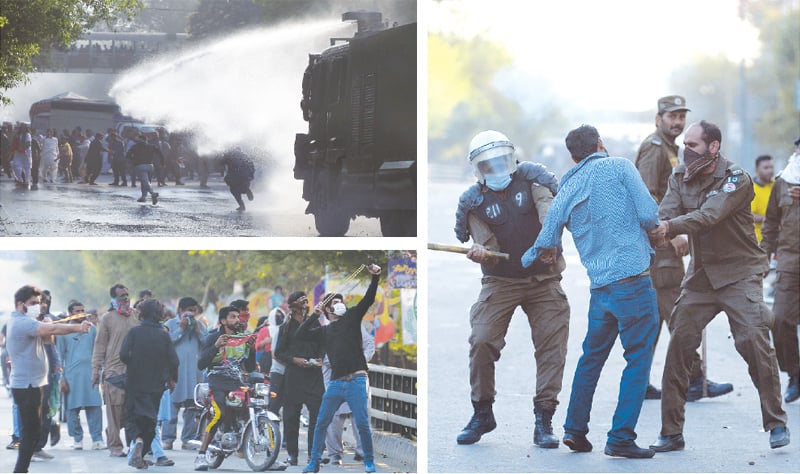
KARACHI: Supporters of Pakistan Tehreek-e-Insaf (PTI) staged a protest near Fawara Chowk in Karachi to express solidarity with the party’s founder, leading to clashes with police and widespread traffic disruptions across the city.

According to reports, PTI workers pelted police with stones during the demonstration. In response, police used tear gas and baton charges to disperse the protesters. The unrest forced nearby businesses to shut down, while commuters and residents faced significant inconvenience.

Police detained several PTI leaders and workers, including PTI Sindh Secretary General Dr Masroor Sial.

The protest caused severe traffic congestion around Governor House, Metropole, and Shaheen Complex. Authorities closed multiple roads to traffic, including the stretch from M.R. Kiani Road to Fawara Chowk and Din Muhammad Wafai Road.

The route from Coast Guard to Regal Chowk and Sarwar Shaheed Road was also closed. In addition, the road from M.T. Khan Road towards PIDC remained blocked.

Traffic restrictions were also imposed on both tracks of Zamzama Street and Khayaban-e-Shamshir, as well as both sides of Sir Shah Suleman Road from Quba Masjid, Ghareebabad, to Liaquatabad.

Motorists were advised to use alternative routes as authorities worked to manage the situation.

Similar Posts

  • |

    CPEC 2.0: Pakistan, China shift focus to B2B investment

    ISLAMABAD: Pakistan and China are moving toward a more business-driven model of cooperation under the second phase of the China-Pakistan Economic Corridor (CPEC), with greater emphasis on Business-to-Business (B2B) partnerships, industrial development, exports and productivity rather than large-scale Government-to-Government (G2G) financing. The development emerged during a high-level Chinese delegation’s visit to the CPEC Secretariat, where discussions focused on strengthening industrial and commercial ties between the two countries. According to an official statement issued by the Ministry of Planning on Tuesday, the Chinese delegation was headed by Sun Dongsheng, Senior Advisor, Economic Affairs Press. The delegation met Federal Minister for Planning, Development and Special Initiatives Ahsan Iqbal, along with senior policymakers and development experts. The talks centred on ways to advance B2B and industrial cooperation under CPEC 2.0, reflecting a broader shift in the corridor’s priorities from infrastructure-led development toward industrialisation, exports, technology and private-sector participation. From infrastructure to industrialisation During the meeting, Ahsan Iqbal briefed the Chinese delegation on the government’s Uraan Pakistan economic transformation programme and outlined Islamabad’s priorities for the next phase of CPEC. The minister proposed closer cooperation with Chinese institutions, including counterparts of the National Centre of New Manufacturing, to benefit from China’s experience in advanced manufacturing, innovation, automation and robotics. He said Pakistan needed to strengthen its productive capacity and adopt modern technologies to remain competitive in the era of Industrial Revolution 4.0 and prepare for the emerging Industrial Revolution 5.0. Ahsan Iqbal identified Pakistan’s limited export base as one of the country’s major economic challenges. According to the minister, repeated attempts to accelerate economic growth have struggled to generate sustainable momentum because productive sectors have not been sufficiently integrated with export markets. He stressed that the government’s priority was therefore to turn agriculture, manufacturing and other productive sectors into stronger sources of exports and foreign exchange. Pakistan seeks greater access to Chinese market The minister also called for greater facilitation of Pakistani exports to China, highlighting the considerable gap between the two countries’ trade potential. He noted that China imports goods worth around $2.6 trillion annually, whereas Pakistan’s exports to the Chinese market remain close to $3 billion. Ahsan said Pakistan needed to increase its presence in the Chinese market by improving production standards, competitiveness and the ability of domestic businesses to meet international demand. He expressed the expectation that CPEC 2.0 could help Pakistan address what he described as its “export deficit”, just as the first phase of the corridor contributed to addressing the country’s energy shortfall. CPEC enters a new phase Under CPEC’s first phase, China committed substantial financing to infrastructure, energy and other development projects in Pakistan. Nearly $30 billion was invested in infrastructure and power-sector projects, including independent power producers. However, the focus is now increasingly shifting toward private-sector-led cooperation. Islamabad continues to pursue financing for selected road and motorway projects, but China has yet to demonstrate readiness to finance the long-delayed Main Line-1 (ML-1) railway upgrade, which had previously been regarded as one of CPEC’s flagship projects. The latest consultations indicate that CPEC 2.0 is expected to rely more heavily on commercial partnerships between Pakistani and Chinese companies. The government has already been encouraging enterprises from both countries to explore joint ventures and investment opportunities in sectors including manufacturing, agriculture and mining. Ahsan Iqbal said recent agreements between Pakistani and Chinese companies showed that B2B cooperation was beginning to gain momentum. He expressed confidence that stronger business-to-business engagement would support the modernisation of Pakistan’s industrial and agricultural sectors while creating opportunities for investment, employment and exports. China stresses productive capacity Sun Dongsheng reaffirmed the importance China attaches to its longstanding relationship with Pakistan and highlighted the achievements of CPEC’s first phase. He called for further cooperation in industrial and agricultural development, particularly in strengthening Pakistan’s productive capacity. The Chinese delegation also stressed the importance of involving small and medium-sized manufacturing enterprises in bilateral economic cooperation. Greater enterprise-to-enterprise engagement, according to the delegation, could help create commercially sustainable partnerships and expand opportunities for businesses in both countries. The discussions also focused on technology transfer, innovation, skills development and the creation of stronger industrial linkages. Five Corridors aligned with Uraan Pakistan Officials also discussed the strategic relationship between the Five Corridors of CPEC 2.0 and Pakistan’s 5Es framework under Uraan Pakistan. The government’s 5Es framework focuses on exports, e-Pakistan, environment and climate change, energy and infrastructure, and equity and empowerment. The participants stressed that alignment between the two initiatives needed to translate into concrete economic outcomes, including new enterprises, technology adoption, innovation, employment opportunities, skills development, increased exports and higher investment. The delegation was also briefed on the progress achieved during CPEC Phase I and Pakistan’s priorities for the second phase. The consultations suggest that the next stage of CPEC will increasingly be measured not only by the volume of infrastructure investment but also by its ability to improve Pakistan’s industrial competitiveness, expand exports, attract private investment and create sustainable employment.

  • |

    Sonu Nigam opens up on being banned by music companies over copyright fight

    Sonu Nigam recently revisited one of the most controversial chapters of his career. He spoke about it during a candid conversation on the YouTube show Game Changers with Komal Nahta. The topic centered on the time music companies banned him after he raised his voice on copyright issues. Nigam began by looking back at how well his career was going before the controversy started. He said albums kept releasing one after another during that time. Audiences loved his work, and everything seemed to be going smoothly. That changed the moment he raised concerns over copyright. Several music companies responded by cutting ties with him entirely. He recalled how people within the industry began labelling him an activist at the time. The tone behind that label, he noted, was often dismissive rather than respectful. Looking back now, he finds it ironic that those same companies eventually started paying him royalties. He added that representatives from these companies now visit his home as guests. Nigam also explained his reasoning behind taking such a bold stand at the time. He said someone had to take the risk, comparing his decision to belling the cat. According to him, he felt he was meant for something bigger than just singing. He believed he was destined to carry forward a movement that legendary singer Lata Mangeshkar had once started. That movement, he said, had never reached its logical conclusion. When asked whether he felt scared during that turbulent period, Nigam said fear was not something he experienced. He admitted he never expected to actually get banned in the first place. He initially believed things would eventually work out on their own. However, as the situation kept worsening and more doors closed around him, he found strength through his live performances instead. He felt confident that nobody could stop him once he stepped on stage. Nigam went on to describe how his relationship with music companies gradually improved over time. He credited changing laws, along with the industry’s eventual realization that his stance had been justified. According to him, this shift slowly repaired his equation with these companies. Today, he said, their interactions feel warm and almost familial in nature. Reflecting on the entire journey, Nigam suggested that everyone involved likely needed to go through that difficult phase for real change to happen. He noted that any bitterness or resentment that once existed between him and the industry has since completely faded away, leaving behind a much healthier relationship.

  • Thailand to Raise International Passenger Fee by More Than 50% Starting June 2026

    BANGKOK — Airports of Thailand (AOT) announced on Friday that the passenger service charge (PSC) for outbound international travelers will increase to 1,120 baht per person from the current 730 baht, effective June 20, 2026. The 53 percent hike will apply across all six airports operated by the company: Suvarnabhumi, Don Mueang, Phuket, Hat Yai, […]

  • | |

    Sohail Afridi warns rulers to ‘open their eyes?…

    PESHAWAR: Khyber Pakhtunkhwa Chief Minister Sohail Afridi has warned Pakistan’s rulers and decision-makers to “open their eyes” before September 27, saying the situation could become increasingly difficult to control if justice, constitutional supremacy and the rule of law are not restored. Speaking to reporters while attending a protest outside the Supreme Court, Afridi also expressed concern over reports about the health of Pakistan Tehreek-e-Insaf founder Imran Khan. The chief minister said serious concerns were emerging about Khan’s health and called for the matter to be treated with urgency. He said neither he nor Khan had attempted to use the former prime minister’s health for political relief. Afridi demanded that Khan’s family be allowed to be present and that his treatment be conducted under the supervision of his personal doctors. The KP chief minister referred to the treatment of former Prime Minister Nawaz Sharif during Imran Khan’s government. He said Khan had allowed Sharif to travel abroad for medical treatment on humanitarian grounds, despite questions that had been raised at the time regarding medical certificates. According to Afridi, Khan was now being deprived of basic human rights and justice, which he described as a matter of serious concern. Afridi also criticized what he described as politically motivated cases against Khan. He alleged that his political opponents had themselves faced corruption allegations and accused them of misusing national resources. These claims represent Afridi’s political position and were not independently established in his remarks. The KP chief minister also spoke about the judiciary, saying Pakistan’s justice system was facing a major test. He urged judges to stand up for justice and said that one judge taking a principled position could encourage others to do the same. Afridi argued that the public was looking toward the judiciary for relief and justice. He questioned where citizens would turn if judges failed to perform their constitutional responsibilities. The chief minister further warned about growing anger among young people, saying he could see what he described as a “revolution” in the eyes of the country’s youth. He cautioned that continued injustice and rising hatred could eventually create a situation in which even Imran Khan might struggle to persuade people to respond with affection or restraint. Afridi urged the rulers and decision-makers to understand the seriousness of the situation before September 27 and move the country toward justice, constitutional supremacy and the rule of law. He warned that failure to address these concerns could make the situation increasingly difficult to manage, adding another strong political message to the ongoing tensions surrounding Imran Khan and his supporters.

  • Thailand’s Government Complex Sets a Global Benchmark for Sustainable Public Architecture

    Dhanarak Asset Development Co., Ltd. (DAD), has officially unveiled the “21st Century Government Complex,” a national milestone that redefines how architecture, technology, and nature coexist within the public sector. Spanning 378 rai (60 hectares), the Government Complex Bangkok is developed under the vision Regenerative Government Complex Bangkok :“A Low-Carbon City Working with Nature,” a model for future […]

  • Thailand’s First Conscientious Objector Handed Suspended Prison Sentence

    SAMUT PRAKAN, Thailand — A Thai lower court has sentenced prominent student activist Netiwit Chotiphatphaisal to a six-month prison term, suspended for one year, for refusing to participate in the national military conscription process. The landmark ruling marks the first time a Thai citizen has formally cited conscientious objection as the basis for boycotting the […]

Leave a Reply

Your email address will not be published. Required fields are marked *