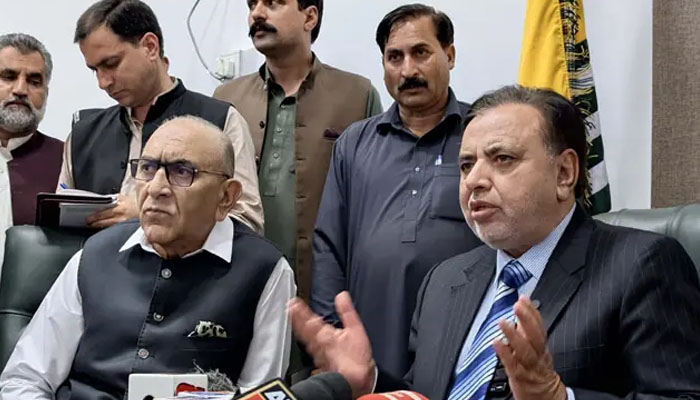
mufti muneeburrehman criticizes
| |

Mufti Muneeb-ur-Rehman criticizes Pakistan’s…


Renowned Islamic scholar Mufti Muneeb-ur-Rehman has strongly criticized Pakistan’s judicial and economic systems, stating that a justice system that fails to deliver justice even after forty years cannot be considered a true system of justice but rather a system of oppression. He made these remarks while addressing a public ceremony in Karachi, where he spoke about the country’s pressing legal and economic challenges.

During his speech, Mufti Muneeb-ur-Rehman expressed concern over the prolonged delays in the judicial process. He argued that when people have to wait decades for justice, the very purpose of the legal system is defeated. According to him, justice delayed for such an extended period effectively becomes justice denied, leaving citizens frustrated and deprived of their fundamental rights. He emphasized that a judicial system should provide timely and fair decisions so that public confidence in the rule of law remains intact.

The scholar also urged those in positions of authority to focus on resolving Pakistan’s domestic problems instead of concentrating solely on international issues. He remarked that while government leaders often discuss and engage with global affairs, the country’s internal challenges require immediate attention. He specifically called upon policymakers and those holding power to prioritize the welfare of the people by addressing the nation’s economic difficulties.

One of the major issues highlighted by Mufti Muneeb-ur-Rehman was the problem of Independent Power Producers (IPPs). He appealed to the government to find a practical and sustainable solution to the IPP issue, which has been widely debated due to its impact on electricity prices and the country’s financial stability. According to him, resolving this matter would help reduce the economic burden on both the government and ordinary citizens.

Speaking about the national economy, Mufti Muneeb-ur-Rehman painted a concerning picture of Pakistan’s financial condition. He stated that after distributing the constitutionally allocated shares to the provinces and making payments on interest obligations, the federal government is left with very limited financial resources. This situation, he suggested, reflects the severity of the country’s fiscal challenges and highlights the urgent need for comprehensive economic reforms. He stressed that policymakers should adopt measures that promote financial stability, reduce unnecessary expenditures, and improve revenue generation without placing excessive burdens on the public.

The event also featured an address by Maulana Bashir Farooqi, who criticized the government’s approach toward eliminating the interest-based financial system. He argued that the authorities are not demonstrating sufficient seriousness in transitioning toward an Islamic banking framework. According to him, meaningful reforms require not only policy changes but also practical steps to prepare financial institutions for such a transformation.

Maulana Bashir Farooqi announced that his organization is willing to provide training for approximately 100,000 employees working in conventional banks. He explained that this initiative aims to equip banking professionals with the knowledge and skills necessary to operate within an interest-free Islamic banking system if the government decides to pursue such reforms. He maintained that the availability of trained professionals would facilitate a smoother transition and strengthen the implementation of Islamic financial principles in the country’s banking sector.

The speeches delivered at the Karachi ceremony underscored concerns regarding Pakistan’s judicial efficiency, economic management, and financial policies. Both religious leaders called on the government to prioritize domestic reforms, strengthen public institutions, address long-standing economic challenges, and work toward a system that better serves the interests of the people.

Similar Posts

  • |

    US issuing final opportunity for nuclear agreement with Tehran before extreme military action

    US President Donald Trump has issued a final ultimatum to Iran, stating that Tehran has one last opportunity to negotiate a diplomatic resolution with Washington before facing severe military force, which he referred to as decapitation. Speaking from the Oval Office, the American leader confirmed he had paused planned air strikes following direct requests from Persian Gulf nations, including Saudi Arabia, Qatar, and the United Arab Emirates, who urged Washington to allow diplomacy one final window. The framework for the proposed negotiations relies on a two-stage approach, with the initial phase requiring the immediate and unconditional reopening of the Strait of Hormuz to international shipping. The subsequent phase will address the complete denuclearisation of Iran, referencing commitments previously outlined in a joint memorandum signed in June. Trump further dismissed any personal domestic political considerations regarding the timeline, emphasising that his decision to delay military action was driven by a desire to prevent widespread loss of life while pursuing a durable diplomatic outcome.

  • | |

    Army troops deployed in Rawalpindi for six months

    The federal government has approved the deployment of three companies of the Pakistan Army in Rawalpindi. The troops will perform sensitive security duties in the city. The deployment will remain in place for six months. The decision was taken after a request from the Punjab Home Department. The Interior Ministry issued the deployment order on August 21. The order said the army personnel would help prevent any undesirable situation. They will also assist the civil administration in dealing with any unexpected security challenge. The deployment has been authorised under Article 245 of the Constitution. The provision allows the armed forces to assist the civil administration when required. The troops will perform their duties according to the requirements of the district administration. Their presence is intended to strengthen security arrangements and improve the authorities’ ability to respond to emergencies. The government has given the deployment immediate effect. The three army companies can therefore begin their assigned security responsibilities without delay. The order did not provide details about the exact locations where the troops will be stationed. It also did not specify particular operations or threats that prompted the deployment. The decision places additional security resources at the disposal of the Rawalpindi administration. Civil authorities can seek the assistance of the deployed personnel when required during the six-month period. The deployment is part of the government’s broader security arrangements. The use of military personnel under Article 245 is intended to support civilian authorities while they carry out their responsibilities.

  • |

    Austin Reaves’ Lakers future faces fresh trade questions

    LOS ANGELES: Austin Reaves has just secured a massive new contract with the Los Angeles Lakers, but his long-term future in Hollywood could still become a major talking point after the franchise made sweeping changes to its roster this summer. The Lakers have entered a new era with their focus increasingly centred on Luka Doncic, while the departure of LeBron James has changed the shape and direction of the team. Reaves, meanwhile, remains an important part of the Lakers’ plans. The 28-year-old guard re-signed with Los Angeles in late June on a four-year, $180 million contract, including a player option in the final season. The deal appeared to confirm that the Lakers viewed Reaves as a key piece alongside Doncic. His contract also reportedly gives Los Angeles greater financial flexibility moving forward, including the possibility of pursuing another player with the non-taxpayer mid-level exception next summer. But the Lakers’ subsequent move for centre Walker Kessler has complicated the picture. Los Angeles acquired Kessler from the Utah Jazz in July, reportedly committing significant draft capital in the process. The move reflects the Lakers’ desire to secure a long-term defensive presence in the frontcourt, but it also reduced the number of valuable assets available to the franchise. That situation has prompted NBA insider Zach Lowe to raise an intriguing possibility: Reaves could eventually become a trade candidate. Lowe argued that the Lakers paid heavily for Kessler and now have fewer tradeable assets with which to reshape the roster. “There’s no question that they overpaid for him,” Lowe said, suggesting the Lakers may eventually have to decide whether the current roster is good enough or whether they need to pivot by moving Reaves. The logic behind the speculation is straightforward. Doncic is now firmly positioned as the franchise cornerstone, making it highly unlikely that Los Angeles would consider moving him. Reaves, however, could command significant interest around the league if the Lakers eventually decide they need additional draft capital or another major piece. That does not mean a trade is imminent. In fact, Reaves could be more important to the Lakers than ever during the upcoming season. With James no longer in the picture, the team will need additional scoring, playmaking and leadership around Doncic. Reaves has already demonstrated that he can thrive in a high-pressure environment, evolving from an undrafted player into one of the Lakers’ most valuable contributors. His new contract suggests the organisation believes he can play an important role in its next chapter. Yet NBA roster building can change quickly. If the Lakers struggle to build a championship-calibre supporting cast around Doncic, Reaves’ value could become a tempting trade asset — particularly because the team has already sacrificed considerable draft capital to acquire Kessler. For now, Reaves remains a Laker and an important part of the franchise’s post-LeBron era. But with Doncic at the centre, Kessler anchoring the future frontcourt and the Lakers’ trade assets significantly reduced, one question is beginning to emerge: Could Austin Reaves ultimately become the price Los Angeles pays to build its next championship team?

  • | |

    US reviews military strategy as weapons stockpile …

    WASHINGTON: Senior US officials have reportedly raised concerns over the country’s military readiness as the conflict with Iran intensifies, prompting the Trump administration to temporarily pause its air campaign while continuing diplomatic efforts. According to US media reports, Vice President JD Vance and Chairman of the Joint Chiefs of Staff General Dan Caine briefed President Donald Trump during a White House meeting on the escalating conflict and the potential impact of prolonged military operations on US weapons stockpiles. Sources said military leaders expressed concern over the depletion of key defence munitions and outlined the risks of expanding the conflict. While General Caine reportedly assured the president that the US military remains capable of carrying out all available operational options, he also highlighted the strategic consequences of continued military escalation. Following the meeting, the United States halted its nightly airstrikes on Iran after nearly two weeks of sustained attacks. Defence officials described the pause as temporary, although they did not confirm whether it was directly linked to concerns over weapons supplies or other strategic considerations. President Trump said negotiations with Iran remain ongoing but warned that military operations could resume or intensify if necessary. He also acknowledged appeals from several Gulf nations urging Washington to exercise restraint as regional tensions continue to rise. White House Communications Director Steven Cheung reiterated that President Trump continues to favour a diplomatic resolution but stressed that all military options remain available if Iran threatens international shipping in the Strait of Hormuz or targets US allies. He added that after nearly two weeks of economic pressure and strikes on military targets, the administration believes Tehran should pursue negotiations to avoid further escalation.

  • | |

    PM Shehbaz orders audit of Discos’ billing s…

    ISLAMABAD: Prime Minister Shehbaz Sharif has directed a comprehensive technical audit of the billing systems of electricity distribution companies (Discos), reaffirming that reforming Pakistan’s power sector remains one of the government’s top priorities. Chairing a high-level meeting on the performance of the Power Division, the prime minister acknowledged that distribution companies had shown noticeable improvement but stressed that further reforms were essential to enhance efficiency and service delivery. He described the nationwide installation of smart electricity meters as a key step toward modernising the sector and improving transparency. Shehbaz Sharif also called for strict action against electricity theft, instructing authorities to strengthen enforcement mechanisms at every level. He ordered the Power Division to establish clear performance benchmarks for distribution companies, supported by measurable targets and specific implementation timelines. To encourage better performance, the prime minister announced that the country’s best-performing distribution company would receive formal recognition and awards, promoting healthy competition among power utilities. Addressing the issue of prolonged electricity shortages in rural areas, he directed officials to prepare village-level solarisation projects, saying decentralised solar energy systems could reduce pressure on the national electricity grid while improving access to reliable power. During the meeting, officials informed the prime minister that technical and commercial losses across distribution companies had continued to decline. Islamabad, Lahore and Gujranwala electricity companies recorded the lowest transmission and distribution losses during the last fiscal year, while power utilities in Islamabad, Lahore, Gujranwala, Faisalabad and Multan achieved full recovery of billed electricity dues in the 2025–26 fiscal year. The meeting was also told that specialised Disco Support Units have been established in Hyderabad, Sukkur, Lahore, Multan and Hazara to combat electricity theft, improve bill recovery and resolve technical challenges more effectively. Officials further briefed the prime minister that the first phase of the Asset Performance Management System (APMS) at the transformer level is expected to be completed by the end of September. The system is designed to improve monitoring of transformers, helping reduce both power theft and load-shedding. In addition, the government is considering the installation of 16.2 million Advanced Metering Infrastructure (AMI) single-phase smart meters across the Multan, Lahore, Peshawar, Hazara and Quetta regions as part of its broader strategy to modernise Pakistan’s electricity distribution network.

  • | |

    Mandy Moore reveals if she wants to expand her fam…

    Mandy Moore has officially answered the question of whether she and her husband, Taylor Goldsmith, plan to expand their family. The This Is Us star, 42, already shares three children with Goldsmith: sons August “Gus,” 5, and Oscar “Ozzie,” 3, and daughter Louise “Lou,” who is 23 months old. In a recent interview, Moore made it clear that their family of five is now complete. (Us⁠) “We are absolutely done and so grateful for our family,” Moore said, explaining that she and Goldsmith are enjoying this stage of parenthood and trying to savor the small moments. Moore admitted that seeing pregnancy announcements on social media can still bring up complicated feelings. She joked that her Instagram feed now seems filled with pregnant people, which makes her realize that pregnancy will not be part of her future again. At the same time, she said she is simply too tired to imagine starting over with another baby. After having three children in three and a half years, Moore appears ready to embrace a new chapter rather than return to the newborn stage. For the actress, there is also something bittersweet about watching her youngest child, Lou, grow up. She recently reflected on reaching milestones that signal the end of the baby years, including moving away from diapers, bottles and a crib. Moore described the transition as exciting but emotional. Her family is entering what she called “uncharted territory,” as the children become more independent and develop their own personalities. (E! Online⁠) The actress has also been candid about the physical and emotional impact of having three children so close together. Earlier this year, she shared an honest look at her postpartum body, acknowledging the changes that came after three pregnancies in just three and a half years. (People.com⁠) Moore previously revealed that she had undergone an unsuccessful round of IVF before unexpectedly becoming pregnant naturally with Lou. She had considered IVF partly because she wanted the possibility of creating more space between pregnancies as she got older. (The Express Tribune⁠) Now, however, Moore appears confident that she and Goldsmith have reached the right place for their family. Rather than focusing on having another baby, the actress is choosing to appreciate the children she already has. With Gus, Ozzie and Lou growing quickly, Moore is embracing the next stage of motherhood with gratitude. For Moore and Goldsmith, the baby chapter may be closing—but their family story is continuing to grow in new ways.

Leave a Reply

Your email address will not be published. Required fields are marked *