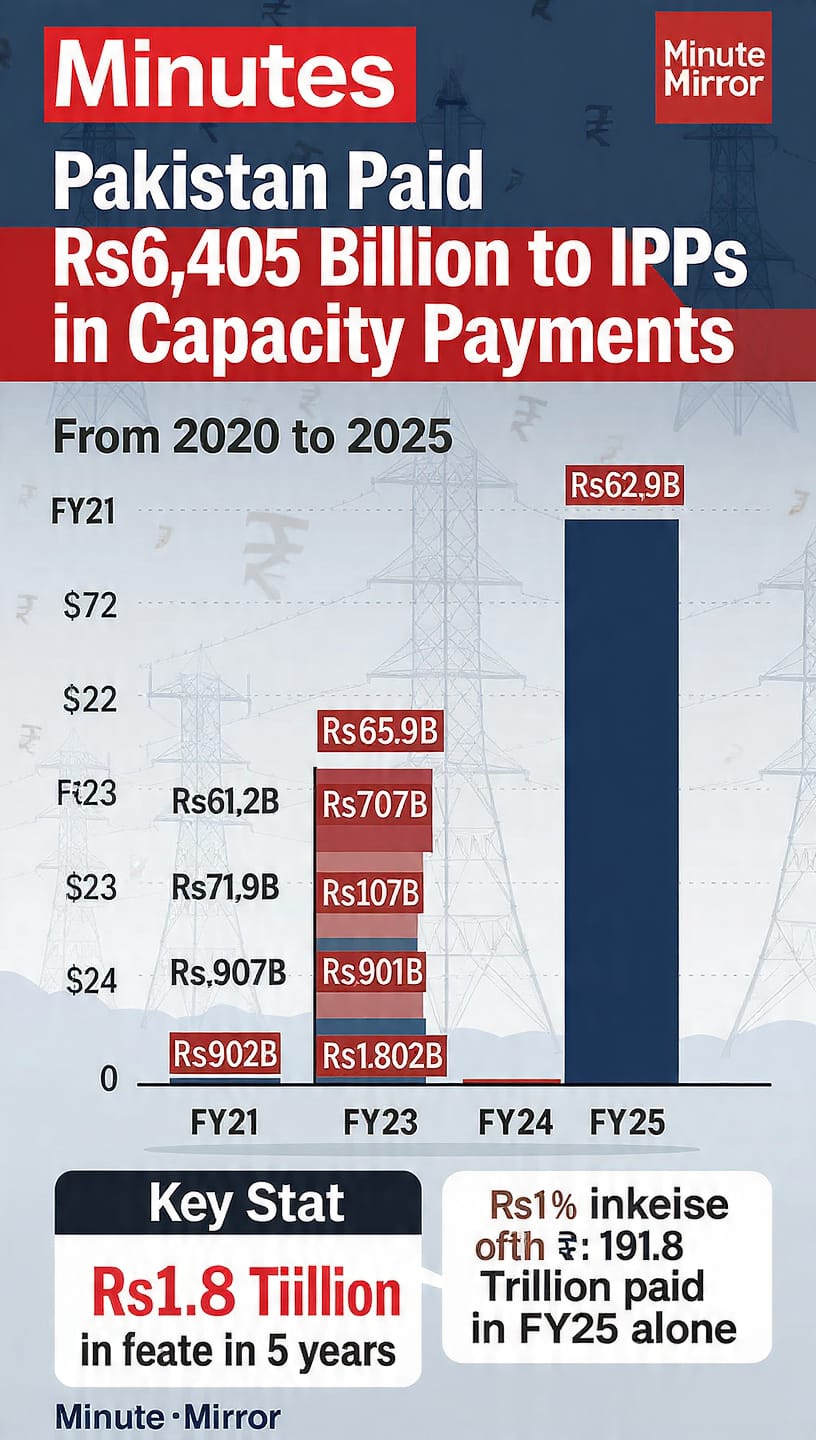
pakistan paid rs6405
| |

Pakistan paid Rs6,405 billion to IPPs in capacity …


ISLAMABAD: Pakistan’s federal government paid a total of Rs6,405 billion to Independent Power Producers (IPPs) in capacity payments between 2020 and 2025, the National Assembly has been informed, highlighting the growing financial burden associated with the country’s power sector.

According to a written response submitted by Federal Minister for Energy Awais Ahmad Leghari, capacity payments increased significantly during the five-year period despite government efforts to renegotiate power purchase agreements and reduce electricity costs.

The figures presented to the National Assembly show that capacity payments rose from Rs613.9 billion in FY2020-21 to Rs1,807 billion in FY2024-25. This represents an increase of approximately 194% over the period.

The government paid Rs613.9 billion in capacity charges during FY2020-21. The amount increased to Rs775.9 billion in FY2021-22 before rising sharply to Rs1,307 billion in FY2022-23.

Capacity payments reached their highest level during FY2023-24, when the government paid around Rs1.902 trillion to IPPs. Although the amount declined slightly in FY2024-25 to Rs1.807 trillion it remained almost three times higher than the amount paid in FY2020-21.

Capacity payments are charges made to power producers for keeping their generating plants available to supply electricity, regardless of whether the full generation capacity is actually utilised. These payments are part of the contractual arrangements between the government and IPPs and have frequently been identified as one of the factors contributing to Pakistan’s expensive electricity system and growing circular debt.

Responding to questions in the National Assembly, Energy Minister Awais Ahmad Leghari said the government has taken several measures to reduce the financial pressure created by existing power agreements.

According to the minister, a government task force has terminated power purchase agreements with six IPPs, while agreements with several other producers have also been revised. The objective of these measures is to reduce electricity costs and limit the financial burden on the national power sector.

The Ministry of Energy estimates that the changes made to the agreements could result in savings of approximately Rs4.3 trillion over the remaining life of the contracts.

Leghari also clarified that payments made to power producers are based on tariffs determined by the National Electric Power Regulatory Authority (Nepra) and the terms agreed under the relevant power purchase agreements. He rejected the impression that generators were receiving payments outside the approved contractual and regulatory framework, stating that there were no additional payments beyond the applicable arrangements.

Despite the government’s renegotiation efforts, the figures show that capacity payments continue to represent a major financial obligation for Pakistan. The Rs1.807 trillion paid in FY2024-25 alone demonstrates the scale of the challenge facing the country’s power sector.

The government’s efforts to terminate and revise agreements are expected to provide substantial savings in the coming years. However, reducing capacity payments and addressing the broader issues of electricity pricing, power utilisation and circular debt remain critical challenges for Pakistan’s energy sector.

Similar Posts

  • RCCI calls for stronger Pakistan-Indonesia trade ties

    RAWALPINDI: The Rawalpindi Chamber of Commerce and Industry (RCCI) has called for enhanced trade and investment cooperation between Pakistan and Indonesia, with a particular focus on expanding bilateral trade, strengthening business-to-business linkages and promoting private-sector engagement. The call was made during a visit to the RCCI by Ambassador of Indonesia to Pakistan H.E. Chandra W. Sukotjo, who was accompanied by officials of the Indonesian Embassy, including Head of Economic Affairs Mrs. Ingan Malen. RCCI President Usman Shaukat, Vice President Fahad Barlas, members of the Executive Committee and representatives of the business community welcomed the ambassador and his delegation. RCCI President Usman Shaukat highlighted the longstanding friendly relations between Pakistan and Indonesia and said there was considerable untapped potential for expanding bilateral trade. He stressed the need to increase Pakistani exports to Indonesia, facilitate business delegations and establish stronger business-to-business contacts. He also called for greater cooperation in manufacturing, agriculture, value-added products and emerging industries, saying that closer economic ties could create new opportunities for businesses in both countries. On this occasion, Ambassador Chandra W. Sukotjo reaffirmed Indonesia’s commitment to strengthening economic and commercial relations with Pakistan. He identified tourism, halal food, renewable energy, healthcare, agriculture, pharmaceuticals and digital technologies as promising areas for bilateral cooperation. The ambassador said that Pakistan and Indonesia enjoy excellent diplomatic relations and that the existing goodwill should be translated into stronger trade and investment partnerships.He further informed the business community that Indonesia had simplified the visa process for Pakistani business travellers, while a reduction in visa fees was also under consideration to facilitate greater business mobility and commercial exchanges. The Indonesian ambassador also invited Pakistani exporters, manufacturers and investors to participate in the 41st Trade Expo Indonesia, scheduled to be held from October 14 to 18, 2026. He described the exhibition as a major trade platform in Southeast Asia, offering Pakistani businesses opportunities to explore new markets, develop strategic partnerships and expand their international presence. The meeting concluded with an interactive question-and-answer session. Both sides reaffirmed their commitment to strengthening institutional cooperation, increasing private-sector engagement and exploring new avenues for sustainable economic growth between Pakistan and Indonesia.

  • |

    Major US financial firms targeted in extensive phone-phishing campaign

    Ransom-seeking cybercriminals have launched a coordinated campaign targeting high-profile US financial institutions, including Blackstone, Apollo Global Management, KKR, Bain Capital, and CME Group. A technical report from Google’s Threat Intelligence Group revealed that hackers created 72 malicious websites designed to steal corporate login credentials. Operatives used social engineering tactics, reaching employees directly on personal mobile phones while spoofing corporate IT helpdesk numbers. Under the guise of urgent system updates, callers guided staff to fraudulent domains such as “passkeyhelpdesk” or “secure-passkey” to capture login credentials and multi-factor authentication passcodes in real time. According to threat intelligence analysis, the campaign represents a strategic pivot toward private equity firms, law practices, and financial rating agencies, driven by the assessment that these targets hold sensitive commercial data worth paying substantial ransoms to protect. While digital intelligence data identified fake portals created for over 200 organisations, including Uber, Levi Strauss, and several major law firms, it remains unconfirmed which specific financial targets experienced compromised systems. The threat actors operating under names such as Redact, Falcon, Helix, and Pink share common digital infrastructure. Analysts noted that despite advanced enterprise perimeter security, direct voice-phishing techniques exploiting human trust continue to rank among the most effective cyber-intrusion vectors.

  • | |

    General Aamer Raza assumes command of National Str…

    General Syed Aamer Raza, HI (M), S Bt, formally assumed command of the National Strategic Command on Monday, marking the beginning of his tenure in the key military position. A Guard of Honour was presented to General Aamer Raza following his appointment as Commander National Strategic Command. The ceremony was held as part of the formal proceedings marking his assumption of command. After the Guard of Honour, General Aamer Raza visited Yadgar-e-Shuhada. He laid a floral wreath at the memorial to pay tribute to the martyrs who sacrificed their lives for the country. The general also offered Fateha at the memorial. The ceremony reflected the military tradition of honouring personnel who lost their lives in the service of Pakistan. Following the proceedings, General Aamer Raza visited General Headquarters (GHQ) in Rawalpindi. He called on Field Marshal Syed Asim Munir, Chief of Army Staff and Chief of Defence Forces. During the meeting, Field Marshal Asim Munir congratulated General Aamer Raza on assuming command of the National Strategic Command. The meeting was part of the formal transition following General Aamer Raza’s appointment. The National Strategic Command holds an important position within Pakistan’s strategic security structure. The appointment comes at a time when Pakistan continues to focus on maintaining national security and strengthening its strategic preparedness. General Aamer Raza’s assumption of command formally completes the transition to his new responsibility. His meeting with the military leadership also provided an opportunity to mark the start of his tenure at the command. The ceremony and subsequent meeting were conducted in accordance with established military traditions.

  • | |

    Spotify reveals Atif Aslam nears 8 billion streams

    Atif Aslam is entering the release of his fourth studio album with a set of streaming numbers that underscore just how far his music has travelled and how deeply it has embedded itself in the listening habits of people around the world. With Subah Aye Na set to arrive on July 31, 2026, his first full-length album since Meri Kahani debuted in 2008, Spotify has released a series of listening insights that paint a remarkable picture of his global reach. According to the figures, Atif currently holds nearly 8 billion monthly streams on the platform, drawing in more than 80 million listeners spread across 184 countries. In 2025 alone, 96 percent of Atif’s listeners streamed his songs outside Pakistan, highlighting the strength of his international fanbase across the Middle East, North America, Asia Pacific, Europe, South Asia and beyond. (jang) It is a figure that speaks to something more than commercial success. It points to a voice that has crossed cultural and linguistic boundaries in a way that very few South Asian artists have managed at this scale. The generational dimension of his audience is equally striking. Spotify stats confirm that 85 percent of his streams come from younger listeners, suggesting that despite being a millennial himself, Atif’s music resonates deeply with Gen-Z audiences who have discovered him well into his career. (jang) That cross-generational appeal is one of the rarer qualities an artist can have, and the numbers suggest it is very much alive. Last year, more than 41 million listeners discovered or returned to his music on Spotify, a surge that reflects both new audiences finding him for the first time and long-time fans coming back. (jang) The platform also confirmed that his songs appear on more than 37.5 million user-created playlists, including wedding playlists, late night drive compilations and more, (jang) a detail that says as much about the emotional context of his music as it does about its streaming performance. His songs are not simply being listened to. They are being chosen for life’s most significant moments. Atif himself has been characteristically thoughtful in describing what the new album represents. “This album is a true representation of freeing myself from the chaos and meeting my real self,” he said. “Stay tuned. I can’t wait for all of you to hear it.” Subah Aye Na is an eight-track album featuring the songs Subah Aye Na, Safar Mein Hun, Ishq, Let’s Have Some Fun, Sun Sajna, Hun Ishq Mein, Char Yaar and Sachay Waday. For an artist whose career began with Doorie and Aadat and has since become the soundtrack to countless lives across the subcontinent and beyond, July 31 represents not just a new release but a return to something deeply personal.

  • | | |

    Survival Stories Describe Chaos and Narrow Escapes After Bangkok Pub Fire Claims 27 Lives, Injures Over 60 Others

    Bangkok, Thailand Survivors of the deadly fire at Rong Beer Na Lat Phrao pub in Bangkok’s Chatuchak district on the night of July 12th, 2026, have described scenes of sudden panic, thick smoke, and desperate attempts to flee as the blaze rapidly engulfed the popular entertainment venue, killing at least 27 people and injuring over […]

  • |

    Brandon King injured after brilliant Babar Azam run-out

    TRINIDAD: West Indies endured a significant setback on day three of the second Test against Pakistan after opener Brandon King was forced off the field with a painful lower back injury moments after producing a brilliant run-out to dismiss Babar Azam. The dramatic incident unfolded during Pakistan’s first innings when Babar, who resumed play on an overnight score of 84, looked well placed to end his long wait for a Test century. However, a costly mix-up with fellow batter Abdullah Shafique brought his innings to an abrupt end. Attempting a quick single after guiding the ball into the off side, Babar found himself stranded halfway down the pitch as King reacted sharply from cover. The West Indies fielder gathered the ball cleanly and unleashed a direct hit that caught the Pakistan star well short of his crease. While the dismissal gave the hosts a much-needed breakthrough, it came at a heavy price. King appeared to injure his lower back during the throwing action and immediately collapsed to the ground in visible pain. Medical staff rushed onto the field, and after several minutes of treatment, the 31-year-old was taken off on a stretcher, leaving teammates and spectators concerned. Cricket West Indies later confirmed that King had suffered lower back muscle spasms and would take no further part in day three’s play as a precaution. Team officials added that his condition would continue to be monitored by the medical staff before a decision is made on his availability for the remainder of the match. Earlier in the day, Pakistan resumed on 266-2, with Babar and Abdullah adopting a cautious approach as the West Indies bowling attack maintained disciplined lines and restricted scoring opportunities. The pressure eventually paid off with Babar’s dismissal in the 75th over after he added just two runs to his overnight total. King’s injury has added fresh concern for the West Indies camp at a crucial stage of the Test, with the hosts now awaiting further medical updates while trying to keep Pakistan’s batting lineup under control. The coming days could prove decisive not only for the outcome of the match but also for King’s immediate cricketing future.

Leave a Reply

Your email address will not be published. Required fields are marked *