pakistan paid rs6405
| |

Pakistan paid Rs6,405 billion to IPPs in capacity …


ISLAMABAD: Pakistan’s federal government paid a total of Rs6,405 billion to Independent Power Producers (IPPs) in capacity payments between 2020 and 2025, the National Assembly has been informed, highlighting the growing financial burden associated with the country’s power sector.

According to a written response submitted by Federal Minister for Energy Awais Ahmad Leghari, capacity payments increased significantly during the five-year period despite government efforts to renegotiate power purchase agreements and reduce electricity costs.

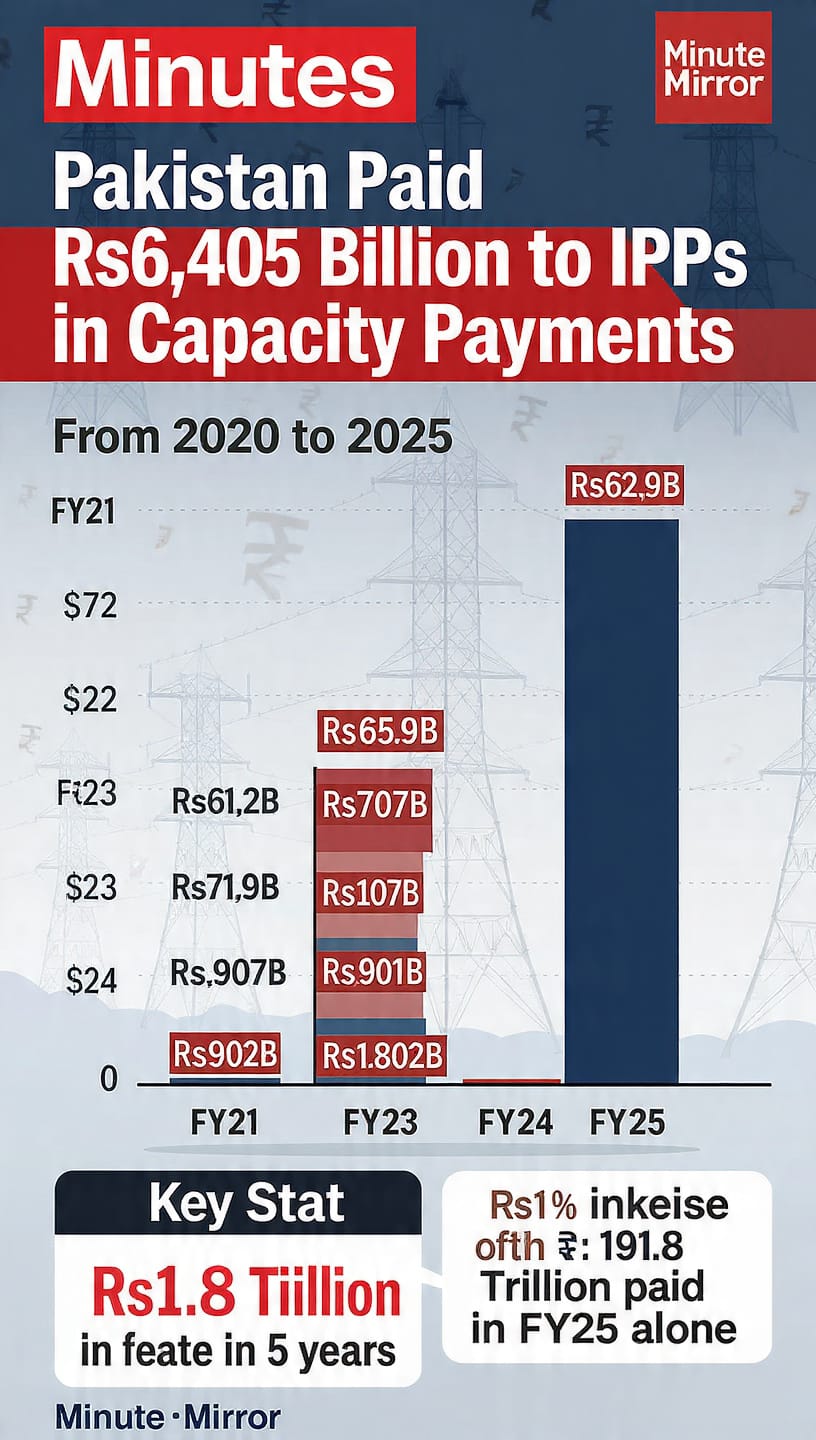
The figures presented to the National Assembly show that capacity payments rose from Rs613.9 billion in FY2020-21 to Rs1,807 billion in FY2024-25. This represents an increase of approximately 194% over the period.

The government paid Rs613.9 billion in capacity charges during FY2020-21. The amount increased to Rs775.9 billion in FY2021-22 before rising sharply to Rs1,307 billion in FY2022-23.

Capacity payments reached their highest level during FY2023-24, when the government paid around Rs1.902 trillion to IPPs. Although the amount declined slightly in FY2024-25 to Rs1.807 trillion it remained almost three times higher than the amount paid in FY2020-21.

Capacity payments are charges made to power producers for keeping their generating plants available to supply electricity, regardless of whether the full generation capacity is actually utilised. These payments are part of the contractual arrangements between the government and IPPs and have frequently been identified as one of the factors contributing to Pakistan’s expensive electricity system and growing circular debt.

Responding to questions in the National Assembly, Energy Minister Awais Ahmad Leghari said the government has taken several measures to reduce the financial pressure created by existing power agreements.

According to the minister, a government task force has terminated power purchase agreements with six IPPs, while agreements with several other producers have also been revised. The objective of these measures is to reduce electricity costs and limit the financial burden on the national power sector.

The Ministry of Energy estimates that the changes made to the agreements could result in savings of approximately Rs4.3 trillion over the remaining life of the contracts.

Leghari also clarified that payments made to power producers are based on tariffs determined by the National Electric Power Regulatory Authority (Nepra) and the terms agreed under the relevant power purchase agreements. He rejected the impression that generators were receiving payments outside the approved contractual and regulatory framework, stating that there were no additional payments beyond the applicable arrangements.

Despite the government’s renegotiation efforts, the figures show that capacity payments continue to represent a major financial obligation for Pakistan. The Rs1.807 trillion paid in FY2024-25 alone demonstrates the scale of the challenge facing the country’s power sector.

The government’s efforts to terminate and revise agreements are expected to provide substantial savings in the coming years. However, reducing capacity payments and addressing the broader issues of electricity pricing, power utilisation and circular debt remain critical challenges for Pakistan’s energy sector.

Similar Posts

  • |

    PIA-style model proposed for DISCO privatisation

    ISLAMABAD: The government has proposed a new financial structure for the privatisation of three major power distribution companies. The plan covers Faisalabad Electric Supply Company (FESCO), Gujranwala Electric Power Company (GEPCO) and Islamabad Electric Supply Company (IESCO).The proposal is based on the restructuring model used during the privatisation process of Pakistan International Airlines (PIA). Under the proposed plan, selected assets and liabilities of the three companies will be separated from their balance sheets.The government plans to establish a Special Purpose Vehicle (SPV) for this purpose. The SPV will be owned by the government. It will hold specific assets and liabilities removed from the DISCOs. The restructuring is aimed at making the companies more attractive to private investors. The government wants to offer financially stronger entities to potential buyers.Land assets are among the items expected to be separated from the DISCO balance sheets. Liabilities related to retired employees and pension benefits will also be shifted to the SPV.These pension-related liabilities were worth around Rs312 billion for the three companies as of June 2025. The final amount could change after the companies’ balance sheets are restructured. The government plans to use audited financial results for March 2026 as the basis for the final calculation.The three DISCOs had combined assets of around Rs1.2 trillion in June 2025. Their combined liabilities stood at approximately Rs1.05 trillion.The companies together reported net positive equity of around Rs145 billion. However, the financial position of the three companies varies considerably.GEPCO had negative equity of around Rs14.4 billion as of June 2025. The final figures may be different because the government is using March 2026 audited accounts for the restructuring process. The Privatisation Commission board has recommended that the Cabinet Committee on Privatisation approve the restructuring plans. The plans cover the first group of DISCOs selected for privatisation.The proposed arrangements have been prepared using audited financial statements for the period ending March 31, 2026. Officials believe the new structure could increase the value of the companies for the government.It is also intended to make the transactions commercially viable for private-sector investors. The government hopes the approach will attract stronger interest from domestic and international buyers.The strategy closely resembles the model adopted for PIA. During the airline’s privatisation process, the government separated more than Rs650 billion in liabilities from PIA’s balance sheet.The move was designed to leave the airline in a stronger financial position before its transfer to new owners. A similar approach is now being considered for the three DISCOs.The Privatisation Commission has been informed that both local and foreign investors have shown interest in the companies. The government has already announced deadlines for Expressions of Interest.Investors interested in FESCO must submit their Expressions of Interest by August 7, 2026. The deadline for GEPCO is August 21, 2026.For IESCO, the deadline has been set for September 7, 2026. FESCO has a relatively stronger financial position among the three companies.Its assets stood at around Rs410.3 billion as of June 2025. Its liabilities were approximately Rs347 billion.The company reported positive equity of around Rs63 billion. The equity position was supported by deposits for shares and gains from asset revaluation.FESCO also recorded a profit after tax of around Rs9.4 billion. Its non-current liabilities stood at approximately Rs217.6 billion.Staff retirement benefits accounted for around Rs123 billion of these liabilities. The company’s current liabilities were estimated at about Rs130 billion.Trade payables made up around Rs118 billion of the current liabilities. GEPCO reported a profit after tax of around Rs13.7 billion.Its total assets stood at approximately Rs238 billion. However, its equity remained negative at around Rs14.4 billion.The company’s total liabilities were around Rs252.5 billion. Staff retirement benefits accounted for approximately Rs79 billion.IESCO reported a loss after tax of around Rs1.42 billion during the same period. The company had total assets of approximately Rs547 billion.Its liabilities stood at around Rs450 billion. Despite recording a loss, IESCO had positive equity of around Rs97 billion. The company’s equity position was supported by a share deposit of approximately Rs67 billion. It also benefited from a surplus revaluation of around Rs158 billion.IESCO’s liabilities included staff retirement benefits worth around Rs110 billion. The company also carried deferred tax liabilities.The proposed privatisation is part of Pakistan’s wider power-sector reform programme. It is also linked to commitments made under Pakistan’s agreement with the International Monetary Fund (IMF).Pakistan has repeatedly pledged to reduce government involvement in the power distribution sector. The commitment to privatise at least three DISCOs has been made several times since 2013.Previous attempts, however, failed to reach completion. The IMF has urged Pakistan to implement structural reforms in the power sector.The broader objective is to reduce electricity costs for households and businesses. The reforms also aim to improve the operational efficiency of power distribution companies.The IMF has previously noted delays in the private-sector participation process for DISCOs. The first group, consisting of FESCO, GEPCO and IESCO, faced delays after potential investors raised concerns about the proposed transaction structure.The government has now said that those concerns have been addressed. Officials expect the privatisation process to move forward.The government is targeting completion of the first phase by early 2027. The proposed SPV will be an important part of the process.It is intended to separate selected financial burdens from the three companies before they are offered to private investors. The government hopes the restructuring will improve investor confidence and make the DISCO transactions more commercially attractive.

  • | | |

    Pezeshkian says Iran seeks peace, not wider conflict

    Iranian President Masoud Pezeshkian has said that Iran has no intention of prolonging the current conflict or expanding it beyond its existing scope. However, he made it clear that the country will continue to defend its sovereignty, territorial integrity and national interests against any threat. Speaking at a ceremony in Tehran, the president said Iran’s policy is based on protecting its borders while avoiding any unnecessary escalation. He stressed that the country does not seek war but will not hesitate to respond if its security or independence is challenged. Pezeshkian said maintaining national security is not only the responsibility of the armed forces but also depends on the unity and solidarity of the Iranian people. He urged citizens to set aside political and social differences and work together to strengthen the country during a difficult period. The president said internal unity is one of the strongest defenses against foreign interference. According to him, divisions within society can create opportunities for outside powers to influence domestic affairs. He added that a united nation is better equipped to face political, economic and security challenges. He emphasized the need to build a strong and stable society where people enjoy confidence in national institutions and where hostile elements cannot create unrest or weaken public trust. He said Iran must focus on strengthening its social fabric to prevent enemies from exploiting internal disagreements. Pezeshkian also called for greater national cooperation to overcome current challenges. He said every segment of society has a role to play in safeguarding the country’s future and preserving stability. The Iranian president reiterated that his government remains committed to protecting the country’s borders and national interests while pursuing policies that avoid a wider regional conflict. He said Iran’s priority is to maintain security, preserve national unity and prevent conditions that could lead to further instability.

  • |

    Pakistan’s ambassador presents credentials to Uzbek foreign minister

    Pakistan’s newly appointed Ambassador to Uzbekistan, Muhammad Mudassir Tipu, formally presented copies of his diplomatic credentials to Uzbek Foreign Minister Bakhtiyor Saidov in Tashkent. Describing the meeting as a distinct honor, Ambassador Tipu confirmed that both sides held constructive talks on bilateral cooperation. Foreign Minister Saidov highlighted that discussions focused on deepening the strategic partnership between the two nations, ensuring the implementation of high-level agreements, and expanding trade, investment, and interregional connectivity.

  • | | |

    Salman Khan house security guard dies suddenly dur…

    A Mumbai police constable posted outside Bollywood superstar Salman Khan’s residence has died after reportedly falling ill while on security duty. The officer, identified as Constable Ganesh Raite, was part of the Mumbai Police team deployed outside Salman Khan’s Galaxy Apartments in Mumbai. According to Indian media reports, the constable complained of feeling unwell at around 6pm on Friday while carrying out his duty. His colleagues reportedly arranged for him to be taken to a hospital shortly afterward. However, doctors declared him dead after he was brought to the medical facility. Police officials have indicated that the constable may have suffered a heart attack while on duty. However, the exact cause of death has not yet been officially established. His body has been sent for a post-mortem examination, and the medical report is expected to provide further details. The incident occurred as Salman Khan continues to remain under heightened security because of threats against him. The actor’s security was upgraded to the Y-Plus category in 2024 following the killing of his close friend and former Maharashtra minister Baba Siddique. Salman has faced repeated threats reportedly linked to the Lawrence Bishnoi gang, with tensions surrounding a long-running blackbuck poaching case involving the actor. Security around Salman Khan’s residence has also been tightened following previous incidents. In April 2024, two motorcycle-borne individuals reportedly fired several rounds outside Galaxy Apartments. Investigators later linked the shooting incident to people associated with the Lawrence Bishnoi network. The latest death occurred while police personnel were continuing their security duties outside the actor’s Mumbai residence. The sudden death of Constable Ganesh Raite has raised attention because of the demanding security arrangements surrounding Salman Khan, who remains one of Bollywood’s most prominent and closely protected celebrities. Authorities are expected to establish the precise medical cause of death after the post-mortem examination. Until the medical findings are released, reports of a heart attack remain an initial assessment rather than a confirmed cause. The incident is also a reminder of the risks faced by police personnel assigned to high-profile security duties, where officers are required to maintain prolonged vigilance around protected individuals and their residences. Further details about the constable’s medical history and the circumstances surrounding his final moments are expected to emerge as the investigation and medical examination continue.

  • | |

    Police record fiancée’s statement in Mir Ra…

    Police have made fresh progress in the investigation into the murder of 25-year-old Mir Raza, whose body was found in Karachi’s Gulistan-e-Jauhar area. Investigators have recorded the statement of his fiancée and uncovered new details about his movements before his death. According to the investigation, Mir Raza left his home at approximately 4:02am on July 28. Before leaving, he reportedly left behind several personal belongings, including his wallet, house keys, and smartwatch. Police said he also transferred some money to his parents’ bank account before departing. Investigators have obtained more than 100 CCTV recordings from different locations and are reviewing the footage to trace Mir Raza’s final movements and identify any suspects or suspicious activity. Police also recorded the statement of Mir Raza’s fiancée as part of the investigation. She told investigators that he had not shared any concerns, fears, or personal problems with her before leaving home. She added that she repeatedly tried to contact him by phone on the morning of July 28 but received no response. According to the post-mortem report, Mir Raza died after suffering a gunshot wound to the chest, with excessive blood loss identified as the cause of death. Police recently recovered Mir Raza’s mobile phone from a location near the crime scene. The device has been sent for forensic examination to help investigators retrieve digital evidence and establish the circumstances leading to the killing. The investigation remains underway, with police examining CCTV footage, forensic evidence, and witness statements as they continue efforts to determine the motive behind the murder and identify those responsible.

  • | |

    Canada announces retaliatory tariffs as trade talks with US collapse

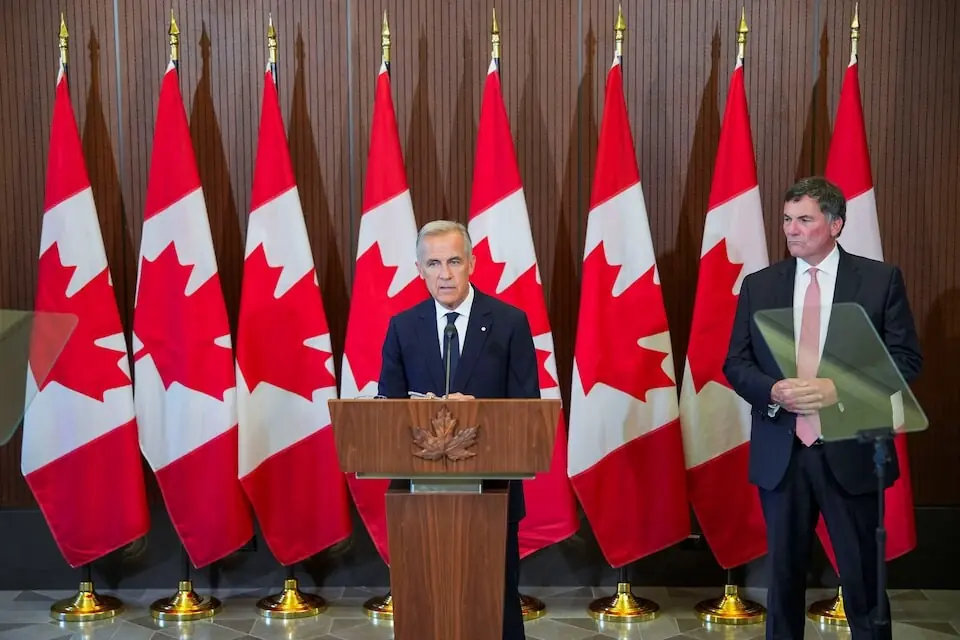
    OTTAWA: Canada has announced plans to impose new tariffs on a range of American products in response to steep duties introduced by US President Donald Trump on Canadian goods, marking another sharp deterioration in trade relations between the two North American neighbours. Prime Minister Mark Carney said on Saturday that Canada would adopt a “dollar-for-dollar” approach to Washington’s latest tariffs. The retaliatory measures are scheduled to take effect on September 8 and will cover products including US steel, electronics, appliances, agricultural equipment, pulp and paper and other goods. The announcement came after three days of intensive negotiations between Canadian and US officials ended without a trade agreement. Both sides blamed the other for the failure to reach a breakthrough, raising fresh uncertainty over the future of the United States-Mexico-Canada trade framework. Carney vows to defend Canadian economy Speaking at a press conference in Ottawa, Carney said Canada would respond to the US measures in an effort to shield workers, farmers, businesses and families from the economic impact of the new duties. “Canada will match Washington’s new tariffs dollar for dollar,” Carney said, stressing that Ottawa could not accept the conditions put forward by the US administration. Asked whether the dispute had effectively developed into a trade war, Carney responded in stark terms, saying Canada had been attacked and therefore had to defend its economic interests. The Canadian government said its countermeasures would target a broad selection of US products. Further details, including the specific goods affected and the tariff rates, are expected to be announced in the coming days. Carney also indicated that Ottawa would introduce support programmes for Canadian industries affected by the American duties. The assistance could remain in place for several years depending on the impact of the trade measures. US-Canada negotiations break down The latest dispute follows the collapse of negotiations that had been viewed as an opportunity to prevent a further escalation in tariffs. US Trade Representative Jamieson Greer described the failed talks as a missed opportunity for Canada and said Washington would proceed with measures responding to Canadian retaliation. He also suggested that no fresh negotiations were immediately planned. The White House and offices representing the US commerce secretary and trade representative did not immediately issue a detailed response to Canada’s announcement. The breakdown has created additional uncertainty for businesses operating across the US-Canada border, particularly industries that depend heavily on integrated North American supply chains. New US duties affect key Canadian exports The latest US tariffs apply to a range of Canadian exports, including wine, furniture, dairy products, cement, clothing, fishing equipment and hockey-related products. According to the Canadian government, the new duties affect approximately $20 billion worth of Canadian exports to the United States. Unlike some previous measures, the latest tariffs do not fully exempt products traded under the existing North American trade agreement. The new duties represent a relatively small share of Canada’s overall exports to the US, but officials and industry representatives warn that individual sectors could face significant pressure. Industries such as softwood lumber, wine, manufacturing and other export-oriented businesses could experience weaker demand, higher costs and potential employment losses if the dispute continues. Candace Laing, chief executive of the Canadian Chamber of Commerce, urged companies across the country to prepare for a prolonged period of uncertainty. Dispute over vehicles and trade conditions One of the most difficult issues during the negotiations involved the treatment of larger vehicles. Canadian negotiators reportedly sought to extend preferential tariff arrangements for light-duty vehicles to medium- and heavy-duty trucks. Washington opposed the proposal, according to people familiar with the negotiations. Carney said the US position could have placed Canadian-made models at a competitive disadvantage. He specifically pointed to vehicles produced in Canada, including Ford’s F-350, F-450 and F-550 trucks and General Motors’ Silverado. The Canadian prime minister also said some US proposals touched on issues involving Canadian culture, language and sovereignty, although he did not provide further details. Ontario backs Ottawa’s position Ontario Premier Doug Ford, a prominent critic of US tariffs, welcomed Carney’s decision to reject what he described as an unfavourable agreement. Ford said the proposed terms would have harmed Ontario’s automotive, steel and manufacturing industries, adding that he supported Ottawa’s decision to retaliate rather than accept a deal that he considered damaging to the province. Ontario is particularly exposed to disruptions in US-Canada trade because of its large manufacturing and automotive sectors and its close integration with American supply chains. Canada seeks new international partnerships The escalating dispute also comes as Canada seeks to reduce its economic dependence on the United States. Nearly 70% of Canadian exports are destined for the US market, making the country particularly vulnerable to changes in American trade policy. Carney has nevertheless pledged to strengthen Canada’s relationships with other countries and explore new trade and security partnerships. The prime minister was elected on a platform that included a tougher negotiating stance toward the Trump administration. His government has maintained that Canada should defend its economic interests while looking for opportunities to expand trade beyond its southern neighbour. Public opinion has also strengthened Ottawa’s position, with polling indicating that many Canadians oppose making major concessions to Washington. Conservative Party leader Pierre Poilievre, who leads the federal opposition, also called for national unity in response to the US tariffs.

Leave a Reply

Your email address will not be published. Required fields are marked *