canada announces retaliatory
| |

Canada announces retaliatory tariffs as trade talks with US collapse

OTTAWA: Canada has announced plans to impose new tariffs on a range of American products in response to steep duties introduced by US President Donald Trump on Canadian goods,

marking another sharp deterioration in trade relations between the two North American neighbours.

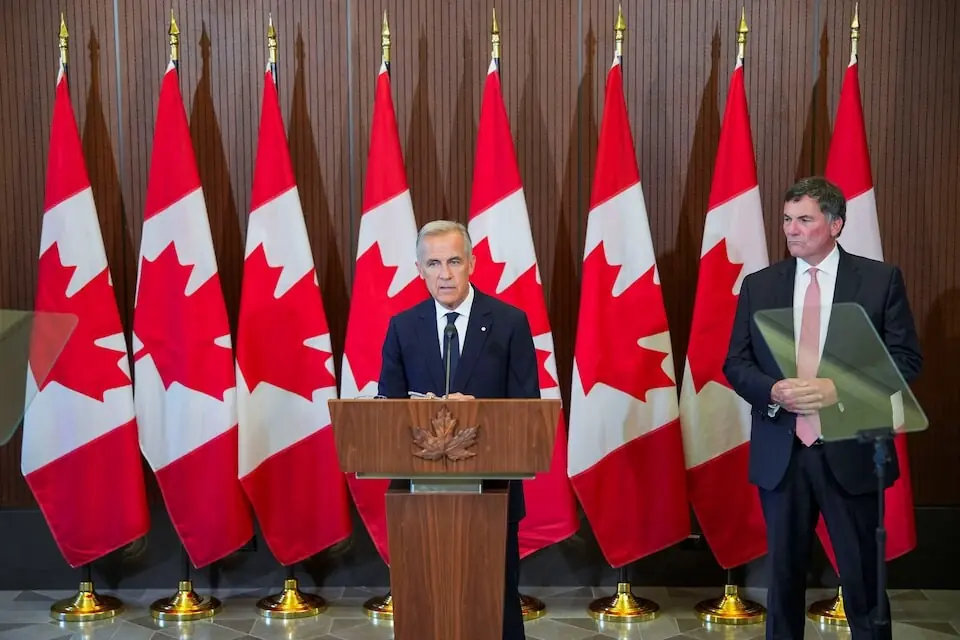
Prime Minister Mark Carney said on Saturday that Canada would adopt a “dollar-for-dollar” approach to Washington’s latest tariffs. The retaliatory measures are scheduled to take effect on September 8 and will cover products including US steel, electronics, appliances, agricultural equipment, pulp and paper and other goods.

The announcement came after three days of intensive negotiations between Canadian and US officials ended without a trade agreement. Both sides blamed the other for the failure to reach a breakthrough, raising fresh uncertainty over the future of the United States-Mexico-Canada trade framework.

Carney vows to defend Canadian economy

Speaking at a press conference in Ottawa, Carney said Canada would respond to the US measures in an effort to shield workers, farmers, businesses and families from the economic impact of the new duties.

“Canada will match Washington’s new tariffs dollar for dollar,” Carney said, stressing that Ottawa could not accept the conditions put forward by the US administration.

Asked whether the dispute had effectively developed into a trade war, Carney responded in stark terms, saying Canada had been attacked and therefore had to defend its economic interests.

The Canadian government said its countermeasures would target a broad selection of US products. Further details, including the specific goods affected and the tariff rates, are expected to be announced in the coming days.

Carney also indicated that Ottawa would introduce support programmes for Canadian industries affected by the American duties. The assistance could remain in place for several years depending on the impact of the trade measures.

US-Canada negotiations break down

The latest dispute follows the collapse of negotiations that had been viewed as an opportunity to prevent a further escalation in tariffs.

US Trade Representative Jamieson Greer described the failed talks as a missed opportunity for Canada and said Washington would proceed with measures responding to Canadian retaliation. He also suggested that no fresh negotiations were immediately planned.

The White House and offices representing the US commerce secretary and trade representative did not immediately issue a detailed response to Canada’s announcement.

The breakdown has created additional uncertainty for businesses operating across the US-Canada border, particularly industries that depend heavily on integrated North American supply chains.

New US duties affect key Canadian exports

The latest US tariffs apply to a range of Canadian exports, including wine, furniture, dairy products, cement, clothing, fishing equipment and hockey-related products.

According to the Canadian government, the new duties affect approximately $20 billion worth of Canadian exports to the United States. Unlike some previous measures, the latest tariffs do not fully exempt products traded under the existing North American trade agreement.

The new duties represent a relatively small share of Canada’s overall exports to the US, but officials and industry representatives warn that individual sectors could face significant pressure.

Industries such as softwood lumber, wine, manufacturing and other export-oriented businesses could experience weaker demand, higher costs and potential employment losses if the dispute continues.

Candace Laing, chief executive of the Canadian Chamber of Commerce, urged companies across the country to prepare for a prolonged period of uncertainty.

Dispute over vehicles and trade conditions

One of the most difficult issues during the negotiations involved the treatment of larger vehicles.

Canadian negotiators reportedly sought to extend preferential tariff arrangements for light-duty vehicles to medium- and heavy-duty trucks. Washington opposed the proposal, according to people familiar with the negotiations.

Carney said the US position could have placed Canadian-made models at a competitive disadvantage. He specifically pointed to vehicles produced in Canada, including Ford’s F-350, F-450 and F-550 trucks and General Motors’ Silverado.

The Canadian prime minister also said some US proposals touched on issues involving Canadian culture, language and sovereignty, although he did not provide further details.

Ontario backs Ottawa’s position

Ontario Premier Doug Ford, a prominent critic of US tariffs, welcomed Carney’s decision to reject what he described as an unfavourable agreement.

Ford said the proposed terms would have harmed Ontario’s automotive, steel and manufacturing industries, adding that he supported Ottawa’s decision to retaliate rather than accept a deal that he considered damaging to the province.

Ontario is particularly exposed to disruptions in US-Canada trade because of its large manufacturing and automotive sectors and its close integration with American supply chains.

Canada seeks new international partnerships

The escalating dispute also comes as Canada seeks to reduce its economic dependence on the United States.

Nearly 70% of Canadian exports are destined for the US market, making the country particularly vulnerable to changes in American trade policy. Carney has nevertheless pledged to strengthen Canada’s relationships with other countries and explore new trade and security partnerships.

The prime minister was elected on a platform that included a tougher negotiating stance toward the Trump administration. His government has maintained that Canada should defend its economic interests while looking for opportunities to expand trade beyond its southern neighbour.

Public opinion has also strengthened Ottawa’s position, with polling indicating that many Canadians oppose making major concessions to Washington.

Conservative Party leader Pierre Poilievre, who leads the federal opposition, also called for national unity in response to the US tariffs.

Similar Posts

  • Dr. Fauci Invokes 5th Amendment in Senate Hearing Refuses to Answer Questions

    WASHINGTON, D.C. – Former Chief Medical Advisor Dr. Anthony Fauci invoked his Fifth Amendment right against self-incrimination during a Senate hearing on Wednesday. Lawmakers questioned Fauci about his handling of the COVID-19 pandemic and accused him of lying about virus research in Wuhan, China. Dr Fauci stated he took this step under legal advice to […]

  • | |

    Kris Jenner and daughters mourn beloved Mary Jo ?…

    Kris Jenner and the Kardashian-Jenner family are reportedly grieving the loss of their beloved matriarch, Mary Jo “MJ” Campbell, who died on July 16 at the age of 91. According to People magazine, the family has been left heartbroken by the passing of the woman who played a central role in their lives and remained a constant source of love, wisdom, and support for generations. Mary Jo, affectionately known as “MJ,” was a familiar face to fans of Keeping Up with the Kardashians and The Kardashians. Although she largely stayed away from the spotlight, her warm personality and close relationship with her children, grandchildren, and great-grandchildren made her a cherished member of the famous family. Over the years, viewers watched her share heartfelt moments with Kris Jenner and the rest of the Kardashian-Jenner clan, earning admiration from fans worldwide. According to insiders who spoke with People, the family has been leaning on one another as they process the heartbreaking loss. Kris Jenner is said to be devastated by the death of her mother, with her daughters rallying around her during this difficult time. Sources described MJ as the heart of the family, someone who always brought everyone together and offered unconditional love and guidance. The insider added that MJ maintained a close bond with each of her grandchildren, including Kourtney Kardashian, Kim Kardashian, Khloé Kardashian, Rob Kardashian, Kendall Jenner, and Kylie Jenner. She was also deeply involved in the lives of her great-grandchildren, making every family gathering feel special with her warmth and kindness. Friends close to the family reportedly said MJ lived a full and meaningful life surrounded by those she loved most. Despite her age, her passing has left a profound void, with family members reflecting on the countless memories they shared over the years. They are said to be celebrating her remarkable life while mourning the loss of a woman who shaped the family’s values and traditions. Although the Kardashian-Jenner family has experienced many public milestones, insiders say this is one of the most emotional moments they have faced together. They have reportedly found comfort in spending time with one another, sharing stories about MJ, and honoring the legacy she leaves behind. As tributes continue to pour in from friends and fans, Mary Jo “MJ” Campbell is being remembered not only as Kris Jenner’s mother but also as the beloved grandmother and great-grandmother whose love touched every member of the Kardashian-Jenner family. While her presence will be deeply missed, those closest to her are determined to keep her memory alive by cherishing the values, laughter, and love she shared throughout her extraordinary 91 years.

  • | |

    Sindh High Court rejects disqualification plea aga…

    The Sindh High Court has dismissed a petition seeking the disqualification of Pakistan Peoples Party leader and National Assembly member Shazia Marri over an alleged fake degree. The court announced its decision after the case remained pending for around 13 years. The petition was declared not maintainable and subsequently rejected. The court said the High Court does not have constitutional authority to disqualify a member of Parliament. According to the court, such matters must be dealt with through the relevant constitutional and electoral forums. The court also noted that a similar objection had previously been raised during the 2018 general elections. The matter was taken before an election tribunal at that time. The Election Commission later rejected the objection concerning Marri’s degree in 2022. An appeal against the tribunal’s decision was subsequently filed before the Supreme Court. The Supreme Court dismissed the appeal in 2023 after it was withdrawn. During the latest proceedings, Marri’s lawyer argued that the degree issue had already been examined by the Election Commission. He told the court that evidence relating to the qualification had been presented before the commission. The lawyer maintained that the Election Commission had already rejected the petition concerning Marri’s degree. The court also discussed the constitutional requirements for disqualification. It observed that a person cannot be disqualified simply through a constitutional petition. The court said the authority to determine whether a person meets the required constitutional standards rests with the appropriate judicial and electoral forums. It further stated that the courts cannot declare an individual truthful and trustworthy outside the constitutional procedure provided for such matters. The judges also referred to previous orders of the Supreme Court while determining the maintainability of the petition. Based on these considerations, the court concluded that the petition could not be entertained. The decision brings an end to a legal challenge that had remained pending for more than a decade. The case had focused on allegations concerning Marri’s educational qualification. However, the Election Commission had already rejected the related objection. The latest ruling also reinforces the distinction between the powers of the High Court and those of election tribunals and other constitutional forums in matters involving parliamentary eligibility. The court’s decision means that the petition seeking Marri’s disqualification has been dismissed without granting the requested relief.

  • |

    China missile test deepens pacific’s struggle fo…

    SUVA: A Chinese ballistic-missile test in the Pacific has exposed a growing dilemma for the region’s small island nations: how can they preserve their vision of an “Ocean of Peace” while increasingly finding themselves caught between the military ambitions of major powers? China’s July missile launch, its first known ballistic-missile test into the Pacific since September 2024, has intensified concerns about the region’s rapid militarisation. The test came just hours after Fiji signed a major defence agreement with Australia, its first-ever military alliance. The timing highlighted the competing security interests shaping the Pacific, where the United States and China are increasingly contesting influence. Yet despite widespread concern among Pacific leaders, the region failed to agree on a joint statement condemning the Chinese missile test during a meeting of foreign ministers in Suva last week. Papua New Guinea Foreign Minister Justin Tkatchenko described the launch as “totally inappropriate”, saying that while China remained a close friend and partner of Papua New Guinea, the missile test was not helpful. Beijing had informed Papua New Guinea about the launch beforehand, Tkatchenko said, but did not provide details about where the missile would land. China defended the exercise at the time. Foreign Ministry spokesperson Mao Ning said the test had been conducted safely and urged other countries not to “over-interpret” the event. Pacific caught between major powers The missile launch was the latest in a series of military developments that have transformed the Pacific into an increasingly contested strategic space. Chinese naval deployments and live-fire exercises, including drills in the Tasman Sea, have become more visible. At the same time, US allies have expanded military exercises around Guam and Hawaii, while Washington maintains major military facilities and forces across Hawaii, Guam and the Marshall Islands. For Pacific island governments, the growing military activity creates an uncomfortable contradiction. Many have repeatedly insisted that their region should not become another battleground for global power competition. In September 2025, Pacific leaders endorsed the Ocean of Peace Declaration, pledging to protect the region and strengthen international peace and security. The initiative was intended to put Pacific countries themselves at the centre of discussions about their security rather than allowing outside powers to define the region’s strategic priorities. David Peebles of the Australian National University’s Pacific Security College said Pacific nations had historically resisted security agendas imposed by larger countries. But the growing number of defence agreements is now testing that principle. Defence deals bring benefits — and fears For some Pacific governments, security partnerships offer practical advantages. They can provide surveillance against illegal fishing, disaster-response capabilities, policing assistance, military equipment and training. Australia’s new defence agreement with Fiji, known as the Ocean of Peace Alliance, reflects that approach. But critics fear that a growing network of bilateral security arrangements could gradually draw Pacific nations deeper into the strategic competition between China and the United States. Tuvalu’s permanent foreign secretary, Pasuna Tuaga, speaking in a personal capacity, expressed concern over increasing militarisation, including security arrangements such as the AUKUS partnership between Australia, Britain and the United States. The concern is not simply about military exercises or missiles. Pacific governments also worry that agreements could eventually influence how their territory, waters and critical infrastructure are used. Solomon Islands Foreign Minister Rick Houenipwela, who chaired the Suva talks, stressed that the region’s security agenda must remain “conceived by the Pacific, shaped by the Pacific”. Yet achieving that unity is becoming increasingly difficult. China divides Pacific consensus The failure to produce a common statement on China’s missile test revealed just how sharply interests differ among Pacific nations. Officials familiar with the discussions said Kiribati and Nauru did not support the wording of a proposed statement. Both countries have strengthened relations with Beijing after switching diplomatic recognition away from Taiwan. New Zealand Foreign Minister Winston Peters attributed the failure to reach consensus to foreign influence, although he did not identify any country. The disagreement reflects a broader challenge. Some Pacific governments, particularly those closer to longstanding US military facilities, favour stronger security ties with Washington and its allies. Others remain cautious about becoming involved in military competition between major powers and maintain close economic or diplomatic relations with Beijing. Fiji faces a difficult balancing act Fiji is now at the centre of this debate. The country signed its defence agreement with Australia and participated for the first time in the US-led RIMPAC military exercises last month. At the same time, Fiji has publicly supported the vision of a peaceful Pacific free from major-power confrontation. Foreign Minister Sakiasi Ditoka acknowledged the tension, saying Pacific nations wanted to be free from “all these war-making paraphernalia” while recognising that some security capabilities were necessary to protect them. For Pacific leaders, the challenge is increasingly about finding the right balance. The region does not want to choose sides in a rivalry between Washington and Beijing. But as military exercises expand, defence agreements multiply and missiles are tested in Pacific waters, remaining completely outside that rivalry is becoming harder. The issue is expected to return to the spotlight when Pacific leaders gather in Palau in three weeks for the Pacific Islands Forum summit. The missile test may have lasted only moments, but its political impact could linger far longer — forcing Pacific nations to confront whether their dream of an “Ocean of Peace” can survive amid an increasingly militarised region.

  • |

    Meghan and Harry urged to pause business ventures

    Meghan Markle and Prince Harry have been advised to step back from their growing list of business ventures and focus on building a single successful project after the theatrical debut of their documentary, “Cookie Queens.” The Duke and Duchess of Sussex have continued to explore opportunities across entertainment, media and business since stepping away from their senior royal roles. However, a royal commentator believes the couple should now reduce their public announcements and concentrate on creating work that can establish long-term credibility. Royal expert Kinsey Schofield, host of the YouTube program “Kinsey Schofield Unfiltered,” said Meghan and Harry have significant name recognition but have struggled to turn their global fame into sustained consumer interest and revenue. According to Schofield, the couple would benefit from taking a quieter professional approach instead of constantly introducing new projects or pursuing another public rebrand. She suggested that they temporarily “disappear professionally” and significantly reduce the number of announcements they make. The expert recommended that Meghan and Harry select one strong project and surround themselves with experienced professionals who understand how to successfully execute it. In her view, producing a genuinely successful project could do more for their public image than another publicity campaign. Schofield argued that reputation recovery does not necessarily require another rebranding exercise. Instead, she believes the couple should allow their work to speak for itself. She emphasized that success can be one of the most effective ways to improve a celebrity’s reputation, particularly in Hollywood. If Meghan and Harry were able to produce something widely praised and commercially successful, the public conversation surrounding them could potentially change. The royal commentator also warned against trying to establish themselves as authorities across too many industries at the same time. She suggested that attempting to build a presence in multiple categories could ultimately prevent them from becoming strongly associated with any particular field. Her advice was for the couple to choose one area, develop genuine expertise and allow their achievements to gradually rebuild their credibility. Schofield further suggested that Meghan and Harry should stop relying primarily on their celebrity status as the selling point of their ventures. Instead, they should focus on creating products and projects that are strong enough to succeed independently of their royal connections and personal fame. The comments come after reports surrounding “Cookie Queens,” which marked a major theatrical feature debut for Meghan and Harry as executive producers. The documentary reportedly earned around $354,000 from 446 theaters. While the figure represents a theatrical release, the reported performance has renewed discussion about the couple’s business strategy and their ability to convert their considerable public profile into commercially successful projects. With Meghan and Harry continuing to develop their careers outside the royal institution, the latest advice suggests that a period of fewer announcements and greater focus could help them build a more sustainable presence in the entertainment industry.

  • |

    US democrat challenges antisemitism claims over Israel aid

    US Democratic politician Abdulrahman Mohamed El-Sayed has pushed back against attempts to portray criticism of US funding for Israel as antisemitic, arguing that invoking concerns about antisemitism to defend the actions of a foreign government ultimately harms Jewish Americans. Speaking during an interview with a US host, El-Sayed said that criticism of government policies should not automatically be dismissed as hatred against a religious or ethnic community. He stressed that the fight against antisemitism must continue alongside efforts to combat Islamophobia and other forms of discrimination. El-Sayed argued that both antisemitism and Islamophobia represent serious challenges that society must confront rather than use as political tools. He said Americans should be able to question how public funds are being spent, particularly when those funds support the military policies of another country. “We cannot remain silent and ignore why the United States provides billions of dollars in annual assistance and how that support is being used,” he said, questioning whether American aid should contribute to policies he described as involving racial segregation. The Democratic politician also criticized Washington’s approach to military assistance, saying the US should not provide unconditional support to any foreign government. He argued that American involvement in the war in Gaza over the past several years was not inevitable and that Washington should have taken a more critical approach to its relationship with Israel. El-Sayed’s comments reflect a broader debate within the Democratic Party and across the United States over American military and financial support for Israel. While supporters of Israel argue that US assistance helps protect a key ally and supports its security, critics have called for stricter conditions on aid and greater scrutiny of Israel’s military actions. The remarks also highlight the growing political debate over how to distinguish legitimate criticism of Israeli government policies from antisemitism, while ensuring that concerns about antisemitism are not dismissed or minimized.

Leave a Reply

Your email address will not be published. Required fields are marked *