
seven killed including
|

Seven killed, including two police officers, in crash during pursuit near Middlesbrough


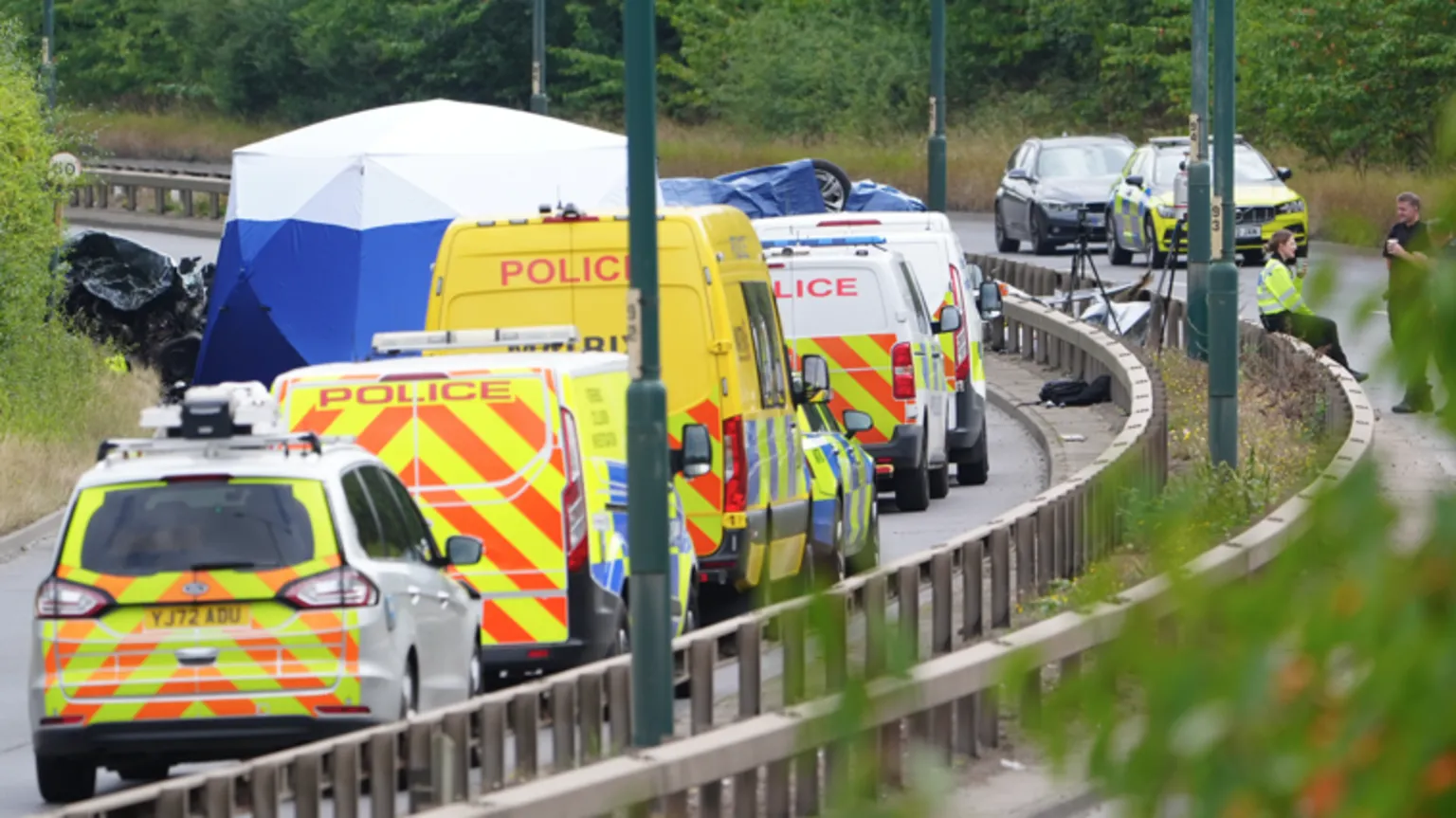
MIDDLESBROUGH: Seven people, including two police officers, have died in a serious road crash during a police pursuit involving a “suspicious” vehicle travelling in the wrong direction on a dual carriageway in northeastern England.

The collision occurred at around 3:39am BST on the A66 in South Bank, near Middlesbrough in Teesside. Cleveland Police said the crash involved a marked police vehicle and a Volkswagen Passat.

According to police, the marked police car had been travelling in the correct direction on the road when the collision occurred. Emergency services rushed to the scene, but all occupants of both vehicles were pronounced dead at the location.

Cleveland Police Chief Constable Victoria Fuller expressed her condolences to the victims and their families, saying that no one should leave their home without being able to return safely, including police officers who serve and protect their communities.

The force said the families of those identified had been informed and were being offered specialist support. Fuller described the incident as a tragedy that would have a profound impact on communities across Cleveland and the wider policing family.

The Independent Office for Police Conduct (IOPC), the police watchdog, has launched an investigation into the circumstances surrounding the crash.

The watchdog said that, based on information available at the early stage of the inquiry, Cleveland Police had spotted a suspicious vehicle and a pursuit subsequently began.

Investigators will examine the circumstances leading up to the pursuit, including why the vehicle was considered suspicious, how the pursuit developed and what happened immediately before the fatal collision.

The A66 is one of the main roads running through the Teesside region. The area surrounding the crash site includes a number of industrial buildings and factories.

Following the incident, the road was closed in both directions between Normanby Road and Church Lane. Police said the closure was expected to remain in place for the rest of the day while emergency crews and investigators worked at the scene.

Police vehicles and officers could be seen along the road as a major emergency response continued. Motorists were advised to avoid the area and use alternative routes.

The North East Ambulance Service said it deployed 14 ambulance resources as part of the major emergency response.

Despite the efforts of emergency responders, several patients died at the scene. The ambulance service expressed its condolences to everyone affected by the tragedy and thanked those who worked through the night in response to the crash.

Cleveland Police said a significant number of emergency service vehicles remained at the scene and urged members of the public not to speculate about the circumstances while the investigation was still developing.

Home Secretary Shabana Mahmood described the incident as “devastating” and expressed her support for Cleveland Police as officers worked to identify everyone involved.

She paid tribute to police officers who put their safety at risk every day to protect the public and offered her condolences to the victims’ families, friends, emergency responders and the wider police community.

Local MP Anna Turley also expressed deep sadness over the deaths. She extended her sympathies to the families and loved ones of those who lost their lives and thanked emergency services personnel who worked throughout the night.

The investigation remains ongoing, with authorities expected to examine forensic evidence, witness accounts and other information to establish the exact sequence iof events that led to the fatal crash.

Similar Posts

  • |

    US Department of Defence orders swift ramp-up in weapons manufacturing as conflict with Iran strains stockpiles

    The United States Department of Defence has called on defence contractors to accelerate weapons production amidst growing anxiety over dwindling military stockpiles as hostilities with Iran persist. Deputy Secretary of Defence Steve Feinberg issued a formal directive on Wednesday, setting a 21-day deadline for defence industry leaders to deliver proposals aimed at driving significantly faster delivery timelines and boosting output for critical capabilities. The directive was initially revealed by The Washington Post following heightened scrutiny regarding the condition of US weapons reserves during the ongoing conflict. Spokesperson for the Department of Defence Sean Parnell verified the authenticity of the directive, noting that the submissions will directly shape the Pentagon’s budget request for fiscal year 2028. “The August 5 memo is real,” Parnell stated. “It will inform the fiscal year 2028 budget submitted to Congress for funding, and it is entirely consistent with our ongoing push to rebuild the defence industrial base.” Parnell added that direct engagement with weapons manufacturers is routine practice, defending the administration’s aggressive measures to expedite procurement schedules. He detailed that Feinberg is actively working to overhaul what he characterized as a broken, outdated, and overly intricate procurement framework, ensuring the military retains the capability to produce equipment at a pace that matches modern threat levels.

  • US destroyer left powerless for four days in South China Sea

    A US Navy destroyer spent four full days without power in the South China Sea last month, after suffering a serious mechanical breakdown. The incident has raised fresh questions about the strain on America’s naval fleet. The USS Benfold, an Arleigh Burke-class guided-missile destroyer, was carrying out routine operations in the Indo-Pacific region on July 24 when the failure occurred. US 7th Fleet spokesperson Cmdr. Matthew Comer told CNN the ship suffered what the Navy described as an engineering casualty involving its generators. The breakdown left the nearly 10,000-tonne warship unable to manoeuvre on its own. It also knocked out several essential onboard systems, including toilets, air conditioning, galley services and drinking water. Despite the disruption, Comer confirmed there were no injuries among the crew throughout the ordeal. He praised their response, describing it as resilient, professional and remarkably steady under difficult circumstances. To help manage the crisis, another US warship, the USS Robert Smalls, stepped in to supply cooked meals to the stranded crew. Additional support came from vessels attached to the USS George Washington Carrier Strike Group, which assisted throughout the four-day period. Once power could not be restored at sea, the Benfold was towed to Subic Bay in the Philippines for proper repairs. The Navy confirmed that repair work wrapped up by August 8, and the destroyer has since returned to active duty. The exact cause behind the generator failure remains under investigation. Officials haven’t yet confirmed what specifically triggered the malfunction aboard the vessel. The incident adds to growing concern that the US Navy is being stretched thin by its expanding list of global commitments. Ongoing tensions tied to the Iran conflict, alongside broader Indo-Pacific operations, have placed additional pressure on naval resources in recent months. This isn’t an isolated case either. Back in May, another US destroyer, the USS Higgins, also experienced a temporary loss of power and propulsion while operating in the same broader Indo-Pacific region. With back-to-back incidents now affecting multiple vessels, questions are mounting over whether ageing systems and overstretched deployments are beginning to take a toll on naval readiness.

  • |

    Netanyahu accuses New York Mayor Mamdani of ‘fomenting hate’ and rejects ICC war crimes charges

    Israeli Prime Minister Benjamin Netanyahu has strongly criticised New York City Mayor Zohran Mamdani, accusing him of “fomenting hate” and attempting to divide the city’s population. The sharp exchange follows comments by Mamdani asserting that Netanyahu is unwelcome in New York City due to ongoing International Criminal Court (ICC) war crimes charges linked to the war in Gaza, and urging federal authorities to execute the court’s arrest warrant when the prime minister attends the United Nations General Assembly in September. Appearing on Fox News Channel, Netanyahu dismissed the ICC charges as “bogus” and claimed the allegations were designed to divert attention from internal misconduct within the prosecutor’s office. He expressed concern over eroding bipartisan support for Israel within the United States, warning that political rhetoric from progressive Democrats risks fueling rising anti-Semitism in major American cities. Despite the mayor’s stance, US President Donald Trump has publicly assured Netanyahu that he will face no risk of arrest during his visits to the United States.

  • |

    King Charles and Queen Camilla to pay state visit …

    King Charles III and Queen Camilla are due to pay a state visit to Spain next year, marking the first British royal state visit to the country since the late Queen Elizabeth II visited in 1988 with Prince Philip. The trip, expected to take place in 2027, will see the British monarchs hosted by Spanish King Felipe VI and Queen Letizia. Precise dates for the forthcoming trip have yet to be officially confirmed, but the visit is expected to include a state banquet and meetings with the Spanish royal family, including King Felipe’s daughters, Princess Leonor, 20, and Infanta Sofia, 19. The visit is a significant diplomatic gesture, reflecting the close ties between the two monarchies and the broader relationship between the United Kingdom and Spain. The announcement comes shortly after King Felipe, Queen Letizia, and their daughters returned from New Jersey, where they witnessed Spain’s triumphant victory over Argentina in the World Cup final. The royal family were seen celebrating with the team, with King Felipe breaking protocol to hug teenage star Lamine Yamal during the victory celebrations. King Charles and Queen Camilla’s visit is expected to strengthen the cultural and historical bonds between the UK and Spain, building on the legacy of Queen Elizabeth II’s visit nearly four decades ago. The 1988 visit was a milestone in Anglo-Spanish relations, and this upcoming state visit is seen as a continuation of that tradition. The royal visit will also provide an opportunity for discussions on mutual interests, including trade, climate change, and cultural exchange. Both countries are committed to strengthening their partnership in various fields, and the state visit is likely to further enhance these ties. As preparations for the visit get underway, the British and Spanish royal families are expected to engage in a series of events showcasing the best of both nations. The visit is anticipated to be a highlight of the diplomatic calendar for 2027, drawing attention from royal watchers and the media alike. King Charles has maintained a strong interest in international relations since ascending to the throne, and this visit to Spain will be an important step in his diplomatic outreach. Queen Camilla’s involvement in the trip underscores the importance of the visit in strengthening the monarchy’s ties with other royal houses. The state visit to Spain is part of a broader effort by the British monarchy to strengthen its international relationships and promote cultural diplomacy. The trip is expected to include engagements with Spanish officials, cultural institutions, and the public, showcasing the enduring friendship between the two nations. As the date approaches, more details about the itinerary and specific engagements are expected to be released.

  • |

    Netanyahu visits White House for first Trump talks…

    Israeli Prime Minister Benjamin Netanyahu visited the White House on Tuesday for his first in-person meeting with US President Donald Trump since the Iran war began, as the two leaders held closed-door talks dominated by the conflict and regional security. The meeting, described by the White House as “positive and productive,” lasted about an hour and a half. It came amid a recent pause in the fighting between the US and Iran, with Washington signaling it wants to give negotiations a chance. Israel has not taken part in the latest round of hostilities, which flared earlier this month after an April ceasefire collapsed. Relations between Trump and Netanyahu reached a low point in April during negotiations on the ceasefire with Iran, with Trump unleashing profanity-laced tirades against his Israeli ally. Trump later described Netanyahu in an interview as a “very difficult guy,” while Netanyahu downplayed the exchanges as “tactical disagreements” that were “drawn out.” Upon arriving in Washington, Netanyahu attended a private memorial dinner on Monday evening in honor of the late US senator Lindsey Graham, and he was also scheduled to attend Graham’s memorial service later on Tuesday. Observers suggest that any differences between Trump and Netanyahu concern the means  timeline, intensity, and immediate objectives of operations rather than the ends of the war. Analysts believe Trump would mainly seek to focus on his two regional priorities: Iran and the expansion of the Abraham Accords, the US-brokered normalisation agreements signed during his first term that established formal diplomatic relations between Israel and the United Arab Emirates, Bahrain, and Morocco. Gaza is seen as less of a priority for Trump, but other observers believe the talks could also address the possible easing of Israel’s military presence elsewhere in the region, such as in Lebanon, Syria, or Gaza. The meeting comes as diplomatic efforts to end the broader conflict continue, with Pakistan and Qatar playing mediation roles between Washington and Tehran.

Leave a Reply

Your email address will not be published. Required fields are marked *