rejects settlement plan
|

UK rejects E1 settlement plan

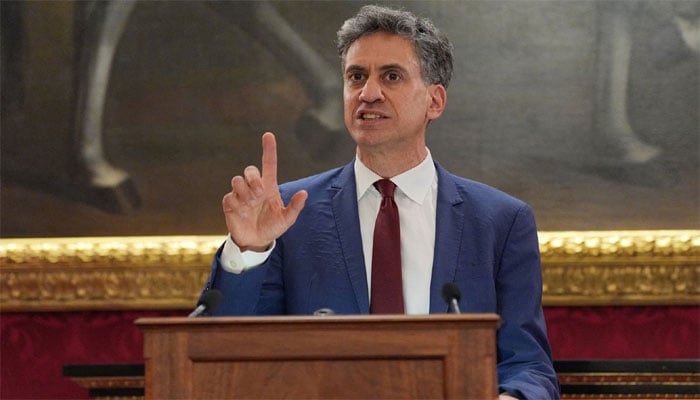
LONDON: British Foreign Secretary Ed Miliband has strongly opposed Israel’s plan to invite tenders for the construction of 1,200 new homes under the controversial E1 settlement project, warning that the move could seriously undermine prospects for a future Palestinian state and the two-state solution.

The British government has urged Israel to immediately withdraw the E1 plan, cancel the construction tenders and halt the expansion of Israeli settlements in the occupied West Bank.

A UK government spokesperson said Israeli settlement activity violates international law and remains a major obstacle to achieving lasting peace in the region. The government stressed that continued settlement expansion could further weaken efforts to establish a viable and geographically connected Palestinian state.

Miliband said Britain would continue to strongly support a two-state solution, arguing that it offers the best path toward lasting peace, security and stability for both Palestinians and Israelis.

The E1 area, located east of Jerusalem in the occupied West Bank, has long been a sensitive issue because large-scale settlement development there could divide Palestinian communities and complicate the possibility of creating a contiguous Palestinian state.

The British government’s latest warning comes amid continued international concern over settlement expansion in the occupied Palestinian territories and its potential impact on future peace negotiations.

Similar Posts

  • |

    US authorises private firms to target cybercrime groups

    WASHINGTON: The United States has taken an unusual step in its fight against international cybercrime by allowing selected private companies to conduct government-approved hacking operations against foreign criminal organisations. President Donald Trump has signed a memorandum directing the departments of Justice and Homeland Security to establish a framework under which approved private-sector partners can investigate, infiltrate and disrupt transnational cybercrime networks. The move is aimed at tackling growing threats including ransomware attacks, online fraud and so-called sextortion schemes. The White House said such crimes caused more than $20 billion in losses to Americans during 2025. Under the new framework, authorised companies could potentially infiltrate cybercriminals’ computer systems, deploy spyware or disrupt servers used to conduct criminal activities. However, each operation would require approval from the US government before any action is taken. Participating companies would also be required to provide a bond of at least $1 million. Operations involving actions that could cause death or physical injury would remain prohibited. Activities that could qualify as the use of force under international law would also be excluded. The initiative has drawn comparisons with privateering, a practice used centuries ago when governments authorised private vessels to attack or seize enemy ships. Supporters argue that private technology companies possess specialised cyber expertise and access to data that government agencies may not have. They believe combining those capabilities with government authority could help disrupt criminal networks more effectively. However, cybersecurity experts have raised concerns about accountability, oversight and the possibility of unintended consequences. Critics warn that allowing private companies to conduct offensive cyber operations could create diplomatic complications and make it difficult to control activities once they begin. The policy also represents a notable shift in the Trump administration’s previous position. Earlier this year, senior US officials had indicated that the government was not interested in using private companies to fight cybercriminals through offensive operations. It remains unclear what prompted the change in policy. Some cybersecurity specialists believe the programme contains important safeguards because operations will be conducted under government authorisation. Others remain concerned that existing oversight institutions may not be strong enough to monitor such activities effectively. The initiative could also expose participating technology companies to new risks. Experts warn that firms involved in government-sanctioned cyberattacks could become targets themselves and face retaliation from criminal groups or foreign governments. The Trump administration has 60 days to finalise the programme’s operational framework, while some details are expected to remain classified.

  • | |

    Lavrov’s ‘nice hairstyle’ reply …

    Russian Foreign Minister Sergey Lavrov has gone viral on social media after responding to a journalist’s tough foreign policy questions with an unexpected compliment instead of an answer. The unusual moment took place during the ASEAN Regional Forum in Manila, Philippines, where Lavrov was approached by reporters following official meetings. A female journalist pressed the veteran diplomat with a series of sensitive questions covering Russia’s alleged support for Iran and Moscow’s position on ending the war in Ukraine. The reporter first asked whether Russia was helping Iran target American troops amid escalating tensions in the Middle East. She then followed up by asking if Moscow was prepared to agree to a ceasefire and peace negotiations with Ukraine. Rather than addressing either question, Lavrov continued walking calmly toward an elevator without breaking stride. As he reached the elevator doors, he briefly turned toward the journalist, smiled, and delivered a single unexpected remark. “Your hairstyle looks great,” he said before stepping into the elevator, leaving the reporter’s questions unanswered. The brief exchange was captured on camera and quickly spread across social media platforms, where it attracted millions of views and sparked widespread debate. Many users described Lavrov’s response as a classic example of diplomatic deflection, arguing that the seasoned foreign minister deliberately avoided commenting on politically sensitive issues without appearing confrontational. Others found the moment humorous, praising his composure and quick wit under pressure. Some social media users, however, criticized the response, saying it sidestepped important questions about international security and ongoing conflicts. The clip generated mixed reactions, with supporters calling it a clever diplomatic maneuver while critics argued that public officials should provide direct answers on major global issues. Lavrov, one of Russia’s longest-serving diplomats, is well known for his measured public appearances and his ability to navigate challenging media interactions. Throughout his career, he has frequently faced difficult questions from international journalists on issues ranging from the Ukraine conflict to Russia’s broader foreign policy. The latest viral moment once again highlighted how even a few unexpected words from a senior world leader can dominate online conversations. Whether viewed as a calculated diplomatic tactic, a light-hearted joke, or simply an attempt to avoid controversy, Lavrov’s short reply transformed an ordinary media encounter into one of the most talked-about moments of the ASEAN Regional Forum, proving that sometimes a single sentence can make bigger headlines than a lengthy press conference.

  • |

    Bangladesh MP defends controversial second marriage

    A controversy has erupted in Bangladesh after a member of parliament from Jamaat-e-Islami, Ghazi Nazrul Islam, became the center of public debate over his alleged second marriage following the circulation of a viral video on social media. According to Bangladeshi media reports, the video showed Ghazi Nazrul Islam with a young woman whom he later identified as his second wife. The footage quickly spread online, prompting widespread discussion and speculation. A fact-checking organization examined the video and stated that it found no evidence suggesting it had been generated using artificial intelligence or digitally manipulated. Following that assessment, public attention shifted from the authenticity of the video to the identity of the woman and the nature of her relationship with the lawmaker. In a statement, Ghazi Nazrul Islam confirmed that the woman is his second wife. He said the marriage took place on June 17 with the consent of both families and the approval of his first wife. The lawmaker alleged that the viral video had been secretly recorded and later released as part of an extortion attempt and a politically motivated campaign to damage his reputation. His first wife also released a video supporting his account. She confirmed that her husband had married Maryam Begum as his second wife and said the marriage had taken place with her knowledge and consent. Maryam Begum also appeared in a separate video, identifying herself as Ghazi Nazrul Islam’s wife. She said the marriage ceremony was held on June 17 in the presence of both families and the lawmaker’s first wife. Despite these public statements, Bangladeshi media reported that documents related to Maryam Begum later surfaced on social media. The authenticity of those documents has not been independently verified, and neither the lawmaker nor Maryam Begum or her family has publicly addressed the apparent inconsistencies contained in them. According to the documents, Maryam Begum’s marital status was listed as “unmarried.” The papers also reportedly included a recommendation signed by Ghazi Nazrul Islam on June 22—five days after the claimed marriage—in support of her application for a government job. Reports said Maryam Begum had applied for public sector employment and that the MP had endorsed her application. Ghazi Nazrul Islam rejected all allegations arising from the documents. He claimed that on July 13 he visited an office in Dhaka’s Moghbazar area, where both of his wives were present. He alleged that his driver, his second wife’s uncle and several unidentified individuals held him captive, extorted 100,000 taka, demanded additional money and secretly recorded a private video, which was later circulated on social media. Meanwhile, Jamaat-e-Islami Bangladesh said it is gathering information about the incident and will decide on any organizational action once all facts have been established. Assistant Secretary General Ehsanul Haque Mahbub Zubair said the party is reviewing media reports as well as statements from the member of parliament, his two wives and the woman’s father before reaching any conclusion.

  • |

    Houthis deny reports of Red Sea transit fees

    Yemen’s Houthi movement has rejected reports claiming it plans to charge commercial vessels for passing through the Red Sea, insisting that navigation through the strategic waterway remains free. In a statement issued by the Houthi-run Humanitarian Operations Coordination Center (HOCC), the group said its safe transit service for ships using the Bab al-Mandeb Strait is voluntary and does not involve any fees. It emphasized that no authorized Houthi body is collecting payments from shipping companies. The HOCC also warned shipping operators against making payments or sharing sensitive information with unauthorized individuals or organizations claiming to represent the group. It said any such demands are fraudulent and should not be recognized as official. The clarification came after recent reports suggested that the Houthis were considering introducing transit charges for vessels passing through the Bab al-Mandeb Strait. The reports claimed the proposal had been discussed during meetings with Iranian officials and that plans were being explored to establish a system for regulating such payments. The Bab al-Mandeb Strait is one of the world’s most important maritime routes, linking the Red Sea with the Gulf of Aden. Thousands of commercial vessels carrying oil, fuel and other goods use the passage every year, making it a vital corridor for global trade between Asia, Europe and the Middle East. Security concerns in the Red Sea have remained high since attacks on commercial shipping began in late 2023. The conflict significantly disrupted international shipping, forcing many companies to divert vessels to longer and more expensive routes around southern Africa. Although attacks temporarily declined following a ceasefire last year, commercial traffic through the region has yet to return to previous levels. Shipping companies continue to monitor the security situation closely before routing vessels through the area. The latest reports have also prompted regional efforts to strengthen maritime security. Saudi Arabia recently announced a multinational maritime coalition aimed at protecting freedom of navigation in the Bab al-Mandeb Strait, the Red Sea and the Gulf of Aden.

  • |

    Houthis launch deadly missile and drone strikes in Yemen

    Houthi forces launched a series of missile and drone attacks on several Yemeni government military bases in the provinces of Hadramout and Marib, killing at least 30 soldiers and injuring 15 others, according to the Yemeni government. Officials warned that the death toll could rise as some of the wounded remain in critical condition. Meanwhile, the Houthis claimed the attacks caused hundreds of casualties among government forces, although independent verification of that figure is not available. Houthi spokesperson Yahya Saree said the strikes came in response to recent military movements by government forces. The Yemeni military confirmed the attacks and said they followed its own operations against Houthi positions. Arab media reported that the Houthis fired eight missiles from Al Jawf province, targeting military camps in Al Thaniyah and Al Abr in Hadramout, as well as Al Rawk in Marib. The strikes hit while soldiers had gathered for training exercises, contributing to the high number of casualties. The attacks rank among the deadliest military operations in Yemen since 2022 and come as clashes between the two sides have intensified in recent weeks, raising fears of further escalation. The U.S. Embassy condemned the attacks, describing them as a “cowardly act of terrorism,” and expressed condolences to the families of the fallen Yemeni soldiers. Separately, the Saudi-led coalition said a Houthi attack on the Saudi border city of Najran wounded 11 civilians, including a woman and a child. The Houthis have not immediately claimed responsibility for that incident.

  • |

    Germany hunts terror suspect after Berlin pride cr…

    German authorities launched a national manhunt on Sunday for an individual suspected of ploughing a minivan into a crowd near a huge LGBTQ Pride gathering in Berlin, killing one person and injuring 29 others. The attack occurred in Tiergarten park near the Brandenburg Gate at approximately 10 pm, close to one of Europe’s largest annual LGBTQ celebrations, Christopher Street Day. The incident is the latest in a series of vehicle attacks on crowds in Germany that have intensified debate around security and immigration amid a surge in support for the far-right. Chancellor Friedrich Merz urged Germans to protect liberal values, stating: “We will defend the freedom, openness, and liberal spirit of our lives and our society with everything we can do.” It remains unclear whether the perpetrator acted alone, as police said more than one person may have exited the van. Berlin broadcaster RBB reported that an Iranian who had been a passenger in the vehicle had been arrested. The fire service confirmed that three of the injured were in a life-threatening condition. The attack comes at a sensitive time for Merz’s unpopular coalition government, which is undergoing a bruising cabinet reshuffle amid criticism of its effectiveness. The far-right Alternative for Germany party, campaigning on immigration and security, was quick to comment on the attack. AfD co-chief Tino Chrupalla said on X: “We will not allow religious extremists to divide our country with violence and intolerance!” Germany has experienced several vehicle attacks in recent years. In May, a man believed to have mental health problems drove into a pedestrian zone in Leipzig, killing two and injuring three. In 2016, a Tunisian failed asylum seeker hijacked a truck and drove it into a busy Christmas market, killing 11 people. At the Tiergarten park, people lit candles and left flowers in memory of the victim. The investigation is ongoing, with authorities working to determine the full circumstances of the attack. The incident has once again raised questions about security measures at public events and the broader challenges of preventing such acts of violence. The government faces increasing pressure to address these concerns while upholding the country’s commitment to openness and tolerance. As the manhunt continues, the nation mourns the loss of life and hopes for the recovery of those injured in this senseless act of violence. The coming days will be crucial in determining the motives behind the attack and ensuring that those responsible are brought to justice. The international community has expressed solidarity with Germany, offering support in the aftermath of the tragedy. The attack serves as a stark reminder of the ongoing threat of extremism and the need for continued vigilance to protect public safety.

Leave a Reply

Your email address will not be published. Required fields are marked *