forms top panel
| | |

PM forms top panel to revive Iran gas pipeline

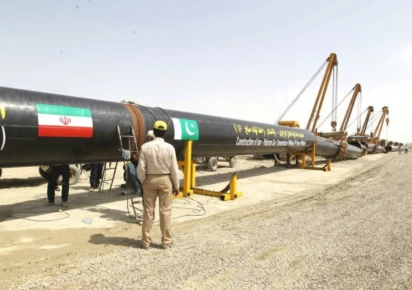
Prime Minister Shehbaz Sharif has formed a high-level committee to find a mutually acceptable solution to the long-delayed Pakistan-Iran gas pipeline project, which has remained stuck for more than a decade.

Petroleum Minister Ali Pervaiz Malik informed the Senate that the committee is examining the legal, financial and energy implications of the project. It will assess Pakistan’s potential financial exposure in the ongoing arbitration process while also considering the country’s future energy requirements.

The minister was responding to a calling-attention notice raised by Senator Talha Mahmood. He said the government was seeking a negotiated solution rather than allowing the dispute to become more complicated through prolonged litigation.

Describing Iran as a “brotherly country”, Malik said the leadership of Pakistan and Iran remained in contact and was working towards an amicable settlement.

He noted that Iran had already completed substantial infrastructure on its side of the project. Iranian authorities have brought gas from the South Pars field towards a major city close to the Pakistani border.

The dispute over the pipeline has reached international arbitration in Paris. Pakistan is therefore assessing the possible financial consequences of the project delays and the legal proceedings before deciding its next course of action.

The government is also reviewing whether the pipeline can be made commercially viable. Pakistan has previously asked Iran to cut its gas price by around 50 per cent and reduce the proposed supply volume because several domestic sectors have shown limited interest in purchasing Iranian gas at existing prices.

Officials have said that domestic consumers and fertiliser plants are currently receiving gas at significantly lower prices than the cost at which imported gas could be supplied through the project.

Power producers have also indicated that purchasing imported gas at prices above Rs2,000 per million British thermal units would not be commercially feasible. The government has therefore been considering a lower price as a potential benchmark for making the pipeline economically sustainable.

Pakistan has also indicated that it could move ahead with the project if the United States provides a waiver allowing energy cooperation with Iran despite Washington’s sanctions regime.

The Iran-Pakistan pipeline, commonly known as the Peace Pipeline, was originally designed to transport Iranian natural gas to Pakistan and help address the country’s long-term energy needs.

Iran completed a substantial portion of the pipeline within its territory. Pakistan, however, did not complete its section by the agreed deadline, leaving the project largely dormant.

US sanctions against Iran, difficulties in securing financing and wider geopolitical tensions have complicated Pakistan’s efforts to complete the project.

The issue has also resulted in legal disputes between the two countries. Iran initiated international arbitration proceedings in Paris over delays in the implementation of the project.

Meanwhile, the petroleum minister told the Senate that the government was separately addressing gas-related problems in Balochistan.

He said Prime Minister Shehbaz Sharif had instructed him to engage with provincial stakeholders. Another high-level committee, headed by Deputy Prime Minister and Foreign Minister Ishaq Dar, is examining gas-related issues in the province, including technical and payment-related matters.

The latest move indicates that Islamabad is attempting to balance its obligations under the Iran gas project with its financial constraints, international commitments and changing energy requirements.


Similar Posts

  • |

    UK cancels military training exercise in Kenya amid legal jurisdiction and funding dispute

    The British Ministry of Defence (MoD) has been forced to cancel a major military training exercise in Kenya after the Kenyan government refused to ratify a renewed bilateral defence agreement. The decision follows a stalemate between London and Nairobi regarding the framework governing the British Army Training Unit Kenya (BATUK). Kenyan lawmakers have demanded key structural revisions to the pact, including greater local authority and primary jurisdiction to prosecute British soldiers who commit criminal offences on Kenyan soil. Disagreements over the financial compensation Britain pays to host its training operations in Laikipia have also stalled negotiations. As a direct consequence of the expired permits, a scheduled exercise involving the 1st Battalion, the Duke of Lancaster’s Regiment, set to begin in September, has been called off, with the MoD relocating the drills to an alternative site outside Kenya. The diplomatic standoff comes amid escalating domestic pressure in Kenya over alleged human rights violations, environmental damage, and misconduct associated with BATUK operations. Scrutiny has particularly intensified around the high-profile 2012 murder of Agnes Wanjiru. A former British soldier, Robert Purkiss, faces a single charge of murder in the case, with Kenya retaining jurisdiction and an extradition hearing scheduled for November. While both governments maintain that they are actively engaging to resolve the outstanding legal and financial issues, the training suspension deals a immediate blow to local businesses in Laikipia that depend on the economic activity generated by visiting British troops.

  • | | |

    IHC asked to frame rules for social media use by c…

    ISLAMABAD: The Islamabad High Court has been petitioned to direct the federal government to introduce legislation and a comprehensive regulatory framework governing social media access by children below the age of 16. The petition, filed by advocates Muhammad Jalal Haider and Yahya Farid Khawaja, calls for a reliable age-verification system to prevent minors from creating or operating social media accounts without appropriate safeguards. The petitioners argue that children face growing risks online, including cyberbullying, harassment, exposure to inappropriate material and other forms of digital harm. They have urged the government to establish clear policies covering children’s digital rights, privacy and physical and psychological safety. They have also sought specific legal responsibilities for social media companies, including stronger safeguards for minors and the creation of an institutional mechanism dedicated to protecting children in the digital environment. The petition refers to measures adopted or proposed in countries including Australia, France, Britain, New Zealand and Spain, where authorities have considered age limits, parental consent and age-verification requirements for children’s social media use. Citing the United Nations Convention on the Rights of the Child and General Comment No. 25, the petitioners maintain that protecting children’s best interests is a legal responsibility of the state rather than merely a policy choice. They argue that the absence of an effective age-verification mechanism leaves minors exposed to online dangers and makes it difficult to enforce protections designed specifically for children. The Ministry of Information Technology and Telecommunication, Ministry of Information and Broadcasting, Ministry of Interior, Ministry of Law and Justice, Pakistan Telecommunication Authority and Pakistan Electronic Media Regulatory Authority have been named as respondents. Punjab Assembly Resolution The development follows a resolution submitted to the Punjab Assembly last month calling for restrictions on social media accounts operated by children under 16 without parental consent. The resolution, moved by Punjab lawmaker Sarah Ahmad, urged the provincial government to recommend federal legislation aimed at regulating minors’ access to social media and strengthening online protection. It highlighted concerns over cyberbullying, online exploitation, inappropriate content, digital addiction and psychological distress among children, stressing that safeguarding their physical, mental and moral development is a responsibility of the state. The resolution proposed prohibiting children below 16 from creating or maintaining social media accounts without verified parental or legal guardian consent. It also called on the PTA to develop and enforce effective age-verification mechanisms across platforms operating in Pakistan. It further recommended holding social media companies accountable for child-safety standards, including the timely removal of harmful content and measures to provide a safer online environment for minors.

  • | |

    Nirmal Purja’s body recovered after deadly Broad Peak avalanche

    Renowned British-Nepali mountaineer Nirmal Purja’s body has been recovered from Broad Peak in Pakistan, days after a devastating avalanche claimed the lives of members of his international climbing team. Rescue officials confirmed that Purja’s remains were found at an altitude of around 5,700 metres on Sunday. Search teams also located three additional bodies on the mountain, although their identities have not yet been officially confirmed. The fatal avalanche struck the 8,047-metre Broad Peak in the Karakoram mountain range during a climbing expedition. Authorities earlier confirmed that at least 10 climbers from different countries lost their lives in the tragedy. Purja, 43, was leading the multinational expedition when the avalanche occurred. Before his body was recovered, rescue teams had already retrieved the remains of American climber Mallory Geis, Omani mountaineer Nadhira Ahmed Abdullah Al Harthy, and Nepalese climber Pur Bahadur Gurung. Rescue operations continue in the difficult high-altitude terrain, with officials working to recover the remaining victims. The recovered bodies are being transported to a nearby base camp before further arrangements are made. Purja was regarded as one of the world’s greatest mountaineers. Born in Nepal, he later served in the British Army and spent several years with the elite Special Forces before pursuing a career in high-altitude climbing. He gained global recognition in 2019 after completing the ascent of all 14 mountains above 8,000 metres in just 189 days, breaking the previous world record by several years. His remarkable achievement was later featured in the widely acclaimed Netflix documentary 14 Peaks: Nothing Is Impossible. At the time of the accident, Purja was attempting another historic milestone by becoming the first climber to summit all 14 peaks above 8,000 metres twice without supplemental oxygen. His death has prompted tributes from leaders and members of the international mountaineering community. Britain’s Prince William expressed deep sorrow over the loss, describing Purja as an outstanding soldier and one of the world’s finest climbers. Nepalese officials also praised his courage, determination and lasting contribution to mountaineering.

  • |

    Over one million evacuated as Typhoon Dolphin makes landfall in eastern China

    More than one million people have been evacuated across eastern China following the landfall of Typhoon Dolphin, which struck Zhejiang province on Sunday evening packing maximum sustained winds of 150 km/h. The system slammed into Yuhuan before making a second landfall in Wenzhou shortly after, forcing emergency relocations and widespread transport shutdowns. Meteorological authorities downgraded Dolphin to a tropical storm on Monday morning, but critical warnings remain active for severe urban flooding, torrential downpours, and landslides across eastern provinces through Wednesday. The severe weather triggered massive transport disruptions, including the cancellation of 1,400 flights in Shanghai alone. In Wenzhou, officials relocated roughly 900,000 residents and opened over 1,000 emergency shelters, while Taizhou evacuated 390,000 people. In Shanghai, urban flooding submerged ground-floor businesses in high-traffic tourist areas, prompting major attractions like Disneyland and Legoland to halt operations. In Fujian province, maritime agencies suspended dozens of passenger ferry routes and shut down over 100 offshore construction projects. Search operations are underway in Wenling, Zhejiang, for a nine-year-old boy who remains missing after being swept into the sea. Chinese state media also confirmed the arrest of two individuals accused of fabricating and spreading AI-generated misinformation about storm casualties online. Before striking mainland China, the storm system intensified monsoon conditions across the region, causing eight deaths in the Philippines and injuring five elderly residents in Okinawa, Japan.

  • |

    Kremlin claims capture of two key eastern Ukrainian villages

    Russian military forces have claimed control over two settlements in Ukraine’s eastern Donetsk region, according to statements released by the Russian Defence Ministry via state media. The ministry reported that its troops captured Vasyutinske, located near Kramatorsk, alongside Toretsk, situated southwest of Druzhkivka. Ukrainian authorities have not confirmed the loss of either location, and battlefield reports remain unverified independently. While frontlines across the 1,200-kilometre border have experienced minimal overall shifts in recent months, Russian forces continue an incremental westward push through the region. Ukrainian war-monitoring group DeepState reported additional Russian advances near Illinivka outside Kostiantynivka, as well as movements near Chasiv Yar, west of Bakhmut. The General Staff of the Ukrainian Armed Forces stated that its troops successfully repelled 24 individual assaults around Kostiantynivka and Illinivka. Russian commanders previously claimed control of Kostiantynivka, a statement contested by Ukrainian officials. Ukrainian President Volodymyr Zelenskiy did not address frontline shifts directly in his nightly address, but commended Ukrainian units engaged in heavy combat around Dobropillia, Kostiantynivka, and Kramatorsk.

  • | | | |

    Attack on one, defence of all: Makkah pact

    Saudi Arabia, Türkiye and Pakistan have signed a joint defence agreement aimed at strengthening collective security and defence capabilities among the three countries. According to the Foreign Office spokesperson, the agreement was signed during a trilateral joint defence summit held in Makkah. Saudi Crown Prince and Prime Minister Mohammed bin Salman, Prime Minister Shehbaz Sharif and Turkish President Recep Tayyip Erdogan signed the agreement. Under the pact, an armed attack against any one of the three countries will be treated as an attack against all three. The Foreign Office said the agreement is aimed at strengthening the three countries’ collective defence capabilities against any act of aggression. The development came after Prime Minister Shehbaz Sharif met Saudi Crown Prince Mohammed bin Salman in Makkah. Field Marshal Syed Asim Munir and other members of the Pakistani delegation also attended the meeting. The leaders discussed the regional situation and ways to further strengthen the strategic partnership between Pakistan and Saudi Arabia. Earlier, a trilateral summit involving Saudi Arabia, Pakistan and Türkiye was scheduled to take place in Jeddah, with expectations of important developments concerning regional peace and security. According to Turkish media reports, the three countries were set to sign an agreement concerning regional security during the summit. Turkish President Recep Tayyip Erdogan also arrived in Saudi Arabia to participate in the high-level meeting. Prime Minister Shehbaz Sharif and Field Marshal Syed Asim Munir had arrived in Saudi Arabia a day earlier at the invitation of the Saudi Crown Prince. During their visit, the Pakistani delegation also performed Umrah and offered prayers at the Holy Kaaba.

Leave a Reply

Your email address will not be published. Required fields are marked *