hafiz naeem announces
| |

Hafiz Naeem announces nationwide strike on Septemb…

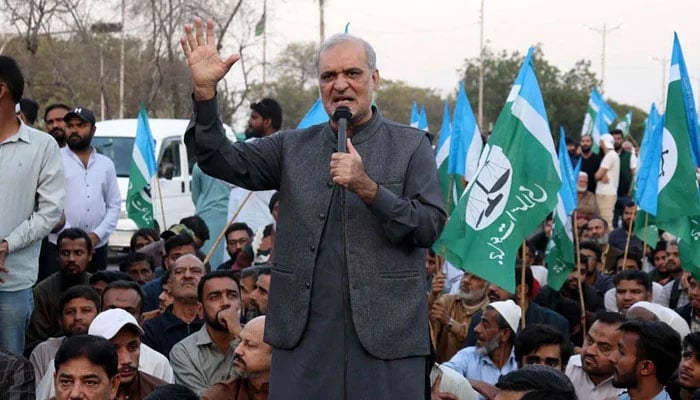
Jamaat-e-Islami chief Hafiz Naeemur Rehman has announced a nationwide strike on September 3, saying he will visit different cities to persuade traders to join the party’s ongoing protest movement.

Addressing a press conference in Lahore, Hafiz Naeem said the party would hold a major public gathering in Faisalabad on Friday, followed by another gathering in Lahore and then Peshawar. He said he would also meet industrialists and traders in Faisalabad to discuss their concerns and encourage them to participate in the movement.

He announced that sit-ins would also begin in Quetta from the following day.

Hafiz Naeem said the protests and sit-ins would continue until the government accepted the party’s demands. He added that consultations were under way over a possible call for a march towards Islamabad.

The Jamaat chief said the party was not yet formally announcing a wheel-jam strike, but expressed the view that the September 3 strike could eventually turn into a complete shutdown.

He strongly criticised prolonged power outages across the country and questioned who would be held responsible for the situation. He said ending load-shedding was among the key demands of the protest movement.

He also demanded the withdrawal of fixed charges imposed on electricity bills and called for the immediate termination of agreements with independent power producers.

Hafiz Naeem accused the government of burdening citizens with rising fuel and electricity costs. He said gas shortages had also reached alarming levels, despite consumers paying high prices for the commodity.

Criticising the government’s taxation policies, he alleged that authorities were focused on collecting taxes while businesses were being pushed towards closure. He accused government officials of enjoying expensive facilities at the expense of ordinary citizens.

The Jamaat chief warned that if the levy and so-called “bhatta tax” were not withdrawn, no one would be able to stop a mass public movement.

He further alleged that the government had been formed through what he described as a “Form 47” mandate and claimed that the party’s protests had exposed irregularities involving diesel pricing.

According to Hafiz Naeem, additional refinery charges were being imposed on locally produced diesel, further increasing the burden on consumers and businesses.

He also raised questions over the deaths of 14 children in the fire at Pakistan Institute of Medical Sciences (PIMS), demanding accountability over the incident and criticising the hospital’s administration.

The Jamaat chief also accused the country’s three major political parties of engaging in what he described as a political “noora kushti”, alleging that they were creating the appearance of confrontation while avoiding substantive action.

Hafiz Naeem said Jamaat-e-Islami would continue its campaign until its demands were addressed and urged traders, industrialists and citizens to join the protest movement.

Similar Posts

  • |

    Pakistan fiscal deficit falls to 22-year low

    ISLAMABAD: Pakistan’s fiscal position improved significantly during the fiscal year 2025-26, with the federal Ministry of Finance reporting that the country’s fiscal deficit fell to its lowest level in 22 years. According to a statement issued by the Ministry of Finance, the fiscal deficit stood at 2.6% of Gross Domestic Product (GDP) during FY2025-26. The government also recorded a primary surplus of 2.9% of GDP, marking its highest level in 26 years. Pakistan has now maintained a primary surplus for three consecutive years, reflecting an improvement in the government’s ability to cover its non-interest expenditures through its revenues. The ministry reported that total government revenues reached Rs19.8 trillion during the fiscal year. Tax revenues accounted for Rs14.8 trillion, highlighting the central role of improved revenue collection in strengthening the country’s fiscal position. Meanwhile, the government significantly reduced its interest-related expenditure. Interest payments declined to Rs6.95 trillion in FY2025-26 from Rs8.9 trillion in the previous fiscal year. The reduction helped ease pressure on the overall budget and contributed to the improvement in the fiscal balance. On the expenditure side, defence spending increased by 18% to Rs2.588 trillion during the year. The government, however, reduced spending on subsidies by 22%, bringing the amount down from around Rs1.3 trillion to Rs1.001 trillion. Development spending also declined during the fiscal year. According to the ministry, development expenditure fell from Rs786 billion to Rs727 billion. The latest figures indicate a notable improvement in Pakistan’s fiscal management, particularly through stronger revenue collection, a reduction in interest payments and tighter control over certain categories of expenditure. The government’s continued primary surplus also represents an important indicator of progress in efforts to stabilise public finances.

  • |

    Google’s $15bn India data centre faces green bac…

    VISAKHAPATNAM: Google’s ambitious $15 billion data centre investment in India is facing mounting resistance from environmental groups, residents and legal activists, turning what was expected to be a landmark technology project into one of the country’s most closely watched development disputes. The massive project, being developed in partnership with Indian billionaire Gautam Adani’s group, is under construction in Tarluvada near the coastal city of Visakhapatnam in Andhra Pradesh. Touted as Google’s largest-ever investment in India, the facility is expected to strengthen the company’s cloud computing and artificial intelligence infrastructure while generating an estimated 188,000 jobs. However, critics argue that the economic benefits could come at a significant environmental cost. Water concerns spark protests In recent weeks, environmental activists have intensified protests against the project, warning that the data centre could worsen water shortages in a city already struggling to meet daily demand. Demonstrators, including schoolchildren, have marched through Visakhapatnam carrying banners reading “We Cannot Drink DATA”, while others painted handcuffs over Google’s logo to symbolise what they describe as the environmental consequences of unchecked technological expansion. At a public awareness gathering attended by local campaigners, members of the environmental organisation Green Visakha outlined plans for neighbourhood campaigns and beach demonstrations aimed at increasing public awareness. Raja Rama Mohan Roy, founder of Green Visakha, argued that development should never come at the expense of local communities. “Development should not be at the cost of the livelihood of the people,” Roy said, pointing to government figures showing that Visakhapatnam currently receives around 410 million litres of water daily, despite requiring approximately 480 million litres. Water rationing has become a regular feature of life for the city’s 2.5 million residents, raising concerns about future demand. Legal battle gains momentum Opposition to the project has now reached the courts. India’s Andhra Pradesh High Court this week directed the state government to respond to allegations raised by environmental group Jal Biradari (Water Community), which claims the project could place additional pressure on regional water resources. The court is scheduled to hear the public interest litigation again on August 24. Meanwhile, three additional petitions have been filed before India’s National Green Tribunal by the Human Rights Forum. The petitioners argue that authorities approved the project without conducting sufficient environmental assessments regarding water usage and ecological impacts. Environmental groups are questioning the government’s reported commitment to provide guaranteed water supplies for the project over the next two decades while many residents continue experiencing periodic shortages. Wildlife under threat? Another major concern centres on the project’s location. According to campaigners, the construction site lies only about 860 metres from the Kambalakonda Wildlife Sanctuary, a protected forest known for its biodiversity and home to species including leopards, pangolins, spotted deer and numerous bird species. Activists fear continuous construction, heavy machinery and increased industrial activity could disturb wildlife through noise, habitat disruption and increased human presence. The Andhra Pradesh government, however, insists the development complies with all legal requirements and maintains that the sanctuary is located at a safe distance under existing regulations. Google also said it intends to minimise environmental impacts by installing sound-dampening technologies designed to reduce noise pollution around the facility. Government and Google defend project Despite growing criticism, Andhra Pradesh authorities continue to describe the project as transformational for the state’s economy. Officials rejected accusations that environmental clearances were rushed or that local drinking water resources would be diverted for industrial use. In a statement, the state government acknowledged citizens’ right to protest but said many claims circulating about the project were “incorrect and misleading.” It added that authorities remain willing to examine legitimate concerns and provide clarification where necessary. Google has similarly defended the project, stating that construction will comply fully with Indian environmental regulations. The company said it plans to use advanced air-cooling technology, significantly reducing dependence on water compared with conventional cooling systems used by many data centres. Google also stressed that sustainability remains a key part of its global operations and that the Visakhapatnam facility would be designed to protect local water resources while supporting India’s rapidly expanding digital economy. Global debate over data centres The controversy reflects a broader international debate over the environmental footprint of modern data centres. As demand for artificial intelligence, cloud computing and digital services continues to surge, technology companies worldwide are investing billions in new infrastructure. Yet these facilities often require enormous amounts of electricity and cooling, placing additional pressure on local water and power supplies. Similar concerns have emerged across the United States and Europe, where communities have challenged large-scale data centre developments over resource consumption, environmental sustainability and their impact on nearby residents. For Google, the Andhra Pradesh project represents a major strategic investment in one of its fastest-growing markets. But with legal challenges pending and public protests gathering momentum, the future of the project may depend not only on engineering and investment, but also on the company’s ability to convince local communities that technological progress can coexist with environmental protection.

  • | |

    Screwworm spreads in Mexico, raising alarm across …

    MEXICO CITY: A dangerous flesh-eating parasite known as the New World screwworm is spreading through parts of Mexico and Central America, with hundreds of human infections reported and growing concern over its potential impact on livestock and animal health. The parasite is the larval stage of a particular fly. Unlike ordinary flies, the female screwworm fly can lay eggs in open wounds or vulnerable areas of living animals and humans. The eggs can hatch within about a day, after which the larvae enter the wound and feed on living tissue. The infection, known as myiasis, can become severe if treatment is delayed. In serious cases, the larvae can damage muscles and even reach deeper tissues and bones. A study published in a medical journal linked to US health authorities examined 202 confirmed human cases recorded in Mexico between April 2025 and March 2026. Researchers found that reported infections increased sharply, rising from roughly three cases a week in 2025 to more than nine cases a week during 2026. More than half of the patients examined had infections involving their legs. Other cases affected the head, neck, nose, mouth and eyes, highlighting the parasite’s ability to invade different parts of the body through wounds or vulnerable tissue. The study reported six deaths among the patients examined, although researchers directly linked only one of those deaths to screwworm infection. The average age of patients was about 61, while 72 per cent were men. Researchers also found that 77 per cent of those infected had at least one pre-existing medical condition, potentially increasing their vulnerability to complications. The parasite is considered particularly dangerous for livestock because its larvae feed on living tissue. Untreated infections can cause serious wounds, weaken animals and, in severe cases, prove fatal. The resurgence has also raised concerns in the United States. The country had previously eliminated the New World screwworm after decades of control efforts, achieving eradication in 1966. However, the parasite returned to the spotlight after an infected calf was confirmed in Texas’s Zavala County in June 2026, according to international reports. The development has heightened fears that the parasite could spread further north, particularly through livestock movement and other routes. Health and agricultural authorities face the difficult task of controlling the parasite while detecting infections early. For people, experts generally stress the importance of seeking medical attention for unusual or worsening wounds, particularly after exposure in areas where screwworm is circulating. The outbreak serves as a reminder that a tiny insect can create a major public-health and agricultural challenge when conditions allow a dangerous parasite to spread.

  • | |

    Shaboozey shares rare insight into friendship with…

    Shaboozey has opened up about his lasting friendship with Beyoncé, revealing that their relationship has continued to grow since they worked together on her Grammy-winning album Cowboy Carter. The 31-year-old country singer and rapper recently spoke with GQ about his music, style and creative journey. During the conversation, he reflected on his connection with Beyoncé and explained that their collaboration eventually developed into a genuine friendship. Shaboozey was featured on two songs from Cowboy Carter: “SPAGHETTII” and “SWEET ★ HONEY ★ BUCKIIN’.” The project became a major moment in his career and helped introduce his genre-blending sound to an even wider audience. (GQ⁠) Shaboozey calls Beyoncé a good friend Speaking about their relationship, Shaboozey said he now considers Beyoncé “a really good friend.” He explained that they have stayed in contact since working together and that the superstar continues to show support for his career. According to Shaboozey, Beyoncé regularly congratulates him on his achievements and celebrates his successes. He described that kind of encouragement as something artists need, especially while navigating the music industry. The singer also praised Beyoncé for being someone who consistently celebrates other people. For Shaboozey, her support has made their relationship meaningful beyond their professional collaboration. (People.com⁠) Their collaboration changed his career Working with Beyoncé was already a major opportunity for Shaboozey, but the experience also gave him valuable creative freedom. When he first heard the songs, Shaboozey recalled wondering what Beyoncé wanted from him. However, he was encouraged to approach the music in his own way rather than trying to imitate her style. That freedom allowed him to bring his distinctive country and hip-hop influences to the project. He has previously explained that one of his biggest artistic goals is connecting different cultures and genres through his music. (GQ⁠) The collaboration also showed how naturally his sound could fit alongside Beyoncé’s genre-bending vision. Cowboy Carter explored country, hip-hop, R&B, blues and other musical influences while challenging traditional ideas about genre. A friendship that continues For Shaboozey, the relationship with Beyoncé did not end when the album was released. Her continued encouragement has remained an important part of their connection. As Shaboozey moves forward with his own music, including his new concept album The Outlaw Cherie Lee & Other Western Tales, he appears focused on building an identity that goes beyond a single hit or collaboration. His friendship with Beyoncé is another reminder of the lasting impact that meaningful creative partnerships can have. What began with two songs on Cowboy Carter has developed into a supportive personal connection that Shaboozey clearly values.

  • Kallar Syedan women hold March against inflation and petrol levy

    Kallar Syedan – On the call of Ameer Jamaat-e-Islami Pakistan, Hafiz Naeem ur Rehman, just like across the entire country, the Jamaat-e-Islami Kallar Syedan Women’s Wing also held a march today for the elimination of inflation, unjust taxes on petrol, and the cruel levy. The march started from the Jamaat-e-Islami Kallar Syedan officec and concluded at the NADRA office. Women from across the area participated in large numbers along with their children. The participants were holding placards bearing slogans such as “Reduce Inflation” and “Let the People Live”. Besides this, the women also raised strong slogans against the government. The march was addressed by Qari Qasim-ul-Haq, General Secretary Jamaat-e-Islami Kallar Syedan, Javed Iqbal, Naib Ameer Jamaat-e-Islami Kallar Syedan, and Shahida Javed, Nazima Jamaat-e-Islami Women’s Wing Kallar Syedan. At the conclusion of the march, the speakers said that tomorrow, 7th August, on the instructions of the Ameer-e-Jamaat, we will come out for a massive protest. By blocking the Motorway at 26 Number Chungi, we will compel the government to end its cruel measures and abolish the petroleum levy, and we will secure the rights of the people. Therefore, they appealed to all the people of Kallar Syedan to join this protest. The caravan from Kallar Syedan will depart tomorrow after Friday prayers at 3 PM from the Jamaat-e-Islami Kallar Syedan office.

  • |

    Italy faces growing childhood obesity crisis as diets change

    Italy is confronting a growing childhood obesity problem as traditional Mediterranean eating habits are increasingly replaced by calorie-heavy and highly processed foods. The issue is particularly serious in southern Italy. In parts of the Campania region, more than 40% of children aged eight and nine are reported to be overweight. Naples and surrounding communities have become major areas of concern for health professionals. Doctors say they are seeing increasingly younger patients with severe obesity. At a hospital in Naples, specialists who once mainly treated adults are now treating teenagers with serious weight-related problems. In severe cases, patients may require bariatric surgery to reduce the size of the stomach. However, doctors say some teenagers are now arriving at weights that make such procedures too risky. Some are first given medical treatment to help control appetite and lose enough weight to undergo surgery safely. Health experts point to major changes in Italian eating habits as one factor behind the trend. The traditional Mediterranean diet, built around vegetables, legumes, whole grains, olive oil and fish, is becoming less common. Instead, children are increasingly exposed to processed snacks, sugary drinks, refined carbohydrates and calorie-dense foods. Experts say the problem is not necessarily one particular meal but the cumulative effect of frequent snacking and poor diet quality. Doctors also say many parents struggle to recognise when their children are overweight. In some communities, a heavier child may traditionally be viewed as healthy or well-fed, making it harder for families to identify a potential health problem early. Physical activity can also be difficult for some children. Many schools operate in historic buildings that were not designed to provide adequate space for modern sports and exercise. Authorities are now attempting to address the problem through schools and community programmes. A regional initiative in Campania plans to involve more than 17,000 students across 25 schools in nutrition education and healthy lifestyle programmes, with families also receiving guidance. Italy has also taken a broader approach to obesity. In 2025, it became the first country to introduce a national law recognising obesity as a chronic, progressive and relapsing disease. Campania is also being used to test new approaches, including a controlled “fast-mimicking” diet for overweight adolescents. Researchers hope the programme could improve metabolic health, although some paediatric specialists have raised concerns about the limited evidence and possible psychological effects of restrictive diets on young people. Health experts stress that tackling childhood obesity will require more than simply telling children to eat less or exercise more. Families, schools, healthcare providers and policymakers all have a role in changing the environment around young people.

Leave a Reply

Your email address will not be published. Required fields are marked *