karachirohri rail track
| |

Karachi-Rohri rail track construction to begin nex…

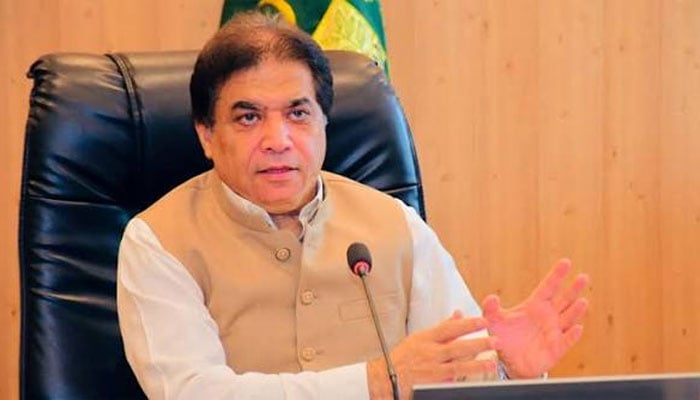
Federal Minister for Railways Hanif Abbasi has said construction of a 480-kilometre railway track from Karachi to Rohri will begin next year.

He made the remarks during a meeting with Sindh Governor Nihal Hashmi, where Federal Petroleum Minister Ali Pervaiz Malik, Minister of State Kheial Das Kohistani, Fahad Haroon and other officials were also present.

During the meeting, Abbasi said Pakistan Railways would soon begin transporting fuel, automobiles, minerals and liquefied petroleum gas (LPG) through its network.

He said around 11,000 tonnes of coal was currently being transported from Thar to the national grid every day.

Abbasi also remarked that only two or three countries could be considered Pakistan’s enemies.

The Sindh governor praised the government for ensuring uninterrupted supplies of petroleum products despite the ongoing challenges.

Hashmi particularly appreciated the measures taken by Petroleum Minister Ali Pervaiz Malik to maintain the supply of fuel across the country.

Ali Pervaiz Malik said stakeholders had extended full cooperation to ensure the uninterrupted availability of petroleum products.

The meeting also discussed measures to strengthen transportation and logistics infrastructure and improve coordination between relevant federal and provincial authorities.

Similar Posts

  • |

    Northwestern province warns of glacial floods as Pakistan monsoon death toll rises to 107

    Authorities in Khyber Pakhtunkhwa province have issued urgent warnings regarding potential glacial lake outburst floods, urging residents and tourists to stay away from rivers, streams, and narrow mountain valleys. The disaster alert follows persistent heavy monsoon rains that have killed at least 107 people and injured 344 others across the country since late June, with the heaviest casualties reported in Khyber Pakhtunkhwa and Punjab due to flash floods, structural collapses, and electrocutions. The Provincial Disaster Management Authority has highlighted specific high-risk northern districts, including Upper and Lower Chitral, Upper Dir, Swat, Upper Kohistan, and Mansehra, where warm temperatures combined with intermittent rainfall are rapidly accelerating glacial melt. Local administrations have been instructed to monitor vulnerable zones closely, with officials advising the public to watch for sudden changes in river water colour or unusual mountain sounds that could signal an imminent surge.

  • | |

    IHC issues cause list with eight benches for next …

    The Islamabad High Court (IHC) Registrar’s Office has issued the cause list for the upcoming week. According to the cause list, eight benches will be available to hear cases during the week. These include six single benches and two division benches. The court has constituted two division benches to hear cases involving matters requiring consideration by two judges. The first division bench will comprise Justice Khadim Hussain Soomro and Justice Umair Majid Malik. The second division bench will consist of Justice Muhammad Asif and Justice Shah Rukh Arjumand. The cause list also includes six single benches. These benches will hear cases assigned to individual judges during the upcoming week. The six single benches will comprise Justice Sarfraz Dogar, Justice Khadim Hussain Soomro, Justice Muhammad Asif, Justice Ayaz Shaukat, Justice Umair Majid Malik and Justice Shah Rukh Arjumand. The Registrar’s Office has issued the schedule as part of the court’s regular judicial proceedings. Cases listed before the respective benches will be taken up according to the cause list. The cause list determines which cases are scheduled for hearing and which judges will hear them. Lawyers and litigants will appear before the relevant benches on the dates fixed by the court. The Islamabad High Court will continue hearing cases through the six single benches and two division benches during the coming week.

  • | |

    Pakistan Idol finale nears as Atif Aslam, Fawad Kh…

      The country’s biggest music competition, Pakistan Idol is rapidly moving toward its decisive stage, with the countdown to the grand finale officially underway. In a special appearance that has already generated excitement among music fans, internationally renowned pop singer Atif Aslam, actor and singer Fawad Khan, and legendary vocalist Ustad Rahat Fateh Ali Khan are set to appear together on Geo’s screen for the first time. Fans of the three celebrated artists are now eagerly preparing to watch the stars share the stage. As the competition reaches its final episode, anticipation is growing over which contestant will emerge as the new superstar of the country. With only a few days remaining before the final decision, excitement among viewers is reaching its peak. The winner of Pakistan Idol will not only receive the prestigious title but will also be rewarded with prizes worth millions of rupees. The opportunity is expected to be life-changing for the contestant who succeeds in winning the competition and earning the title of the next generation’s singing sensation. Pakistan Idol is broadcast first on Geo, making it one of the major platforms for discovering and showcasing emerging musical talent in Pakistan. Throughout its run, the show has presented a wide variety of musical performances and introduced audiences to different styles, traditions and cultural sounds. Its music has created such a strong impact that its popularity has also been noticed in neighboring countries. The programme has featured evergreen songs traditionally associated with weddings and celebrations, giving audiences an opportunity to enjoy familiar melodies in fresh and engaging presentations. Basant songs were also presented in new styles, generating considerable interest among viewers and adding a festive touch to the competition. One of the highlights of Pakistan Idol has been its celebration of Pakistan’s diverse musical heritage. Folk songs from all four provinces were performed by contestants, reviving memories of the country’s rich musical past and introducing younger audiences to traditional sounds. The show also embraced national occasions, with patriotic songs adding another dimension to its musical offerings during Independence Day celebrations. The judging panel has featured some of Pakistan’s most respected names in music and entertainment. Internationally acclaimed singer Ustad Rahat Fateh Ali Khan, actor and singer Fawad Khan, Bilal Maqsood and Zeb Bangash have served as judges, bringing their experience and expertise to the competition. The programme has also welcomed several prominent guest judges and performers, further increasing its appeal. Atif Aslam, widely regarded as one of the country’s most popular contemporary singers, appeared alongside other major names including the “Bhangra King” Abrar-ul-Haq, Asim Azhar and Fakhar-e-Alam. The show has also featured celebrated artists such as Arif Lohar, Sanam Marvi, Akhtar Chanal, Alamgir, Shazia Manzoor and Shafaat Ali, who contributed to the programme’s entertainment value and helped elevate its profile among viewers. Behind the success of Pakistan Idol is a large production team that has worked to bring the programme to audiences. Nadeem J, Badr Ikram and Tanveer Afridi, along with other members of the team, have played significant roles in making the programme successful. As the final episode approaches, viewers are eagerly waiting to discover who will claim the Pakistan Idol crown and become the newest star in Pakistan’s music industry.

  • | | |

    PM Shehbaz accuses India of backing terrorism, urg…

    ISLAMABAD: Prime Minister Shehbaz Sharif on Friday accused India of playing a direct role in terrorism inside Pakistan and urged Afghanistan’s interim government to prevent militant groups from using its territory to launch attacks across the border. Addressing participants at the Balochistan National Workshop, the prime minister said Pakistan had successfully eliminated terrorism by 2018, but claimed that violence later resurfaced as part of what he described as a “well-organized conspiracy.” “India’s role in terrorism inside Pakistan is evident,” Shehbaz said, adding that the country had paid an enormous price in the fight against militancy, with more than 90,000 Pakistanis losing their lives over the years. Referring to the recent killing of a session judge in Mastung, the prime minister described the incident as another reminder of the continuing terrorist threat facing the country. He stressed that defeating terrorism requires a united national response involving state institutions and the public. Shehbaz also called on Afghanistan’s interim authorities to ensure that Afghan soil is not used by militant groups to carry out attacks against Pakistan. While emphasizing the importance of good relations between the two neighboring countries, he expressed regret that the Afghan administration had failed to stop terrorist elements operating from its territory. The prime minister said Pakistan’s diplomatic efforts for regional peace had received international recognition, adding that the country’s recent achievements had unsettled its adversaries. He praised Field Marshal Syed Asim Munir and Deputy Prime Minister and Foreign Minister Ishaq Dar for their diplomatic initiatives aimed at strengthening Pakistan’s regional and international engagement. Turning to development, Shehbaz highlighted the strategic importance of Balochistan, describing it as Pakistan’s largest province by area and the smallest by population. He said the people of Balochistan had always played a vital role in strengthening the federation and assured them that their sacrifices would never be forgotten. He also announced that construction work on the dual carriageway linking Karachi and Chaman was progressing, calling it a major infrastructure project expected to improve connectivity and economic activity in the province. Discussing the National Finance Commission (NFC) Award, the prime minister said Punjab had made significant contributions for Balochistan while the other provinces had also extended full support. He pledged to correct past shortcomings and ensure every province receives its constitutional share of national resources. Responding to questions from workshop participants, Shehbaz said Pakistan’s future prosperity depends on the collective efforts of all four provinces, expressing confidence that the country is ready to embark on a new phase of national development while continuing its fight against terrorism.

  • | | |

    Pakistan rejects Indian claims, calls allegations …

    ISLAMABAD: Pakistan has rejected allegations by Indian Home Minister Amit Shah linking Islamabad to the arrest of alleged terror suspects in India, describing the accusations as part of a politically motivated campaign against Pakistan. Foreign Office spokesperson Tahir Hussain Andrabi said the allegations were baseless and appeared aimed at shifting attention away from India’s own internal security challenges. He accused New Delhi of using anti-Pakistan rhetoric for domestic political purposes. The remarks followed claims by Shah that Indian security agencies had detained more than 200 suspected militants allegedly connected to Pakistan during a nationwide crackdown across 14 states on August 12. Shah said the suspects were linked to what he described as the Shahzad Bhatti Network and alleged that the arrests had prevented planned attacks. Rejecting the claims, Andrabi said Pakistan had repeatedly faced accusations that he described as part of an ongoing campaign to portray Islamabad as responsible for security problems inside India. The spokesperson also levelled counter-allegations against New Delhi, accusing India of suppressing minorities and dissent at home while allegedly supporting terrorism and destabilising activities abroad. He maintained that such accusations could not divert international attention from what Pakistan considers India’s involvement in terrorism and subversive activities. Andrabi referred to Indian national Kulbhushan Jadhav, who was convicted by a Pakistani military court and remains in Pakistani custody, as evidence of Islamabad’s longstanding allegations of Indian involvement in activities against Pakistan. Pakistan called on the international community to reject what it termed unfounded allegations and to hold India accountable for what Islamabad describes as state-sponsored terrorism and destabilising activities in the region. Moreover, Pakistan has strongly rejected what it described as India’s attempt to reshape the history of the 2025 military confrontation through a recently produced documentary on “Operation Sindoor,” calling the production a highly dramatized and factually distorted portrayal of events. In a statement, Pakistan said the documentary relied on selectively edited interviews, emotional narration and cinematic reconstructions to present a version of the conflict designed primarily for domestic political consumption. It argued that the production failed to provide an objective account of the military engagements and instead sought to portray a disputed outcome as an unequivocal Indian victory. Pakistan also questioned the documentary’s chronology surrounding the Pahalgam incident of April 22, 2025. It said India had subsequently claimed that the alleged perpetrators of the incident were identified and eliminated on July 28, nearly three months after Operation Sindoor. Islamabad argued that this timeline raised questions about India’s assertion that the May 7 operation was specifically intended to punish those responsible for the Pahalgam attack. The statement further rejected India’s claim of “100 percent mission success,” maintaining that Pakistani forces had effectively responded to the Indian offensive during what Pakistan refers to as Marka-e-Haq. Islamabad claimed that eight Indian military aircraft were shot down during the confrontation and said Pakistan later launched Operation Bunyanum Marsoos, targeting military installations with precision-guided rockets and missiles, precision air-launched munitions, loitering munitions and artillery. Pakistan said the documentary itself contained admissions that undermined its portrayal of decisive Indian dominance. According to Islamabad, references by Indian military officials to Pakistani missile and drone activity, prolonged engagements along the Line of Control and the activation of Indian air-defence systems demonstrated that the confrontation involved significant military exchanges on both sides. The Pakistani statement also challenged New Delhi’s account of how hostilities ended. It noted that the documentary acknowledged communication between the two countries’ Directors General of Military Operations and an agreed cessation of military activity. Islamabad said this account was inconsistent with portraying the conclusion of the conflict as an unconditional Indian military victory, particularly given the role of international diplomatic engagement in facilitating the ceasefire. Pakistan further accused the documentary of presenting contradictory explanations for India’s approach to escalation. While the production reportedly emphasised surprise attacks, precision strikes and escalation dominance, it simultaneously portrayed India as deliberately restricting the scope of the conflict and offering Pakistan an opportunity to withdraw. Islamabad described the documentary as an attempt to create a politically convenient narrative rather than an impartial military assessment. It maintained that cinematic reconstructions and official claims could not alter the chronology of events, the military engagements or the losses suffered during the confrontation. Pakistan said it had no need to construct an alternative narrative around Marka-e-Haq, arguing that battlefield developments, diplomatic interactions and subsequent statements by Indian officials provided sufficient material for assessing the conflict. Reaffirming its stated commitment to regional peace and stability, Pakistan said its armed forces remained prepared to protect the country’s sovereignty and territorial integrity. It warned that any future military escalation would receive a strong response, while asserting that no subsequent narrative or media production could change the actual course of events on the battlefield.

  • Hospital and Airline Tycoon Dr Prasert Prasarttong-Osoth Dies at 93

    BANGKOK — Dr Prasert Prasarttong-Osoth, the visionary founder of Thailand’s largest private hospital network and the airline that put Koh Samui on the global tourism map, has passed away at the age of 93. Bangkok Airways, Thai Airways rise in world rankings Dr Prasert died on Tuesday after being treated for an unspecified condition for […]

Leave a Reply

Your email address will not be published. Required fields are marked *