ihc issues cause
| |

IHC issues cause list with eight benches for next …

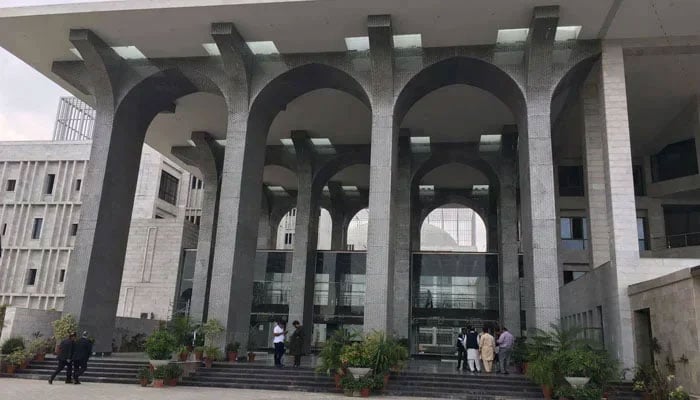
The Islamabad High Court (IHC) Registrar’s Office has issued the cause list for the upcoming week.

According to the cause list, eight benches will be available to hear cases during the week. These include six single benches and two division benches.

The court has constituted two division benches to hear cases involving matters requiring consideration by two judges.

The first division bench will comprise Justice Khadim Hussain Soomro and Justice Umair Majid Malik. The second division bench will consist of Justice Muhammad Asif and Justice Shah Rukh Arjumand.

The cause list also includes six single benches. These benches will hear cases assigned to individual judges during the upcoming week.

The six single benches will comprise Justice Sarfraz Dogar, Justice Khadim Hussain Soomro, Justice Muhammad Asif, Justice Ayaz Shaukat, Justice Umair Majid Malik and Justice Shah Rukh Arjumand.

The Registrar’s Office has issued the schedule as part of the court’s regular judicial proceedings. Cases listed before the respective benches will be taken up according to the cause list.

The cause list determines which cases are scheduled for hearing and which judges will hear them. Lawyers and litigants will appear before the relevant benches on the dates fixed by the court.

The Islamabad High Court will continue hearing cases through the six single benches and two division benches during the coming week.

Similar Posts

  • |

    Fakhar Zaman says one good PSL game is not enough for a call-up

    Pakistan opener Fakhar Zaman has weighed in on national team selections. He believes players should not be picked based on just one or two standout PSL performances. According to him, there is a significant gap between franchise cricket and the international game. The 35-year-old pointed out a growing trend. Several young players have made it into the national side after impressing in only a few PSL matches. He said that if a youngster is truly good enough to take his spot in the white-ball team, they should get that chance without hesitation. However, he added an important condition. Such players still need to prove their quality and consistency over time, not just deliver one strong performance. Fakhar also spoke about the gap between league and international cricket. He explained that many domestic performers only understand this difference once they step onto the international stage themselves. He suggested that regular development camps could help close this gap. At the same time, he cautioned against calling any player extraordinary after just one or two good PSL games. League cricket, he stressed, is simply not the same as international cricket. Turning to team matters, Fakhar revealed that batting order discussions have already taken place with the management. He was careful to note that not every detail from those conversations can be shared publicly. His personal approach, he said, has always been to prioritize what the team needs. He acknowledged that individual players naturally have their own preferences. Still, he pointed out that not everything can be aired through the media. What matters most, according to him, is that the entire squad stays united and aligned moving forward. Looking ahead, Fakhar also shared some thoughts on his history in South Africa. He said he has fond memories of playing there in the past. He credited the pace and bounce of South African pitches for suiting his natural batting style. He added that his current preparation is already focused on the 2027 World Cup. As selection debates continue to swirl around PSL performances, Fakhar’s comments offer a timely reminder. Consistency, not a single flash of brilliance, remains the real benchmark for making it at the international level, a point he seems keen on reinforcing as competition for spots heats up.

  • | |

    Family challenges post-mortem report of youth kill…

        The family of a young man who was killed in an alleged police encounter in the Kadhan area on the outskirts of Badin has raised serious objections to his post-mortem report, alleging that the report does not accurately reflect the condition of his body. The relatives of the deceased, identified as Moharram Dil, have declared the post-mortem report to be fake and demanded that his grave be exhumed so that a fresh post-mortem examination can be conducted. The family has called for an impartial investigation into the circumstances surrounding his death and the preparation of the medical report. Moharram Dil’s father said that there were no visible signs on his son’s body indicating that it had been cut open for a post-mortem examination. He said that when the body was being washed before burial, the family observed gunshot wounds but did not see any other marks that would suggest that a post-mortem had been performed. The father said that the family also possesses video recordings of his son’s body taken before the burial. According to him, these videos could provide important evidence regarding the condition of the body and may help determine whether the post-mortem examination described in the official report actually took place. The controversy has emerged over the timing and circumstances of the post-mortem report. Moharram Dil was reportedly killed in an alleged police encounter on July 26, while his post-mortem report was issued five days later, on July 31, by the Rural Health Centre. The family has questioned the circumstances under which the examination was conducted and how the report was prepared. Their demand for exhumation is aimed at obtaining a new medical examination that could independently establish the cause and circumstances of the young man’s death. Badin District Health Officer (DHO) has provided an explanation regarding who can conduct a post-mortem examination. According to the DHO, if a medico-legal officer is not available, the medical superintendent or a senior duty doctor can perform the post-mortem. The clarification comes amid questions raised by the family regarding the validity of the medical report. The authorities may now face pressure to determine whether the procedure was conducted according to the relevant medical and legal requirements. Police, meanwhile, maintain that Moharram Dil was a drug dealer who was killed during a police encounter on July 26. According to the police version, an exchange of fire took place between the police and the alleged drug dealer, during which Moharram Dil was killed. Police also claimed that two officers were injured during the encounter. The law enforcement authorities have presented the incident as an armed confrontation, while the deceased’s family has challenged the official account and raised doubts about the circumstances surrounding his death. The conflicting accounts have increased calls for an independent investigation. The family believes that a fresh post-mortem could help establish whether the injuries on the body correspond with the police account and whether the original medical report was prepared accurately. The demand for exhumation and a second post-mortem is now at the centre of the controversy. The videos reportedly recorded before the burial could also become relevant if an investigation is launched. The case has raised broader questions about transparency in alleged police encounters and the importance of properly documented medico-legal procedures. A fresh examination, if authorized, could provide additional evidence and help address the concerns raised by the deceased’s family.

  • |

    Russia-Ukraine war intensifies, 13 killed as Franc…

    KYIV: The Russia-Ukraine war has entered another dangerous phase as fresh attacks across both countries killed at least 13 people, while France moved to strengthen Ukraine’s air defences with additional missile interceptors. The latest violence came as Russian and Ukrainian forces continued exchanging long-range strikes, with civilian areas once again bearing much of the cost. Seven people were reported killed in Ukraine, while four died in Russia and two others were reportedly killed in Russian-occupied Crimea. In the Ukrainian city of Kryvyi Rih, emergency workers continued searching through the wreckage of a shopping centre damaged in a Russian drone strike a day earlier. That attack reportedly killed 16 people and left dozens injured, adding to growing concerns over the safety of civilians as aerial attacks intensify. The escalating strikes have also renewed pressure on Ukraine’s allies to provide stronger air-defence systems. French President Emmanuel Macron has pledged to accelerate the delivery of French interceptor missiles to Ukraine following discussions with Ukrainian President Volodymyr Zelensky. Macron has stressed that Ukraine needs the necessary means to protect its airspace and defend its population against Russian attacks. Ukraine has faced particular difficulty countering Russian ballistic missiles, which can reach targets within minutes and are considerably harder to intercept than many drones and cruise missiles. Kyiv has repeatedly appealed to Western allies for additional air-defence systems, especially Patriot interceptors. Recent Russian attacks have demonstrated the scale of the challenge. A major August assault on Kyiv and surrounding areas killed at least 16 people and damaged residential buildings, a school and a children’s medical facility, according to Ukrainian officials. The violence has been accompanied by Ukrainian drone strikes inside Russia. Russian officials said a Ukrainian drone attack in the southern city of Yeysk struck a residential property, killing two children and injuring their parents. With attacks intensifying, diplomatic efforts to end the war remain stalled. Several rounds of US-backed discussions have failed to produce a lasting breakthrough, leaving the prospect of a ceasefire uncertain. France and Britain are also preparing to bring allied countries together for further discussions on strengthening Ukraine’s defences and increasing pressure on Moscow. For civilians on both sides, however, the latest escalation is a grim reminder that despite diplomatic efforts, the war continues to expand its human toll. As missiles and drones cross borders, the immediate priority remains protecting people caught in the path of an increasingly intense conflict.

  • | | |

    Suicide blast outside Swat police station injures …

    A suspected suicide bomber detonated explosives outside the Kabal Police Station in Swat district on Sunday after reportedly failing to enter the premises, leaving several police personnel and civilians injured. According to senior police officials, the attacker tried to force his way into the police station but was intercepted by an alert police officer at the main entrance. Unable to gain access, the suspect blew himself up near the station’s gate, triggering a powerful explosion. Authorities said the police station is located close to the police lines and several other sensitive government installations, raising concerns that the attacker may have intended to target security facilities. Officials credited the swift response of police personnel with preventing the bomber from reaching the compound, which likely averted greater casualties and damage. Initial reports indicated that at least four police officers sustained serious injuries in the blast, while two civilians were also hurt. However, rescue officials later confirmed that more than 15 injured people had been transported to different hospitals for medical treatment, suggesting the number of casualties could rise as rescue efforts continued. Emergency response teams rushed to the scene immediately after the explosion, providing first aid to the injured and shifting them to nearby healthcare facilities. Security forces cordoned off the area, launched a search operation, and began collecting evidence to determine the nature of the attack and identify those behind it. Police officials also clarified that a protest by local youths was taking place in the wider area at the time of the incident, but the demonstration was located some distance from the blast site and was not directly affected.

  • Advance Voting Underway in Thailand for 2 Million Voters

    BANGKOK – Advance voting for Thailand’s general election opened on Sunday, with over 2.4 million registered voters casting their ballots a week ahead of the official polling day on February 8. Thailand Sets General Election for February 8, 2026 According to the Election Commission (EC), 2.41 million people signed up for early voting, including 2.26 […]

  • | |

    Khuzdar triple murder rocks Balochistan Assembly

    The alleged murder of a young woman’s fiancé, uncle and father in Balochistan’s Khuzdar district over a marriage dispute echoed in the Balochistan Assembly, where lawmakers demanded the immediate arrest of the main suspect. During the assembly session chaired by Speaker Abdul Khaliq Achakzai, Provincial Minister Ali Madad Jatak informed the house that the suspect allegedly killed the woman’s fiancé after his marriage proposal was rejected. He said the victim’s uncle was also murdered, while the woman was allegedly abducted before being recovered by police. According to the minister, the woman’s father was later shot dead after her video statement highlighting security threats surfaced on social media. Jatak told the assembly that despite two days having passed since the father’s killing, a first information report (FIR) had not yet been registered. He expressed concern over the delay in legal proceedings and called for immediate action against the accused. Opposition Leader Younis Zehri warned that if the suspect was not arrested, the provincial chief minister and the home minister would be held responsible. In protest over the lack of progress, both Zehri and Provincial Minister Ali Madad Jatak staged a walkout from the assembly. Member of the Provincial Assembly Maulana Hidayatur Rehman also voiced serious concern over the incident and demanded the resignation of the provincial home minister. He claimed that those responsible for the crime were widely known and criticised the prevailing law and order situation in the province. Responding to the criticism, Home Minister Zia Langove assured lawmakers that the government was in contact with the affected family and that police had been directed to arrest the suspect without delay. The speaker instructed the Inspector General of Police, the Deputy Inspector General and the Khuzdar district police chief to ensure the suspect’s arrest within two days. He also sought daily progress reports on the investigation before adjourning the assembly session until August 28.

Leave a Reply

Your email address will not be published. Required fields are marked *