vietnam macau shanghai
|

Vietnam, Macau, Shanghai: More flight options are coming for your next trip

MANILA, Philippines – Travelers planning their next overseas getaway will soon have more options, with Vietjet, Air Macau, and Juneyao Airlines adding or restoring flights from the Philippines to destinations across Vietnam, Macau, and China.

Vietnamese budget carrier Vietjet is mounting the biggest expansion, with three new Philippine routes starting November 10: Ho Chi Minh City-Clark, Ho Chi Minh City-Cebu, and Hanoi-Cebu. Each route will operate three round-trip flights a week.

Vietjet is Vietnam’s largest private airline and follows a low-cost model. The airline already flies between Manila and Ho Chi Minh City, so the November launch marks an expansion of its Philippine network. (READ: Ho Chi Minh City and Hoi An: What you need to know on your Vietnam vacation)

For travelers already eyeing Vietnam, Vietjet is also dangling promotional fares for its Clark launch, with one-way Eco tickets starting at $75 inclusive of taxes and fees for travel until March 31, 2027, subject to blackout periods.

Manila-Macau daily flights

Meanwhile, Air Macau is scheduled to increase the service of its daily flights to Manila beginning September 2. 

The Macau flag carrier initially returned with five flights a week using Airbus A320 aircraft, resuming its Manila-Macau service on July 2 after suspending the route in 2024.

The expansion of Air Macau’s flights gives travelers another option for a quick Macau trip alongside Cebu Pacific and Philippines AirAsia, which also operate nonstop flights between Manila and Macau.

Manila-Shanghai flights

Another new choice is coming for travelers bound for mainland China. Shanghai-based Juneyao Airlines is preparing to launch direct flights between Shanghai and Manila. The carrier is already promoting the new Manila service on its official website.

Juneyao will join Philippine Airlines, Cebu Pacific, and China Eastern on the Manila-Shanghai route. – Rappler.com


Similar Posts

  • | | |

    Rising energy costs expand trade deficit

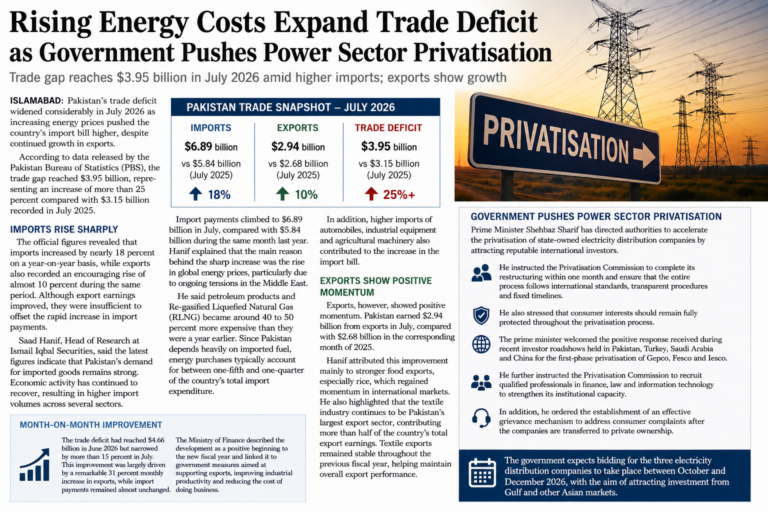
      Pakistan’s trade deficit widened considerably in July 2026 as increasing energy prices pushed the country’s import bill higher, despite continued growth in exports. According to data released by the Pakistan Bureau of Statistics (PBS), the trade gap reached $3.95 billion, representing an increase of more than 25 percent compared with $3.15 billion recorded in July 2025. The official figures revealed that imports increased by nearly 18 percent on a year-on-year basis, while exports also recorded an encouraging rise of almost 10 percent during the same period. Although export earnings improved, they were insufficient to offset the rapid increase in import payments. Saad Hanif, Head of Research at Ismail Iqbal Securities, said the latest figures indicate that Pakistan’s demand for imported goods remains strong. According to him, economic activity has continued to recover, resulting in higher import volumes across several sectors. He noted that the country’s reliance on imported products has remained significant despite efforts to improve the trade balance. Import payments climbed to $6.89 billion in July, compared with $5.84 billion during the same month last year. Hanif explained that the main reason behind the sharp increase was the rise in global energy prices, particularly due to ongoing tensions in the Middle East. He said petroleum products and Re-gasified Liquefied Natural Gas (RLNG) became around 40 to 50 percent more expensive than they were a year earlier. Since Pakistan depends heavily on imported fuel, energy purchases typically account for between one-fifth and one-quarter of the country’s total import expenditure. In addition, higher imports of automobiles, industrial equipment and agricultural machinery also contributed to the increase in the import bill. Exports, however, showed positive momentum. Pakistan earned $2.94 billion from exports in July, compared with $2.68 billion in the corresponding month of 2025. Hanif attributed this improvement mainly to stronger food exports, especially rice, which regained momentum in international markets. He also highlighted that the textile industry continues to be Pakistan’s largest export sector, contributing more than half of the country’s total export earnings. Textile exports remained stable throughout the previous fiscal year, helping maintain overall export performance. When compared with the previous month, Pakistan’s trade position showed some improvement. The trade deficit had reached $4.66 billion in June 2026 but narrowed by more than 15 percent in July. This improvement was largely driven by a remarkable 31 percent monthly increase in exports, one of the strongest monthly gains recorded in recent years, while import payments remained almost unchanged. The Ministry of Finance described the development as a positive beginning to the new fiscal year and linked it to government measures aimed at supporting exports, improving industrial productivity and reducing the cost of doing business. Meanwhile, Prime Minister Shehbaz Sharif has directed authorities to accelerate the privatisation of state-owned electricity distribution companies by attracting reputable international investors. During a review meeting in Islamabad, he instructed the Privatisation Commission to complete its restructuring within one month and ensure that the entire process follows international standards, transparent procedures and fixed timelines. He also stressed that consumer interests should remain fully protected throughout the privatisation process. The prime minister welcomed the positive response received during recent investor roadshows held in Pakistan, Turkey, Saudi Arabia and China for the first-phase privatisation of Gepco, Fesco and Iesco. He further instructed the Privatisation Commission to recruit qualified professionals in finance, law and information technology to strengthen its institutional capacity. In addition, he ordered the establishment of an effective grievance mechanism to address consumer complaints after the companies are transferred to private ownership. The government expects bidding for the three electricity distribution companies to take place between October and December 2026, with the aim of attracting investment from Gulf and other Asian markets.

  • | |

    Expensive sugar export decision raises concerns

      Lahore: The federal Ministry of Industries and Production has reportedly allowed the export of sugar that was imported at a higher cost, raising concerns over potential losses to the national exchequer. Sources within the ministry said the government has yet to approve the export of around 250,000 tonnes of locally produced sugar, which is available at a comparatively lower cost. Instead, authorities have decided to permit the export of only 100,000 tonnes, a move that industry sources have described as disappointing. According to the sources, the decision could create further difficulties for the sugar industry and affect the procurement of sugarcane from farmers. Sugar mill owners have already warned the Ministry of Industries and Production that they may face difficulties purchasing the upcoming sugarcane crop under the current circumstances. The sources expressed concern that allowing the export of expensive imported sugar while holding back cheaper locally produced stocks could increase financial pressure on the country. They also questioned the rationale behind exporting only 100,000 tonnes when a significantly larger quantity of locally produced sugar remains available. Sugar industry stakeholders have warned that the situation could affect the entire supply chain, particularly farmers who depend on sugar mills for the purchase of their sugarcane crop. If mills struggle to sell their existing stocks or face financial constraints, they may find it difficult to make timely purchases from growers. The development has also raised questions about the government’s sugar management policy, particularly its approach to balancing domestic availability, imports, exports and the interests of farmers and millers. Industry representatives are now seeking a clearer policy to prevent disruptions in sugarcane procurement and avoid further losses to the national economy.

Leave a Reply

Your email address will not be published. Required fields are marked *