
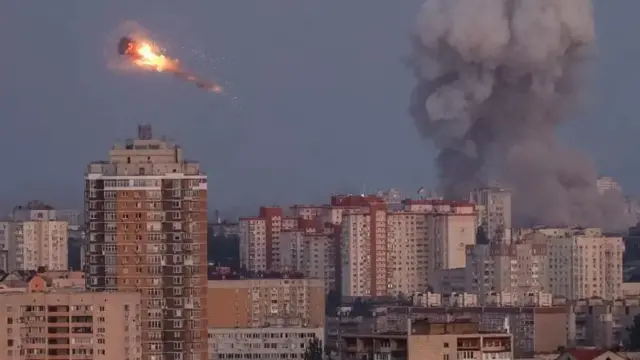
overnight missile barrage
| |

Overnight missile barrage on Kyiv region kills 17,…

Russia launched a large scale missile assault on Kyiv and the surrounding region on Wednesday, killing at least 17 people and leveling warehouses belonging to major retail chains, according to Ukrainian officials, as Kyiv’s dwindling stock of air defence interceptors leaves the capital increasingly exposed.

Explosions tore through the region overnight, lighting up the sky above the Ukrainian capital, which has faced missile attacks roughly every three to four days in recent weeks as Moscow has ramped up its aerial campaign. President Volodymyr Zelenskiy said on Telegram that ballistic missile interceptors could have prevented the deaths recorded on Wednesday, calling on Ukraine’s international partners to replenish the country’s interceptor stocks. He said shipments of air defence missiles have arrived at only a third of the pace seen in 2025.

Ukraine’s air force said its defences shot down close to 90 percent of the 115 drones Russia launched but failed to stop any of the 24 ballistic missiles or four Zircon cruise missiles fired during the same assault. Russia’s Defence Ministry said its forces struck seven logistics centres in Kyiv and the wider region, claiming the sites were used to store or move dual use goods and drone components.

Ukraine has struggled for months with a shortage of interceptor missiles for its US supplied Patriot systems, currently the only weapon in its arsenal able to shoot down Russian ballistic missiles traveling at many times the speed of sound. Since the outbreak of the Iran war in February, Patriot interceptors originally intended for Ukraine have instead gone to the US military and its Gulf allies. Russia has used the opening to intensify ballistic strikes on Kyiv and other Ukrainian cities even as its ground advances have slowed markedly this year.

Officials said the attack injured more than 40 people in addition to those killed. At a commuter rail station in the Kyiv suburb of Brovary, rescue workers found seven bodies scattered across the platform, with an eighth victim discovered nearby in nearby bushes. Volodymyr Bigun, head of the local administration in Brovary, said residents had missed their last train home when the strike hit, and confirmed eight deaths in the district so far. He said five logistics warehouses sustained damage there, including one belonging to food retailer Fozzy, and accused Russian forces of continuing to target civilian infrastructure. Both Russia and Ukraine have consistently denied targeting civilians throughout the war, which began with Russia’s full scale invasion in February 2022.

Ukraine has continued striking back at Russian territory as part of its own campaign, hitting a logistics hub belonging to Russian online retailer Wildberries in the Tula region overnight, adding to more than a dozen similar facilities Kyiv has damaged in recent operations.

Epicentr, Ukraine’s largest home improvement retail chain, said two major logistics facilities and a manufacturing plant were destroyed within minutes during Wednesday’s strikes, and that it was still working to determine the full extent of the damage. The company described the attack as a deliberate effort to undermine Ukrainian manufacturing, logistics, employment and the broader capacity to recover from the war. Food retailer Silpo said on social media that at least six of its employees died in the strikes and that two of its distribution centres caught fire. Iryna Chechotkina, co founder of the online retailer Rozetka, said she watched overnight as three ballistic missiles destroyed years of work, describing the experience as devastating while stressing that her company remains operational.

Ukraine’s economy has shown considerable resilience over more than four years of war, sustained in part by billions of dollars in financial support from Western governments, but business losses have mounted this year as strikes on commercial infrastructure have grown more frequent. The Kyiv regional military administration said Wednesday’s attack damaged 13 warehouses, a manufacturing facility, four private homes and dozens of vehicles. Prime Minister Sergii Koretskyi, who took office last month following a government reshuffle, said officials would hold an emergency meeting with business leaders to determine how to keep logistics and trade operations running smoothly.

Kyiv has renewed its request for additional PAC-3 interceptors, the newest generation of Patriot missile. Separately, the United States is continuing talks that would allow Ukraine to manufacture Patriot missiles domestically, according to four people familiar with the discussions, even after President Donald Trump expressed skepticism about such an arrangement.

Similar Posts

  • | | |

    Goods transporters begin indefinite strike across …

    The All Pakistan Goods Transporters Alliance has announced an indefinite strike across Pakistan from Saturday, August 8, in protest against rising fuel prices and additional financial burdens on the transport sector. Alliance President Malik Shehzad Awan confirmed the strike and said goods transporters would continue keeping their vehicles off the roads until further decisions were made. He said the federal government had invited representatives of the transport alliance to a meeting on Monday to discuss their concerns. Awan said a committee had been formed to represent the transporters during talks with government officials. He added that the strike would continue until the meeting was held and the alliance announced its next course of action. According to Awan, earlier negotiations between the transport alliance and government officials at the commissioner’s office had failed to resolve the dispute. Following the unsuccessful talks, the transporters decided to proceed with their planned indefinite strike. The alliance is protesting against higher petrol and diesel prices. It is also opposing the government’s decision to determine petroleum product prices on a daily basis. Another major demand concerns the seven percent withholding tax imposed on the transport sector. Transporters say rising fuel costs and additional taxes have increased their operating expenses and created serious financial difficulties for the industry. They have urged the government to review the current policies and provide relief to the transport sector. The transporters have warned that the strike could affect the movement of goods across the country if the dispute continues. Goods transporters play a major role in supplying food, industrial products, raw materials and other essential items to markets and businesses. A prolonged strike could therefore put pressure on supply chains and affect the availability and transportation of essential goods in different areas. The government’s scheduled meeting with the transport alliance on Monday is expected to determine the next course of action. Transport representatives will present their demands during the talks and seek a solution to the ongoing dispute.

  • |

    SBP chief reaffirms Islamic banking push

    State Bank of Pakistan (SBP) Governor Jameel Ahmad has reaffirmed the central bank’s commitment to implementing a fully Shariah-compliant financial system, saying the SBP continues to work closely with the government to achieve the country’s Islamic banking goals. Addressing a ceremony via video link, Ahmad said the central bank has introduced several measures to facilitate freelancers, helping them receive payments more easily through formal banking channels. He noted that these initiatives have contributed to an increase in workers’ remittances and strengthened the flow of foreign exchange into Pakistan. The SBP governor said the central bank has established a dedicated steering committee to oversee the transition toward Islamic banking. He added that the SBP is revising its regulatory and operational framework to ensure it fully complies with Shariah principles while supporting the financial sector’s gradual transformation. Ahmad recalled that Pakistan’s founder, Quaid-e-Azam Muhammad Ali Jinnah, had expressed the vision of an Islamic financial system during the inauguration of the State Bank in 1948. He said the government has adopted a roadmap to implement a complete Islamic banking system by December 2027, and the SBP remains committed to meeting that target in collaboration with relevant stakeholders. He also revealed that work is underway to develop a comprehensive asset register for government-owned assets, describing it as an important step in supporting Islamic finance initiatives. Stressing the importance of skilled professionals, Ahmad said expanding the capacity of the banking workforce will play a key role in ensuring the successful implementation of the Islamic banking system across the country.

  • Royally Donated Targeted Cancer Drug Delivered For Universal Healthcare Patients In Thailand

    BANGKOK, Thailand — The Chulabhorn Royal Academy (CRA) has completed the inaugural delivery of a royally bestowed targeted cancer medication to the National Health Security Office (NHSO), marking a historic milestone in Thailand’s public healthcare system. The delivery of Imcranib 100 paves the way for nationwide, equitable access to the life-saving treatment for patients enrolled […]

  • | |

    MQM-P groups resume talks after Bahadurabad clash

    Differences between two groups within the Muttahida Qaumi Movement-Pakistan (MQM-P) have led to renewed contacts and negotiations between the rival factions, according to party sources. The dispute reportedly surfaced after a party meeting at the MQM-P headquarters in Bahadurabad, Karachi. Tensions escalated during the incident, with members of one group allegedly engaging in a physical confrontation with MPA Ijazul Haq, party leader Zakir, and their supporters. MQM-P leader Aminul Haq claimed that members of the opposing group also resorted to intense aerial firing during the confrontation. He said one party worker sustained injuries in the firing, while several others were hurt as a result of stone-pelting. Following the escalation, senior leaders from both sides have started communicating with each other in an effort to ease tensions and resolve their differences through dialogue. Party sources said the two groups are currently holding discussions and exploring ways to settle the dispute. The sources added that the two factions may hold a joint press conference within the next 48 hours. During the press conference, the leadership is expected to outline the party’s future course of action and announce decisions aimed at addressing the internal differences. The developments come as the party seeks to prevent further escalation and restore unity among its ranks following the clash at the Bahadurabad headquarters.

  • | | | |

    President Masoud Pezeshkian meets Supreme Leader M…

    TEHRAN: Iranian President Masoud Pezeshkian has held an important meeting with Supreme Leader Ayatollah Mojtaba Khamenei as speculation over the president’s future continues to attract attention amid heightened tensions with the United States and Israel. The meeting reportedly came as Pezeshkian entered the third year of his presidency. It also followed reports suggesting that the Iranian president was considering stepping down, claims he has rejected. Iranian authorities have previously dismissed resignation reports as unfounded, while Pezeshkian has publicly indicated that he intends to continue serving. According to statements attributed to Mojtaba Khamenei on social media, the discussions covered a wide range of economic, military and strategic issues facing Iran. Among the topics were the economic needs of ordinary Iranians, the country’s military situation, access to resources and management of the Iranian rial, foreign currency and energy costs. The two leaders also discussed economic relations with foreign partners and the wider implications of the confrontation with Washington and Israel. The meeting comes at a particularly sensitive moment for Tehran. Iran remains under pressure from the continuing regional conflict and economic difficulties, while efforts to engage Washington have faced repeated obstacles. The reported contact is also notable because Pezeshkian recently said that reaching Mojtaba Khamenei had been difficult, prompting speculation about the supreme leader’s health and whereabouts. Reports in recent days have offered conflicting accounts about how and where senior Iranian officials have been able to meet him. Meanwhile, Iran’s diplomatic efforts with the United States remain uncertain. According to the material cited by Iranian officials, negotiations have been reduced largely to messages exchanged through intermediaries after earlier attempts failed to produce a lasting agreement. The political backdrop has also been complicated by reported tensions between the presidency and powerful military-security institutions. Some reports have suggested disagreements over decision-making and the conduct of Iran’s response to the conflict, although details remain contested. Pezeshkian’s political position has therefore become a subject of renewed attention. He was elected president in July 2024 following the death of former President Ebrahim Raisi in a helicopter crash. Mojtaba Khamenei, meanwhile, became Iran’s supreme leader in March 2026 following the death of his father, Ayatollah Ali Khamenei, during the conflict. Against this backdrop, the latest meeting between the president and supreme leader carries significance beyond routine government business, particularly as Iran confronts economic pressures, military uncertainty and difficult relations with Washington. For now, however, Pezeshkian remains in office, while reports of his resignation have been publicly rejected.

  • | | |

    PSX retreats as profit-taking, oil prices hit sent…

    The Pakistan Stock Exchange (PSX) came under pressure on Friday as investors opted to book profits after the market’s recent gains. The benchmark KSE-100 Index fell sharply during early trading, reflecting cautious investor sentiment amid rising global oil prices and uncertainty over developments surrounding the Strait of Hormuz. The index dropped 771.05 points, or 0.42%, to 181,005.54 by 9:39am. Selling was reported across several major sectors, putting pressure on the overall market. By noon, the KSE-100 had recovered some of its losses and was trading at 181,326.54 points, down 450.05 points, or 0.25%, from Thursday’s close of 181,776.59. During the session, the index moved between an intraday high of 181,647.27 and a low of 180,620.08 points. Trading activity remained moderate, with around 146.05 million shares changing hands. The total value of traded shares stood at approximately Rs10.06 billion. Selling was visible in several heavyweight sectors, including automobile assemblers, cement companies, commercial banks, fertiliser firms, oil and gas exploration companies and oil marketing companies. Market sentiment was also affected by the continued rise in international crude prices. Investors remained cautious over possible disruptions to energy supplies amid tensions surrounding the Strait of Hormuz. Analysts attributed the decline largely to profit-taking following the market’s recent strong performance. Investors appeared reluctant to make fresh aggressive positions while global oil prices and geopolitical risks remained elevated. Despite Friday’s decline, the KSE-100 remained above the 181,000-point level, indicating that the broader market continued to retain much of its recent gains.

Leave a Reply

Your email address will not be published. Required fields are marked *