punjab cnf seizes
| |

Punjab CNF seizes 24.7 tonnes of narcotics worth R…


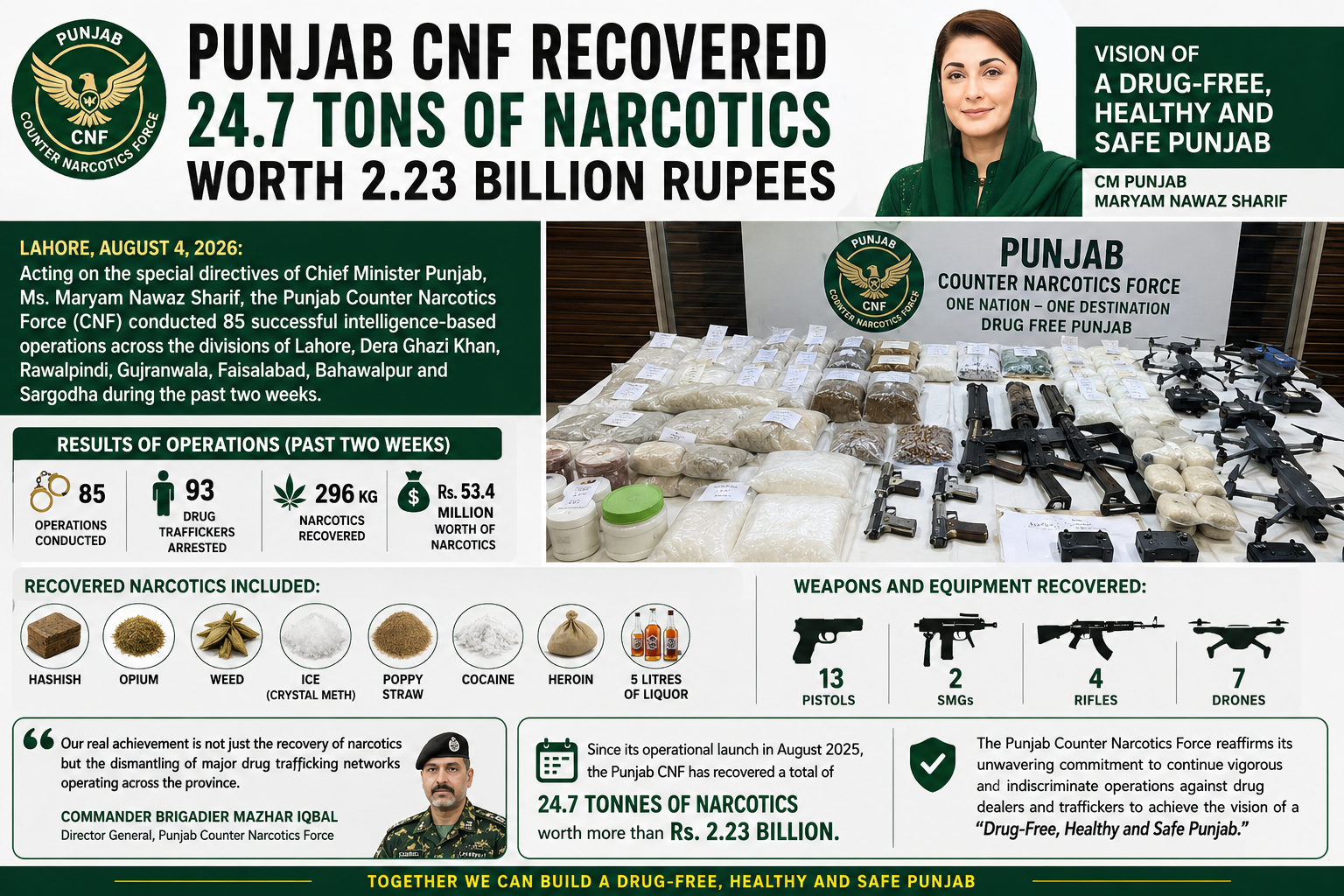
Lahore, August 4, 2026: The Punjab Counter Narcotics Force (CNF) has intensified its crackdown on drug trafficking across the province, achieving significant success in recent intelligence-led operations. The campaign is being carried out under the special directives of Punjab Chief Minister Maryam Nawaz Sharif as part of the government’s commitment to building a “Drug-Free, Healthy and Safe Punjab.”

Over the past two weeks, the CNF conducted 85 intelligence-based operations across the divisions of Lahore, Dera Ghazi Khan, Rawalpindi, Gujranwala, Faisalabad, Bahawalpur and Sargodha. These coordinated raids targeted major drug trafficking networks operating in different parts of the province.

The operations resulted in the arrest of 93 suspected drug traffickers, while authorities recovered approximately 296 kilograms of narcotics with an estimated market value of more than Rs. 53.4 million. Officials described the operations as a major step toward curbing the illegal drug trade and improving public safety.

The seized narcotics included a wide range of illegal substances such as hashish, opium, cannabis (weed), crystal meth (Ice), poppy straw, cocaine, heroin and five litres of illicit liquor. In addition to narcotics, the CNF recovered a significant cache of weapons from the suspects. These included 13 pistols, two sub-machine guns (SMGs), four rifles and seven drones that investigators believe were being used to facilitate criminal activities and drug distribution.

Director General of the Punjab Counter Narcotics Force, Commander Brigadier Mazhar Iqbal, said the Force’s success should not only be measured by the quantity of drugs confiscated but also by its ability to dismantle organised drug trafficking networks across Punjab. He noted that the CNF continues to rely on modern intelligence gathering, professional expertise and coordinated operational planning to identify and eliminate criminal groups involved in the narcotics trade.

He further highlighted the Force’s overall performance since it became operational in August 2025. According to the Director General, the Punjab CNF has recovered a cumulative 24.7 tonnes of narcotics valued at more than Rs. 2.23 billion. He described these achievements as evidence of the provincial government’s zero-tolerance policy against narcotics and the effectiveness of its law enforcement strategy.

Commander Brigadier Mazhar Iqbal also credited the Force’s progress to close coordination among various law enforcement agencies, which has strengthened efforts to combat drug trafficking and disrupt criminal organisations operating throughout the province.

Reaffirming the CNF’s commitment, the Director General said the Force will continue to launch vigorous and indiscriminate operations against drug dealers and traffickers. He stressed that intelligence-driven policing, enhanced operational capabilities and sustained enforcement efforts will remain central to achieving the government’s vision of a province free from the menace of narcotics.

Punjab authorities have reiterated that the fight against drugs remains a top priority, emphasizing that continued action against traffickers is essential to protecting communities, safeguarding young people and ensuring a healthier and safer future for the province.

Similar Posts

  • | |

    Pakistan lights up in grand Independence Day celeb…

    Pakistan marked its 79th Independence Day with spectacular celebrations, dazzling fireworks and a vibrant display of national spirit across major cities, including Islamabad, Lahore, Karachi, Peshawar and Quetta. The festivities reached a major highlight in Islamabad with the inauguration of the newly built Victory Monument. President, Prime Minister and Field Marshal attended the ceremony, where the national flag was hoisted in the presence of service chiefs, federal ministers and foreign diplomats. Across the country, streets, homes, markets and public buildings were illuminated with colourful lights and decorated with Pakistan’s green-and-white flags. Citizens joined the celebrations with patriotic enthusiasm, while national songs echoed through cities and communities. Karachi took on a festive appearance as residents decorated their neighbourhoods and public spaces. The special Azadi Safari train also travelled from Karachi to Chhor as part of the Independence Day celebrations. Lahore witnessed colourful decorations and lively festivities, while Islamabad was illuminated with spectacular displays. In Peshawar, Quetta and Multan, people also celebrated the national day with great enthusiasm. The Punjab government organised a special Independence Day ceremony featuring performances by renowned singers, adding music and entertainment to the celebrations. From fireworks lighting up the night sky to the widespread display of national flags and patriotic songs, Pakistan’s Independence Day brought citizens together in a nationwide expression of pride, unity and love for the country.

  • | |

    Ahsan Iqbal highlights importance of Artificial In…

    Federal Minister for Planning, Development, and Special Initiatives Ahsan Iqbal has stated that artificial intelligence (AI) is set to bring extraordinary changes across the world. He emphasized that Pakistan must prepare its youth for the future by providing them with modern education, digital skills, and technological resources, including laptops, to compete in the rapidly changing global environment. Addressing a ceremony at Islamia Degree College Narowal, Ahsan Iqbal said that equipping young people with digital skills has become an urgent necessity in today’s era. He stressed that technology is transforming economies, industries, and workplaces around the world, and nations that fail to adapt to these changes may fall behind in global competition. The federal minister highlighted that science and technology will play a decisive role in shaping the future economy. According to him, investment in scientific research, innovation, and technological development is essential for securing a prosperous future for the country. He stated that countries that focus on research and technological advancement are better positioned to achieve economic growth and development. Ahsan Iqbal said that the modern world is moving rapidly towards digital transformation, where artificial intelligence, automation, and emerging technologies are changing the way people work and communicate. He emphasized that Pakistan’s youth represent a valuable resource, and providing them with the right skills and opportunities can help them contribute significantly to national progress. He further stated that the government is committed to supporting young people by improving access to quality education, digital training programs, and technological facilities. He mentioned that initiatives such as providing laptops and promoting skill development programs are aimed at helping students gain knowledge and abilities required in the modern job market. The minister explained that digital skills are no longer limited to the technology sector but have become important in almost every field, including business, education, communication, healthcare, and industry. He encouraged students to learn new technologies and develop skills that can increase their employment opportunities and enable them to participate in the digital economy. Ahsan Iqbal also highlighted the importance of scientific research and innovation in achieving sustainable development. He said that investment in universities, research institutions, and technology-based projects can help Pakistan create solutions for future challenges and strengthen its position internationally. He stated that nations that successfully integrate technology into their education systems and economic structures will be the ones that succeed in the global arena. According to him, technological awareness and digital readiness are essential for young generations to take advantage of emerging opportunities. The minister urged students to focus on acquiring knowledge, improving their technical abilities, and using technology positively for personal and national development. He said that the youth must be prepared to meet future challenges and benefit from opportunities created by advancements in science and technology. Concluding his remarks, Ahsan Iqbal reiterated that artificial intelligence and digital transformation will shape the future of the world. He emphasized that Pakistan’s progress depends on empowering its young population with modern education, research opportunities, and digital skills. By investing in technology and human resources, the country can build a stronger economy and compete effectively at the international level.

  • |

    Turkish parliament passes landmark law to advance PKK peace process

    Turkey’s parliament passed a law on Monday establishing a legal framework for the disbandment of the outlawed Kurdistan Workers’ Party (PKK), marking a major step toward ending a decades-old conflict that has killed tens of thousands. The legislation provides legal protections for many former militants who have not committed specific crimes and facilitates the suspension of prison sentences for some people convicted of PKK membership, paving the way for their reintegration into society. The law was approved by a 468-vote majority in the 600-seat parliament after securing support from President Tayyip Erdogan’s ruling AK Party, its nationalist MHP allies, and the pro-Kurdish DEM Party. This measure represents the most concrete step taken by Ankara in the peace process since jailed PKK leader Abdullah Ocalan called on the group in February 2025 to disarm and disband. Following Ocalan’s call, the PKK announced in May 2025 that it would end its armed struggle, leading to a symbolic ceremony in northern Iraq two months later where a group of militants burned their weapons. The PKK launched its insurgency in 1984, leading to a conflict that has killed over 40,000 people, placed a heavy economic burden on southeast Turkey, and fuelled decades of political and social division. This new legislation specifically addresses the long-standing question of how to manage thousands of PKK members as the organisation dismantles its military and organizational structures. The current public peace initiative began in October 2024 when MHP leader Devlet Bahceli unexpectedly suggested that Ocalan could address parliament to announce the PKK’s dissolution. A parliamentary commission established in August 2025 subsequently heard testimony from politicians, officials, and civil society groups before recommending legislation to oversee disarmament and reintegration. While the law addresses reintegration, it does not by itself resolve broader Kurdish demands regarding expanded political and cultural rights, anti-terrorism amendments, or the detention status of Ocalan. The Turkish government frames the initiative as a pathway toward creating a “terror-free Turkey,” whereas Kurdish politicians emphasize that achieving lasting peace requires broader democratic and legal reforms.

  • |

    Indian activist Sonam Wangchuk ends 26-day hunger strike

    Indian environmentalist and social activist Sonam Wangchuk has ended his 26-day hunger strike after holding discussions over the ongoing nationwide protests against alleged examination paper leaks. However, demonstrations demanding the resignation of Education Minister Dharmendra Pradhan are continuing across India. Wangchuk announced his decision through a post on social media, saying he ended the fast after lengthy negotiations and concerns that the situation could lead to further violence. He said he would soon explain the conditions that led to his decision in a separate video message. The 59-year-old activist had been fasting since June 28 in support of a youth-led protest movement that accuses the government of failing to prevent repeated examination paper leaks. Protesters have demanded the resignation of the education minister after alleged leaks in medical college entrance examinations forced millions of students to retake the tests. Shortly before Wangchuk’s announcement, Prime Minister Narendra Modi addressed the nation and pledged stronger legal action against those responsible for examination fraud. He described the paper leak scandal as a serious issue affecting the future of hundreds of thousands of students and said the government would introduce tougher legislation to combat such crimes. Modi also announced plans to speed up court proceedings against those involved in examination fraud, adding that the issue would be discussed by the federal cabinet. While outlining the government’s response, he did not comment on demands for the education minister’s resignation. Despite Wangchuk ending his fast, thousands of protesters continue to gather at New Delhi’s Jantar Mantar and in several other cities. Demonstrators say they will maintain their peaceful campaign until the education minister steps down and comprehensive reforms are introduced to restore transparency and fairness in India’s examination system. The protests have become one of the biggest public challenges faced by Prime Minister Modi’s government since beginning its third term. Tensions have risen in recent days after clashes between police and protesters. Security forces used tear gas and batons to stop demonstrators attempting to march towards parliament, leading to widespread criticism from rights organisations over the handling of the protests.

  • |

    Kriti Sanon urges people to prioritise mental health

    Bollywood actress Kriti Sanon has opened up about the importance of mental and emotional well-being, urging people to pay as much attention to their minds as they do to their physical health. The National Award-winning actress reflected on how her experiences while working on films such as Mimi and Do Patti changed her perspective on acting and the emotional impact of portraying complex characters. According to Kriti, she once believed that the characters she played remained confined to the world of cinema and did not have any lasting effect on her personal life. However, her experiences with these two films made her realise that characters can leave an unconscious emotional impact on actors. Kriti explained that the effect of a demanding role does not always become apparent immediately. Sometimes, an actor may complete filming and only begin noticing emotional changes several days later. She said that a character can continue to influence a person’s mood, behaviour and thoughts even after the cameras stop rolling. The actress said this experience taught her the importance of consciously separating herself from the characters she portrays. While actors are expected to completely immerse themselves in their roles, Kriti believes that it is equally important to know when to step away from the emotional world created for a film. She also recalled times when she was personally dealing with difficult or emotionally challenging situations while having to continue working on a comedy project. Despite going through personal struggles, she still had to portray cheerful and entertaining characters in front of the camera. Kriti pointed out that actors repeatedly draw upon their own emotions while performing. They have to access different feelings and sometimes revisit difficult emotional spaces to make their performances believable. Because of this, she believes that maintaining good mental and emotional health should be an important part of an actor’s life. The actress encouraged people to find healthy ways of managing their emotions and maintaining mental balance. She suggested practices such as meditation, therapy and other activities that help individuals feel mentally grounded and emotionally stable. Kriti also shared that she personally turns to meditation from time to time and finds it beneficial. For her, taking a pause and reconnecting with herself helps maintain emotional balance, particularly after working on emotionally demanding projects. Her comments highlight a broader reality of the entertainment industry, where performers are often required to move between intense emotions and different personalities within a short period of time. While professional commitment is important, Kriti believes that taking care of one’s mental health should never be overlooked. Kriti Sanon was most recently seen alongside Shahid Kapoor and Rashmika Mandanna in Cocktail 2. The actress continues to remain one of Bollywood’s prominent performers, balancing commercially successful projects with roles that require emotional depth and versatility.

  • |

    US, Saudi Arabia sign major civil nuclear cooperation agreement

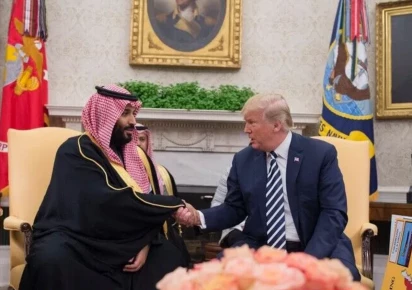
    The United States and Saudi Arabia have signed a major civil nuclear cooperation agreement, opening a new chapter in their strategic partnership and expanding cooperation in the peaceful use of nuclear energy. The agreement was signed by US Energy Secretary Chris Wright and Saudi Energy Minister Prince Abdulaziz bin Salman. Along with the civil nuclear cooperation pact, both countries also signed a bilateral safeguards agreement to ensure that nuclear technology is used only for peaceful and civilian purposes. The agreement establishes the legal framework for long-term cooperation in the civil nuclear sector. It is expected to support multi-billion-dollar investments, strengthen commercial ties, and create opportunities for collaboration on future nuclear energy projects. US officials said the partnership will allow American companies to participate in Saudi Arabia’s growing civil nuclear programme. The agreement is also expected to increase exports of US nuclear technology, equipment, and services while creating new employment opportunities and strengthening industrial supply chains in the United States. The two governments said the agreement reflects their shared commitment to expanding economic cooperation while maintaining the highest international standards for nuclear safety, security, and non-proliferation. Officials stressed that the partnership is designed to ensure that nuclear technology is used exclusively for peaceful purposes and remains under strict international safeguards. US Energy Secretary Chris Wright described the agreement as an important step toward strengthening relations between Washington and Riyadh. He said the partnership would promote economic growth, improve energy cooperation, and enhance security for both countries and their regional allies. He added that the agreement relies on advanced American nuclear technology and scientific expertise while fully complying with international nuclear safety and non-proliferation requirements. Officials also believe the agreement will strengthen the United States’ position in the global civil nuclear industry by expanding overseas markets for American technology and reinforcing its leadership in peaceful nuclear development. For Saudi Arabia, the agreement supports the country’s long-term energy strategy, which aims to diversify energy sources and reduce dependence on oil by developing a civilian nuclear power programme alongside renewable energy projects. The agreement will now be submitted to the US Congress for review before it can enter into force. Following congressional approval, both countries are expected to begin implementing the framework and advance cooperation on future civil nuclear projects.

Leave a Reply

Your email address will not be published. Required fields are marked *