punjab cnf seizes
| |

Punjab CNF seizes 24.7 tonnes of narcotics worth R…


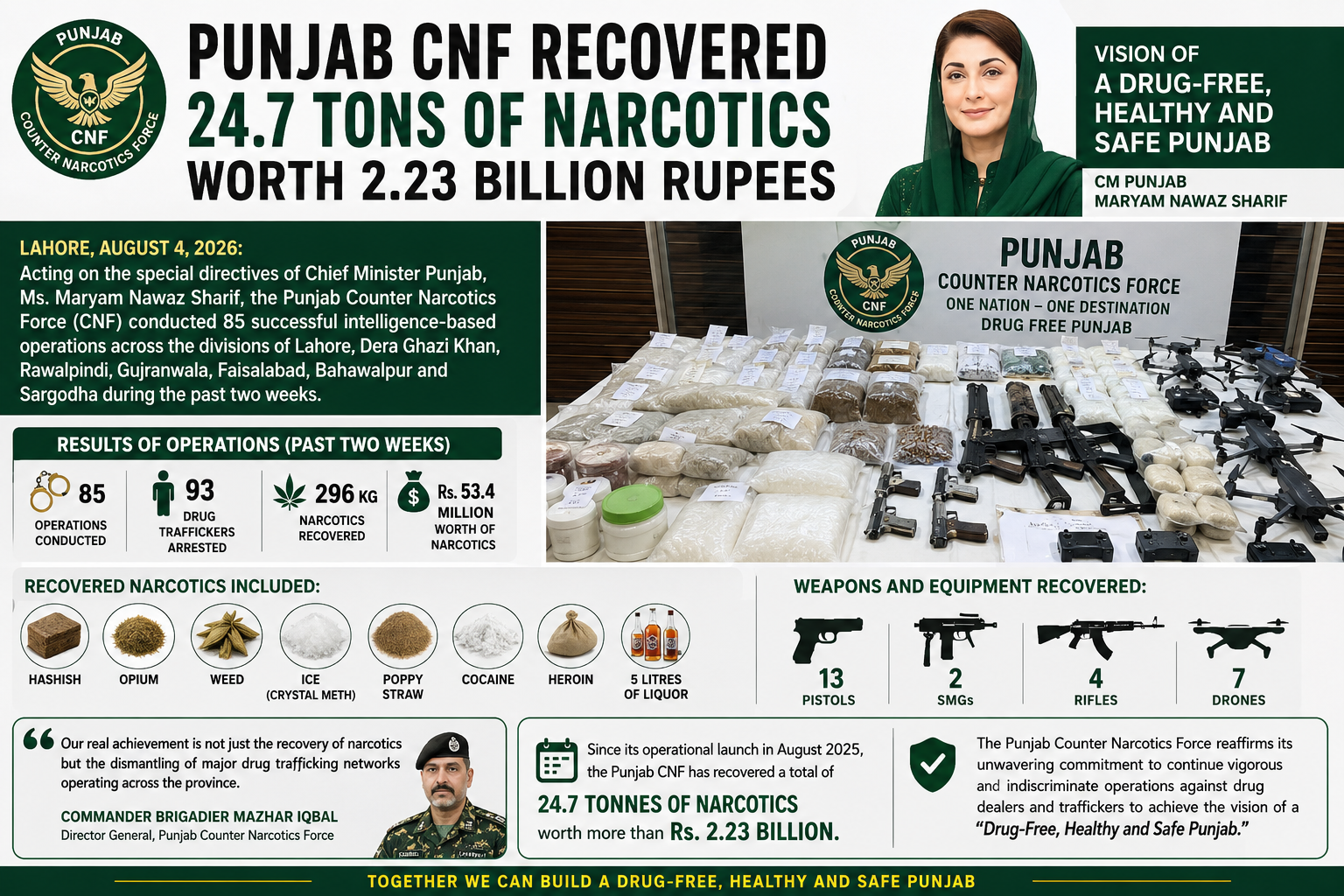
Lahore, August 4, 2026: The Punjab Counter Narcotics Force (CNF) has intensified its crackdown on drug trafficking across the province, achieving significant success in recent intelligence-led operations. The campaign is being carried out under the special directives of Punjab Chief Minister Maryam Nawaz Sharif as part of the government’s commitment to building a “Drug-Free, Healthy and Safe Punjab.”

Over the past two weeks, the CNF conducted 85 intelligence-based operations across the divisions of Lahore, Dera Ghazi Khan, Rawalpindi, Gujranwala, Faisalabad, Bahawalpur and Sargodha. These coordinated raids targeted major drug trafficking networks operating in different parts of the province.

The operations resulted in the arrest of 93 suspected drug traffickers, while authorities recovered approximately 296 kilograms of narcotics with an estimated market value of more than Rs. 53.4 million. Officials described the operations as a major step toward curbing the illegal drug trade and improving public safety.

The seized narcotics included a wide range of illegal substances such as hashish, opium, cannabis (weed), crystal meth (Ice), poppy straw, cocaine, heroin and five litres of illicit liquor. In addition to narcotics, the CNF recovered a significant cache of weapons from the suspects. These included 13 pistols, two sub-machine guns (SMGs), four rifles and seven drones that investigators believe were being used to facilitate criminal activities and drug distribution.

Director General of the Punjab Counter Narcotics Force, Commander Brigadier Mazhar Iqbal, said the Force’s success should not only be measured by the quantity of drugs confiscated but also by its ability to dismantle organised drug trafficking networks across Punjab. He noted that the CNF continues to rely on modern intelligence gathering, professional expertise and coordinated operational planning to identify and eliminate criminal groups involved in the narcotics trade.

He further highlighted the Force’s overall performance since it became operational in August 2025. According to the Director General, the Punjab CNF has recovered a cumulative 24.7 tonnes of narcotics valued at more than Rs. 2.23 billion. He described these achievements as evidence of the provincial government’s zero-tolerance policy against narcotics and the effectiveness of its law enforcement strategy.

Commander Brigadier Mazhar Iqbal also credited the Force’s progress to close coordination among various law enforcement agencies, which has strengthened efforts to combat drug trafficking and disrupt criminal organisations operating throughout the province.

Reaffirming the CNF’s commitment, the Director General said the Force will continue to launch vigorous and indiscriminate operations against drug dealers and traffickers. He stressed that intelligence-driven policing, enhanced operational capabilities and sustained enforcement efforts will remain central to achieving the government’s vision of a province free from the menace of narcotics.

Punjab authorities have reiterated that the fight against drugs remains a top priority, emphasizing that continued action against traffickers is essential to protecting communities, safeguarding young people and ensuring a healthier and safer future for the province.

Similar Posts

  • | |

    Capital one defends closure of Trump organization accounts

    Capital One Financial has responded to a lawsuit filed over its decision to close bank accounts linked to the Trump Organization, arguing that the move was based on internal anti-money laundering reviews rather than political or ideological motivations. The bank, in a legal filing submitted on Friday, stated that it closed the accounts following a detailed assessment conducted by its anti-money laundering (AML) specialists. The company argued that the decision was made after months of analysis and was consistent with its internal policies as well as regulatory requirements. The filing represents the first time a major bank has publicly connected concerns related to money laundering risks with its decision to end a banking relationship involving the Trump family business. However, Capital One clarified that it has never accused the Trump Organization of committing illegal money laundering activities. Instead, the bank said that the account closures were the result of routine compliance procedures. Capital One argued that documents presented in the case, along with the plaintiffs’ own claims, demonstrate that the decision was related to AML concerns rather than any attempt to discriminate against the company because of political beliefs. The dispute began after Capital One informed the Trump Organization in March 2021 that it planned to close more than 300 accounts associated with businesses connected to former U.S. President Donald Trump. The Trump Organization and Eric Trump, Trump’s son, later filed a lawsuit in March 2025 in a Florida federal court, claiming that the bank had unfairly “debanked” them because of political pressure and what they described as the company’s “woke” policies. The lawsuit alleged that Capital One’s decision was influenced by the political environment following the January 6, 2021, attack on the U.S. Capitol. The plaintiffs argued that the bank wanted to distance itself from Trump and his supporters during a period of intense public and political scrutiny. A federal court in Miami has already dismissed two versions of the complaint but allowed the plaintiffs opportunities to revise and submit updated claims. Capital One argued in its latest filing that the amended complaint continues to contain the same weaknesses as earlier versions and fails to establish evidence of unlawful discrimination. The bank accused the Trump Organization of presenting selective information and relying on statements taken out of context. Capital One maintained that the allegations of political motivation were unsupported and ignored the broader circumstances behind the account closures. According to the bank’s filing, certain transaction patterns identified during its review matched types of activities that federal banking authorities commonly recognize as requiring additional examination. Capital One said its AML team followed established procedures before reaching the decision to terminate the accounts. The legal battle comes during a broader political debate in the United States over the issue of “debanking,” with some conservatives accusing financial institutions of unfairly targeting individuals and organizations because of their political views. During his second presidential term, Trump’s administration has criticized such practices and taken steps aimed at preventing what it describes as discriminatory banking decisions. The controversy has also involved other major financial institutions. Trump previously filed a lawsuit against JPMorgan Chase, making similar allegations regarding political discrimination. During his first term in office, Trump also took legal action against Capital One and Deutsche Bank in an effort to prevent the release of his financial records to Congress. The case continues to highlight the growing tension between banking compliance practices, political concerns, and the debate over whether financial institutions should have broader restrictions on ending relationships with controversial clients.

  • |

    US judge dismisses bribery and fraud case against Gautam Adani despite procedural concerns

    A US federal judge has formally dismissed criminal bribery and fraud charges against Indian billionaire Gautam Adani, bringing an end to a high-profile prosecution while issuing a sharp rebuke over how the Department of Justice handled the case. US District Judge Nicholas Garaufis approved the Justice Department’s request to drop all charges with prejudice, permanently barring prosecutors from refiling the case. The decision closes an investigation launched in 2024 that accused Adani and senior executives of paying over $250 million in bribes to Indian officials to secure solar energy contracts while misleading American investors. In a 47-page order, Judge Garaufis voiced deep concern over procedural irregularities, noting that senior Justice Department official R. Trent McCotter negotiated the dismissal directly with Adani’s defence team without consulting the FBI agents and career prosecutors handling the investigation. The judge also scrutinized whether Adani’s public pledge to invest $10 billion in the United States and create 15,000 jobs influenced the outcome. While Garaufis ultimately concluded the investment promise did not legally dictate the government’s decision, he warned that the unusual handling of the case raised troubling questions about public perception of equal justice. The dismissal follows efforts by Adani’s legal team, led by prominent attorney Robert J. Giuffra Jr., who argued that much of the alleged conduct occurred outside US jurisdiction and no longer aligned with federal enforcement priorities. Adani, who maintained his innocence throughout the proceedings, welcomed the ruling in a statement, expressing deep respect for the judicial process.

  • | | |

    Iran’s Revolutionary Guards claim Trump suffered…

    TEHRAN: Iran’s Islamic Revolutionary Guard Corps (IRGC) has claimed that international media outlets are increasingly portraying US President Donald Trump as having suffered a defeat in the conflict with Iran. In a statement, the IRGC said reports from various parts of the world were highlighting what it described as the failure of the United States to achieve its objectives against Iran. The Guards further claimed that the war had placed the Trump administration in a situation of its own making, with international coverage allegedly pointing to Washington’s difficulties in achieving its declared goals. According to the IRGC, recent agreements between the parties should not be viewed simply as diplomatic arrangements but as evidence of what it described as an American retreat in the face of Iran’s military capabilities and negotiating position. The Iranian force also maintained that the United States and Israel had failed to accomplish their stated objectives despite extensive military operations and accompanying media campaigns. The IRGC characterized the latest agreements as reflecting Iran’s ability to withstand military pressure and secure a stronger position at the negotiating table.

  • | |

    Ghazi University marks Minorities Day, reaffirms e…

    Dera Ghazi Khan: The Ghazi University, Dera Ghazi Khan observed National Minorities Day today on the special directions of the Vice Chancellor Prof. Dr. Ashfaq Ahmad. The event, organized by the Directorate of Students Affairs and hosted by Prof. Dr. Arshad Munir, brought together members of the non-Muslim community and university officials to highlight the equal rights, religious freedom, and contributions of minorities in Pakistan. Members of the non-Muslim community from Dera Ghazi Khan, including Mr. Saleem Ilyas and Mr. Boota Masih, and others attended the ceremony. Senior university officials, Registrar Dr. Muhammad Asif, Prof. Dr. Saeed Ullah, Dr. Muhammad Ziaullah, Director ORIC Dr. Sagheer Atta, Dr. Irum Aziz, Dr. Khizra Bakhsh, and other faculty members were also in the event. The programme commenced with the recitation of the Holy Quran by an M.Phil scholar from the Department of Islamic Studies, followed by the recitation of verses from the Injeel (Gospel) by Mr. Boota Masih. Dr. Muhammad Ibrahim then presented a Naat-e-Rasool-e-Maqbool in praise of the Holy Prophet (PBUH). Thereafter, the National Anthem of Pakistan was played, with all participants standing in respect. In his welcome address, Prof. Dr. Arshad Munir highlighted the significance of National Minorities Day in Pakistan. He acknowledged the historic contributions of the non-Muslim community to the establishment of Pakistan and their continued role in strengthening the nation. On behalf of Vice Chancellor Prof. Dr. Ashfaq Ahmad, he extended an open invitation to members of the non-Muslim community to visit Ghazi University and enrol their children for higher education, assuring that the university would provide full facilitation and support in this regard. Two documentaries were screened during the event. The first showcased the establishment and progressive transformation of Ghazi University under the leadership of Vice Chancellor Prof. Dr. Ashfaq Ahmad. The second, prepared by the Directorate of Students Affairs, highlighted the efforts of non-Muslim personalities and movements that played a vital role in the creation of Pakistan and in its subsequent development. Speaking on the occasion, Mr. Saleem Ilyas expressed gratitude to the university administration for inviting members of the non-Muslim community and honouring them. He stated that minorities in Pakistan enjoy complete liberty, freedom of livelihood and worship, and equal rights alongside citizens of all other faiths. Mr. Boota Masih also thanked the university for the respect and affection extended to the community. He said non-Muslims feel comfortable and content in Dera Ghazi Khan, actively participate in local festivities, and remain an integral part of the social fabric. Extending a gesture of interfaith harmony, he invited all participants to visit their church. A cake marking National Minorities Day was cut by the honourable guests, symbolising unity and equality among people of all religions. Refreshments were also served to the participants. The Director Students’ Affairs, Dr. Muhammad Salman Haider presented the vote of thanks at the conclusion of the programme. The event conveyed a clear message of equal rights, religious freedom, and interfaith harmony, reaffirming that minorities are valued partners in Pakistan’s national progress and social cohesion.

  • | | |

    PML-N leads as second phase of AJK elections concl…

    The second phase of the 2026 Azad Jammu and Kashmir (AJK) Assembly elections concluded with voters casting their ballots across multiple constituencies under heightened security. Preliminary and unofficial results indicated that the Pakistan Muslim League-Nawaz (PML-N) secured victories in several constituencies, while the Pakistan Peoples Party (PPP) also registered wins in selected seats. Election authorities continued the counting process as additional results were awaited. More than one million registered voters were eligible to participate in the second phase of the elections. Polling stations were established across the region and in designated constituencies for Kashmiri refugees residing in different parts of Pakistan. In some areas, polling hours were extended to facilitate voters and improve participation. According to preliminary results, PML-N emerged as the leading party in the declared constituencies, strengthening its position in the AJK Assembly. PPP candidates also secured victories in several constituencies, while independent candidates and representatives of other political parties remained competitive in a number of closely contested seats. Final official results are expected after the Election Commission completes the consolidation process. Election day remained largely peaceful, although reports of isolated clashes were received from a few constituencies. Media reports stated that one political worker lost his life during an incident, while several others, including a member of Pakistan’s National Assembly, were reportedly injured in separate firing incidents. Authorities are expected to investigate these events, while political parties have urged supporters to remain calm. Security arrangements remained a key feature of the electoral process, with thousands of police personnel deployed at polling stations. Sensitive locations received additional security to ensure the smooth conduct of voting. In one constituency, polling was postponed because of adverse weather conditions and landslides, with the Election Commission announcing a revised polling date. The AJK elections are considered an important indicator of the political landscape in the region. As official results continue to emerge, attention will remain focused on the final distribution of seats and the formation of the next government. Political analysts believe the outcome could influence future policy discussions and shape the region’s governance in the coming years.

  • | |

    Hungary shuts only nuclear plant amid drought

    BUDAPEST: Hungary has taken the unprecedented step of shutting down its only nuclear power plant after severe drought pushed the Danube River to critically low levels, threatening the facility’s ability to safely cool its reactors and raising fears of an energy crisis during an intense summer heatwave. The closure of the Paks Nuclear Power Plant marks the first complete shutdown in the facility’s 44-year history. The plant, which typically supplies between one-third and 40 percent of Hungary’s electricity, has been forced offline as water levels in the Danube continue to fall amid one of Central Europe’s worst droughts in recent decades. Prime Minister Peter Magyar warned that the country now faces its “most critical five days,” with temperatures expected to climb to around 40 degrees Celsius just as electricity demand peaks. In a video message shared on social media, Magyar said the shutdown would place enormous pressure on Hungary’s electricity grid, public services and essential infrastructure. “Tomorrow, the Paks power plant will not be generating, while the hottest days are still ahead,” he said, urging citizens and businesses to reduce electricity consumption during evening peak hours between 5 p.m. and 10 p.m. The 2-gigawatt facility operates four Russian-built reactors that rely on water from the Danube for cooling. With river levels dropping to record lows, authorities determined that continuing operations could compromise reactor safety. Officials have also warned that the plant could remain offline for several weeks if weather conditions fail to improve. The drought has affected more than just power generation. Falling water levels have disrupted river transport, slowed tourism and prompted water-use restrictions in over 100 cities and villages, including areas surrounding Budapest. To maintain electricity supplies, Hungary has begun importing emergency power from neighboring countries while considering additional measures to stabilize the grid. The government is also weighing mandatory electricity restrictions for large industrial consumers if conditions worsen. Officials estimate the crisis could cost the country between 100 billion and 200 billion forints (approximately $315 million to $630 million) because of soaring electricity import prices. Climate experts say the situation highlights the growing vulnerability of Europe’s energy infrastructure to extreme weather events linked to climate change. Nuclear power plants across the continent depend on rivers and lakes for cooling, making prolonged droughts an increasingly serious operational challenge. For now, authorities remain focused on conserving electricity and closely monitoring the Danube’s water levels. With scorching temperatures forecast to continue, Hungary faces a difficult balancing act between ensuring public safety, maintaining energy security and managing one of the country’s most severe climate-related emergencies in decades.

Leave a Reply

Your email address will not be published. Required fields are marked *