airbus completes record
|

Airbus completes record 24-hour flight with plane …

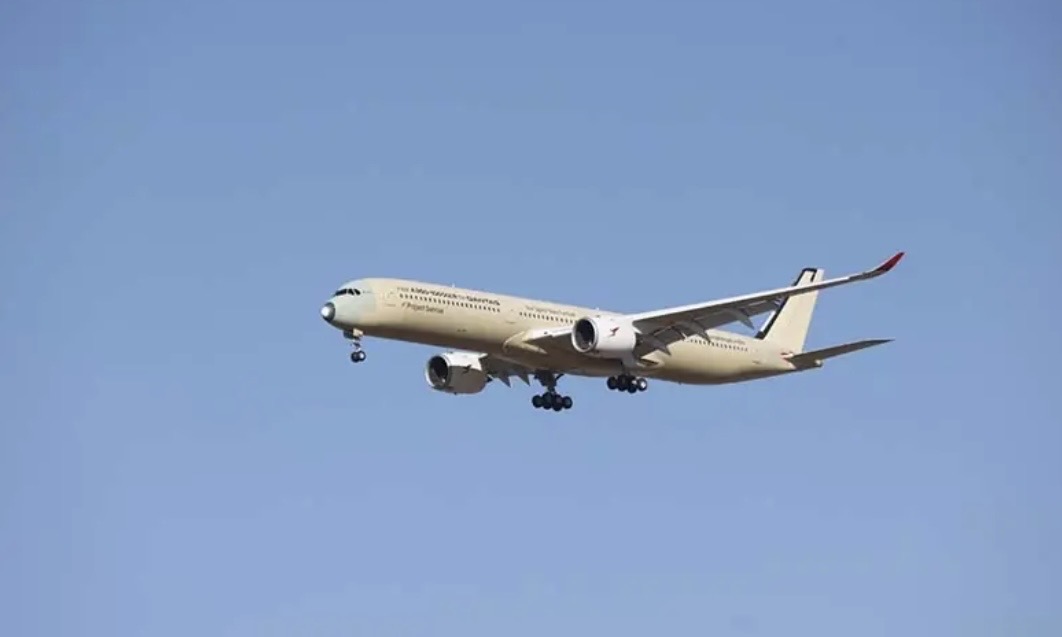
A specially modified Airbus A350 plane touched down in France on Tuesday after a record 24-hour test flight from Australia, ahead of its joining Qantas’s fleet next year.

Its 23,076-kilometre journey across three continents and two oceans, and through two sunsets and two dawns  was one of the most-watched flights shown on the Flightradar24 tracking site. The flight from Australia to France took precisely 24 hours and 24 minutes. On its outbound flight last week, from Toulouse to Melbourne, the test aircraft flew 17,000 kilometres in 19 hours and 12 minutes.

The test flight was a crucial step before Australian airline Qantas receives its first A350-1000ULR in April next year, to be followed by 11 others for services able to link Australia non-stop to destinations in the United States and Europe. The ULR in its designation stands for “ultra long distance,” a feat made possible by an additional 20,000-litre rear centre fuel tank being fitted to Airbus’s A350-1000 model.

Qantas plans to start offering non-stop flights between London and Sydney from October 2027. Later, it intends to start flying between Sydney and New York. On board the plane was a cockpit crew of eight people from Airbus’s testing division, accompanied by two Qantas pilots. Two Airbus engineers were also on board. Some of the aspects studied on the flight were the modified architecture around the extra fuel tank, changes to make the cabin quieter, and the plane’s air circulation system.

Qantas’s ‘Project Sunrise,’ using ultra-long-haul planes, has been on the cards for the past nine years but has been repeatedly delayed. Currently, the longest commercial flight service in the world is Singapore Airlines’ route between Singapore and New York, which covers 15,350 kilometres and lasts more than 18 hours using another variant of the A350. The successful test flight brings Qantas one step closer to realizing its vision of non-stop connections between Australia and some of the world’s farthest destinations.

Similar Posts

  • | | |

    Iran says every threat will strengthen its militar…

    TEHRAN: Iran’s acting Defence Minister, Seyed Majid Ibn al-Reza, has declared that Tehran will continue strengthening its military capabilities by treating every threat from its adversaries as genuine, even as the United States signals a renewed diplomatic effort. His remarks came after US President Donald Trump announced that Washington had postponed a planned military strike against Iran in favour of restarting negotiations aimed at reducing tensions in the Middle East. In a statement posted on social media platform X on Monday, Ibn al-Reza said Iran viewed recent statements from its enemies as part of a broader campaign of psychological and cognitive warfare. However, he stressed that Tehran would not dismiss any warning, regardless of its nature. “We consider every threat to be real and deserving of a serious response,” the acting defence minister said, adding that Iran’s strategy was to transform every external challenge into an opportunity to reinforce its military preparedness and national defence. He said the Iranian armed forces would neither be caught off guard nor remain passive in the face of rising regional tensions. Instead, every warning or hostile statement would serve as a catalyst for expanding the country’s defensive capabilities and maintaining operational readiness. The comments underscore Iran’s continued emphasis on deterrence at a time when uncertainty surrounds the future of US-Iran relations and broader security dynamics across the Gulf. Earlier, President Trump announced that the United States had suspended plans for military action against Iran after requests from Tehran and several Middle Eastern countries to give diplomacy another chance. Writing on his social media platform, Truth Social, Trump claimed the US military had been fully prepared for an operation of unprecedented scale, describing it as one of the largest potential military actions since the Second World War. According to Trump, the proposed negotiations focus on two key objectives: ensuring the immediate and uninterrupted reopening of the Strait of Hormuz for global shipping and addressing concerns over Iran’s nuclear programme. The Strait of Hormuz remains one of the world’s most strategically important maritime routes, carrying a significant share of global oil exports. Any disruption in the waterway has the potential to affect international energy markets and regional stability. While Washington has presented the renewed talks as an opportunity to prevent further escalation, Iranian officials continue to insist that the country will not relax its military vigilance during the diplomatic process. The latest exchange of statements reflects the delicate balance between diplomacy and deterrence, with both sides signalling a willingness to negotiate while simultaneously emphasizing military preparedness amid persistent regional tensions.

  • | |

    SHC orders independent probe into HIV cases at Kar…

    KARACHI: The Sindh High Court has directed the provincial government to establish an independent committee to conduct a comprehensive investigation into the reported spread of HIV among children treated at Karachi’s Kulsum Bai Valika Hospital. A two-member bench, headed by Justice Adnanul Karim Memon and comprising Justice Muhammad Jaffer Raza, issued the directions while announcing its reserved judgment on a petition seeking an impartial investigation, medical treatment and compensation for affected children. The court noted that the departmental inquiries and reports submitted so far were not sufficient to establish the actual number of affected patients, determine how the virus was transmitted or assess whether proper infection-control procedures were followed. According to figures presented by the Sindh government, 78 children were identified as HIV-positive at the hospital, while screening in the surrounding area detected another 120 cases. However, the petitioner claimed that the number of infected children could be around 200. The court ordered the Sindh chief secretary to head the inquiry committee and include two senior government officers of at least BS-20 rank. The officers should preferably have no direct administrative connection with the hospital or the investigations already conducted. The committee has been directed to establish the exact number and identities of HIV-positive children and other patients who were treated at the hospital during the relevant period. It will also investigate the possible source and method of HIV transmission on the basis of medical and scientific evidence. The committee will examine whether disposable syringes or other medical equipment were reused, improperly discarded or inadequately sterilised in violation of medical standards and applicable laws. It will also review the hospital’s infection-prevention arrangements, including the procurement, storage and use of auto-lock, auto-destruct and auto-break syringes. The roles of doctors, nurses, technical staff, administrative officials and supervisors will also come under scrutiny. The committee will determine whether any official failed to fulfil a legal, administrative or supervisory responsibility. The inquiry will further assess ongoing departmental proceedings against 37 officials and determine whether those proceedings adequately address individual responsibility. Officials will also examine whether the Sindh Regulation and Control of Disposable Syringes Act, 2010, or any other relevant law was violated and identify those responsible if evidence establishes wrongdoing. The committee has been authorised to examine medical and laboratory reports, screening records, procurement and stock registers, syringe records, duty rosters, infection-control reports, inspection documents, departmental inquiry material and relevant CCTV footage. The inquiry must provide an opportunity for a fair hearing to anyone against whom adverse findings are proposed. The committee has been directed to submit its report to the competent authority and the high court within two months of its formation. The court also directed the Sindh chief secretary to ensure that all affected HIV-positive children and other identified patients receive uninterrupted medical care while the inquiry continues. The treatment must include medicines, diagnostic tests, counselling and follow-up care and must be provided completely free of cost. The government and SESSI will bear all expenses, and no costs are to be recovered from affected children or their families. Treatment should continue for as long as medically necessary. Given the vulnerability of the children, the court also ordered authorities to determine whether affected families are entitled to compensation, financial assistance or other relief under the relevant laws and government policies. The court stressed that no affected child or family should face discrimination, stigma or denial of lawful assistance because of HIV status. It further ordered authorities to protect the privacy and confidentiality of the children’s identities and medical records. The Sindh chief secretary and health department secretary were directed to take immediate corrective and preventive measures at the hospital to prevent further avoidable risks to patients. Authorities were also ordered to ensure strict compliance with infection-control procedures and the law governing disposable syringes. The court said the case involved fundamental rights, including the rights to life, health, dignity and fair treatment. It observed that the matter could not be treated merely as an administrative issue because the state has a constitutional responsibility to protect life and ensure proper public health and medical safety. At the same time, the court cautioned that allegations or departmental proceedings alone cannot establish the guilt of individual officials. Responsibility must be determined through evidence and after providing the concerned persons an opportunity to defend themselves. The court also took notice of an incident involving the petitioner, Advocate Tariq Mansoor, during proceedings. According to the order, Mansoor allegedly raised his voice and encouraged people accompanying him, while some individuals reportedly recorded videos inside the courtroom. The court said the incident disrupted proceedings and affected the dignity and decorum of the courtroom. It also noted that the situation was serious enough for the bench to retire to chambers before completing the order. The court issued a show-cause notice to Mansoor, asking why contempt and criminal proceedings should not be initiated against him. Court security officials were also directed to explain an alleged security lapse that allowed a group of people to enter the courtroom and disrupt proceedings. The Sindh High Court Bar Association and Sindh Bar Council were asked to intervene and take appropriate measures regarding the alleged misconduct.

  • |

    Pakistan fiscal deficit falls to 22-year low

    ISLAMABAD: Pakistan’s fiscal position improved significantly during the fiscal year 2025-26, with the federal Ministry of Finance reporting that the country’s fiscal deficit fell to its lowest level in 22 years. According to a statement issued by the Ministry of Finance, the fiscal deficit stood at 2.6% of Gross Domestic Product (GDP) during FY2025-26. The government also recorded a primary surplus of 2.9% of GDP, marking its highest level in 26 years. Pakistan has now maintained a primary surplus for three consecutive years, reflecting an improvement in the government’s ability to cover its non-interest expenditures through its revenues. The ministry reported that total government revenues reached Rs19.8 trillion during the fiscal year. Tax revenues accounted for Rs14.8 trillion, highlighting the central role of improved revenue collection in strengthening the country’s fiscal position. Meanwhile, the government significantly reduced its interest-related expenditure. Interest payments declined to Rs6.95 trillion in FY2025-26 from Rs8.9 trillion in the previous fiscal year. The reduction helped ease pressure on the overall budget and contributed to the improvement in the fiscal balance. On the expenditure side, defence spending increased by 18% to Rs2.588 trillion during the year. The government, however, reduced spending on subsidies by 22%, bringing the amount down from around Rs1.3 trillion to Rs1.001 trillion. Development spending also declined during the fiscal year. According to the ministry, development expenditure fell from Rs786 billion to Rs727 billion. The latest figures indicate a notable improvement in Pakistan’s fiscal management, particularly through stronger revenue collection, a reduction in interest payments and tighter control over certain categories of expenditure. The government’s continued primary surplus also represents an important indicator of progress in efforts to stabilise public finances.

  • Massive Fire Engulfs Ammunition Storage Facility in Surin, Triggering Continuous Explosions

    SURIN — A massive fire broke out at an ammunition storage facility belonging to the Border Patrol Police 21 command centre in Surin province on Tuesday night, triggering continuous explosions that sent a towering wall of flames into the sky and forced the evacuation of nearby residential areas. Several People Injured Following Blast at Ammunition […]

  • |

    Motorway police told not to check marriage certifi…

    Senate Standing Committee on Communications Chairman Senator Pervez Rashid has directed the Motorway Police not to check citizens’ marriage certificates, stressing that the force must maintain its professional reputation. During a committee meeting chaired by Rashid, Senator Saifullah Abro questioned the inclusion of senators’ names in a Motorway Police handout related to a seizure operation. He asked how the police determined that the recovered goods belonged to specific senators. Abro said no individual’s personal actions should be linked to the Senate or its committees. He demanded a clear explanation if any government institution had officially released the names. The IG Motorway Police said the department’s responsibility was to take action based on available information and not comment on individuals or institutions. Rashid questioned the authority under which the Motorway Police checked citizens’ marriage certificates and urged the department to avoid such practices in the future. The meeting also discussed delays in National Highway Authority (NHA) development projects and the allocation of funds. Senator Zameer Ghumro called for the completion of existing projects before launching new ones, while officials said the government was prioritising ongoing schemes. Senator Abdul Qadir raised concerns over delays in releasing funds, saying projects sometimes remain stalled for months. The committee also proposed inviting Planning Commission officials to a future meeting. The committee further discussed a motorway incident under investigation. The IG Motorway Police said officials checked a vehicle in a parking zone and that the inquiry would be presented to the committee after completion. On the seizure of smuggled cigarettes near Chakri, the IG said the Motorway Police conducts operations based on intelligence and information provided by Customs authorities. Officials from the Ministry of Communications also told the committee that the government provides loans to the NHA rather than direct funding. They said the NHA’s outstanding debt has reached around Rs3.7 trillion and the authority pays interest on the loans.

  • |

    China missile test deepens pacific’s struggle fo…

    SUVA: A Chinese ballistic-missile test in the Pacific has exposed a growing dilemma for the region’s small island nations: how can they preserve their vision of an “Ocean of Peace” while increasingly finding themselves caught between the military ambitions of major powers? China’s July missile launch, its first known ballistic-missile test into the Pacific since September 2024, has intensified concerns about the region’s rapid militarisation. The test came just hours after Fiji signed a major defence agreement with Australia, its first-ever military alliance. The timing highlighted the competing security interests shaping the Pacific, where the United States and China are increasingly contesting influence. Yet despite widespread concern among Pacific leaders, the region failed to agree on a joint statement condemning the Chinese missile test during a meeting of foreign ministers in Suva last week. Papua New Guinea Foreign Minister Justin Tkatchenko described the launch as “totally inappropriate”, saying that while China remained a close friend and partner of Papua New Guinea, the missile test was not helpful. Beijing had informed Papua New Guinea about the launch beforehand, Tkatchenko said, but did not provide details about where the missile would land. China defended the exercise at the time. Foreign Ministry spokesperson Mao Ning said the test had been conducted safely and urged other countries not to “over-interpret” the event. Pacific caught between major powers The missile launch was the latest in a series of military developments that have transformed the Pacific into an increasingly contested strategic space. Chinese naval deployments and live-fire exercises, including drills in the Tasman Sea, have become more visible. At the same time, US allies have expanded military exercises around Guam and Hawaii, while Washington maintains major military facilities and forces across Hawaii, Guam and the Marshall Islands. For Pacific island governments, the growing military activity creates an uncomfortable contradiction. Many have repeatedly insisted that their region should not become another battleground for global power competition. In September 2025, Pacific leaders endorsed the Ocean of Peace Declaration, pledging to protect the region and strengthen international peace and security. The initiative was intended to put Pacific countries themselves at the centre of discussions about their security rather than allowing outside powers to define the region’s strategic priorities. David Peebles of the Australian National University’s Pacific Security College said Pacific nations had historically resisted security agendas imposed by larger countries. But the growing number of defence agreements is now testing that principle. Defence deals bring benefits — and fears For some Pacific governments, security partnerships offer practical advantages. They can provide surveillance against illegal fishing, disaster-response capabilities, policing assistance, military equipment and training. Australia’s new defence agreement with Fiji, known as the Ocean of Peace Alliance, reflects that approach. But critics fear that a growing network of bilateral security arrangements could gradually draw Pacific nations deeper into the strategic competition between China and the United States. Tuvalu’s permanent foreign secretary, Pasuna Tuaga, speaking in a personal capacity, expressed concern over increasing militarisation, including security arrangements such as the AUKUS partnership between Australia, Britain and the United States. The concern is not simply about military exercises or missiles. Pacific governments also worry that agreements could eventually influence how their territory, waters and critical infrastructure are used. Solomon Islands Foreign Minister Rick Houenipwela, who chaired the Suva talks, stressed that the region’s security agenda must remain “conceived by the Pacific, shaped by the Pacific”. Yet achieving that unity is becoming increasingly difficult. China divides Pacific consensus The failure to produce a common statement on China’s missile test revealed just how sharply interests differ among Pacific nations. Officials familiar with the discussions said Kiribati and Nauru did not support the wording of a proposed statement. Both countries have strengthened relations with Beijing after switching diplomatic recognition away from Taiwan. New Zealand Foreign Minister Winston Peters attributed the failure to reach consensus to foreign influence, although he did not identify any country. The disagreement reflects a broader challenge. Some Pacific governments, particularly those closer to longstanding US military facilities, favour stronger security ties with Washington and its allies. Others remain cautious about becoming involved in military competition between major powers and maintain close economic or diplomatic relations with Beijing. Fiji faces a difficult balancing act Fiji is now at the centre of this debate. The country signed its defence agreement with Australia and participated for the first time in the US-led RIMPAC military exercises last month. At the same time, Fiji has publicly supported the vision of a peaceful Pacific free from major-power confrontation. Foreign Minister Sakiasi Ditoka acknowledged the tension, saying Pacific nations wanted to be free from “all these war-making paraphernalia” while recognising that some security capabilities were necessary to protect them. For Pacific leaders, the challenge is increasingly about finding the right balance. The region does not want to choose sides in a rivalry between Washington and Beijing. But as military exercises expand, defence agreements multiply and missiles are tested in Pacific waters, remaining completely outside that rivalry is becoming harder. The issue is expected to return to the spotlight when Pacific leaders gather in Palau in three weeks for the Pacific Islands Forum summit. The missile test may have lasted only moments, but its political impact could linger far longer — forcing Pacific nations to confront whether their dream of an “Ocean of Peace” can survive amid an increasingly militarised region.

Leave a Reply

Your email address will not be published. Required fields are marked *