police constable martyred
| | |

Police constable martyred, Two suspected robbers k…

A police constable was martyred while two suspected robbers were killed during an exchange of fire in Karachi’s Orangi Town early Tuesday morning, according to police officials. The incident occurred near Liaquat Chowk within the jurisdiction of Pakistan Bazaar Police Station during a routine police patrol.

Senior Superintendent of Police (SSP) West Tariq Illahi Mastoi said four police officers were conducting motorcycle patrols when they encountered armed suspects. According to the police, the suspects opened indiscriminate fire upon spotting the patrol team, prompting officers to return fire in self-defense.

During the shootout, both suspected robbers were killed at the scene. Police recovered two pistols, ammunition, spent shell casings, and the motorcycle allegedly used by the suspects.

However, 26-year-old Constable Hassan Ali sustained serious gunshot injuries during the exchange. He was immediately shifted to a nearby hospital, where doctors made every effort to save his life. Despite medical treatment, he succumbed to his injuries and was later declared martyred.

District West police spokesperson Nabeel Ahmed Rajput stated that the constable was wearing body armor at the time of the encounter. However, the bullets struck him from the side, causing fatal injuries.

Constable Hassan Ali was unmarried and hailed from Sukkur. Following funeral prayers at the Garden Police Headquarters in Karachi, his body was transported to his hometown for burial. The funeral was attended by Sindh Inspector General of Police Javed Alam Odho, Additional IGP Azad Khan, and several senior police officials, who paid tribute to the fallen officer’s sacrifice.

Police investigations later revealed that one of the deceased suspects had a significant criminal history. Officials said he had previously been arrested in connection with the 2021 killing of an assistant sub-inspector and was involved in at least 13 criminal cases. Another criminal case had also been registered against the second suspect.

The incident highlights the continuing security challenges faced by law enforcement personnel in Karachi. Police officers frequently encounter armed criminals during patrols, placing their lives at risk while carrying out their duties.

Authorities have reiterated their commitment to continuing operations against street crime and organized criminal networks across the city to improve public safety and maintain law and order.

Similar Posts

  • |

    South Africa proposes stricter protocols for former leaders following Jacob Zuma’s controversial India visit

    South Africa’s Department of International Relations and Cooperation has submitted formal recommendations to parliament to establish stricter rules and greater transparency regarding foreign travel undertaken by former heads of state. The legislative push follows intense backlash over a recent visit to India by former President Jacob Zuma, during which the 84-year-old politician was photographed at a temple alongside fugitive businessman Ajay Gupta. The Gupta family remains central to South Africa’s massive “state capture” corruption scandal, which involved allegations of systemic political influence and state asset siphonage that ultimately contributed to Zuma’s resignation in 2018. The incident sparked severe political friction, leading South Africa’s High Commissioner to India, Anil Sooklal, to be recalled after he was also pictured alongside Zuma and Gupta. Foreign Affairs Minister Ronald Lamola confirmed that the proposed protocols would require former presidents to disclose complete details regarding international itineraries prior to departure. The advance documentation would allow government agencies to evaluate security requirements alongside potential diplomatic, political, and reputational risks to the nation. The controversy marks the latest diplomatic dispute involving the former president, who now leads the opposition uMkhonto we Sizwe (MK) party following his expulsion from the ruling African National Congress (ANC). Last year, the South African government issued a formal diplomatic protest to Morocco after Zuma engaged in talks supporting Moroccan sovereignty over the disputed Western Sahara region, directly contradicting official South African foreign policy.

  • | |

    Greek air defense system intercepts missiles fired…

    A Greek-operated air defense system stationed in Saudi Arabia reportedly intercepted and destroyed two ballistic missiles launched from Yemen, preventing what officials described as a potential attack on the kingdom’s critical energy infrastructure. According to international media reports citing informed sources, the missiles were aimed at the oil refineries in Yanbu, a strategic industrial city on Saudi Arabia’s Red Sea coast. The projectiles were intercepted before reaching their intended targets, avoiding potential damage to one of the country’s key energy facilities. Saudi Civil Defense authorities issued an emergency alert in Yanbu during the incident, warning residents of a possible security threat and advising them to remain cautious until the situation was brought under control. No casualties or damage were reported following the successful interception. Sources familiar with the incident said the attack involved two ballistic missiles fired from Yemen. A separate source also confirmed that both missiles were successfully destroyed by the air defense system before they could strike the targeted oil infrastructure. The interception was reportedly carried out using a U.S.-made Patriot air defense battery operated by Greek military personnel. Greece deployed the Patriot system to Saudi Arabia in 2021 under a bilateral defense agreement aimed at strengthening the kingdom’s air defense capabilities and protecting vital energy infrastructure from missile and drone attacks. The deployment marked a significant step in defense cooperation between Greece and Saudi Arabia, with the Patriot battery providing additional protection for critical facilities, including oil refineries and other strategic installations. Yanbu is home to some of Saudi Arabia’s most important refining and export facilities, making it a vital hub for the country’s energy sector. As a result, the city has remained a key location for enhanced security measures amid regional tensions. The reported interception comes against the backdrop of ongoing instability in the region, where missile and drone threats have periodically targeted energy infrastructure. Saudi Arabia has invested heavily in advanced air defense systems to safeguard its strategic assets and maintain the uninterrupted flow of energy supplies. While the reported attack was successfully thwarted, the incident underscores the continuing security challenges facing the region and the importance of international defense cooperation in protecting critical infrastructure. Neither Saudi authorities nor Greek officials had released a detailed official statement on the reported interception at the time of publication.

  • | |

    OGDC top executives receive monthly salaries rangi…

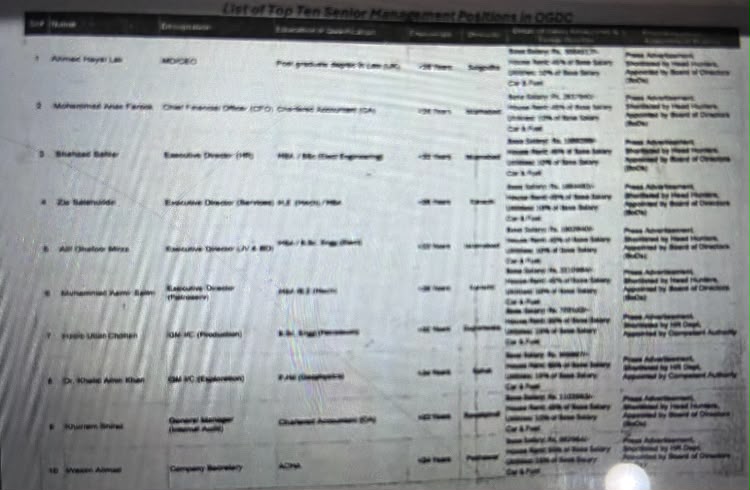
      Islamabad:Details of the salaries and benefits of senior officials at Oil and Gas Development Company Limited (OGDC) were presented before the Senate, revealing that the company’s Managing Director and Chief Executive Officer receives a basic monthly salary of more than Rs. 5.56 million. The information was shared with parliament as part of a disclosure concerning the remuneration packages of senior executives at the state-owned exploration and production company. The figures show significant differences in the basic salaries of OGDC’s top management, with the company’s highest-paid official earning several million rupees each month before allowances and other facilities are added. According to the details presented in the Senate, Ahmed Hayat Lak, OGDC’s Managing Director and CEO, receives a basic monthly salary of Rs. 5,564,171. Chief Financial Officer Muhammad Anas Farooq earns Rs. 2,837,940 per month, while Executive Director Petroleum Muhammad Aamir Saleem receives Rs. 2,211,990. Among other executive directors, Shehzad Safdar, Executive Director Human Resources, has a basic monthly salary of Rs. 1,889,298. Zia Salahuddin, Executive Director Services, receives Rs. 1,849,433, while Atif Ghafoor Mirza, Executive Director Joint Ventures and Business Development, earns Rs. 1,893,434. The salaries of general managers are comparatively lower but still substantial. Khurram Shehraz, General Manager Internal Audit, receives Rs. 1,100,929 per month. Dr. Khalid Ameen Khan, General Manager Exploration, earns Rs. 900,881, while General Manager Production Habib Ullah Chohan receives Rs. 700,443. The company secretary, Waseem Ahmad, has a basic monthly salary of Rs. 607,754. In addition to their basic salaries, the ten senior officials are entitled to several allowances and facilities. These include a house-rent allowance equivalent to 45 percent of their basic salary and utilities allowance amounting to 10 percent of the basic pay. They are also provided with car and fuel facilities. After the applicable allowances are included, the monthly remuneration package of the OGDC managing director exceeds Rs. 8.6 million. The CFO’s overall monthly package is reported to be more than Rs. 4.4 million. The information presented to the Senate also showed that all ten officials have more than three decades of professional experience. Most of the executives were recruited through press advertisements and headhunters before being appointed by OGDC’s Board of Directors. Their educational qualifications include professional and advanced degrees in fields such as law, chartered accountancy, business administration, engineering and geophysics. The MD is based in Islamabad, while other senior executives are posted in Islamabad, Karachi, Quetta and Sukkur. OGDC is Pakistan’s largest exploration and production company and is listed on the stock exchange, with the government holding a majority share. The disclosure has drawn attention to the compensation structures followed by state-owned enterprises. During the Senate proceedings, questions were raised regarding whether OGDC’s remuneration packages are comparable with those offered by private-sector exploration and production companies. Senators also discussed the possible impact of high executive compensation on the company’s overall operational expenses. However, no change to the existing salary and benefits structure was announced during the briefing.

  • |

    ECNEC approves Rs1.15tr development projects amid major cost escalations

    ISLAMABAD: The government has approved 16 development projects with a combined estimated cost of around Rs1.15 trillion, including the controversial Lahore-Sahiwal-Bahawalnagar motorway and the fifth extension of the Tarbela hydropower project, whose cost has surged by nearly 282% from the original estimate. The decisions were taken by the Executive Committee of the National Economic Council (ECNEC), chaired by Deputy Prime Minister Ishaq Dar. Several of the projects had previously been considered by development forums and returned with revised costs following delays, changes in scope and rising construction expenses. Of the total approved amount, approximately Rs320 billion represents additional expenditure linked to cost increases and delays, highlighting the financial pressures facing major public-sector development schemes. The government, however, issued only a brief statement following the ECNEC meeting and did not provide a complete breakdown of all the projects and their financial details. The omission of the Lahore-Sahiwal-Bahawalnagar motorway from the official summary was particularly notable given the political controversy surrounding the scheme. Lahore-Bahawalnagar motorway approved The ECNEC approved the Rs407 billion Lahore-Sahiwal-Bahawalnagar Motorway project, retaining its original 295-kilometre alignment in accordance with a directive issued by Prime Minister Shehbaz Sharif earlier this year. The first package, covering an 18.5-kilometre stretch from the Lahore Ring Road to Raja Jang Interchange, was approved at an estimated cost of Rs49 billion through federal financing. The project has faced opposition from the Pakistan Peoples Party (PPP), which has raised objections to the scheme and its proposed alignment. Given the heavy financial burden on the Public Sector Development Programme (PSDP), the ECNEC directed the National Highway Authority (NHA) to examine public-private partnership options for sections that could attract private investment. For commercially viable portions, the NHA will arrange its contribution through its own revenues in the form of Viability Gap Funding. For sections that are considered financially unviable, alternative arrangements will be explored, including contributions from the Punjab government, loans or financing from international financial institutions and direct federal funding, subject to the availability of resources. Tarbela extension faces major cost increase One of the most significant approvals was the fifth extension of the Tarbela project, which received approval at a revised cost of Rs316 billion. The project’s original estimated cost stood at approximately Rs82 billion, meaning its revised price tag represents an increase of about 282%. The steep escalation has already attracted scrutiny from government officials. During the Central Development Working Party (CDWP) review, Planning Minister Ahsan Iqbal reportedly raised concerns over project management, transparency and oversight. Questions were also raised regarding the technical capacity of personnel associated with the project. The Ministry of Water Resources had previously highlighted shortcomings in an inquiry into problems encountered during project implementation. An inquiry into the failure of the downstream cofferdam reportedly concluded that the structural collapse was linked to design changes, inadequate supervision and delayed administrative action rather than flooding. The findings attributed the failure to the shift from roller-compacted concrete to a rock-fill structure, along with weaknesses in project oversight. The incident resulted in delays and financial losses, adding to concerns over the project’s rising cost. The Ministry of Finance also sought an explanation for the substantial increase in the project’s estimated cost. Since the scheme is being financed through international financial institutions, the ministry asked the Water and Power Development Authority (Wapda) to provide details regarding the mechanism for repayment. Despite the concerns and requests for additional information, the ECNEC ultimately approved the revised project cost. Road and infrastructure schemes The committee also approved the 48-kilometre Khwazakhela-Besham Expressway at a revised cost of Rs116.6 billion. The new estimate is around 47% higher than the original cost. Another interprovincial road scheme aimed at improving connectivity between Gilgit-Baltistan and Azad Jammu and Kashmir was approved at Rs29 billion, representing an increase of approximately Rs10 billion over its initial estimate. The Rathoa Haryam Bridge over the reservoir channel on the Mirpur-Islamgarh Road also received approval at a revised cost of Rs10.8 billion. Its original estimate had been only Rs1.4 billion, reflecting a substantial increase over the initial projection. The ECNEC further approved the Lahore Wastewater Treatment Plant at a cost of Rs56.6 billion, around Rs4.2 billion above the earlier estimate. Poverty alleviation and education initiatives The Southern Punjab Poverty Alleviation Project was approved at Rs29.7 billion and will cover 10 districts: Bahawalnagar, Bahawalpur, Bhakkar, Dera Ghazi Khan, Khushab, Layyah, Mianwali, Muzaffargarh, Rahim Yar Khan and Rajanpur. The scheme includes an additional cost escalation of around Rs6.8 billion and is aimed at improving socioeconomic conditions and livelihood opportunities in some of the region’s less-developed areas. The ECNEC also sanctioned Rs10.6 billion for the Fulbright scholarship programme, under which 816 scholarships are planned. Of these, 550 MS and 141 PhD scholarships will be administered through the United States Educational Foundation in Pakistan (USEFP), while the Higher Education Commission (HEC) will provide funding for another 125 PhD scholarships through the PSDP. Water projects in Sindh and Balochistan The Mazarani Dam project in Qambar Shahdadkot, Sindh, was approved at an estimated cost of Rs16.1 billion. The committee directed the provincial authorities to begin Command Area Development alongside construction of the main dam so that the project’s agricultural and economic benefits could be realised during its second phase. The Winder Dam project was also approved at Rs21.6 billion, with the federal government expected to contribute Rs15.6 billion. Meanwhile, the Mashkel Dam in Washuk, Balochistan, received approval at a cost of Rs41 billion. The project will be financed by the Balochistan government, while an environmental assessment report will be incorporated into the official project documentation.w Power-sector efficiency projects The ECNEC approved several schemes aimed at improving the performance of electricity distribution companies. A Rs24 billion project for the Supply, Installation, Testing and Commissioning of Asset Performance Management Systems at Lahore Electric Supply Company (LESCO) was approved. The committee also sanctioned Rs19 billion for the Electricity Distribution Efficiency Improvement Project of Hyderabad Electric Supply Company (HESCO). A similar initiative for Peshawar Electric Supply Company (PESCO) was approved at Rs30.2 billion. These projects are intended

  • |

    Rajab Butt’s emotional fan encounter triggers online trolling

    Rajab Butt is among Pakistan’s most popular and widely discussed YouTubers, with a massive fan base that closely follows his personal and professional life. Known for sharing updates about his family, lifestyle and daily activities, Rajab has built a strong connection with his viewers over the years. His followers are often referred to as the “Rajab Family,” and the YouTuber has previously spoken about how emotionally attached many of his fans are to him. However, a recent video involving one of his female fans has taken social media by storm and sparked a wave of mixed reactions online. The video shows a female fan meeting Rajab Butt in person. According to the footage circulating on social media, the moment she saw the YouTuber, she became overwhelmed with emotion and suddenly burst into tears. She appeared visibly emotional while standing in front of Rajab, who remained there as she struggled to contain her feelings. The unexpected reaction quickly attracted attention after the video began spreading across social media platforms. While some viewers appeared surprised by the intensity of the fan’s emotions, others turned the incident into a subject of criticism and trolling. Several social media users questioned why the fan became so emotional after meeting Rajab. Some found the scene uncomfortable to watch, while others accused the entire interaction of being staged for attention and views. A few commenters also suggested that the reaction appeared exaggerated and described the video as scripted. One social media user expressed embarrassment over the scene, while another criticized the fan’s reaction and claimed that the moment seemed deliberately created for the camera. Another commenter simply dismissed the incident as unnecessary, reflecting the growing criticism surrounding the viral clip. The reactions have highlighted the complicated relationship between online personalities and their followers. For influencers with millions of viewers, fan encounters can sometimes become highly emotional moments, particularly when followers have spent years watching their content and developing a personal connection with the creator. At the same time, viral moments involving public figures often attract criticism, especially when viewers believe that a reaction may have been exaggerated or staged. In Rajab’s case, the fan’s emotional response has quickly become a topic of discussion, with social media users divided over whether it was a genuine display of admiration or simply another viral moment. Rajab Butt has not publicly clarified whether the interaction was spontaneous or planned. For now, the video continues to circulate online, while users remain divided between those who understand the fan’s emotional reaction and those who believe the entire scene was unnecessary or scripted. The incident once again demonstrates how closely Rajab’s fans follow him and how even a brief interaction can quickly become a major talking point across social media.

  • | |

    US reviews military strategy as weapons stockpile …

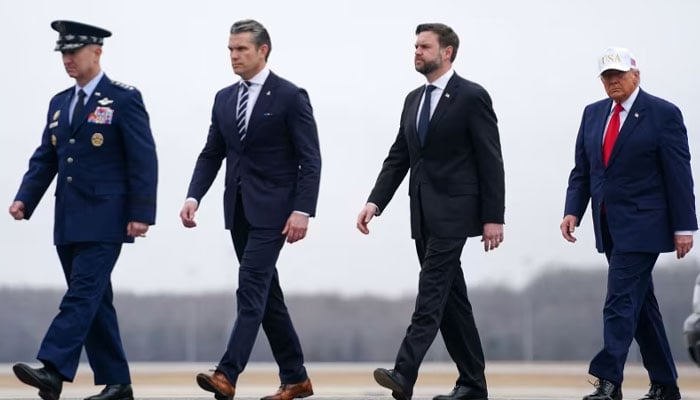
    WASHINGTON: Senior US officials have reportedly raised concerns over the country’s military readiness as the conflict with Iran intensifies, prompting the Trump administration to temporarily pause its air campaign while continuing diplomatic efforts. According to US media reports, Vice President JD Vance and Chairman of the Joint Chiefs of Staff General Dan Caine briefed President Donald Trump during a White House meeting on the escalating conflict and the potential impact of prolonged military operations on US weapons stockpiles. Sources said military leaders expressed concern over the depletion of key defence munitions and outlined the risks of expanding the conflict. While General Caine reportedly assured the president that the US military remains capable of carrying out all available operational options, he also highlighted the strategic consequences of continued military escalation. Following the meeting, the United States halted its nightly airstrikes on Iran after nearly two weeks of sustained attacks. Defence officials described the pause as temporary, although they did not confirm whether it was directly linked to concerns over weapons supplies or other strategic considerations. President Trump said negotiations with Iran remain ongoing but warned that military operations could resume or intensify if necessary. He also acknowledged appeals from several Gulf nations urging Washington to exercise restraint as regional tensions continue to rise. White House Communications Director Steven Cheung reiterated that President Trump continues to favour a diplomatic resolution but stressed that all military options remain available if Iran threatens international shipping in the Strait of Hormuz or targets US allies. He added that after nearly two weeks of economic pressure and strikes on military targets, the administration believes Tehran should pursue negotiations to avoid further escalation.

Leave a Reply

Your email address will not be published. Required fields are marked *