ajk poll drama
| |

AJK poll drama: PML-N, PPP neck-and-neck

The process of announcing unofficial and unofficially unverified results has begun following polling in 13 constituencies of the Azad Jammu and Kashmir (AJK) Legislative Assembly.

According to the initial results, a close contest is underway between the Pakistan Muslim League-Nawaz (PML-N) and the Pakistan Peoples Party (PPP) across several constituencies.

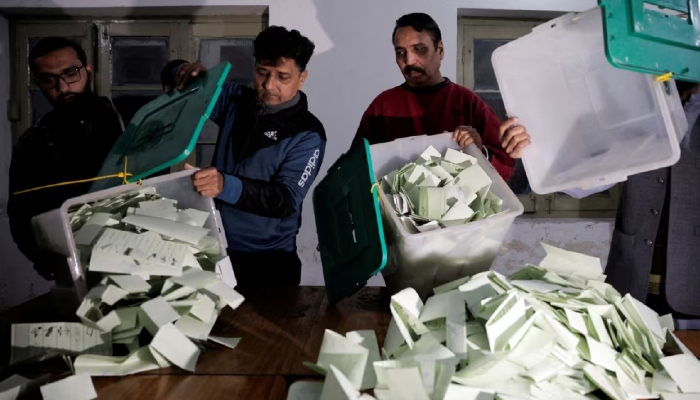
Polling was held on Monday in 13 constituencies across Mirpur, Kotli and Bhimber. Voting officially ended at 5pm, while an additional hour was provided for voters already present at polling stations. Counting subsequently began, with initial unofficial results now being received.

In LA-1 Mirpur-1, unofficial results from 107 of 139 polling stations show PML-N candidate Azhar Sadiq leading with 12,303 votes. PPP’s Muhammad Afsar Shahid is second with 7,278 votes.

In LA-2 Mirpur-2, results from 49 of 149 polling stations show PPP’s Qasim Majeed ahead with 3,663 votes, while PML-N’s Azim Bakhsh Chaudhry has secured 3,570 votes.

In LA-3 Mirpur-3, unofficial results from 131 of 161 polling stations put PPP candidate Chaudhry Yasir Sultan in the lead with 9,361 votes. PML-N’s Chaudhry Muhammad Saeed is close behind with 9,100 votes.

In LA-4 Mirpur-4, results from 16 of 162 polling stations show PML-N’s Chaudhry Rukhsar Ahmed leading with 2,021 votes. PPP candidate Chaudhry Sohaib Arshad has received 1,288 votes.

In LA-5 Bhimber-1, PML-N candidate Waqar Ahmed Noor is leading with 21,573 votes based on results from 115 of 176 polling stations. PPP’s Chaudhry Pervez Ashraf is second with 18,406 votes.

In LA-6 Bhimber-2, PML-N’s Chaudhry Muhammad Razzaq has taken the lead with 21,210 votes from 100 of 195 polling stations. Ali Shan Chaudhry of the Istehkam-e-Pakistan Party is in second place with 11,354 votes.

In LA-7 Bhimber-3, unofficial results from 51 of 237 polling stations show PML-N candidate Chaudhry Tariq Farooq leading with 9,178 votes. Independent candidate Chaudhry Anwar-ul-Haq has secured 5,064 votes.

In LA-8 Kotli-1, PPP’s Zafar Iqbal Malik is narrowly leading with 1,221 votes based on results from 10 of 155 polling stations. PML-N’s Malik Muhammad Nawaz Khan has 1,174 votes.

In LA-9 Kotli-2, PML-N candidate Umair Naeem has established a lead with 23,568 votes from 119 of 178 polling stations. PPP’s Javed Iqbal Budhanvi is second with 15,382 votes.

In LA-10 Kotli-3, PPP’s Chaudhry Muhammad Yasin is leading with 6,999 votes based on results from 36 of 169 polling stations. PML-N candidate Fateh Mahmood-ul-Hassan has 3,560 votes.

In LA-11 Kotli-4, initial results from just two of 206 polling stations show PPP’s Chaudhry Muhammad Akhlaq ahead with 254 votes. PML-N’s Muhammad Asif has received 148 votes.

In LA-12 Kotli-5, PPP candidate Chaudhry Muhammad Yasin is leading with 2,613 votes from 40 of 207 polling stations. PML-N’s Muhammad Riasat Khan is second with 1,255 votes.

In LA-13 Kotli-6, unofficial results from 110 of 193 polling stations show PML-N’s Raja Ayaz Ahmed Khan leading with 13,063 votes. PPP candidate Muhammad Waleed Inqalabi is second with 8,995 votes.

The results remain unofficial and incomplete, with counting still underway in several constituencies. The final outcome will be determined after the completion of counting and the official announcement by the relevant election authorities.

Similar Posts

  • |

    India reclaim No. 1 spot in T20I rankings after Zimbabwe series win

    HARARE, July 26: India have returned to the top of the ICC Men’s T20I rankings after securing a 2-0 lead in their three-match series against Zimbabwe. The reigning T20 World Cup champions had recently slipped from the No. 1 position after England swept them 4-0 in a five-match series. India have now responded strongly by winning the opening two matches of their Zimbabwe tour and reclaiming the summit. India began the series with a comfortable seven-wicket victory. Young opener Vaibhav Sooryavanshi provided the main highlight, scoring a rapid half-century from just 19 balls. The second match saw an even stronger batting performance from India. They posted 219-5 in their 20 overs, with Ishan Kishan producing an aggressive 81 and Tilak Varma remaining unbeaten on 60. Zimbabwe struggled in their chase. India’s bowlers restricted the hosts to 129 runs and secured a commanding 90-run victory. The result gave India an unassailable lead in the series and pushed them back to the top of the T20I rankings. Kishan said India’s batting approach was based on reading the pitch and adjusting their plans according to the conditions. He said the team focused on building partnerships after losing early wickets. The wicketkeeper-batter also highlighted the partnership with Shreyas Iyer. He said they aimed to take the innings deep rather than chase an unnecessarily high total. India’s return to the top comes after a difficult period in T20 cricket. Their latest success has provided a strong response to the setbacks suffered on the previous tour. With the series already secured, India have also strengthened their position ahead of the final T20I. A clean sweep would give the world champions further momentum after their return to the top of the rankings.

  • |

    American tourist killed by lightning strike on Mount Etna

    An American tourist has died after being struck by lightning while hiking on Mount Etna in Sicily. Italian firefighters confirmed the incident on Monday, adding new details to the tragedy. The victim, a 29-year-old man from Kansas, was struck on Sunday evening while hiking through an exposed section of the volcano above the tree line. Mount Etna is widely known as Europe’s most active volcano. Emergency crews responded quickly, rescuing the tourist by helicopter following the lightning strike. Despite the swift response, he was later pronounced dead by medical personnel at the scene. Authorities have not yet released his identity publicly. The area where the incident occurred had reportedly been closed to visitors due to recent volcanic activity. Officials have restricted access to large sections of the volcano’s slopes following an extended period of heightened activity in recent weeks. That same volcanic activity had already caused significant disruption in the region. Catania airport, one of Sicily’s key international travel hubs, was forced to shut down for much of the previous week because of ongoing eruptions. Despite Mount Etna’s frequent volcanic activity, officials noted something notable about the risks the mountain actually poses. Lightning strikes have caused more fatalities on the volcano in recent decades than the eruptions themselves. According to officials, the most recent deaths directly linked to a Mount Etna eruption date back to 1987. That statistic highlights how unpredictable weather, rather than volcanic danger, remains the more immediate threat to hikers today. Mount Etna sits on the eastern side of Sicily, near the city of Catania. Despite ongoing volcanic activity and periodic access restrictions, it continues to draw large numbers of hikers and tourists throughout the year. Sunday’s tragedy serves as a stark reminder of the unpredictable risks tied to hiking in exposed, high-altitude terrain, even in areas officially closed to the public. Authorities are expected to review safety measures and access restrictions around the volcano following the incident.

  • | |

    China stands firm on economic strategy ahead of ke…

    BEIJING: China has intensified its defence of its state-led economic model as it prepares for crucial trade discussions with the European Union and the United States, signalling that it is unlikely to make major policy concessions despite mounting international criticism. Beijing has repeatedly argued that its development strategy, which prioritises investment in advanced manufacturing and technology, remains essential for long-term economic growth. Chinese leaders maintain that the country’s industrial policies have helped strengthen innovation and global competitiveness, rejecting accusations that they distort international trade. The latest policy statements from China’s leadership indicate a commitment to maintaining its current economic direction. While officials acknowledge challenges such as weak domestic demand and excess production capacity, they continue to favour targeted policy support instead of broad consumer-focused stimulus measures. Chinese authorities have also dismissed Western claims of industrial overcapacity, describing such criticism as politically motivated. They argue that China’s manufacturing success reflects its stage of economic development and benefits global consumers through affordable, high-quality products. Ahead of expected meetings between President Xi Jinping and US President Donald Trump later this year, as well as upcoming negotiations with the European Union, Beijing has adopted a more confident tone in defending its economic policies. Analysts believe the messaging is intended to establish clear limits on what China is willing to negotiate while encouraging greater understanding of its development model. China has also sought to counter warnings of a new “China shock” by portraying its industrial expansion as an opportunity for global economic growth. However, many Western economists argue that China’s reliance on exports, combined with subdued domestic consumption, continues to create imbalances that affect international markets. Although Beijing has slowed public investment by tightening oversight of local government spending, officials acknowledge that supply and demand remain uneven. Authorities have pledged to reduce destructive price competition among manufacturers and have reiterated their intention to strengthen consumer demand, though without announcing sweeping structural reforms. Chinese policymakers have also recognised that the country’s traditionally low household consumption cannot remain a permanent feature of its economy. While official publications describe the existing model as historically appropriate, they also suggest gradual adjustments will be necessary to ensure sustainable long-term growth. Despite these acknowledgements, Beijing remains cautious about implementing rapid reforms, fearing that abrupt policy changes could undermine economic stability. International studies continue to raise concerns over China’s economic practices. Recent research suggests that government subsidies have played a significant role in boosting the global market share of many Chinese companies, while other reports attribute much of China’s export growth to weak domestic consumption and industrial overcapacity. Analysts also note that China continues to invest in productive assets at a much faster pace than Europe and the United States, even though returns on those investments have declined. Many experts believe Beijing’s increasingly assertive defence of its economic model reflects growing confidence that it can manage trade tensions with Western partners without fundamentally changing its industrial strategy.

  • | |

    Zelenskiy accuses Russia of targeting world food s…

    Ukraine and Russia traded accusations of lethal attacks on Sunday, with President Volodymyr Zelenskiy saying Moscow deliberately targeted global food security by striking the seaport at Odesa. Three people died and 37 sustained injuries in the eastern Ukrainian city of Kharkiv after a multi storey apartment block took a direct hit. Across the border, authorities in Russia’s Belgorod region reported that a Ukrainian drone attack killed five people and wounded 25 others. Odesa seaport takes major damage Zelenskiy said a strike had damaged Odesa’s seaport, a critical hub for Ukraine’s agricultural exports. Local authorities reported that dozens of drones and missiles struck the southern seaside city, wounding a dozen people in the process. “In this way, the Russians are at war with the world’s food security,” Zelenskiy said, framing the attack as part of a broader effort by Moscow to disrupt global grain supplies that flow through Ukraine’s Black Sea ports. The Ukrainian president said Russia also struck nine other regions across the country on Sunday, extending the assault well beyond Odesa alone. Russia has spent months bombarding Odesa in a sustained campaign aimed at cutting Ukraine off from the Black Sea and choking its export routes. Ihor, a 67 year old Odesa resident whose apartment narrowly avoided destruction in the latest strikes, said residents have grown accustomed to the danger. “Everyone who lives in Odesa knows that the most common target is around the port area,” he said. Ukraine strikes Russian oil tankers in response As Ukraine works to choke off the revenue Russia relies on to fund its war effort, Kyiv’s forces have repeatedly targeted Russian oil tankers and other cargo vessels moving through the Black Sea. Ukrainian forces claimed three additional strikes on such vessels on Sunday alone. Both countries have widened their campaigns against each other’s logistics networks in recent months. E-commerce warehouses on both sides of the border and Ukrainian petrol stations have come under sustained attack throughout the summer. Ukraine’s state energy company Naftogaz reported a significant rise in attacks on its facilities over the past three days, including strikes on oil extraction sites overnight. Ukraine’s energy ministry said Russian forces also struck power facilities in the Odesa region, cutting electricity to a substantial share of the port city’s residents overnight. Power had already been restored to 90,000 consumers by Sunday, the ministry said. Russia’s Defence Ministry confirmed striking fuel storage facilities in the ports of Odesa and nearby Chornomorsk, saying the sites were being used to support the Ukrainian military. Pope Leo renews call for peace At the Vatican, Pope Leo used his Sunday address to renew calls for an end to the war, now in its fourth and a half year. Speaking before worshippers gathered for the Angelus prayer, the pontiff said tragic incidents are multiplying across the conflict, leading to a growing number of civilian casualties, including children. The renewed papal appeal comes as both Russia and Ukraine show little sign of scaling back their attacks, with strikes on energy infrastructure, ports and logistics networks continuing to intensify on both sides as the war grinds into its fifth year without a resolution in sight.

  • |

    IMF-backed move to End EPZ local sales Quota sparks concerns over textile recycling, jobs

    KARACHI: A proposed move to withdraw the permission allowing factories operating in Pakistan’s Export Processing Zones (EPZs) to sell up to 20% of their output in the domestic market has triggered concerns among exporters, investors and international textile-recycling organisations, who fear the policy could disrupt investment, employment and a wider global circular-economy supply chain. The controversy has emerged after Pakistan committed to the International Monetary Fund (IMF) that it would amend the existing rules governing EPZs and prohibit sales from these zones into the domestic tariff area. According to the IMF’s latest programme review, Pakistan has committed to introduce amendments aimed at ending domestic sales by EPZ-based manufacturers. The report states that the amendments were to be placed before the federal cabinet for approval by September 2026. However, exporters and industry representatives have challenged the move, arguing that the existing 80:20 arrangement was part of the investment and regulatory framework under which many businesses established operations in the zones. Under the existing system, EPZ manufacturers can export 80% of their production while selling up to 20% in Pakistan after payment of applicable duties and taxes. Industry stakeholders say the domestic-sale provision is particularly important for products that have limited commercial demand in overseas markets. The proposed abolition has also attracted attention in the United States because American companies supply raw materials and used textiles to Pakistani businesses operating in the EPZs. The US-based Secondary Materials and Recycled Textiles Association (SMART) has approached IMF Mission Chief to Pakistan Iva Petrova, warning that eliminating the domestic-sales provision could have consequences extending beyond Pakistan’s industrial sector. The association has argued that Pakistan occupies an important position in the global textile circular economy, particularly in the sorting, grading, reuse and recycling of used textiles collected in North America and Europe. According to SMART, used clothing and textile materials collected in the United States, Canada and European countries are sent to Pakistan, where they are sorted and graded before being channelled into reuse, recycling, manufacturing and affordable consumer markets. The association has warned that ending the 80:20 mechanism could reduce demand for recovered textiles and place downward pressure on their prices. Such a development, it said, could weaken textile-collection programmes in North America and reduce the income generated by charitable organisations from donated clothing. Organisations including Goodwill, the Salvation Army and St Vincent de Paul depend partly on revenues generated from donated goods to finance a range of social programmes, including workforce training, employment assistance, food support, recovery services, youth programmes and housing assistance. SMART has therefore cautioned that a major disruption in Pakistan’s used-textile market could have financial consequences for charitable organisations in North America, with potential losses running into tens of millions of dollars. The association also warned that reduced demand for used textiles could ultimately result in a greater volume of reusable material being sent to landfills or incinerators rather than being recycled or reused. US exporters raise objections US exporters have also expressed concern over the proposed withdrawal of the 20% domestic-sale allowance. Their concerns are significant because American suppliers form part of the upstream supply chain that feeds Pakistani recycling and manufacturing units located in EPZs. Abid Iqbal, representing Nashmia Industries, said during Express News programme The Review that US exporters had communicated their concerns to Pakistani counterparts. According to Iqbal, US exporters had also been told informally that the IMF itself had not initiated the proposal to remove the 20% quota. The development has consequently raised questions within the industry about how the condition was incorporated into Pakistan’s commitments under the IMF programme and whether sufficient consultation took place with affected stakeholders. Industry representatives have also warned of possible legal and contractual disputes, maintaining that the 20% domestic-sales provision was part of the regulatory and investment framework under which businesses made their investment decisions. They argue that companies entered the zones with an understanding that they would be able to export the bulk of their production while disposing of a limited portion in the domestic market after meeting applicable tax and customs obligations. EPZ rules and proposed amendment The Export Processing Zones Authority (EPZA) operates under the legal framework established through the EPZ Act of 1980. The law enables the establishment of export processing zones with approval from the federal government. Under Rule 228(5) of the Customs Rules, EPZ-based factories have historically been allowed to sell up to 20% of their production in the domestic tariff area, subject to applicable duties and taxes. A higher limit of 30% had been applicable to the Resalpur area. EPZA has reportedly forwarded a proposal to the Federal Board of Revenue (FBR) to eliminate the 20% quota from October 1 in line with the IMF-related commitment. The proposal, however, has exposed differences within the government over the scope and interpretation of the IMF condition. Proceedings of the Senate Standing Committee on Industries held last month indicate that the Ministry of Industries and Production maintained that abolition of the 20% domestic-sales quota was not included in the original IMF agreement. According to the ministry’s position, the initial IMF requirement was restricted to preventing the introduction of new fiscal incentives, including tax concessions and subsidies, rather than immediately eliminating the existing domestic-sales mechanism. The ministry has reportedly argued that the later addition of the quota-related condition requires further clarification. Assessment of EPZs The issue is also linked to an assessment of Special Economic Zones (SEZs) and EPZs that Pakistan was required to undertake under the IMF programme. The government engaged consultancy firm AT Kearney to assess the zones and determine whether their operations were creating distortions in the domestic market. According to records presented before the Senate Standing Committee on Industries, the assessment completed last year concluded that EPZs were not creating significant market distortions. The report, according to the parliamentary proceedings, did not recommend withdrawing existing fiscal incentives. The issue has therefore become a point of discussion between government officials and the IMF as authorities seek to reconcile the lender’s programme requirements with

Leave a Reply

Your email address will not be published. Required fields are marked *