
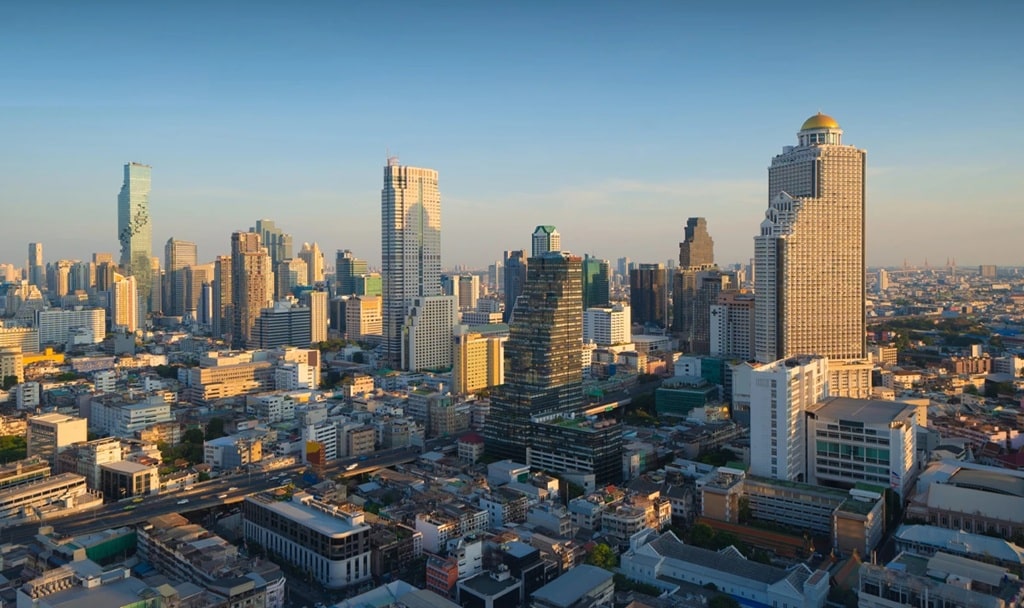
bangkok property market

Bangkok Property Market Shifts to High-Value Homes Amid Economic Slowdown

BANGKOK –  The Bangkok residential real estate market is undergoing a significant transformation in 2026. Developers are shifting their focus toward higher-priced homes while reducing the total number of new properties entering the market.

According to data released by the Agency for Real Estate Affairs, residential properties remain the core driver of Thai real estate. Although fewer individual housing units will launch throughout 2026, the overall financial value of these developments is set to exceed previous years.

Key Takeaways

  • Higher Market Value: Total real estate launch value in 2026 is projected to reach Baht 320.758 billion ($9.720 billion), representing a 10.4% increase over 2025 despite launching fewer total units.
  • Price Shift: The average price per residential unit rose sharply from Baht 7.172 million ($217,333) in 2025 to Baht 8.906 million ($269,879) in 2026, pricing out lower-income buyers.
  • Inventory Strain: Bangkok holds an unsold inventory of 210,112 units, which will take roughly 49.5 months to clear at current sales rates without new project launches.

Bangkok Real Estate Demonstrates Resilience in Mid-2026

The residential sector continues to anchor the broader Thai property landscape. As of mid-2026, there are 3,098 total residential projects actively open for sale across the Bangkok Metropolitan Region.

Among these active developments, 2,670 projects still possess more than 20 unsold units. This high number confirms that the vast majority of housing developments are maintaining standard marketing operations and sales efforts.

Despite ongoing economic challenges, the market has managed to avoid a widespread financial crisis. Only six property developments halted sales during the first six months of 2026.

These stalled projects accounted for 4,136 units valued at Baht 23.939 billion ($725 million). While these numbers sound large, they indicate that sluggish economic growth has not severely damaged the housing sector.

For comparison, eight projects halted sales in the second half of 2025, representing 3,964 units worth Baht 17.880 billion ($542 million). The steady drop in disrupted developments demonstrates that market conditions remain manageable for established homebuilders.

Key Reasons Behind Stalled Real Estate Projects

Understanding why property projects fail helps paint a clearer picture of current industry challenges. When developments stall in Bangkok, regulatory hurdles and market dynamics are usually the primary causes.

Nearly one-third of all stalled projects (31%) failed to pass their Environmental Impact Assessment (EIA). Without EIA approval, developers cannot legally proceed with construction or complete planned sales cycles.

Another 22% of project halts occurred because product designs failed to match local market preferences or locations. In these cases, buyers simply rejected the floor plans, amenities, or pricing structures offered by builders.

Tightening bank policies also played a major role in project delays across the capital region. Approximately 19% of stalled projects stopped because financial institutions refused to extend necessary project financing or home loans.

Finally, unsuitable site selection accounted for 7% of developer project halts. Misjudging neighborhood demographics, road access, or nearby infrastructure frequently leaves projects stranded without adequate buyer interest.

Higher Prices Drive Expansion in Total Launch Value

During the first half of 2026, an overwhelming 95% of all new real estate launches were residential properties. The remaining 5% comprised commercial developments and industrial space across the city.

Developers introduced 97 new residential projects in the first six months of the year. This represents a 15.7% decline compared to the 115 projects launched during the same period in 2025.

However, the actual number of individual housing units launched grew during this timeframe. New units rose by 10.1% to reach 17,045 units, up from 15,484 units in the first half of 2025.

Even more striking is the dramatic increase in total project launch values. The combined value of new residential developments surged by 37.3% to reach Baht 152.742 billion ($4.689 billion).

In comparison, the launch value recorded during the first half of 2025 stood at Baht 110.230 billion ($3.380 billion). This massive jump reveals a clear strategic pivot among major property firms.

Rising Unit Costs Squeeze Low and Middle-Income Homebuyers

The real estate data points toward two important structural changes in modern project development. First, developers are building larger individual housing communities to maximize land efficiency and shared amenities.

The average size of a new residential project expanded to 176 units in 2026. By contrast, projects launched in 2025 averaged just 135 units per site.

This increase was primarily driven by a high concentration of large-scale condominium projects. Multi-story condo complexes naturally contain far more housing units than traditional horizontal housing subdivisions.

Second, housing prices have climbed rapidly across the Bangkok Metropolitan Region. The average price per home unit jumped from Baht 7.172 million ($217,333) in 2025 to Baht 8.906 million ($269,879) in 2026.

As prices rise, lower-income families are finding it increasingly difficult to enter the property market. Reduced purchasing power, paired with strict lending guidelines from the Bank of Thailand, has significantly chilled sales in the affordable segment.

Condominiums Dominate First-Half Residential Sales Volume

Despite economic headwinds, buyers purchased a total of 26,780 residential units across Bangkok during the first half of 2026. Condominiums emerged as the undisputed favorite among city buyers and investors.

Condos accounted for 14,439 sold units, representing 53.9% of all property transactions in the first six months. These sales generated Baht 70.407 billion ($2.134 billion), or 46.8% of total market transaction value.

Townhouses secured the second spot in overall sales volume throughout the capital area. Buyers acquired 6,820 townhouse units (25.5% of total sales) worth Baht 21.362 billion ($647 million).

Single-family detached homes accounted for 3,393 sold units, representing 12.7% of the total volume. However, because single-family homes carry premium price tags, they generated Baht 46.313 billion ($1.403 billion) in value.

This means single-family homes claimed an impressive 30.8% share of all sales revenue despite representing a smaller fraction of physical properties sold. Premium buyers continue to invest heavily in spacious, landed property.

Full-Year 2026 Projections Point to Market Stabilization

Looking at the entire year, experts predict that total new unit launches will decline compared to 2025. The market is expected to record 35,795 new units in 2026, down 13.7% from 41,490 units.

Yet, annual launch values will tell a completely different story. Total development value for 2026 is projected to hit Baht 320.758 billion ($9.720 billion), reflecting a 10.4% increase over 2025 figures.

On the retail side, full-year home sales are expected to reach approximately 57,000 units. This marks a solid improvement over the 50,472 units sold by homebuilders throughout all of 2025.

These statistics confirm that existing housing supply is being absorbed gradually by active buyers. The steady reduction in new project starts is actually helping the market avoid an oversupply crisis.

Because homebuilders are exercising caution, there is no evidence of a speculative real estate bubble forming. Consequently, the threat of a sudden real estate crash or market collapse remains extremely low.

Massive Unsold Housing Supply Requires Strategic Absorption

While the market remains stable, developers still face a massive mountain of existing inventory. As of mid-2026, Bangkok holds 210,112 unsold residential units across all property categories.

At current absorption rates, it would take 49.5 months—over four full years—to sell this entire stock. That estimate assumes that developers launch zero new housing projects in the interim.

Interestingly, townhouses make up the largest percentage of this unsold housing stock. Unsold townhouses total 68,831 units, representing 32.8% of all lingering inventory in the region.

Condominiums represent the second-largest share of unsold units, with 61,543 properties (29.3%) waiting for buyers. Single-family detached homes rank third, with 51,739 unsold properties accounting for 24.6% of the backlog.

Condos continue to enjoy faster relative sales turnover because they offer convenient urban living locations. Additionally, condominiums are far easier for domestic and foreign investors to rent out for steady yield.

Property Type | Unsold Units | Share of Inventory 

  • Townhouses: 68,831 units 32.8%
  • Condominiums: 61,543 units 29.3%
  •  Single-Family Homes: 51,739 units 24.6%
  •  Other Properties: 27,999 units 13.3%

What to Expect from Bangkok Real Estate in Second Half of 2026

Market conditions are expected to show modest improvements during the second half of 2026. Historically, real estate firms save their biggest promotional pushes and flagship project reveals for the final six months.

There are currently 399 potential housing projects waiting in the launch pipeline across Bangkok. However, developers may decide to delay several of these projects if market demand remains weak.

Single-family home developments lead the upcoming launch pipeline, making up 136 planned projects (34%). Condominium developments closely follow, representing 130 planned projects (33%) scheduled for future release.

Townhouse developments represent 115 upcoming projects (29%), with niche residential properties rounding out the remaining pipeline. Homebuilders are clearly betting on higher-margin single-family homes to drive late-year profits.

However, building low-cost or mid-tier housing will remain exceptionally difficult for the foreseeable future. Sluggish economic conditions have weakened the financial leverage of lower-income households.

Certain affordable condo projects priced under Baht 1.5 million ($45,455) receive tax incentives from the Thailand Board of Investment. Even with government backing, only a handful of specialized developers can build these low-margin properties profitably.

The Long-Term Economic Outlook for Thai Housing Development

The future trajectory of Bangkok’s property market remains closely tied to Thailand’s broader economic performance. If macroeconomic conditions accelerate, residential real estate recovery will likely follow suit.

For now, economic growth in Thailand is projected to remain slow and steady rather than dynamic. As a result, property development will likely lack the explosive momentum seen in prior economic booms.

During peak growth periods in past decades, developers regularly launched up to 100,000 new housing units annually across Bangkok. Industry experts agree that those massive expansion figures belong strictly to the past.

Modern real estate strategies now prioritize sustainable development, higher price points, and careful risk management over sheer construction volume. Developers are focusing on profitability rather than rapid expansion.

By targeting affluent buyers and managing project pipelines carefully, the Bangkok property market is charting a cautious path forward. While volume growth may be slow, overall market value remains resilient heading into late 2026.

Trending News:

Thailand’s 5.6 Trillion Baht High-Speed Digital Revolution

Agile Marketing in 2026: How to Stay Flexible and Focused

 

Similar Posts

  • | | |

    PM to decide fate of refinery upgrade policy

    Prime Minister Shehbaz Sharif is expected to address key issues facing Pakistan’s refinery sector today. The Cabinet Committee on Energy (CCoE) will review proposed changes to the Brownfield Refinery Policy.The policy was approved in 2023. It aims to encourage investment in the modernisation of existing refineries. The proposed changes could affect billions of dollars in planned refinery investments.The main dispute is over deemed duty protection. The government has proposed reducing it from 7.5 per cent to 5 per cent. Refinery companies have opposed the proposed cut. They say it could weaken the financial benefits offered under the policy.The industry also disputes the government’s position on delays in signing Upgrade Agreements. Officials say refineries failed to sign the agreements within the required period.Refinery representatives reject the claim. They say they had already accepted the draft agreements in 2024. According to industry officials, the companies were waiting for the government to arrange the formal signing process.They say the industry repeatedly contacted the Petroleum Division and other authorities to complete the process. The companies argue that the delay was caused by administrative issues on the government side.They therefore believe the incentives should not be reduced because of delays beyond their control. Deemed duty protection is a key part of the refinery upgrade package.The incentive is designed to encourage companies to invest in modernisation. The planned upgrades are aimed at increasing production of Euro-V compliant fuels.They are also expected to reduce furnace oil production. The projects could help improve Pakistan’s overall fuel mix.The refining sector has also faced additional financial pressure from changes in the tax system. The Finance Act 2024 moved several petroleum products from the zero-rated sales tax regime to the exempt category.The change affected the ability of refineries to adjust input sales tax. It also increased their unrecoverable tax costs.The Petroleum Division has acknowledged that the tax changes affected the financial viability of refinery upgrade projects. Officials said the prime minister is expected to review the major issues that have delayed the implementation of the policy since August 2023.The Petroleum Division has proposed limited amendments to make the policy operational. It has also recommended a committee to finalise the Upgrade Agreement.The committee would include senior officials from the Petroleum Division, Law Division and OGRA. A representative of the Special Investment Facilitation Council would also be included.OGRA, however, has reservations about signing the agreements. OGRA Chairman Masroor Khan has argued that the regulator should focus on its regulatory role.He believes OGRA should not become a party to commercial agreements. The refinery industry is now hoping for a decision that removes the remaining hurdles.Companies want the government to maintain the existing incentive structure. They say policy consistency is important for attracting investment.They also warn that changes to agreed incentives could discourage investors. A clear decision by the CCoE could help restart delayed refinery upgrade projects.The decision could also influence Pakistan’s fuel supply and long-term energy security.

  • |

    Textile industry urges govt to end transport strike, warns of export disruptions

    ISLAMABAD: Pakistan’s textile industry has called on the government to take immediate measures to resolve the ongoing goods transporters’ strike, warning that a prolonged suspension of freight services could disrupt export shipments, restrict the supply of cotton and affect the operations of textile mills across the country. The All Pakistan Textile Mills Association (APTMA) has formally approached Federal Minister for Communications Abdul Aleem Khan, seeking urgent government intervention to restore the movement of goods and industrial cargo. According to the association, the All Pakistan Goods Transport Ittehad began an indefinite strike on August 8, creating significant logistical challenges for export-oriented industries, particularly the textile sector. APTMA Chairman Kamran Arshad said the strike had severely affected the availability of vehicles and containers required for transporting textile-related cargo. Export consignments awaiting shipment, imported cotton arriving through ports and locally purchased cotton being transported from markets to textile mills have all been affected by the disruption. The association said the lack of transportation was creating difficulties at multiple stages of the textile supply chain. Export containers cannot be moved efficiently, while imported raw materials face delays in reaching manufacturing facilities. At the same time, locally sourced cotton is also experiencing transportation constraints. APTMA cautioned that the timing of the strike was particularly concerning because cotton inventories at textile mills were already at relatively low levels following the end of the cotton season. Any prolonged interruption in the movement of cotton, it said, could eventually affect manufacturing activity as mills depend on a steady supply of raw materials to maintain production. The association warned that a slowdown in textile production could have broader economic consequences, including delays in export orders, disruption to employment and reduced foreign exchange earnings. Pakistan’s textile sector remains one of the country’s most important export-oriented industries, generating a significant share of the country’s foreign exchange through shipments of garments, textiles, yarn, fabrics and other related products. Industry-wide logistical problems could therefore have repercussions beyond individual mills and exporters. APTMA noted that the textile industry had faced similar transportation disruptions in the past, resulting in delays in export consignments, additional financial costs and interruptions to factory operations. The association stressed that cargo movement is an essential component of export activity and that any prolonged blockage could make it more difficult for exporters to meet delivery schedules agreed with international buyers. It urged the Communications Ministry to facilitate the immediate movement of essential industrial cargo while efforts continue to settle the dispute between transporters and the government. APTMA specifically called for priority arrangements for export containers, imported cotton and other raw materials, as well as locally procured cotton destined for textile mills. The association maintained that ensuring uninterrupted logistics was essential not only for the textile industry but also for protecting Pakistan’s export commitments and broader economic activity. APTMA has consequently appealed to the government to intervene on an urgent basis and establish arrangements that would allow the movement of critical industrial and export cargo until the transporters’ strike is brought to an end.

  • | |

    Afghanistan exports Black Dimension Stone to US

    Afghanistan has exported a shipment of its natural Black Dimension Stone to the United States for the first time, marking a significant step for the country’s mining and export sector. According to Afghan media reports, the shipment is valued at around $100,000. The export is being viewed as an important milestone in Afghanistan’s efforts to expand its presence in international mineral markets. The shipment was arranged by a private Afghan company. However, officials have not disclosed the name of the exporting company or the identity of the American buyer. The exported stone was extracted from a mine located in the Zindajan district of Herat province, an area known for its mineral resources. Zindajan lies approximately 40 kilometres west of Herat city, close to the border with Iran. Natural Black Dimension Stone is widely used in the construction and architectural industries for flooring, wall cladding, monuments and decorative projects because of its durability and polished appearance. The latest export highlights Afghanistan’s growing interest in developing its mining sector, which is considered one of the country’s most valuable economic resources. The country possesses significant deposits of marble, gemstones, precious metals and other industrial minerals that have the potential to boost exports and generate foreign exchange. Officials hope that increased international demand for Afghan minerals will encourage further investment in the mining industry and create new economic opportunities

  • |

    Gold prices rise for third straight session, hit two-month high

    Gold prices extended their upward momentum on Tuesday, climbing for a third consecutive session as investors turned their attention to key US inflation figures that could influence expectations for the Federal Reserve’s next interest-rate decision. The precious metal continued to attract buying interest amid renewed safe-haven demand and growing expectations that US monetary policy could become less restrictive if economic data point to a cooling economy. Spot gold gained around 1% to reach $4,432.74 per ounce by 0217 GMT, its highest level since June 5. US gold futures also advanced, rising 1.7% to $4,492.60 per ounce. Market analysts said several factors were contributing to the latest rally, including investors who had stayed on the sidelines during gold’s earlier decline and are now returning to the market as prices recover. IG market analyst Tony Sycamore said the move was partly being driven by a fear of missing out among investors who had failed to take advantage of the previous decline toward the $4,000 level. He also pointed to short-covering by speculative traders and renewed demand for gold as a safe-haven asset. Sycamore added that gold could have further room to advance over the medium term, potentially opening the way for a stronger recovery toward the $5,000-per-ounce mark. US inflation data in focus Investors are now closely watching the latest US inflation figures, with the consumer price index (CPI) scheduled for release on Wednesday and producer price data due on Thursday. The reports are expected to provide important clues about the future direction of US interest rates. Markets have already reduced expectations for further monetary tightening following weaker-than-expected US employment data released last week. The latest jobs figures raised concerns about the strength of the US economy and encouraged traders to reassess expectations for the Federal Reserve’s policy path. At its July meeting, the Federal Reserve left interest rates unchanged, although three policymakers dissented and supported an increase. The split among officials highlighted uncertainty over the appropriate direction of monetary policy as the central bank continues to balance inflation risks against signs of economic weakness. Gold generally benefits from a lower-interest-rate environment because the metal does not provide interest or other regular income. When bond yields and interest rates decline, the opportunity cost of holding non-yielding bullion becomes less significant, potentially increasing its appeal among investors. Fawad Razaqzada said that if incoming economic data continue to indicate a slowing US economy without a significant acceleration in inflation, financial markets could further reduce expectations for tighter monetary policy. Such a development could weigh on the US dollar while creating a more supportive environment for gold, he said. Geopolitical tensions add to safe-haven demand Geopolitical developments also remained an important factor in precious-metals markets. US President Donald Trump responded to Iran’s conditions for a potential peace agreement with demands of his own, including calls for compensation over people killed during wars, attacks and protests. The exchange has added uncertainty to diplomatic efforts aimed at resolving the conflict and reopening the Strait of Hormuz, a strategically important waterway for global energy shipments. Any prolonged disruption or renewed tensions around the Strait could increase concerns over global energy supplies and economic stability. Such uncertainty often encourages investors to seek traditional safe-haven assets, including gold. Analysts are therefore watching both economic indicators and geopolitical developments for signs that could influence bullion prices in the coming sessions. Other precious metals also gain Gold was not the only precious metal to advance during Tuesday’s trading. Spot silver increased by 0.9% to $66.30 per ounce, maintaining its recent strength. Platinum also moved higher, gaining 0.7% to $1,765.26 per ounce. Meanwhile, palladium rose 0.8% to $1,394.00 per ounce. With US inflation figures due later in the week, traders are expected to remain cautious while assessing whether the latest economic data will reinforce expectations for a shift toward easier monetary policy. For gold, a combination of softer US economic indicators, a potentially weaker dollar, lower interest-rate expectations and continued geopolitical uncertainty could provide additional support to prices in the near term.

  • | | |

    Pakistan’s debt growth falls to 20-year low: Fin…

    ISLAMABAD: Pakistan’s Finance Ministry has reported a significant slowdown in the country’s debt growth, saying the rate of increase fell to its lowest level in two decades during fiscal year 2025-26. According to the ministry, Pakistan’s debt increased by only 7.7 per cent during 2025-26, compared with an average annual growth rate of around 16 per cent over the past 20 years. The ministry said the country’s debt-to-GDP ratio also improved, falling to 68.3 per cent from 75 per cent in fiscal year 2022-23. Between 2019 and 2021, the ratio had remained between 86 and 88 per cent. Pakistan’s external debt-to-GDP ratio also declined to 21.5 per cent, which the ministry described as the lowest level in nine years. The country’s foreign exchange reserves have meanwhile increased substantially, rising from $2.9 billion to $18.4 billion, according to the ministry. The Finance Ministry said Pakistan also repaid Rs4.72 trillion in debt ahead of schedule. It added that annual interest expenditure on government debt declined by nearly Rs2 trillion. The burden of interest payments on government revenue also fell sharply, from 61 per cent to 35 per cent, indicating an improvement in the government’s fiscal position. The ministry further said Pakistan has recorded a primary budget surplus for three consecutive years, reflecting continued efforts to strengthen fiscal management and control expenditure. Pakistan has also returned to international capital markets after a four-year gap. The country’s Panda Bond reportedly attracted demand nearly five times higher than the amount offered, indicating strong investor interest. The ministry also highlighted Pakistan’s improved credit outlook. S&P Global Ratings has maintained Pakistan’s rating at B with a stable outlook, with the ministry describing the current rating as the agency’s highest level for Pakistan in nearly nine years.

  • |

    Gold prices hold steady at Rs461,936 per Tola

    KARACHI: Gold prices in Pakistan remained unchanged on Tuesday, with the price of one tola of 24-karat gold holding at Rs461,936, according to the latest rates released by the All-Pakistan Gems and Jewellers Sarafa Association (APGJSA). The local bullion market remained relatively calm after gold recorded a notable increase in the previous trading session. On Monday, the price of gold had risen by Rs2,000 per tola, bringing it to Rs461,936. The price of 10 grams of 24-karat gold also remained unchanged at Rs396,035 on Tuesday. In the international market, gold prices showed little movement, with the benchmark rate standing at $4,395 per ounce, including a $20 premium. The stability in global bullion prices contributed to the lack of significant movement in domestic gold rates. Market participants continue to closely monitor international developments, particularly movements in the US dollar, expectations surrounding global interest rates and geopolitical developments, all of which can influence demand for the precious metal. Meanwhile, silver prices moved in the opposite direction in the domestic market. The price of silver declined by Rs43 per tola, settling at Rs6,986 per tola.

Leave a Reply

Your email address will not be published. Required fields are marked *