cambridge announces 2026
| |

Cambridge announces 2026 A-Level results in Pakist…

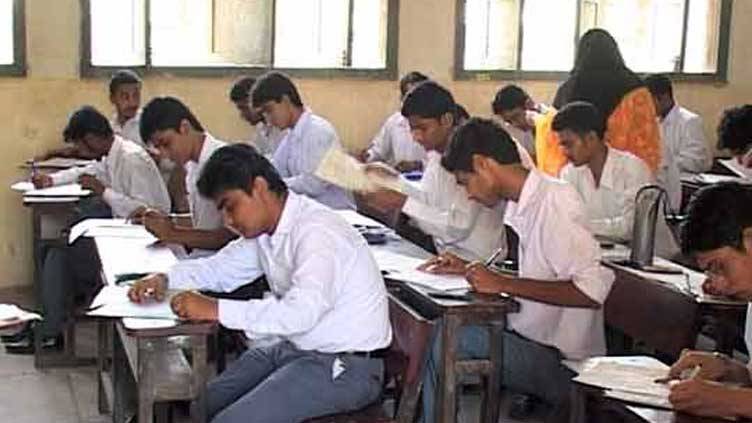
Cambridge International has released the results of its June 2026 examination session, with more than 100,000 students across Pakistan receiving their AS and A-Level results.

Students from more than 850 schools in Pakistan took part in the examination session. The results were announced globally on Tuesday, with nearly 368,000 students worldwide receiving their Cambridge International AS and A-Level results.

In Pakistan, thousands of students appeared for examinations in a wide range of subjects. Mathematics, Physics, Chemistry, Business and Computer Science remained among the most popular choices.

Cambridge officials congratulated students on completing their examinations and acknowledged the challenges faced by some candidates during the preparation period.

Cambridge Pakistan Country Director Uzma Yousuf said this year’s results were particularly significant because some students had prepared for their examinations amid regional tensions, uncertainty and disruptions.

She congratulated the students and praised teachers, parents and school communities for supporting candidates throughout the academic year.

Yousuf said education should not be viewed only through examination grades. She stressed the importance of developing knowledge, confidence and practical skills that can help young people succeed in higher education, employment and their future lives.

Cambridge International also said it was continuing to develop its assessment system. The organisation is working on digital examination initiatives and flexible assessment options aimed at giving students greater choice and accessibility.

Cambridge qualifications are accepted by universities and educational institutions in many countries. The organisation said its international qualifications provide students with pathways to higher education both in their home countries and abroad.

According to Cambridge, recent UK university application data showed that 98% of Cambridge International A-Level students who applied to British universities during the 2025 admissions cycle received at least one university offer.

The organisation said its qualifications are designed to provide students with internationally recognised academic credentials while allowing them to study within their own countries.

The latest results have also been announced amid concerns surrounding examination security in Pakistan during the 2026 examination cycle.

Earlier this year, allegations emerged that Cambridge Mathematics examination papers had been circulated before scheduled tests. One A-Level Mathematics paper was cancelled and candidates were required to sit a replacement examination.

A separate AS-Level Mathematics paper was also cancelled following reports of a leak. Further claims regarding the circulation of another Mathematics paper were later raised by students.

The incidents led to calls for stronger examination security and prompted education authorities to seek investigations into the allegations.

Cambridge has previously said it investigates reports concerning examination integrity and has urged students and parents to follow information released through its official channels.

Meanwhile, students who appeared for the June 2026 IGCSE and O-Level examinations are expected to receive their results on August 18.

Similar Posts

  • | | |

    Gold prices rise further in Pakistan as global rat…

      KARACHI: Gold prices in Pakistan continued their upward trend on Monday, with the price of gold per tola increasing by Rs2,000, according to the All Pakistan Sarafa Gems and Jewellers Association. Following the latest increase, the price of one tola of gold reached Rs461,936 in the domestic market. The latest rise comes amid an increase in international gold prices, which have also strengthened in the global market. According to the association, the price of 10 grams of gold increased by Rs1,715, bringing the rate to Rs396,035. The continued rise in gold prices is likely to keep the precious metal attractive for investors and buyers who traditionally consider gold a store of value during periods of economic uncertainty. In the international market, gold prices also recorded an increase. The price of gold rose by $20 per ounce to reach $4,395 per ounce. The latest movement in domestic gold prices reflects the influence of international bullion rates, while local market conditions and currency fluctuations can also affect the price of gold in Pakistan. Gold remains one of the most widely followed commodities in the country, particularly among investors, jewellery buyers and households that use the precious metal as a form of savings. Changes in gold prices can therefore have a direct impact on consumers, particularly those planning to purchase jewellery for weddings and other important occasions. The increase of Rs2,000 per tola means that buyers will now have to pay more for the same quantity of gold compared with the previous rate. Similarly, the rise in the 10-gram price indicates continued upward pressure on the domestic bullion market. The international increase of $20 per ounce has also contributed to the positive movement in local prices. Global gold rates are closely watched by Pakistani traders because changes in international bullion prices can influence domestic market rates. Gold prices around the world are affected by several factors, including investor demand, inflation expectations, currency movements, interest rates, geopolitical developments and uncertainty in global financial markets. During periods of economic or political instability, investors often turn toward gold because it is traditionally regarded as a relatively safe asset. For Pakistani consumers, movements in gold prices can be particularly significant because jewellery represents an important form of household wealth and savings. A sustained increase in prices can make gold purchases more expensive, while existing gold holders may benefit from higher market valuations. Market participants are likely to continue monitoring international bullion prices as well as developments in the domestic currency market to determine the direction of gold prices in Pakistan in the coming days. The latest figures show that gold continues to trade at historically elevated levels in both domestic and international markets. With the international price now standing at $4,395 per ounce, any further movement in global rates could have an impact on prices in Pakistan. For now, the domestic market has recorded another increase, with one tola of gold priced at Rs461,936 and 10 grams at Rs396,035. Investors, jewellery traders and consumers will be closely watching the market for further changes, particularly as fluctuations in international gold prices and currency rates continue to influence the local bullion market.

  • | |

    Javed Sheikh says he refused fee for Om Shanti Om

    Veteran Pakistani actor Javed Sheikh has revealed that he initially refused to take any remuneration for his role in the hit 2007 Bollywood film Om Shanti Om, stating that sharing the screen with Indian megastar Shah Rukh Khan was an honor in itself. ​Speaking in an interview with Vasay Chaudhry, the veteran actor reminisced about playing the role of Rajesh Kapoor—Shah Rukh Khan’s on-screen father in the Farah Khan directorial—and reflected on the immense warmth and respect he experienced during the film’s production. ​Recalling the financial negotiations prior to filming, Sheikh shared that when the production manager approached him to finalize his contract and discuss his fee, he immediately declined monetary compensation. He emphasized that being chosen out of countless actors across India to portray Shah Rukh Khan’s father felt like a massive privilege that transcended money: ​”Farah Khan wanted me to play Shah Rukh’s father and they started discussing my fee. I said, ‘Money? I won’t take it.’ They said that was impossible. I told them it was such a big honour that, out of everyone in India, they had chosen a Pakistani actor to play Shah Rukh Khan’s father. Money wasn’t important.” ​When the production team insisted that working without pay violated contract guidelines, Sheikh jokingly proposed accepting a symbolic fee of just one rupee. However, both director Farah Khan and Shah Rukh Khan rejected the gesture, insisting on compensating him generously to honor his professional standing. Sheikh praised Shah Rukh Khan for his exceptional hospitality and care on set, describing their working relationship during the shoot as superb. ​Reflecting on his journey in the entertainment industry, Sheikh spoke candidly about his early career struggles. He disclosed that despite his deep passion for acting—which often involved running from school to Radio Pakistan—his father remained strict and skeptical. After his debut film Dhamaka (1974) failed at the box office, his career faced significant setbacks, leaving him devastated when industry insiders initially labeled him a “flop actor.” ​Five years later, his fortunes took a dramatic turn with the hit television drama Ankahi, which earned immense popularity across both Pakistan and India, effectively cementing his star status. Sheikh concluded by highlighting the mindset that guided his decade-long career: focusing entirely on self-improvement rather than competition, envy, or status. ​With a career spanning over four decades, Javed Sheikh continues to remain a vital force across Pakistani media, recently appearing in prominent projects including Delhi Gate, Aag Lagey Basti Mein, and the drama series Kabhi Main Kabhi Tum.

  • |

    Harshad Chopda becomes first finalist as Shivangi Joshi exits

    Harshad Chopda has secured the first finalist position in Lock Upp 2, while Shivangi Joshi’s journey on the reality show came to an unexpected end after a dramatic elimination that left contestants and viewers stunned. The latest episode featured an emotional task to determine the season’s first finalist. Several contestants, including Varun Yadav, Shilpa Shinde, Ram Kapoor and Akanksha Chamola, stepped aside, leaving Harshad Chopda and Shivangi Joshi as the final two contenders for the coveted spot. As part of the challenge, the two actors were locked inside the final cell and asked to decide between themselves who deserved to move directly into the finale. However, the decision proved difficult as both contestants hesitated to choose themselves over the other, resulting in an emotional conversation that revealed the strong bond they had formed during the competition. During the discussion, Chopda surprised Joshi by admitting that he had intentionally lost one of the earlier tasks to help her. The revelation caught the actress off guard, especially after he had previously denied making such a sacrifice. “I did lose the game,” Chopda confessed, leaving Joshi visibly confused and emotional. Questioning his decision, Joshi asked why he had given up an opportunity that could have benefited him. Chopda explained that throughout the season he had often put others before himself. This time, however, he felt it was important to focus on his own journey and fight for a place in the finale. Despite his explanation, neither contestant was willing to make the final decision. Their reluctance prompted hosts Farah Khan and Riteish Deshmukh to intervene and encourage them to settle the matter. Chopda remained firm, saying that for the first time in the competition he wanted to prioritise himself. Realising his determination, Joshi eventually stepped out of the final cell, allowing Chopda to claim the title of the season’s first finalist. The emotional moment was followed by another dramatic twist that changed the course of the game. Earlier in the episode, Shreya Kalra had earned a special advantage after winning a crucial task. The reward gave her the authority to eliminate one contestant from the competition. Most contestants believed Kalra would use her power against either Yogesh Rawat or Akanksha Chamola, making her eventual decision all the more surprising. Instead, Kalra chose to evict Shivangi Joshi, bringing the actress’s journey on Lock Upp 2 to an abrupt end. The unexpected elimination shocked fellow contestants, many of whom had not anticipated Joshi’s exit at this stage of the competition. Viewers also reacted with surprise, as the actress had been widely considered one of the strongest contenders for the title. With Chopda becoming the first confirmed finalist and Joshi leaving the show in a dramatic fashion, the race for the Lock Upp 2 trophy has become even more intense. As the finale draws closer, the remaining contestants will continue battling for the remaining spots in the final, promising more emotional moments, strategic gameplay and unexpected twists before the winner is crowned.

  • | | |

    Iran and Oman discuss temporary shipping corridor …

    Iran and Oman are discussing a proposal to establish a temporary joint shipping corridor through the Strait of Hormuz one of the world’s most important routes for oil and gas shipments. The proposal was discussed during a meeting in Tehran between Omani Foreign Minister Badr Al-Busaidi and Iranian Foreign Minister Abbas Araghchi. A joint statement described their talks as constructive and said both sides discussed developments surrounding the strategic waterway. The discussions come as tensions remain high between Iran and the United States. US President Donald Trump said Tuesday that mines had been removed or destroyed in international waters around the Strait of Hormuz. He warned that any vessel found placing new mines would face immediate military action. Trump also said the United States was closely monitoring the waterway and maintained a zero-tolerance policy toward further mine placement. The Strait of Hormuz is a crucial global energy route with roughly one-fifth of the world’s crude oil and liquefied natural gas flows passing through it before the conflict. Shipping activity has fallen sharply during the current crisis, with only two commodity vessels reportedly using the waterway on Monday. Iran has also communicated its position on the strait through Pakistan. Iranian officials reportedly want provisions of an earlier Islamabad memorandum to be implemented including arrangements requiring safe passage for commercial shipping and consultation with Oman over the waterway’s future management. Meanwhile, Washington has expanded economic pressure on Tehran. US Treasury Secretary Scott Bessent announced additional sanctions targeting Iranian individuals entities and vessels warning that countries continuing to support Iran’s economy could face consequences. China has criticized the new US measures saying unilateral sanctions could disrupt global economic and financial stability. Beijing is a major buyer of Iranian oil and has urged Washington and Tehran to return to negotiations. The United States has also warned that military action against Iran remains possible. Defence Secretary Pete Hegseth said Washington would use military force if necessary and did not rule out further strikes around Iran or the Strait of Hormuz. Iran, meanwhile, has promised to respond to the expanded sanctions and warned that threats to its infrastructure could trigger attacks against US interests and regional energy routes. The diplomatic discussions involving Iran, Oman and Pakistan could therefore become important for restoring commercial shipping through the Strait of Hormuz. However, continued military threats, sanctions and tensions between Tehran and Washington remain major obstacles to a lasting agreement.

  • |

    Shreya Kalra wins Lock Upp season 2 after dramatic finale

    Digital creator and actress Shreya Kalra has emerged as the winner of Lock Upp Season 2, defeating a strong lineup of finalists after an intense grand finale. Television actress Shivangi Joshi finished as the runner-up, while Yogesh Rawat, Shilpa Shinde and Ram Kapoor also reached the final stage of the competition. The finale, hosted by Farah Khan and Riteish Deshmukh, featured several challenging rounds designed to test the contestants’ strategy, resilience and decision-making skills. The finalists also faced the Janta Ki Jury segment, where a panel of 25 audience members questioned them about their gameplay, relationships inside the house and controversies that unfolded during the season. Kalra’s victory marked the end of a journey filled with emotional moments, heated confrontations and controversial incidents that kept viewers engaged throughout the season. From the beginning of the competition, she established herself as one of the strongest contestants, earning both praise and criticism for her outspoken personality. Originally from Indore, Madhya Pradesh, Shreya Kalra first gained popularity as a digital content creator before expanding her career into acting, podcasting and reality television. Her growing online fan base helped her become one of the most recognizable contestants when she entered Lock Upp Season 2. One of the earliest moments that drew attention came during the premiere episode when Kalra confronted fellow contestant Ram Kapoor over remarks he had made in the past. The exchange quickly became one of the season’s most discussed moments and set the tone for her fearless approach inside the competition. As the weeks progressed, Kalra found herself involved in several arguments with contestants including Yogesh Rawat, Akanksha Choudhary, Dheeraj Dhoopar and Sufi Motiwala. While these clashes often divided viewers, they also kept her at the center of the show’s biggest storylines. Among the season’s most controversial incidents was a conversation in which Kalra disclosed fellow contestant Akanksha Chamola’s sexual orientation. Kalra later claimed she revealed the information after Akanksha had filed a chargesheet against her inside the game. The incident sparked widespread debate among viewers, with many questioning issues related to privacy, consent and personal boundaries. Kalra also faced backlash for making personal remarks about actor Harshad Chopda during the season. Despite the criticism, she continued to survive eliminations and remained one of the most talked-about contestants until the finale. Throughout the competition, Shreya balanced emotional moments with strategic gameplay, building alliances while also standing firm during conflicts. Her determination, confidence and willingness to express her opinions helped her maintain a strong presence inside the house. After weeks of challenges, rivalries and public scrutiny, Kalra was ultimately crowned the winner of Lock Upp Season 2. Her victory concluded a season packed with drama, controversy and high-stakes competition, while runner-up Shivangi Joshi and the other finalists also earned praise for their performances throughout the reality show.

  • |

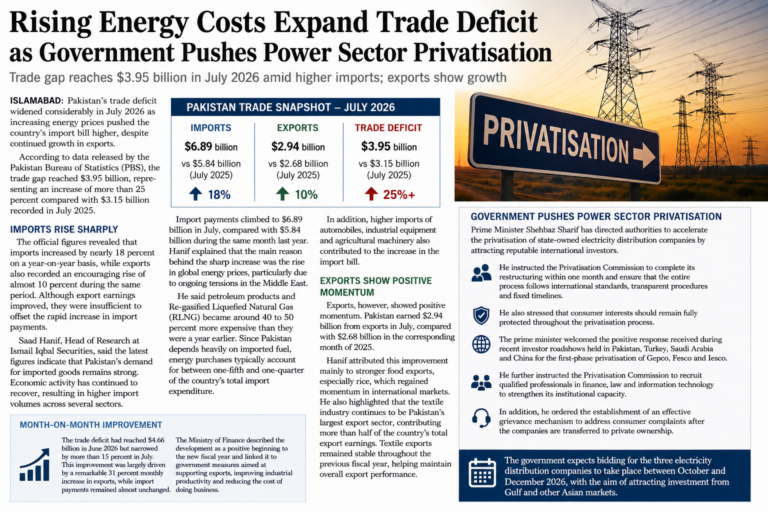
    Pakistan’s trade deficit widens 26% in July as imports surge

    ISLAMABAD: Pakistan’s trade deficit increased by 26% during the first month of the fiscal year 2026-27, mainly driven by a sharp rise in imports, according to the latest data released by the Pakistan Bureau of Statistics (PBS). The widening gap between imports and exports highlights growing pressure on the country’s external trade position at the beginning of the new fiscal year. Imports increased by around 19% in July, with higher purchases recorded across several major categories, including food products, machinery, transport equipment, textiles, agricultural inputs and metals. According to the PBS data, the country’s food import bill reached $805.4 million in July 2026, equivalent to more than Rs224 billion. The increase reflects continued reliance on imported food products and essential raw materials to meet domestic demand. Among food items, imports of milk, cream and food products prepared for infants rose by 25% to $18.7 million. Pakistan also imported significant quantities of spices, soybeans, palm oil and pulses during the month. Sugar imports were also recorded during July, with the country importing around 112 metric tonnes, adding to the overall food import bill. Machinery imports rise sharply Machinery emerged as one of the major contributors to the increase in the import bill. Machinery imports jumped by 41% to $1.31 billion during July compared with the corresponding period. The increase covered a wide range of equipment used in key sectors of the economy. Imports included machinery for power generation, offices, textile manufacturing, agriculture, construction and telecommunications. The rise in machinery imports could indicate increased demand for equipment and investment-related goods across different industries, although it also contributed significantly to the expansion of the overall trade gap. Vehicle imports register strong growth Imports of transport equipment, including vehicles, also witnessed substantial growth during the month. The import bill for the category increased by 40% to $420 million. The increase in vehicle and transport-related imports added further pressure to the country’s import expenditure, particularly as several other major import categories also recorded double-digit growth. Textile-related imports increase Pakistan’s textile sector also recorded higher imports during July. Imports of textile-related products, including raw cotton, increased by 15% to $680 million. The rise in raw cotton and other textile inputs indicates continued demand from the country’s large textile manufacturing and export industry. Since the textile sector remains a major contributor to Pakistan’s exports, higher imports of production inputs can also be linked to industrial activity. Agricultural inputs and chemicals Imports of agricultural machinery, equipment and chemicals increased by 23%, taking the combined import bill for the category to more than $1 billion. The increase comes as demand remains high for inputs and equipment required by the agriculture sector. Higher imports of such goods can support domestic production but simultaneously add to the country’s foreign exchange requirements. Metals import bill also rises The country also witnessed a significant increase in imports of metals, including gold, iron and steel. Imports under the category increased by around 23%, while the import bill for precious metals alone crossed $730 million. The broad-based rise across food, machinery, transport, textiles, agricultural inputs and metals suggests that the increase in imports was not confined to a single sector. The latest figures indicate that controlling the trade gap will remain an important challenge for policymakers during the new fiscal year. While higher imports of machinery, industrial inputs and agricultural equipment may support economic activity, a sustained increase in imports without a corresponding rise in exports could place additional pressure on Pakistan’s external account.

Leave a Reply

Your email address will not be published. Required fields are marked *