chinese ambassador vows
| |

Chinese Ambassador vows expanded collaboration wit…

FAISALABAD : Chinese Ambassador to Pakistan, H.E. Mr. Jiang Zaidong, has reaffirmed China’s steadfast commitment to broadening cooperation with Pakistan, particularly in the critical sectors of poverty alleviation, agriculture, education, and vocational training.

The Ambassador made these remarks during an interactive session at the University of Agriculture Faisalabad (UAF), where he met with Vice Chancellor Prof. Dr. Zulfiqar Ali, senior university officials, Chinese alumni, and representatives from academia and government.

Addressing the gathering, Ambassador Jiang emphasized that as an agrarian economy, Pakistan holds immense potential to combat poverty through the revitalization and modernization of its agricultural sector. He announced that China intends to deepen collaboration in agricultural education, training, and technology transfer. Drawing on his country’s developmental journey, he underlined that strong leadership, consistent long-term policies, and a people-centered approach are fundamental to national progress.

Praising UAF’s role in fostering bilateral ties, the envoy lauded the university and its Confucius Institute for significantly strengthening educational and cultural linkages between the two nations. He stressed that academic collaboration and scientific innovation remain vital pillars of the enduring strategic partnership between Pakistan and China. He remarked that Pakistan and China enjoy an exemplary friendship, built on a foundation of mutual trust, respect, and shared prosperity.

In his response, Vice Chancellor Prof. Dr. Zulfiqar Ali expressed pride in the university’s role as a bridge between the two countries, facilitating academic partnerships, joint research, innovation, and people-to-people exchanges. He noted that 100 UAF faculty members are graduates of Chinese universities, and that several joint laboratories have already yielded patented technologies. The Confucius Institute at UAF, recognized as a top-model institute globally, has trained over 35,000 students in Chinese language and culture and operates branches across 13 Pakistani universities. As a founding member of the Confucius Institute Global Agriculture Alliance, UAF continues to serve as a primary gateway for Sino-Pak collaboration, offering its diverse climates and fields for testing Chinese technology.

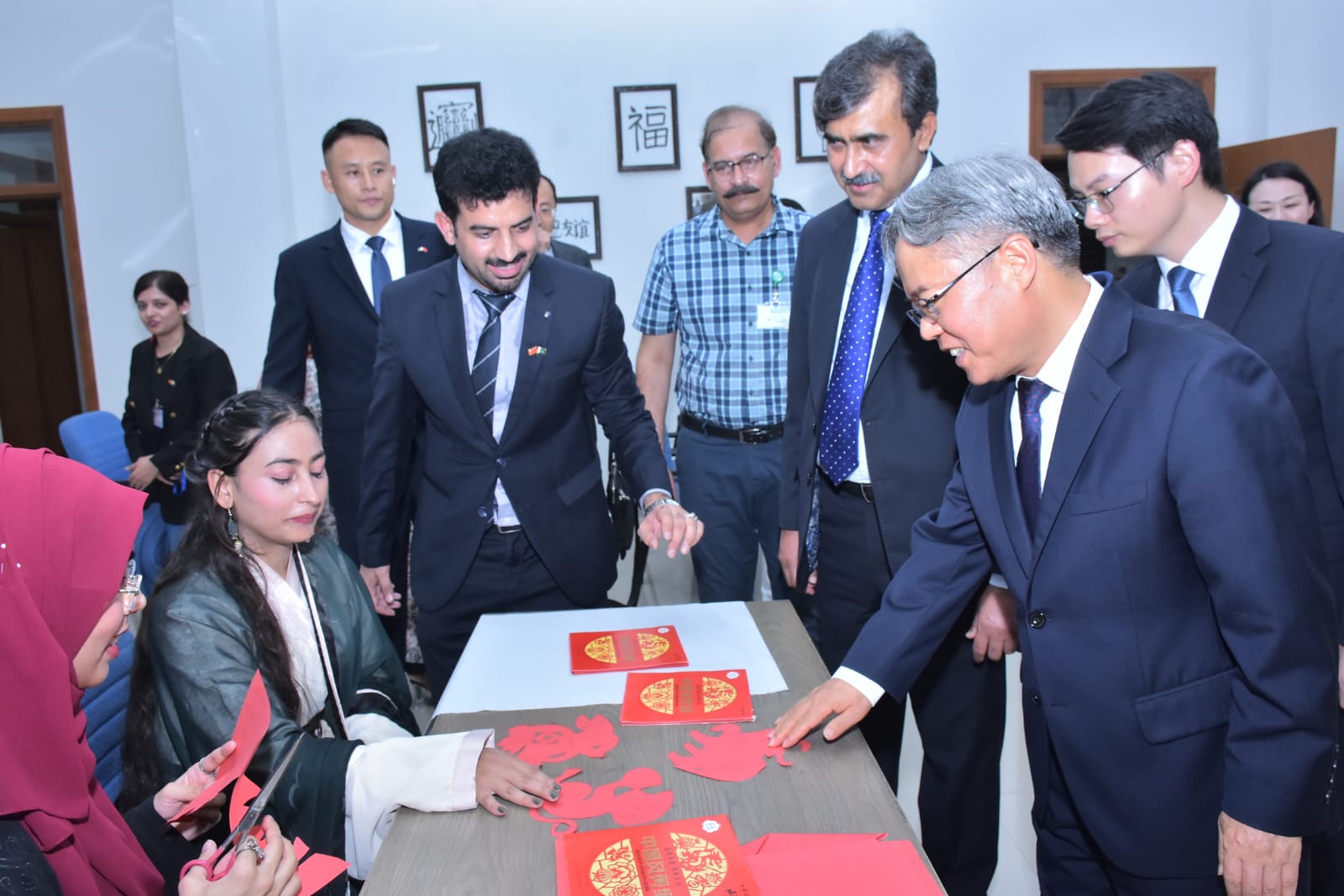
Following the meeting, the Ambassador toured the UAF Exhibition Centre for a briefing on the university’s key research milestones and technological innovations. He then visited the Confucius Institute, where he explored the Pakistan-China 75th Anniversary Art and Cultural Exhibition, inspected smart classrooms and cultural activity facilities, and enjoyed vibrant performances presented by the institute’s students.

The visit concluded with a tree plantation ceremony, during which Ambassador Jiang and Vice Chancellor Prof. Ali jointly planted a sapling—a tribute to their mutual commitment to sustainable cooperation and a greener future.

Earlier, the envoy received a warm welcome at the Administration Block from the Vice Chancellor and Dr. Saddam Hussain, Dean of the Confucius Institute. The high-profile engagement further cemented the longstanding partnership between UAF and Chinese institutions, reflecting both countries’ shared resolve to promote excellence in education, research, innovation, agriculture, and cross-cultural understanding.

Similar Posts

  • | |

    Court extends Gul Plaza probe till Aug 9

    KARACHI: A judicial magistrate in Karachi has granted investigators additional time to complete the investigation into the Gul Plaza tragedy case. The court extended the deadline until August 9 and directed the investigating officer to submit a complete report at the next hearing. During the proceedings, the investigating officer informed the court that the inquiry was still in progress and requested more time to finalize the investigation. He said responses from several government departments had been collected, but information from some key institutions was still awaited. The court was told that six government departments had already submitted their replies to investigators. However, responses from the Sindh Building Control Authority (SBCA) and the Water Corporation had not yet been received, preventing the investigation from being completed. The investigating officer requested that the court allow additional time so that all pending replies could be included in the final investigation report. The court accepted the request and granted an extension until August 9. The magistrate directed the investigating officer to complete all remaining inquiries before the next hearing and submit a comprehensive report covering all aspects of the case. The court stressed the importance of ensuring that the investigation is thorough and based on complete information from all relevant departments. The Gul Plaza tragedy case has remained under investigation as authorities continue collecting evidence and official records from various institutions. Investigators are examining the role of different departments and reviewing all available documents before reaching their final conclusions.

  • | |

    MQM-P groups resume talks after Bahadurabad clash

    Differences between two groups within the Muttahida Qaumi Movement-Pakistan (MQM-P) have led to renewed contacts and negotiations between the rival factions, according to party sources. The dispute reportedly surfaced after a party meeting at the MQM-P headquarters in Bahadurabad, Karachi. Tensions escalated during the incident, with members of one group allegedly engaging in a physical confrontation with MPA Ijazul Haq, party leader Zakir, and their supporters. MQM-P leader Aminul Haq claimed that members of the opposing group also resorted to intense aerial firing during the confrontation. He said one party worker sustained injuries in the firing, while several others were hurt as a result of stone-pelting. Following the escalation, senior leaders from both sides have started communicating with each other in an effort to ease tensions and resolve their differences through dialogue. Party sources said the two groups are currently holding discussions and exploring ways to settle the dispute. The sources added that the two factions may hold a joint press conference within the next 48 hours. During the press conference, the leadership is expected to outline the party’s future course of action and announce decisions aimed at addressing the internal differences. The developments come as the party seeks to prevent further escalation and restore unity among its ranks following the clash at the Bahadurabad headquarters.

  • |

    Russian assassination plot against Ukrainian-American thwarted in Warsaw

    Polish authorities have foiled a Russian intelligence plot to assassinate a Ukrainian-American citizen in Warsaw, Prime Minister Donald Tusk announced. Tusk noted that this marks the first instance of a Russian-directed assassination plot targeting a US citizen on the sovereign territory of a NATO member nation. The suspect was detained in Warsaw on 7 August following a joint operation between Polish security agencies and US intelligence services, and has been remanded in custody for three months. While Polish officials refrained from releasing the victim’s identity, Tusk stated that the targeted individual was deemed “inconvenient” by the Kremlin. The incident comes amid a broader wave of state-sponsored sabotage, arson, and targeted killings across Europe attributed to Russian security services since the 2022 invasion of Ukraine.

  • |

    Youth protests challenge Modi’s image ahead of key state elections

    A growing youth protest movement in India has delivered one of the biggest political setbacks to Prime Minister Narendra Modi’s government in recent years, raising questions about the ruling Bharatiya Janata Party’s appeal among younger voters ahead of crucial state elections. What began as demonstrations over alleged examination paper leaks has developed into a wider expression of frustration over unemployment, education and economic uncertainty. The protests were led by the Cockroach Janta Party, or CJP, a youth movement that quickly gained massive attention on social media. Within days of launching its campaign in May, the group attracted around 22 million followers on Instagram, most of them from Generation Z. The movement demanded the resignation of Education Minister Dharmendra Pradhan after allegations that a medical entrance examination had been compromised. As protests spread across India, thousands of students gathered in central Delhi despite heavy police action. In an effort to calm public anger, Prime Minister Modi posted a rare selfie video on Instagram, saying he understood the concerns of young people and promising action to address their grievances. However, the message failed to ease the demonstrations. Days later, Education Minister Pradhan resigned, fulfilling the protesters’ main demand and handing the movement a significant political victory. The resignation is considered unusual because Modi’s government has generally resisted removing senior ministers in response to public pressure. Political observers say the outcome has encouraged many young Indians who believe their voices can influence government decisions. Analysts say the protests extend far beyond the issue of examination leaks. Many young people are increasingly worried about unemployment, rising competition for limited jobs and the possible impact of artificial intelligence on employment opportunities, particularly in India’s large information technology and business services sectors. While the exam controversy sparked the demonstrations, experts believe it exposed much deeper concerns among the country’s youth. Political analyst Amitabh Tiwari said the paper leak became a symbol of wider frustration felt by many young Indians who are anxious about their future. He noted that disappointment over employment prospects and economic opportunities has created growing dissatisfaction that cannot be ignored. Senior government officials have acknowledged these concerns. Defence Minister Rajnath Singh said the government remains committed to understanding students’ problems and ensuring that their concerns are addressed. However, critics argue the ruling party has struggled to connect with younger generations, particularly on social media platforms where political discussions are rapidly evolving. Demographic trends also highlight the challenge facing India’s political establishment. People between the ages of 18 and 40 make up roughly 40 percent of the country’s population but hold only a small share of seats in the lower house of Parliament. The average age of members of the federal cabinet remains above 60, leading some analysts to argue that younger voices are underrepresented in national decision making. Although the CJP is not officially a political party, opposition groups have openly supported the student protests and attempted to capitalize on growing public dissatisfaction. The first major political test could come during next year’s state elections in Uttar Pradesh, Punjab and Gujarat. The BJP currently governs both Uttar Pradesh and Gujarat, making those contests particularly important. Some analysts believe the movement could have an even greater impact if it eventually enters electoral politics before the 2029 national election. CJP founder Abhijeet Dipke has said no decision has been made about transforming the movement into a political party, but its rapid popularity has already attracted widespread attention across the political spectrum. Observers also believe political campaigning in India is changing. For years, the BJP built a strong digital presence on platforms such as X and Facebook. However, younger audiences have increasingly shifted to Instagram, where authenticity and informal communication often attract greater engagement than carefully managed political messaging. While the BJP has around 10 million Instagram followers, the CJP gained more than twice that number in only a few days. Modi personally continues to command a much larger audience across multiple social media platforms, but analysts say younger users are responding differently to newer forms of political communication. Writers and political commentators argue that Generation Z is less influenced by traditional political authority and more willing to openly question established leaders. They believe successful politicians will increasingly need to engage directly with young voters rather than relying on conventional campaign strategies. For Modi, the protests represent a reminder that public expectations are changing. During much of his time in office, he built a reputation as a decisive leader who rarely reversed government decisions. Political analysts now say that demonstrating a willingness to listen and respond to public concerns may become increasingly important as India moves toward another cycle of state and national elections.

  • | | |

    Pakistan, 7 muslim countries condemn Israel over G…

    Pakistan and seven other Muslim countries have condemned Israel’s reported rejection of the Gaza peace plan, warning that opposition to a political settlement could undermine efforts to end the conflict and achieve lasting regional peace. A joint statement issued by Pakistan, Egypt, Türkiye, Indonesia, Jordan, Qatar, Saudi Arabia and the United Arab Emirates said Israel’s rejection of the Gaza plan and Palestinian statehood was damaging peace efforts. The countries expressed concern over attempts to prevent implementation of the comprehensive plan and stressed the need for immediate action to end the war in Gaza. They also called for measures to address the humanitarian crisis and support reconstruction and recovery in the territory. The statement reaffirmed support for the Palestinian people’s right to self-determination and the establishment of an independent Palestinian state. The eight countries rejected any attempt to prevent or deny Palestinian statehood, saying a two-state solution remains the path toward a fair and lasting peace. They backed the establishment of a sovereign Palestinian state along the 1967 borders, with East Jerusalem as its capital. The countries also urged all parties to cooperate on the second phase of the Gaza plan and called for concrete steps toward implementing the Gaza roadmap.

  • |

    Kourtney Kardashian calls Kylie Jenner her ‘magical little fairy’ in birthday post

    Kourtney Kardashian could not help gushing over her little sister on her big day. The Lemme founder posted on Instagram on August 11 to celebrate Kylie Jenner turning 29, tying the tribute to an old childhood nickname involving Tinker Bell The post featured a throwback photo of the sisters from Kylie’s teenage years, snapped at what looks like a sports event. In the picture, Kylie is dressed casually in a white lace tank top and green pants, while Kourtney wears denim with a graphic tee layered under a blue jacket. Kourtney’s caption played on the fairy theme, marking the moment Kylie supposedly “earned” her magical nickname, and closed with a simple birthday shoutout to her sister. Kim Kardashian joined in too, posting her own set of throwback photos from their Keeping Up with the Kardashians years. One image showed a young Kylie in a yellow dress sitting on Kim’s lap. Kim’s caption was full of affection, calling her sister a princess and pouring on the love. The wave of birthday posts followed an early celebration Kylie threw for herself over the weekend. The party ran with a Princess Kitty theme, and every guest, Kylie included, showed up in pink dresses topped with tiaras and boas.

Leave a Reply

Your email address will not be published. Required fields are marked *